
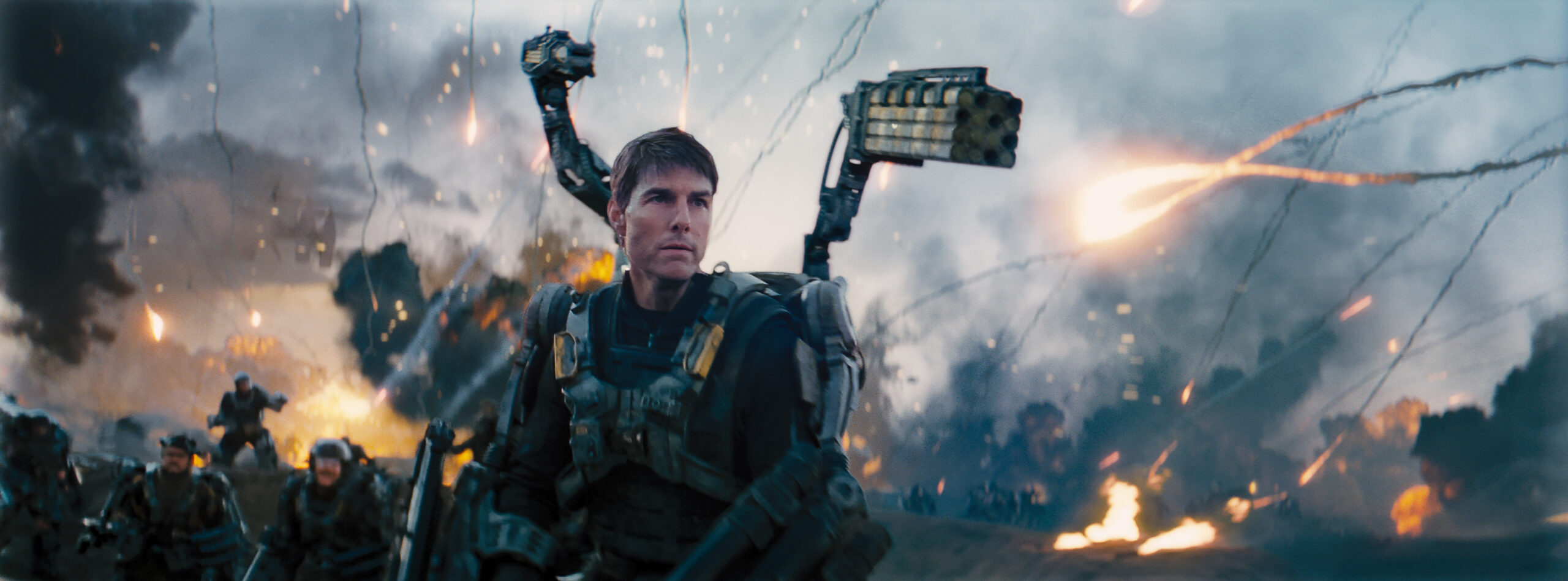
Hey there everyone! Welcome back to Movie Soapbox, the little corner of the internet that only you and I and that guy sleeping in the corner over there know about. This is the place where we find underappreciated films and make sense of them, particularly the ones the industry tried its level best to sand down into something safe and forgettable. Today we are doing a deep dive on Edge of Tomorrow, a movie so mechanically precise in its first two acts and so nakedly compromised in its third that watching it is like watching a watchmaker’s finest work get handed to a guy who just needed to box it up by Friday.
Before we get into it, here’s the trailer. Watch it again. Notice how the marketing couldn’t quite figure out what this movie was, either.
Alright. From here on out this post is nothing but spoilers, wall to wall, the whole ride. If you haven’t seen the film, close this tab, watch it, come back. The ending is the whole reason we’re here and there is no way to discuss it without burning it down to the ground first. You’ve been warned the only way Movie Mike warns anyone, which is once, plainly, and without a safety net.
So. Edge of Tomorrow. 2014. Based on Hiroshi Sakurazaka’s novel All You Need Is Kill, adapted into a script by Dante Harper that landed on the 2010 Black List, which means it was good enough that every development executive in town was talking about it and not one of them had the nerve to make it as written. Warner Bros. bought it, and then the rewrite carousel started spinning: Jez Butterworth, John-Henry Butterworth, Simon Kinberg, Christopher McQuarrie. Four writers. The film went into production without a finished script. You know what that means in practice? It means the third act was being written while the first act was being shot, which means the people holding the camera didn’t know where they were going, which means the ending you got was the ending that survived the longest in a room full of people who were scared of the ending Harper originally wrote. The original script ended on a much darker note. A note that trusted you. The note you got instead trusted the greenlight committee. Feel the difference every time you watch that final scene.
What’s astonishing, what makes this film worth two hours of your life even now, is how much precision survived that process. The first two acts of Edge of Tomorrow are a nearly perfect piece of science fiction construction. The rules are elegant. The emotional logic is airtight. Tom Cruise playing a coward who has to die his way into being a hero is the kind of casting-against-type that only happens when a director still has enough leverage to make a choice. Doug Liman had that leverage, barely, and he used it correctly. What he couldn’t protect was the landing.
The Setup: Mimics, Alphas, and How the Loop Actually Works
Earth is being overrun by aliens called Mimics, a collective organism that operates in tiers you need to understand before any of the time travel mechanics make sense. At the bottom you have the orange worker drones, soldiers, the ones doing the physical damage on the battlefield. Above them are the Blue Alphas, rare, roughly one in 1.6 million, who function as battlefield commanders with a very specific ability: every time an Alpha dies, the Omega, the central intelligence of the entire Mimic network, rewinds the day and starts it over. The Omega learns from everything that happened in the erased loop. It absorbs the data. It adjusts. You are fighting an enemy that has already watched you lose, studied how you lost, and reset the board before you could figure out what went wrong.
This is how the Mimics have been winning. The Omega has been running loops longer than any human general has been alive. Every Allied strategy, every troop movement, every bold gambit, the Omega has already seen it fail in a previous loop and accounted for it. The battle for Europe wasn’t a military campaign, it was a controlled experiment, and humanity was the variable being tested to destruction.
Rita Vrataski, Emily Blunt, is the single exception. At the battle of Verdun she killed an Alpha Mimic and its blood soaked into her during the kill. The Omega’s reset ability transferred, partially, to her. She could now trigger a reset by dying, same mechanic, different operator. She used this to loop Verdun dozens, maybe hundreds of times until she found the sequence of events that let the Allies win. She became the Angel of Verdun. And then she got a blood transfusion in a field hospital and lost everything, because the alien blood left her system and with it the ability to loop. She survived. The power did not.
Cage, Tom Cruise, arrives at Heathrow as a PR officer, a man whose entire military career has consisted of selling the war from a safe distance. He is a coward in the technical sense, meaning a person who has made a careful structural arrangement of his life to avoid consequences. He gets conscripted to the front lines as punishment for trying to blackmail a general, and on the beach he kills an Alpha in a moment of pure terrified desperation, gets soaked in its blood, and dies. He wakes up at Heathrow at the beginning of the previous day. The loop is his now.
The Rules, Because the Rules Are the Movie
One limitation matters above all the others and the film introduces it early enough that you should remember it by the time it becomes critical: if Cage is injured badly enough to require a blood transfusion, the alien blood leaves his system and he loses the loop ability permanently. He keeps the memories of every previous loop, every hard lesson, every person he’s watched die and couldn’t save, but he cannot reset anymore. He is mortal in the same way everyone else is mortal. This is the gun that goes off in the third act and it is the hinge on which every theory about the ending swings.
The second important rule is that the Omega has already used its own looping capability offensively. The false visions of the Omega’s location beneath a dam in Germany are not an accident of the narrative. They are a trap the Omega set across multiple previous loops, specifically calibrated to lure the Allies to the wrong location and waste them there. The enemy isn’t just powerful. The enemy is a strategist who has been playing the long game across timelines you’ll never see.
The Seven Forks: How Cage Actually Moves Through Time
The film’s structure can be understood as a series of bottlenecks, moments where Cage has to solve a specific problem enough times that the solution becomes automatic before he can proceed to the next one. There are roughly seven of these, not all of them given equal screen time, some of them implied by montage rather than shown in full, and understanding them is the key to not feeling lost in the back half.
The first fork precedes Cage entirely. It belongs to Vrataski. Her loops at Verdun, her wins, her eventual loss of the ability after the transfusion, all of that is backstory delivered in conversation, but it is the foundation everything else stands on. She is the proof of concept.
The second fork is Cage’s first genuine achievement: getting to Vrataski on the beach, saving her, and earning enough trust from her that she tells him to find her after he wakes up. That sentence costs him dozens of loops. The beach kills him in a new way every time.
The third fork is training. Vrataski is a brutal teacher in the specific way that someone is brutal when they have already watched too many people die in ways that were preventable with better preparation. She shoots Cage when he hesitates. She makes him repeat movements until the suit becomes reflex rather than thought. This section of the film is played partly for comedy, Cruise dying in spectacular and undignified ways, but underneath it is a portrait of what it actually takes to become competent at something dangerous, which is to fail at it so many times that failure stops being frightening.
The fourth fork is the push toward the dam in Germany. Cage is receiving visions of the Omega’s location, and he and Vrataski dedicate loop after loop to figuring out how to reach it. At a certain point Cage realizes he has to try reaching it without her, because getting there with her is the problem. He goes alone. The dam is a trap. The Omega wanted him to find it.
The fifth fork is the Omega Repeater, a device built by Dr. Carter, the physicist who understands what Cage actually is, that can intercept the signal between an Alpha and the Omega and reveal the Omega’s true location. Getting the general to hand it over takes Cage more loops than almost anything else in the film, because the general is exactly the kind of institutional obstacle that doesn’t respond to logic, only to the correct sequence of pressure applied at the correct moments, which Cage has to find by trial and very painful error.
The sixth fork is the attack on the Louvre. The Omega isn’t under a dam in Germany. It’s under the most famous museum in Paris. Cage, Vrataski, and J-Company go in without the ability to reset, because Cage has already lost the loop through a transfusion. Whatever happens here is permanent. J-Company gets destroyed. Vrataski dies. Cage reaches the Omega chamber and absorbs the Omega’s blood as he’s dying in it.
And then the seventh fork. The one everyone argues about. The one the writers were still arguing about while they were shooting it.
The Ending: Three Ways to Read It, One Way to Believe It
Cage wakes up in a helicopter approaching London. The war is over. The Mimics are dead, all of them, simultaneously, because the Omega is dead and the Omega is the network. Vrataski is alive. She has no idea who he is. He goes to find her. She opens the door. She looks at him in a way that is one half recognition and one half something she can’t name yet, and the film ends. Audiences either found this quietly devastating or completely nonsensical, and the people who found it nonsensical are not wrong to push back, because the film does not explain the mechanism that got Cage to this particular moment in this particular timeline.
There are three theories that account for it, all of them working within the rules the film established, with varying degrees of stress on those rules.
The first theory, and the one with the most internal support, is the Broken Timeline Restored reading. When Cage dies in the Omega chamber, he absorbs not just Alpha blood but Omega blood, the blood of the entity that controls the loop at its highest level. This is categorically different from anything that’s happened before. The Omega’s blood doesn’t just give him the Alpha’s ability to reset to his personal start point. It gives him the ability to go further back than that, past his own entry into the loop, back to before Vrataski lost her ability. In this reading, Cage uses the window he’s given to get three minutes with Vrataski before Verdun, tells her two things: don’t accept a blood transfusion no matter what, and the Omega is under the Louvre, not the dam. With those two pieces of information, Vrataski keeps her loop ability, avoids the trap, finds the real target, and kills the Omega in a version of events Cage is not present for. He wakes up in the helicopter because Vrataski won the war cleanly, in a timeline he corrected but didn’t live through.
The second theory is the Revisionist reading, which is a variation: Cage, still carrying Omega blood, hunts and kills an additional Alpha in the window after the Omega dies and before everything resets, stacking the blood and the power, giving himself just enough extra reach to bounce further back. Same outcome, different mechanism. This theory requires you to accept that the power is somewhat stackable, which the film doesn’t explicitly confirm but also doesn’t contradict.
The third theory is the one nobody should accept: pure Deus Ex Machina, Cage was simply given unlimited power by the Omega blood and arranged things exactly as he wanted them. This theory fails because it dissolves the rules entirely, and a time travel film without rules is just a film with a lot of clocks in it.
Moviesoapbox’s Take on The Edge of Tomorrow
The Broken Timeline Restored theory is the only one worth believing, and here is why it works even beyond the mechanical argument. The entire film is structured around Cage learning information the hard way, carrying it forward, and spending it precisely at the right moment. The ending is that structure applied at maximum scale. Every loop he ran, every time he let someone die so he could learn something from it, every painful repetition, all of it was accumulating toward those three minutes with Vrataski before Verdun. He didn’t get to be the hero of the final timeline. He got to be the reason the actual hero could win. For a film about a coward who spends two hours learning that the only currency that matters is what you’re willing to sacrifice, that’s not a compromised ending. That’s the only honest ending the story had. The problem is that the film doesn’t show you any of it, and when you don’t show the mechanism, audiences assume there isn’t one. That’s a directing and editing choice, not a logic failure, and it is almost certainly the scar left by a production that ran out of time and nerve simultaneously.
What you’re watching when you watch the ending of Edge of Tomorrow is a film that got most of the way home. The engine is sound. The map is accurate. The last mile was driven by committee, in the dark, faster than anyone wanted. The fact that the logic is still there if you look for it is a testament to how good the bones of this thing are. Films this mechanically precise almost never make it out of development intact. This one got further than it had any right to. Remember that when you’re annoyed at the ending. Remember what almost happened to it instead.
🎬 If You Liked This…
- Predestination — the most committed time loop film on the site, a loop that folds back on itself so completely that the beginning and the end are the same moment, no studio would have greenlit this version of the premise
- ARQ — the same die-reset-learn-repeat loop mechanic as Edge of Tomorrow, built for almost nothing in one house, the same discovery that knowledge of the loop is the only weapon that matters
- Dark Season 1 — the most elaborate time loop structure on the site, characters using their knowledge of what’s coming as a tactical weapon across decades, the same chess-game quality of a loop that rewards people who understand its rules