
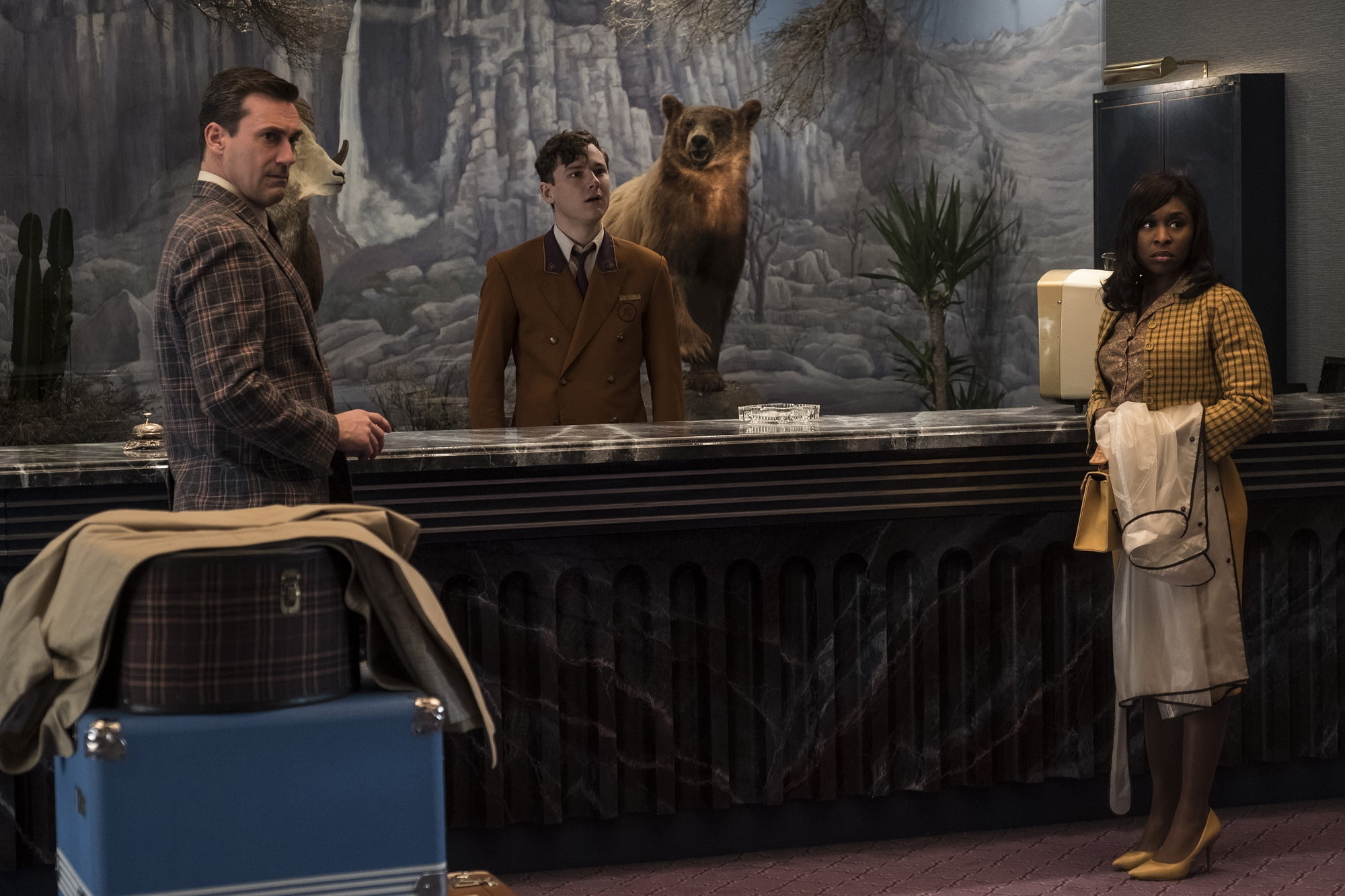
Hey there everyone! Welcome back to Movie Soapbox, the little corner of the internet that only you and I and that guy sleeping in the corner over there know about. This is the place where we find underappreciated indie films and we make sense of them. Today? We are doing a deep dive on Bad Times at the El Royale, a movie so spiritually loaded and structurally vicious that even the people who greenlit it probably thought they were making a pulpy ensemble thriller and only figured out what they’d actually funded somewhere around the third test screening.
Before we go any further, here’s the trailer, because if you haven’t seen this film yet, you’re about to understand why everything I’m about to say matters.
Alright. Full spoilers from here. Every single one. If you haven’t seen the film, go watch it, come back, and I will be here waiting the way Dock O’Kelly waited in that Reno club. You’ve been warned.
The Making of the Bad Times at the El Royale
Now. Drew Goddard wrote and directed this thing, and I want you to hold that fact in your mind the whole time we’re talking, because it matters more than the cast, more than the marketing, more than the box office number that probably gave some VP a migraine. Goddard is a writer who came up through television rooms and big-studio assignments, Cloverfield, The Martian, Lost, Cabin in the Woods, and he knows exactly how the machine works because he has spent years feeding it. Which means he also knows precisely which levers to pull to make something genuinely strange survive inside it. This film had a powerhouse cast attached, Chris Hemsworth, Jeff Bridges, Jon Hamm, Cynthia Erivo, Dakota Johnson, and that cast is the reason you’re watching an original, R-rated, two-hour-and-twenty-minute closed-box spiritual fable instead of whatever the notes would have made it. Without talent at that level attached, this script does not get made in 2018. It gets developed for four years, gets a third-act note that removes the absolution scene, and eventually gets turned into a limited series that never shoots. That’s what happens to films like this without armor. Goddard had armor. This time.
Let’s walk through it.
Bad Times at the El Royale Movie Walkthrough
The film opens with Felix, played by Nick Offerman, burying bank-heist money under the floorboards of a room at the El Royale, a hotel that sits precisely on the California-Nevada state line. The border detail is not incidental. Goddard is telling you where you are from the first frame. You are in a place that is neither one thing nor another. A threshold. A waiting room.
Ten years later, three strangers converge on the hotel. Dwight Broadbeck, who is calling himself Laramie Seymour Sullivan, played by Jon Hamm, is an FBI agent sent to retrieve compromising recordings that hotel management had made of a very famous, very dead guest, through two-way mirrors built into every room. He is not here for any reason that has anything to do with anyone else in the building. Father Daniel Flynn, who is actually Dock O’Kelly, played by Jeff Bridges, is a former bank robber who did the time while his brother Felix hid the money, and he has come to collect what was promised. And Darlene Sweet, played by Cynthia Erivo, is a soul singer who has spent her entire career being handled and diminished by men who own the rooms she performs in, and she is simply trying to get somewhere. Miles, played by Lewis Pullman, runs the hotel alone, a Vietnam veteran with a heroin habit and a sniper’s kill count that he cannot put down.
These four are joined mid-film by Emily Summerspring, played by Dakota Johnson, and her sister Rose, played by Cailee Spaeny. Emily has kidnapped Rose out of a cult. Rose does not want to be saved. And the man running that cult, Billy Lee, played by Chris Hemsworth, is on his way.
The first half of the film is a series of reveals. Laramie discovers the observation rooms. Emily shoots Laramie and wounds Miles when Laramie tries to intervene in her management of Rose. Dock discovers the money is in Darlene’s room and offers her a fifty-fifty split to help him get it. Each character has a secret. Each secret is a kind of sin being carried in a suitcase.
Then Billy Lee arrives, and the film shifts into its final movement. He convenes everyone in the lobby, two cult members flanking him, and he starts running a kind of improvised tribunal, trying to understand the money, the dead FBI agent, the sister who was taken. He runs a roulette game with Emily’s life on the table. Red or black. She loses. He shoots her.
When Billy Lee moves to kill Dock, Miles shoots him dead, then kills the two henchmen. Rose, still loyal to the man who just murdered her sister in front of her, stabs Miles in the chest. Dock shoots Rose. And then we are down to three: Dock, Darlene, and Miles bleeding out on the floor.
What follows is the scene the whole film was built toward. Dock, who has been impersonating a priest the entire film as cover for the heist, kneels down and gives Miles actual last rites. Not performance. Not con. Miles confesses, genuinely, the weight of everything he has done, and Dock absolves him. A fake priest performing a real sacrament for a dying man who needs one. The film earns this moment because it has spent two hours establishing who deserves grace and who does not, and it is not who the genre conventions told you it would be.
We cut to Reno. Six the next morning. Darlene is on a stage. Dock is in the audience, watching, the way he said he would be. She sings. The lights go down.
The Explanation of the Movie Bad Times at the El Royale
Now let’s talk about what is actually happening underneath all of this, because the plot is not the point.
Goddard has been public about the fact that this film is rooted in his Catholic upbringing, and that he only recognized how deep that root went after he finished the script. Seven characters, a hotel on a border, a judgment that separates the living from the dead before the film is over. The hotel is modeled on a real place, the Cal-Neva Lodge, which sat on the California-Nevada line, was frequented by the Kennedys, owned for a time by Sinatra, and carried more rumors of surveillance, mob access, and famous misbehavior than any five normal hotels. The two-way mirrors in the film are fictional. The general atmosphere of a place built for watching people without their knowledge is not.
But here is the structural move Goddard is making that the marketing completely buried. When you watch a closed-box film and there are no background characters, no extras in the parking lot, no other guests at the bar, no ambient life outside the specific players the story requires, that is a tell. You are either inside someone’s mind, or you are in purgatory. Goddard has confirmed the latter reading, sort of. His exact words were that he was working in an “operatic” register, not literally stating these people are ghosts or are literally in purgatory, but using the architecture of purgatory as the film’s moral logic. Everyone in this hotel is being judged. The sentence is carried out before the film ends. And the two who survive are the two who stopped serving only themselves.
Dock spent a decade in prison and came out softer. Still looking for the money, still operating under a false identity, but genuinely changed in ways he cannot fully articulate. Darlene has been absorbing the world’s disregard for her entire adult life and has not let it make her cruel. These two find each other in the middle of a massacre and choose, without negotiation, to take care of each other and to take care of Miles when he is dying. That choice is what the film is about. Every other character dies in service of a self that could not expand beyond its own wants. Billy Lee’s spirituality is entirely ego. Emily’s love for her sister is real but closed, she trusts no one, offers nothing, accepts no grace from outside her own read of the situation. Laramie is a company man with no interiority at all. Rose is so thoroughly subsumed by someone else’s vision of the world that she stabs the man who just saved her life.
The film reel. You need to know about the film reel. The movie is set on October 7th, 1969, which we know from a Nixon speech on the hotel television about Vietnam ceasefire negotiations. The reel contains footage of a very famous man, recently dead, doing something compromising in one of the hotel rooms. Everyone who sees it recognizes him immediately. Billy Lee clocks instantly that it is worth far more than the heist money. The film never names the man. But the Cal-Neva Lodge’s real history points in one direction. Robert F. Kennedy was a documented regular at the real Cal-Neva. He died in June of 1968, which fits the “recently dead” window for 1969. The hotel’s documented history includes rumors of surveillance footage connected to both Kennedys and Marilyn Monroe. Goddard does not confirm this. He does not need to. The film is set in a world where the machinery of powerful men recording each other for leverage is not paranoid fantasy, it is just Tuesday, and everyone in the building already understands that.
The Bad Times at the El Royale and the Correct Reading
So which read of the film is the right one? Is it literally purgatory, dead souls being sorted? Is it a living dream, Dock or Darlene or Emily processing their circumstances in a fugue state? Is it a fable, Goddard using archetypes to work out a moral argument in public?
The competing reads all have real traction. The literalist purgatory read is clean and satisfying and supported by the structure. The fugue-state read, with Darlene as the dreaming center, works because Goddard himself said she kept stepping to the foreground as he wrote, as though the story was choosing its own protagonist. The fable read explains the slightly heightened, slightly stylized quality of every villain in the film, Billy Lee is not a realistic cult leader, he is the idea of charismatic evil rendered for moral argument.
Moviesoapbox’s Preferred Reading
My read is the fable, but a fable with purgatory as its operating system. Goddard is not making a ghost story. He is making a morality play in the tradition of the ones he grew up with, Catholic, operatic, concerned with whether a person can be redeemed at all and under what conditions. The hotel is the mechanism by which that question gets answered, efficiently, over one night, with no exits and no background noise to soften the accounting. Every character gets exactly what their choices have earned them. Miles gets absolution at the last possible moment from a man with no valid authority to grant it, and the film insists that it counts anyway. That is not a genre thriller ending. That is a theological argument dressed in period costuming and lit by a neon sign.
Dock O’Kelly found his way back. Darlene Sweet never lost hers. The fake priest gave the real last rites. And a singer got one person in the audience who actually heard her.
That is what the machine almost turned into a franchise. Goddard had the cast to stop it. This time.