
Hey there everyone! Welcome back to Movie Soapbox, the little corner of the internet that only you and I and that guy sleeping in the corner over there know about. This is the place where we find underappreciated indie films and we make sense of them. Today? We are doing a deep dive on Thoroughbreds, a movie so quietly, precisely vicious that even people who loved it can’t always tell you why it hit them as hard as it did.
Before we go any further, you need to hear this clearly: everything from this point forward is a spoiler. Not a gentle “some plot details discussed” disclaimer, a full-on, beginning-to-end, murder-explained, dream-sequence-unpacked spoiler. If you haven’t watched Thoroughbreds yet, close this tab, find it, watch it, come back. I’ll be here. The movie will be better for it. You have been warned by a man who takes this seriously.
Thoroughbreds Movie and How Did This Get Made?
A first-time feature writer-director, Cory Finley, gets a script that is essentially a two-hander chamber piece about a sociopath and a repressed murderer-in-waiting orbiting each other in a Connecticut mansion until the gravity gets too strong. No franchise hook, no sequel bait, no IP to shelter under when the tracking numbers come in soft. The kind of script that, in a normal development pipeline, gets optioned, praised in a meeting, and then quietly strangled over eighteen months by people asking where the third act “escalation” is and whether the lead characters are “relatable.” The fact that this film exists at the pitch Finley intended, with the ending it has, with dialogue this uncompromising still in place, tells you something. A film at this budget tier, with this cast, either got very lucky with a producer who knew to stay out of the way, or somebody fought for every scene. You can tell by what’s NOT missing. There’s no softened Lily. There’s no redemptive beat smuggled in before the credits. The mechanism that usually flattens a film like this never fully engaged, and you should notice that, because it almost always does.
The Thoroughbreds Movie Walkthrough
The film opens on Amanda and a horse and a knife, and Finley just drops you there, no runway, no establishing warmth. You don’t know what you’re looking at yet. That’s on purpose and it’s also a test, because the entire film operates this way, it hands you information and waits to see what you do with it, the same way Amanda watches Lily across a table and waits.
Amanda (Olivia Cooke) has some form of emotional disorder that no clinician has successfully named, the DSM-5 flipping scene is one of the best in the film precisely because it’s delivered without self-pity or performance: “She’s just flipping random pages from the DSM-5 and throwing medications at me… doesn’t make me a bad person, just means I have to work a little harder to be good.” Lily (Anya Taylor-Joy) is the inverse, she feels everything, performs nothing, and lives inside a beautiful house that is, structurally, a trap. The film’s entire architecture rests on that opposition.
Cory Finley uses his shot-reverse-shot grammar in Chapter 1 to keep them separated in the frame, two poles of the same battery that haven’t touched yet. As the film moves, the framing collapses the distance. By the end they share the frame in ways that stop feeling like two people and start feeling like one person in a room with her own reflection. That’s not a stylistic flourish, that’s the thesis statement delivered through cinematography.
Thoroughbreds Movie Chapter 1
Amanda walks into Lily’s house before Lily arrives and just moves through it, unhurried, touching things she has no business touching, including a samurai sword on the wall. We don’t know why she’s there. The movie isn’t going to explain it to you right now. What we do get is the first real taste of the dialogue, and the dialogue in this film is why it survives every other thing that could have sunk it. “Think I would do better dropping out of college and Steve Jobsing my way through life.” Listen to how that lands. It doesn’t announce itself as a clever line. It arrives flat, like an observation someone made to themselves weeks ago and is only now bothering to say out loud.
By the end of Chapter 1, Lily has floated the idea of killing her stepfather Mark (Paul Sparks) with the offhand delivery of someone suggesting a different route to avoid traffic. “Have you considered killing him? Sure it’s outside the box, but you can only get so far thinking like everyone else thinks.” Amanda does not react with horror. Amanda files it.
Thoroughbreds Movie Chapter 2
Here’s where Lily’s world gets its actual dimensions. Her mother tans because her husband likes it when she has color. Lily was expelled from Andover for plagiarism, the school her biological father bought her way into. Mark has already put a deposit down on Brookemore, a school for girls with behavioral problems, and the conversation about whether she’s going is over before it begins. The mansion isn’t a home. It’s a well-appointed holding cell.
Lily unscrews one of Mark’s bicycle tires. It’s a small act and the film doesn’t comment on it. The film almost never comments on anything. That restraint is everything.
Thoroughbreds Movie Chapter 3
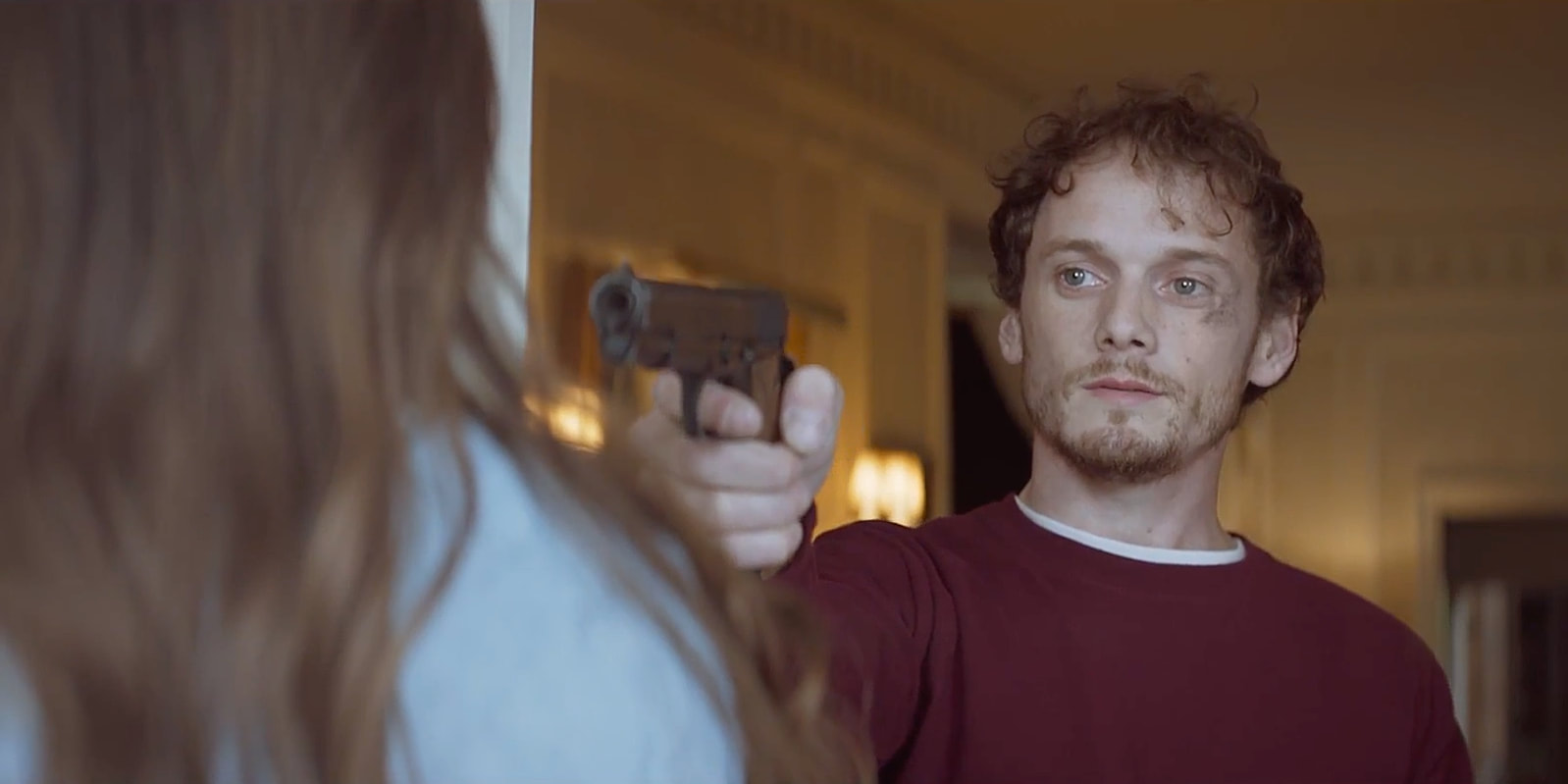
Enter Tim, played by Anton Yelchin in his final screen role before his death, a low-level drug dealer who gets pulled into this by a combination of Lily’s leverage and Amanda’s cold-eyed efficiency. The plan the girls construct is almost insultingly simple: Tim breaks in while Lily and her mother are at a spa, kills Mark, steals some things, makes it look like a robbery. Amateur hour. The kind of plan that works in movies where the universe accommodates the plot.
The universe does not accommodate. Motion-detecting lights panic Tim and he leaves without doing anything. The plan collapses.
What happens next is the most important conversation in the film. Mark corners Lily in the kitchen and says, plainly, what the film has been circling for an hour: “You couldn’t understand another point of view because you believe that all these people are little offshoots of your own consciousness.” Amanda had been standing around the corner with a knife in case Mark became physically threatening. She doesn’t move. When Lily asks her afterward why she didn’t intervene, Amanda says: “He wasn’t far off base, empathy isn’t your strong suit.” That’s the whole movie, in two lines.
Thoroughbreds Movie – The Murder
Lily slips a roofie into Amanda’s drink. The plan, as Lily has quietly rebuilt it in her head, is to use Amanda as the fall. Who better to frame than a girl already on record for killing a horse? Amanda finds out. She drinks the glass anyway, deliberately, fully aware of what she’s choosing. “You’re a great friend,” Lily says. “I’m a skilled imitator,” Amanda answers, and you can watch the drink start to take hold as she says it.
Lily goes upstairs. She kills Mark. She comes back down, puts his blood on Amanda’s arms, and holds her. The film doesn’t linger on this. It moves.
Thoroughbreds – The Aftermath
Jump cut. Lily at a restaurant parking lot, stumbling across Tim now working as a valet. Tim knows Mark is dead. The only question is whether he believes Amanda acted alone. Lily tells him Amanda sent a letter from prison. Tim asks what the letter said. Lily says she threw it away without reading it. That’s the last line of meaningful dialogue before the film’s final image.
Thoroughbreds, The Two Dreams, Untangled
The film gives you two dream sequences that function as Amanda’s interior monologue, so let’s be precise about what they’re doing.
The first dream: Amanda has a horse’s head. When she tries to speak to Lily, what comes out is a whinny. This is the film asking, directly, whether Amanda’s sacrifice can ever be understood by the person it was made for. Lily looks at Amanda’s animal face and the communication fails. That’s it. That’s what the dream means.
The second dream is the one everyone quotes, and for good reason. Amanda describes herself as “a honeymoon, dying,” rising out of her body to watch the suburb below accelerate through generations of bigger houses, phones, neglect, dissolution. And then: the horses take over. Thoroughbreds, no owners, no price tags, no awareness of their own value, just galloping through the ruins. Finley is describing the end state of a culture that made property out of everything, including people, including instinct, including emotion. The horses don’t know they’re expensive. That’s the point. That’s the only way out of the system the film has been diagramming for ninety minutes.
“I’m a honeymoon, and I am dying” is Amanda’s self-description as something that exists only as a gift to someone else, a celebration someone else gets to have, that ends. She knows exactly what she did and what it cost and she filed it the same way she files everything, without visible distress, because that is what she is.
Thoroughbreds Movie Theories
Theory One: Funhouse Mirror Realism. The most surface-level read, and not wrong for being surface-level. The film is a heightened but not fantastical portrait of a specific American pathology, the children of affluence who have been given everything except the tools to survive their own inner lives. Amanda’s horse, Lily’s plagiarism, Mark’s bicycle tire, all of it is plausible. The film just refuses to dilute it with the reassurances that usually show up in a story like this. Nobody learns anything useful. Nobody is saved.
Theory Two: Solipsism as Operating System. Mark’s line about Lily believing other people are “little offshoots of your own consciousness” is a definition of metaphysical solipsism, and the film builds its entire visual grammar around this idea. The collapsing frame distance between Amanda and Lily, the way their traits bleed across as the film progresses, Lily becoming the one who feels nothing while Amanda moves toward feeling everything, all of this reads as a film that is less interested in two characters and more interested in one consciousness watching itself from the outside. The question of which one is the “real” one is part of the trap.
Theory Three: ID and Superego. Lily is the superego, the socially conditioned self that has learned to perform the correct responses while feeling nothing underneath. Amanda is the id, raw instinct that has stopped performing entirely and decided to just be honest about the mechanism. The film is about what happens when these two halves of a psyche recognize each other and start cooperating. The murder is what cooperation looks like when the superego finally stops pretending it doesn’t want what the id has been naming all along. Finley’s structural trick is that by the end, Lily has absorbed Amanda’s emotional vacancy and Amanda has absorbed Lily’s feeling, they’ve traded places, and the trade is irreversible.
Moviesoapbox’s Preferred Read
Theory Three is the one, and it doesn’t cancel Theory Two, they’re the same claim at different altitudes. The film is one psyche in a room with itself, working out whether it can survive its own honesty, and the answer is yes, but only by consuming the part of itself that was capable of shame. Lily ends the film having kept everything she wanted, a dead stepfather, a free future, clean hands in the eyes of the law, and she has paid for it by permanently evacuating whatever was left of her interior life. Amanda knew this was the transaction going in. “I’m a skilled imitator” is her way of saying: I have been performing humanity for so long that performing this last thing, choosing this, costs me nothing you would recognize as a cost. She is the film’s only honest character, and the film rewards her honesty by making her disappear into the system.
The horses running through the ruins aren’t a utopia. They’re what’s left when the thing that made humans dangerous, the awareness of value, the transaction instinct, the empathy used as a weapon, finally exhausts itself. Finley isn’t promising you the horses. He’s just showing you what the suburb looks like afterward.
This film got made. It got made with its ending intact, with its refusal to explain itself intact, with its contempt for the mechanisms that usually smooth a story like this into something more palatable left fully visible. A lot of films that start as Thoroughbreds end up as something you’ve already forgotten. This one didn’t. Pay attention to the ones that don’t.
🎬 If You Liked This…
- The Party — the same brittle social performance concealing something genuinely monstrous underneath, dark comedy of manners where the violence has been building behind the pleasantries the entire time
- Luce — the same question of what is actually behind the perfect surface of a high-achieving young person, and whether the manipulation is coming from them or being done to them, same cold intelligence at the center of it
- Big Bad Wolves — the same dark humor sitting directly on top of something genuinely disturbing, moral inversion, nobody in the frame is simply good and the film is not interested in pretending otherwise