
Hey there everyone! Welcome back to Movie Soapbox, the little corner of the internet that only you and I and that guy sleeping in the corner over there know about. This is the place where we find underappreciated indie films and we make sense of them. Today? We are doing a deep dive on The Card Counter, a movie so convinced of its own theological weight that it forgot to check whether the theology actually holds.
Before we go any further, we are going into full spoiler territory here. Every beat, every reveal, the ending, all of it. If you haven’t seen this one yet and you care about going in clean, go watch it and come back. I’ll be here. Everyone else, let’s get into it.
The Card Counter and the Making Of
Paul Schrader has been writing lonely men in small rooms since before most of the people greenlighting movies today were born, and The Card Counter is very much that same project, a man trying to engineer his own absolution through discipline and routine and carefully controlled behavior, except this time Schrader wanted to ask a different question than he asked in First Reformed. Not whether God will forgive us. Whether we can forgive ourselves. That is a genuinely interesting question to build a movie around. The problem is that the movie keeps flinching every time it gets close to the hard part of that question, and by the time it reaches that final image, two fingers pressed against prison glass like a budget Sistine Chapel, you realize Schrader reached for the obvious symbol at exactly the moment he needed to reach for something true.
Here is the thing you need to know about where this film sits in the production landscape before we go scene by scene. A Schrader film at this budget level, low-to-mid independent, cast anchored by one legitimately A-list name in Oscar Isaac surrounded by character actors, exists in a very specific zone of creative freedom that sounds better on paper than it plays out in practice. The director has enough control that no committee is rewriting his third act, nobody is test-screening the prison glass ending and replacing it with a redemption montage. But that same absence of pushback means nobody is in the room to tell him when the theology has stopped doing work and started just sitting there looking serious. The films that come out of this zone are either First Reformed or they are The Card Counter. The difference is usually whether the director was willing to let the idea beat him up a little, to follow the argument somewhere genuinely uncomfortable, rather than resolving it into an image he already loved before he wrote the first scene.
The Card Counter Movie Walkthrough
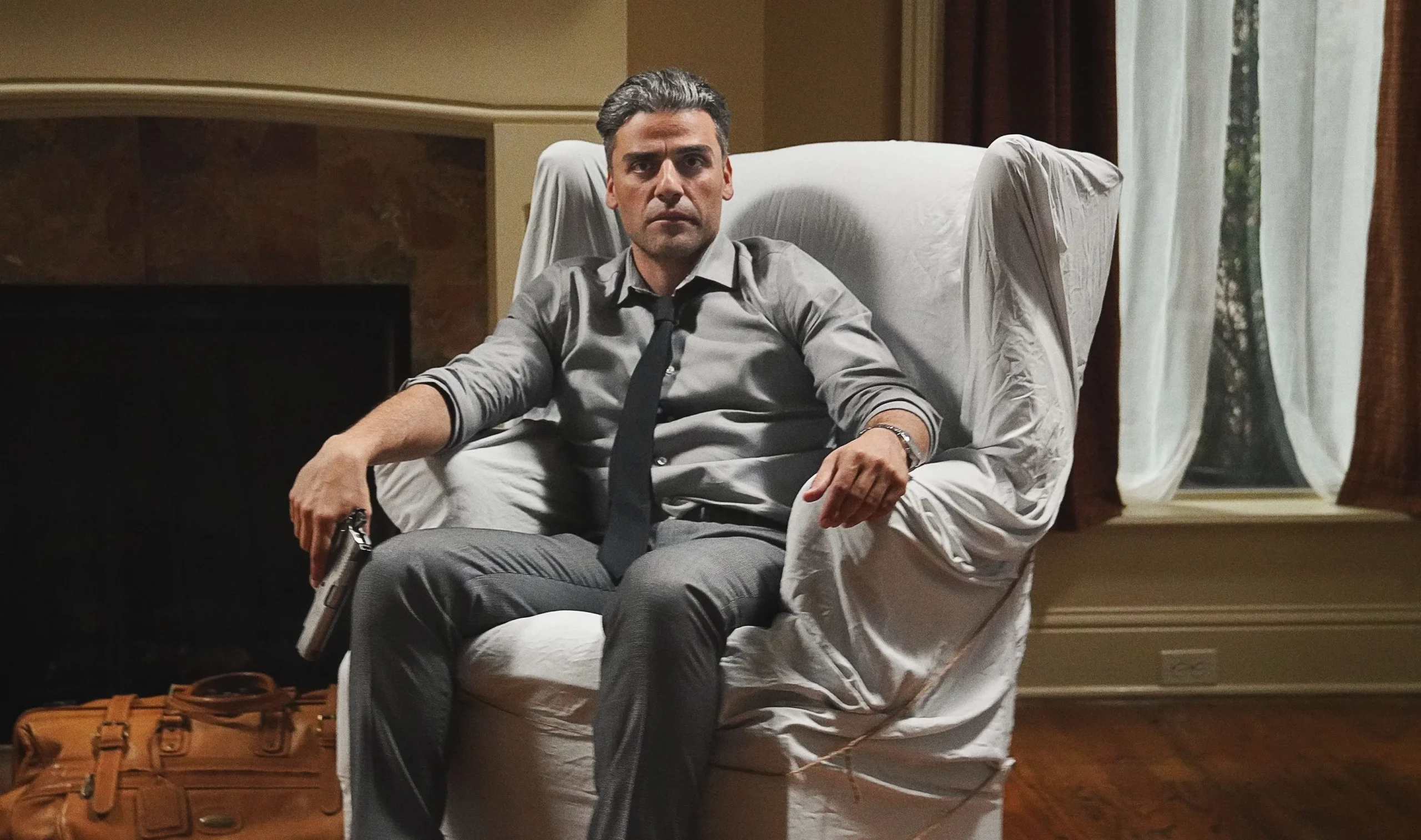
William Tell, played by Oscar Isaac in a performance that is doing everything it can for a screenplay that keeps leaving it stranded, taught himself to count cards during a stretch in military prison. Why military prison? We’ll get to that. Right now what matters is what he’s doing with the skill: not winning big, not making a run at the World Series of Poker, just grinding quietly through mid-tier casinos, taking a little here, a little there, staying invisible. And every night he goes back to whatever motel is nearby, and he wraps every piece of furniture in white sheets, every surface covered, the whole room turned into something between a cell and a confessional. You can tell a lot about what a movie thinks it’s about by watching what it does with its most repeated image, and Schrader repeats this one constantly. The wrapped room is the interior of William Tell’s mind. Controlled. Covered. Contained. The mess of what he did is still in there under all of it, but he can’t see it, and as long as he can’t see it, maybe it doesn’t have to be dealt with. That’s not a metaphor Schrader invented, that’s a metaphor Schrader knows, and in the first act it lands.
A woman named La Linda, played by Tiffany Haddish in a role the film doesn’t quite know what to do with, pitches Tell on getting a financial backer and taking a real shot at the World Series of Poker. He says no. Then he meets Cirk.
Cirk, spelled with a C because this movie wants you to know it’s being deliberate, is the son of a soldier who served under Major John Gordo at Abu Ghraib. Tell also served under Gordo. Tell tortured prisoners there, enjoyed it more than he should have, and when the photos came out, Gordo walked and Tell went to prison. Cirk’s father came home broken, eventually killed himself, and Cirk has channeled all of that into a plan to find Gordo and torture him to death. He wants Tell’s help. Tell, recognizing in Cirk exactly the kind of purposeless rage that used to live in him, decides he is going to save this kid instead. That will take money. Money means La Linda’s backer. Which means the World Series of Poker.
So Tell takes the deal, starts running the circuit with La Linda, and in parallel tries every version of talking Cirk out of the revenge plan. The soft version doesn’t work. Eventually Tell takes Cirk back to a motel room, and in a scene that the film treats as its moral fulcrum, he threatens to torture the kid, mimicking the very behavior he’s supposed to be expiating, trying to scare him straight. Then he gives Cirk a hundred and fifty thousand dollars and tells him to go find his mother and start over. Cirk takes the money. Tell goes back to the poker table.
Then Tell is sitting at the final table of the World Series of Poker and he finds out Gordo had Cirk killed.
He walks away from the table. He walks away from La Linda. He drives to Gordo’s house. And what happens next is the scene the entire film has been building toward, except Schrader doesn’t show it to you. Tell tells Gordo they are going to do a dramatic reenactment of Abu Ghraib. The screen goes somewhere else. You hear screaming. When it’s over, Tell is severely wounded and Gordo is dead, and Tell calls the police himself to report the homicide. He goes back to prison. La Linda visits. They press fingers against opposite sides of the glass.
Okay. So here is where the film’s theological argument is supposed to pay off, and here is where it falls apart, and it falls apart not because the idea is bad but because the film cheats the idea at every step.
The word the movie keeps returning to is expiation. Amends. Reparation. The making-right of a moral debt. Tell asks, in voiceover, whether there is a limit to punishment, whether there is some point at which effort becomes sufficient, whether expiation is actually achievable. These are real questions. Serious questions. The problem is that the movie answers them by having La Linda press her finger to a piece of prison glass, and it treats that as sufficient. As though the feeling of being forgiven by someone who has no standing to forgive you is the same as actually being forgiven.
Think about the geometry of what La Linda is forgiving. She didn’t know the men Tell tortured. She wasn’t in Abu Ghraib. She met this man at a poker circuit. Her warmth for him is genuine, her grace is real, but grace from someone with no stake in your actual crimes is not expiation, it’s just kindness, and kindness is not the same thing as the debt being cleared. The movie quotes itself on this: “the feeling of being forgiven by another, and forgiving one’s self are so much alike, there’s no point in trying to keep them distinct.” Schrader puts that line in the film as though it’s wisdom. But it’s actually the cop-out. It’s the film deciding that the feeling of forgiveness is close enough to the real thing that we can stop asking whether the real thing is possible. That is not a resolved theological argument. That is a theological argument that got tired.
The Card Counter Ending Explained
And then there’s the ending image itself. The Sistine Chapel reach, fingers toward fingers across the glass. Michelangelo’s fresco has God straining toward Adam, Adam’s hand barely raised. The effort is all on God’s side. The grace is all coming from one direction. Schrader uses this image in a movie that has been arguing, for ninety-odd minutes, that a man must take expiation into his own hands, that self-forgiveness is the available path, that the question is what we can do rather than what God will do. And then he ends on the image that means the exact opposite of all of that. If the gesture means anything, it means Tell is Adam, barely lifting his hand, waiting for something to come to him from the other side of the glass. After a whole movie about a man who refuses to wait. The symbol doesn’t fit the argument. Schrader grabbed the beautiful image before he checked whether it was the true one.
The Various Readings of the Movie The Card Counter
There are a few ways to read what the ending is actually doing, and they break down roughly like this.
Card Counter Reading Number 1: The first reading is the generous one: Tell has finally stopped trying to control everything, the wrapped rooms, the counted cards, the managed existence, and the gesture toward La Linda is surrender, the first genuinely uncontrolled act he’s committed, and in that surrender is something like peace, even inside a prison sentence.
Card Counter Reading Number 2: The second reading is the critical one: Tell did exactly what he told Cirk not to do, he killed the man responsible, he became the very cycle he was trying to break, and the ending image is not resolution but repetition, another room he’s going to live in and try to manage.
Card Counter Reading Number 3: The third reading, and I think it’s the honest one, is that the film doesn’t fully know which of these it means, and it reached for the Sistine Chapel because the image is undeniably beautiful and beauty can sometimes cover the gap where the argument should be.
The Moviesoapbox’s Preferred reading of the Card Counter: Tell never actually wanted expiation. He wanted a controlled form of punishment he could administer to himself, on his own terms, in wrapped rooms, at a pace he set. The card counting was never about money. The poker circuit was never about winning. It was about staying inside a system of rules tight enough that the past couldn’t get in. What breaks the system is Cirk, who is Tell twenty years earlier, same rage, same useless target, and when Gordo kills Cirk, Tell doesn’t go to Gordo’s house to achieve some theological endpoint. He goes because the system failed to protect the one thing he’d allowed himself to care about, and without the system, what’s left is just the man who was always in that room under the sheets. That reading makes the ending genuinely bleak and genuinely honest. It also makes La Linda’s finger on the glass heartbreaking rather than redemptive, because she’s reaching toward someone who is already gone back under the sheets, and he’s reaching back because for one moment he wants her to believe he isn’t.
Schrader made Taxi Driver. He made First Reformed. He knows how to let a man drown in his own moral logic without throwing him a rope, and both of those films are better for it. The Card Counter threw the rope. After ninety minutes of refusing to, it threw the rope in the last thirty seconds and called it grace. Oscar Isaac deserved a director who was willing to let Tell stay underwater. What he got instead was a beautiful image that doesn’t quite mean what the film needed it to mean, and a movie that almost asked the hardest version of its own question and then didn’t.
That’s the film. That’s the ending. Some movies survive the machinery and come out true on the other side. This one survived the machinery and came out beautiful, which is not the same damn thing.
🎬 If You Liked This…
- In Bruges — a man who did something unforgivable trying to find a way to carry it forward, guilt as a permanent feature of every room he enters, the past not staying in the past no matter how disciplined the attempt
- Manchester by the Sea — the same portrait of a man for whom what happened has made ordinary life genuinely inaccessible, grief and guilt fused into something that cannot be treated or resolved, only endured
- Monos — the same question of what institutions that sanction violence do to the people inside them, and whether there is anything recognizable left of the person when the institution finally lets them go