
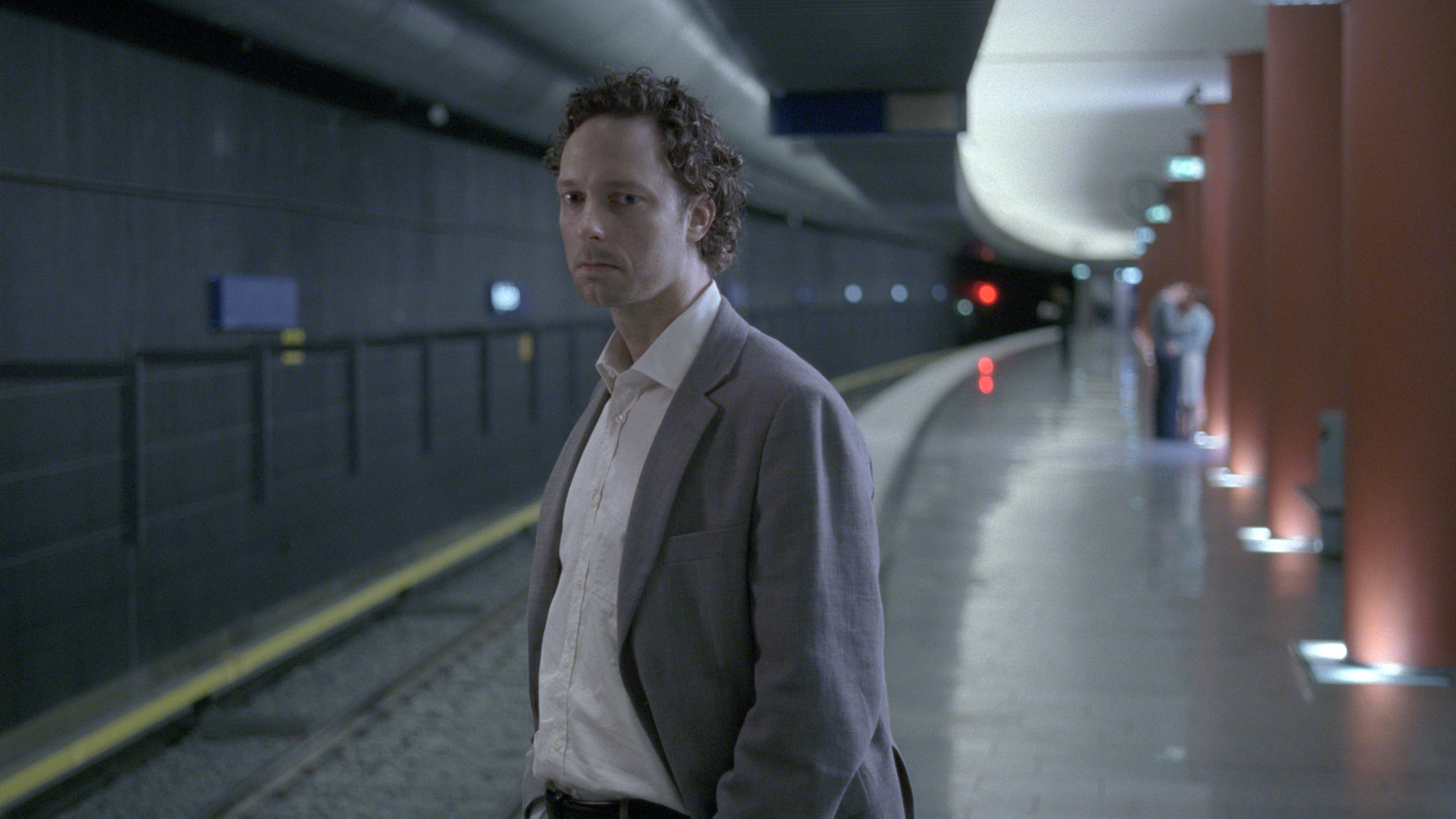
Hey there everyone! Welcome back to Movie Soapbox, the little corner of the internet that only you and I and that guy nodding off in the back row know about. This is the place where we dig up the underseen, the undersold, and the quietly devastating, and we figure out what they were actually trying to say. Today we are doing a full deep dive on The Bothersome Man, a Norwegian film so composed in its dread, so precise in its misery, that you will finish it feeling vaguely accused of something you can’t quite name.
Before we go any further, fair warning: everything past this paragraph is a full spoiler walkthrough. The entire film. The ending, the theories, the crack in the basement wall, all of it. If you haven’t watched yet, go watch it, come back, and we’ll talk. The trailer is right above you. There’s no excuse.
*The Bothersome Man and Movie Walkthrough
Now. A film like this one, quiet, allegorical, shot with that particular Scandinavian patience that American producers confuse with pacing problems, occupies a very specific and very endangered budget tier. Somewhere in that range where the director still has enough rope to hang his own vision, but not enough money to attract the kind of producer who shows up on set with script notes in a binder. Films in this zone either come out exactly as intended, a little raw, a little uncompromising, with the seams showing in ways that feel deliberate, or they get quietly strangled in post when the sales agent gets nervous about the third act. What you can feel, watching The Bothersome Man, is that nobody strangled it. The ending is too unresolved, too deliberately cold, too committed to its own discomfort, to have survived a committee. Someone let Jens Lien make the film he wanted to make. That is rarer than the film itself.
The film opens with Andreas Ramsfjell, played by Trond Fausa Aurvåg, standing in an underground train station, watching a couple kiss. And when I say kiss, I am being generous. What he is watching is two people pressing their mouths together with approximately the emotional investment of two people signing a lease renewal. No hunger, no accident, no warmth. Just a transaction in the shape of affection. Andreas watches this, and then steps in front of a train.
Cut. Andreas is on a bus, moving through a landscape so lunar and empty it reads less like geography and more like a system resetting. The bus deposits him at a gas station somewhere in the gray middle of nowhere, where a single man is waiting to greet him. This man is not alarmed. He is not curious. He has clearly done this before. He takes Andreas into a city that is modern, clean, architecturally precise, and completely correct in every surface detail, and he installs him there. Job, apartment, girlfriend. The whole package, handed over like orientation materials.
The girlfriend is Anne-Britt, and she is lovely the way a rendered image is lovely. Andreas falls into the life. For a while, he tries to want what he is being given. And then one day at work, he cuts off his finger. And later that day, the finger has grown back. Nobody mentions this. Andreas mentions it to no one. The city absorbs it the way it absorbs everything, smoothly, without a ripple.
The monotony begins its slow work on him. The primary activity of domestic life in this city is redecorating. Not as a passion, as a filler. Something to do with the time that would otherwise require feeling something. Andreas is not built for this. He tries to tell Anne-Britt about a dream he had, a dream with a moose in it, which in this city is practically a confession of madness. She doesn’t want to hear it. She doesn’t understand why he’s doing that.
He starts spending time with a woman at the office, Ingeborg. He takes her to a sad film. In the theater, he is the only one crying. Everyone else watches the screen with the same blank attention they give to everything else. He is aware, in that moment, that something is wrong with him, or rather, something is wrong with everyone else, and the city has decided to call that thing normal.
He tells Anne-Britt he is leaving her for someone else. He tells her he has fallen in love. She asks why. He says he is going to leave. She says they have guests on Saturday. That exchange is the whole film in four lines.
Ingeborg is no different from Anne-Britt in the ways that matter. She likes everyone, she says. She is noncommittal about everything, not from cruelty, from a genuine absence of preference. Andreas goes back to the train platform and does what he did at the beginning. Except this time we understand that this is the middle, not the start. The train hits him. And hits him again. He crawls off the tracks, bleeding, ruined, and makes his way back through the city until someone brings him to Anne-Britt, who looks at him, covered in blood and barely ambulatory, and asks if he wants to go go-cart racing. They’ve been invited.
This is when Andreas finds Hugo, a cleaner, who has discovered a crack in his basement wall. Through the crack comes music. Real music, the kind that implies something felt it before it played it. And through the crack, a smell. Something warm and organic and unprocessed, the smell of a world that hasn’t been cleaned into neutrality. The two men begin to dig. Quietly, carefully, in the hours when no one is watching.
They dig far enough that Andreas can get his arm through. He reaches into what appears to be a house, a real one, on the other side of whatever membrane separates this city from wherever it is not, and he grabs a handful of cake off a kitchen counter. The authorities arrive before he can pull back through. They take both men. A city official leans into the car window where Andreas is sitting and delivers the film’s thesis statement with the flat confidence of a man who has had to say it before and expects to have to say it again: most people are happy here. They have everything they need. The majority of people are happy. And we are proud of that.
They put Andreas on a bus back to wherever the buses come from. Workers concrete over the hole. The bus deposits him in a gray tundra at the edge of something. Credits.
The Bothersome Man Movie Theories to Explain It
So. What is this film actually doing.
Bothersome Man Theory #1 – The Literal Reading
The most literal reading is also the most fun and the least satisfying. Andreas is physically trapped in some kind of designed city, a controlled environment operated by persons or entities unknown, populated by people who have either been conditioned out of their emotional responses or arrived without them. In this version, the city is a real place and Andreas is a real prisoner. The finger growing back is the management demonstrating its capabilities. The authorities are literal administrators of a literal system. This is a contained sci-fi premise and it is clean and enjoyable and about as deep as the city itself, which is the point.
Bothersome Man Theory #2 – Consumer Contentment
The more interesting reading is the one the film is actually building toward, and it is not subtle about it if you are watching for the architecture. The city is a portrait of late-consumer-society contentment as a form of spiritual suffocation. Andreas is not being held against his will by aliens. He is living in a world that has successfully optimized for the absence of longing, and he is the malfunction. He still wants something. He cannot name it, he has no framework for naming it, but he knows it smells like whatever was coming through that wall, and sounds like whatever music was leaking through that crack. He is a person who has retained, against all social pressure, the capacity to be dissatisfied. And in this city, that makes him bothersome.
The Norwegian title, Den brysomme mannen, is not a judgment. It’s a category. He is the one who keeps asking questions that the majority of people have agreed to stop asking. He is the one who cries at the sad film. He is the one who tells his girlfriend he is unhappy, who tries to describe a dream, who picks up a pickaxe in a man’s basement because something on the other side of the wall smells like it might be real. He is a bothersome man because he is bothered. Everyone else has solved that problem.
Bothersome Man Theory #3 – The Afterlife?
There is a third read that some viewers land on and I think it earns consideration. The film opens with Andreas on the platform before the suicide, and the film’s timeline is structured so that this is actually a midpoint, not a beginning. This raises the question of what, exactly, the city is in relation to that moment. Is this the afterlife. Is this purgatory in the specific Dante sense, a place of purification structured around the particular failures of the life that preceded it. Andreas’s particular failure being, perhaps, a life of exactly the kind of numbed materialism the city embodies, and this being his reckoning with it. This reading gives the ending a different weight. He is not being expelled from a bad place to a worse one. He is being reset, given the bus, given the tundra, given another chance to arrive and ask better questions this time.
The Moviesoapbox Preferred Read of The Bothersome Man
I am going with the second and third readings together, not as a compromise but as the more precise instrument. The city is both a realistic portrait of a recognizable social condition and a constructed purgatorial space, and the film is smart enough that those two things do not contradict each other. What Lien built is a place that looks exactly like the world most people are currently living in, the comfortable, tasteful, sufficiently amusing world of managed desire and managed disappointment, and he filmed it with the texture of a nightmare. The genius is that the nightmare texture and the realist texture are identical. You cannot tell them apart because there is nothing to tell apart. Andreas is not in a special hell. He is in a normal one. The crack in the wall is not a way out of some fictional city. It is the moment in a real life when you smell or hear or briefly glimpse something that makes you understand that everything around you has been optimized to prevent exactly this feeling. That something real exists. That you have been arranged very carefully to never find it.
The cake is the detail that gets me every time. He reaches through everything, the distance, the risk, the concrete walls and the official car and all of it, and what he manages to grab is a handful of cake off someone’s kitchen counter. It is not a grand object. It is not a key or a map or a message. It is just food that someone made in a house where people apparently still feel things, and it is the most precious thing in the film, and they take it from him before he can even taste it.
Whatever the city represents in your reading, whatever Andreas represents in yours, this much holds: Jens Lien made a film about the violence of contentment without raising his voice once, set it in a world that looks like a real estate listing, and got it across the finish line intact. No third-act rescue. No moment of catharsis that lets the audience off the hook. Just a man on a bus, heading back to the gray, carrying the memory of a smell. That film exists. Most films like it don’t.