
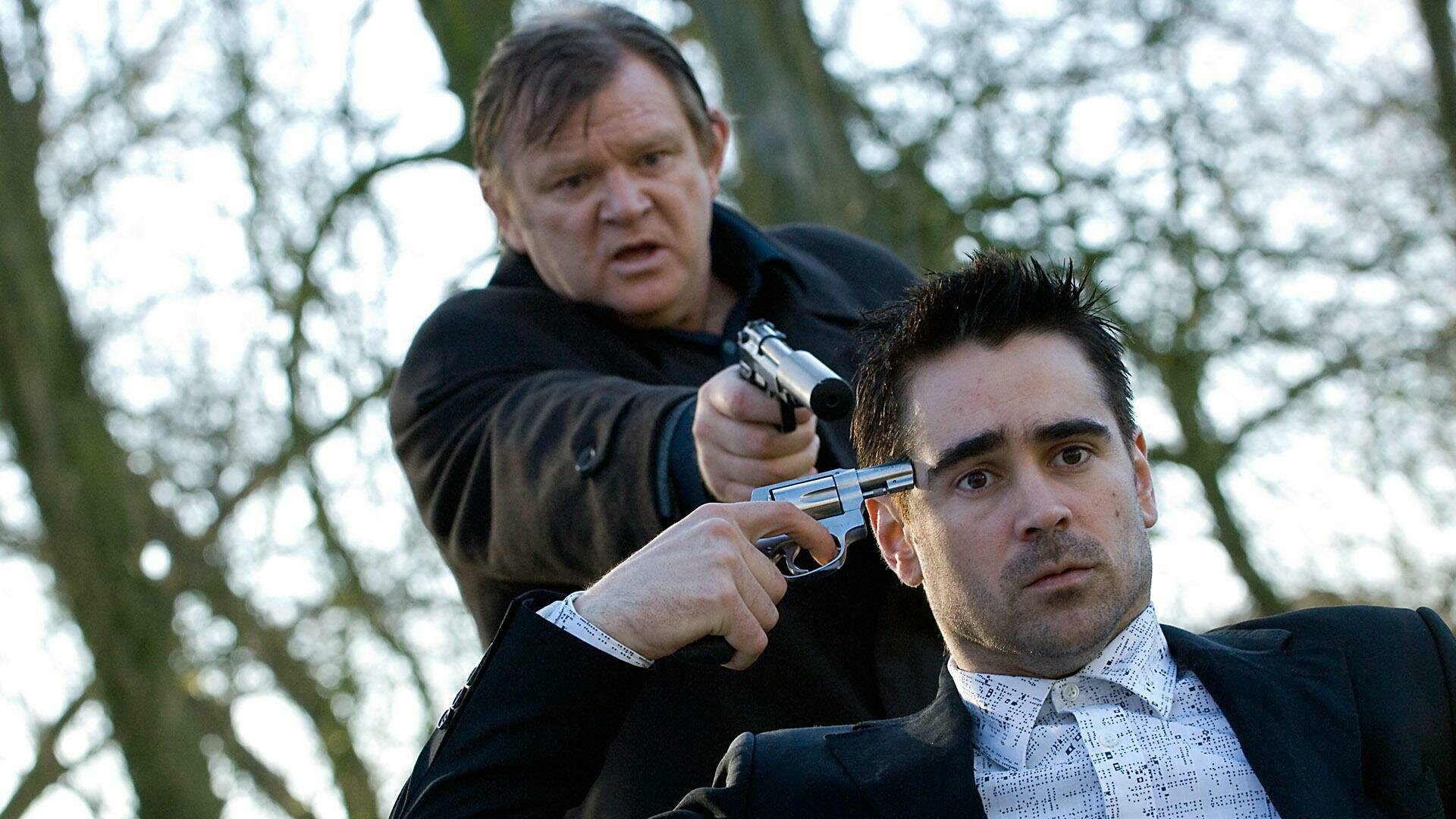
Hey there everyone! Welcome back to Movie Soapbox, the little corner of the internet that only you and I and that guy sleeping in the corner over there know about. This is the place where we find underappreciated films and we make sense of them, really make sense of them, the way the trades never will and the algorithm never could. Today? We are doing a deep dive on In Bruges, a movie so precise in its cruelty and its grace that it makes you angry, genuinely angry, that Martin McDonagh ever had to pitch it to anyone at all.
Watch the trailer first if you somehow haven’t. It won’t ruin anything. It barely scratches the surface.
Alright. Full spoilers from here. Everything. The bell tower, the dwarf, the Bosch painting, the bullet that ends the whole damn thing. If you haven’t seen it yet, close this tab and go watch it, then come back, because I need you to have already lived through it before we talk about what it actually is.
Still here? Good. Let’s get into it.
What This Film Had to Do to Survive
A script like this one, a 90-minute dark comedy about a suicidal Irish hitman stuck in a medieval Belgian city, a script that is secretly a Catholic morality play and doesn’t hide it, a script with a dwarf, a racist Canadian-punching sequence, and a climax that depends entirely on the audience having absorbed a Hieronymus Bosch painting forty minutes earlier, gets one read at most places before it goes in the recycling pile. You know the note it would get. “Love the voice, love the Colin Farrell energy, but WAY TOO BLEAK.” That note. The note that sands down the thing that makes a script a script instead of a product. The fact that In Bruges arrived on screen exactly as McDonagh wrote it, morality tale and all, with its ending intact, with Harry’s code of ethics intact, with Ken’s sacrifice intact, is not something you should take for granted. Films at this budget tier, with this level of thematic ambition, almost never make it through without someone flinching. Someone flinched here too, probably more than once. You can be grateful they lost.
The In Bruges Movie Walkthrough
Ray, played by Colin Farrell in what is probably the best performance of his career and certainly the most emotionally exposed, is a first-time hitman who kills a priest while the priest is in confession. A clean job, theoretically. Except there is a small boy in the pew behind the priest, doing his own quiet praying, and the bullet goes through the priest and into him. Ray did not know the boy was there. The boy is dead. Ray did not mean to kill him. The boy is still dead. That distinction, the gap between intention and consequence, is the entire engine of everything that follows.
Ken, his partner, played by Brendan Gleeson with the kind of warm, exhausted decency that only Gleeson can manufacture, takes Ray to Bruges to await orders from their boss Harry. Bruges is, in Ken’s estimation, a fairytale. Canals, medieval stonework, the Belfry tower, a city that feels like it exists slightly outside of time. In Ray’s estimation, Bruges is a hole. A beautiful, miserable, inescapable hole. He cannot enjoy it. He cannot not think about the boy. Every canal and cobblestone is an accusation.
At the local art museum, Ray stumbles in front of a Hieronymus Bosch triptych called The Last Judgement. Center panel: Christ in a mandorla, angels sounding the end of days, the whole Revelation apparatus cranking into motion. Left panel: paradise, the saved being ferried gently toward Eden. Right panel: hell, fire, insect-demons, the damned. Ray stares at it like a man who has just been handed a bill he can’t pay. Ken watches him stare. McDonagh puts this in the film and says nothing about it out loud. He trusts you to sit with it.
Out on the streets Ray finds a film shoot, meets a pompous dwarf actor named Jimmy, and meets Chloe, played by Clémence Poésy, a woman on the crew he is immediately drawn to. They have dinner. Ray, with characteristic Ray-ness, picks a fight with a Canadian couple he’s convinced are American. It escalates. Later, back at Chloe’s place, her ex-boyfriend shows up and attacks Ray. Ray disarms him, and after a conversation about whether the gun is loaded with blanks (it is), shoots him in the face with it. It’s loaded with blanks. The guy loses an eye anyway. Ray then discovers that Chloe and her ex run a small side business robbing the men she brings home. She swears Ray was not a mark. Ray steals the ex-boyfriend’s gun anyway, and he and Ken and Jimmy and two prostitutes have what is accurately described as a drug-fueled binge.
The next morning, Harry calls Ken. Harry, played by Ralph Fiennes at his most operatically furious, one of the great comic villain performances in modern cinema, gives Ken the order: kill Ray. Because even among professional killers, apparently, there is one absolute moral line, and Ray crossed it. A child died. Harry has a code. The code says Ray must die for it.
Ken goes to do the job. He finds Ray sitting in a park near a children’s playground, alone, with the gun he stole from Chloe’s ex. Ray is already planning to kill himself. He is sitting there, in a park where children play, thinking about a boy who will never play again. Ken comes up behind him, draws his own gun, gets it to the back of Ray’s head, and in the half-second before he pulls the trigger, sees Ray raise his own gun to his own temple.
Ken puts his gun down.
That half-second is the whole movie. Everything before it is setup. Everything after it is consequence. Ken has just decided, without time to think it through, that Ray deserves to live more than he deserves to die. He’s made a theological ruling. He knows what it will cost him.
He gives Ray money. Puts him on a train. Tells him to go, learn a language, become something, you can do anything. And then Ken walks back to the town square, sits down with a beer, and calls Harry to tell him the job is not done and will not be done. Harry arrives. Beyond apoplectic does not begin to cover it. But Ken has a plan for the logistics of what comes next: let’s go up the bell tower, he says. Quieter up there. And at the top, Ken puts his gun on the ground. He tells Harry he won’t fight. Harry will simply have to shoot him. Harry, furious at the lack of a proper showdown, shoots Ken in the leg.
Meanwhile, Ray’s train escape lasts approximately four minutes. A cop boards, asks if he’s the man who assaulted a Canadian couple, and hauls him back to Bruges for a court appearance. Of course. The city won’t release him. Chloe bails him out. They sit at the base of the Belfry to have a drink, which is when Chloe’s ex-boyfriend spots them, recognizes Ray, and goes directly to Harry, who is still up in the tower trying to get a shot at Ken. Ken hears Ray is back in the city. He and Harry struggle. Harry shoots Ken in the neck, and heads down the stairs.
Ken, shot in the neck, bleeding out, crawls back to the top of the tower. He jumps. He survives the fall just long enough to reach Ray and hand him the gun, which is broken. Harry and Ray run. Ray makes it back to the hotel to find the gun he stole from Chloe’s ex. Harry nearly kills Ray’s hotel manager in the chase. Ray decides to jump from a window into the canal below and make a run for it. A barge passes at the exact wrong moment. He lands on it instead of the water. Harry, at distance, shoots him through the stomach anyway. Ray staggers off the barge and onto the film set, the same movie shoot where he met Chloe, now populated with extras costumed as medieval demons and angels and creatures straight off the right-hand panel of the Bosch painting. He is walking, bleeding, through the Last Judgement. McDonagh spent his entire budget of restraint for two years on not underlining this out loud.
Harry catches up. He does not care that there are witnesses. He shoots Ray in the back. The bullet goes through Ray and hits Jimmy, the dwarf actor, who is dressed, for the film shoot, as a small boy. Harry earlier told Ken: if he ever accidentally killed a child, he would kill himself on the spot. He said it as a statement of principle, not a prophecy. He pulls the gun from Ray and puts it in his own mouth.
That’s where it ends. The paramedics come. Chloe runs. Ray’s voiceover closes it out. Whether he lives is left open. Whether it matters is not.
What Is Bruges, Actually
The thing most people miss on a first watch, and McDonagh is absolutely counting on them missing it so it lands harder on the second, is that Bruges is purgatory. Swap the word out every time you hear it and the film makes a completely different kind of sense. Ray did not choose to come here. He arrived after the killing. He cannot leave. He is suffering. He cannot enjoy anything. He is being held in a place of beauty he cannot access, waiting for a judgement to come down from above about whether he goes up or goes down.
The film opens with no backstory, no context, no explanation of how we got here. We just arrive, in Bruges, with two men and a weight neither of them names for a while. McDonagh hated the word “backstory” by all public accounts, and this film is the proof of why: backstory would have broken the spell. We needed to arrive in purgatory the way the souls in purgatory arrive, disoriented, present, with the sin already committed and the consequence not yet determined.
Ken is not just Ray’s partner. Ken is Ray’s advocate. He’s the figure who looks at a man who killed a child, by accident, in his first professional act, and decides that accident matters, that remorse matters, that the soul showing through the wreckage matters. Harry represents the other reading: sin is sin, consequence is consequence, the code has no exemptions. Both positions are stated clearly and without irony. McDonagh lets them fight it out.
The Bosch painting is not decoration. It is the film’s diagram. Left panel: where Ken wants Ray to end up. Right panel: where Harry already is. The center: Christ in judgment, the decision being rendered. Ray spends the whole film standing in the middle triptych, the bottom one, where the damned and the saved are still being sorted, waiting to find out which way the hand points.
The Theories to Explain In Bruges
Theory Number 1 to Explain In Bruges
There are a few camps on what the ending means for Ray specifically, since McDonagh does not close that door all the way. One reading: Ray survives. He has been through purgatory and come out the other side. The suffering was real, the advocate died for him, the judgment came down in his favor. He gets the left panel. This reading is emotionally satisfying and theologically coherent within the film’s framework.
Theory Number 2 to Explain In Bruges
The second reading: Ray dies on that barge or shortly after, and his voiceover at the end is the voice of a man in the moment before death, or already past it. Purgatory ends not with release into life but into whatever comes next. The film’s ambiguity is the point, McDonagh is not going to hand you the answer because the answer is not his to give.
Theory Number 3 to Explain In Bruges
The third reading, which gets less attention, is that the ending is deliberately structured to mirror the opening. Ray’s voiceover at the beginning talks about Bruges. Ray’s voiceover at the end talks about not wanting to die in Bruges. The film closes the loop and refuses to break it. Purgatory doesn’t end. He’s still there. The judgement is still pending.
Moviesoapbox’s Personal Take on In Bruges
The second reading is almost right but it’s missing the generosity McDonagh is actually working with. The man spent the entire film building toward Ken’s act of self-sacrifice as the hinge point, the moment that changes the moral weight of the universe the film is operating in, and he did not do that to leave it unresolved at the level of Ray’s soul. The ambiguity about whether Ray physically survives is real and intentional. The ambiguity about whether Ray has been offered something worth surviving for is not ambiguous at all. Ken jumped. The advocate made his move. The film’s moral logic demands that the offer was real. What Ray does with it is between Ray and whatever comes next, and McDonagh is correct to not show you that part.
What I keep coming back to is Harry. Ralph Fiennes plays a man with a code so absolute it destroys him, a man who built his entire sense of self around a moral line he drew in the sand and then accidentally crossed himself, and who keeps that promise to himself in the most operatically absurd possible circumstances, surrounded by film extras dressed as medieval demons on a Belgian canal set. Harry is not a joke. He is a tragedy. He believed in something and it killed him. That is McDonagh’s real cruelty, not the violence, not the language, the cruelty of giving the villain a moral code more consistent than most heroes have, and then letting that code snap shut around his own neck.
Ken is the Christ figure. Harry is the law. Ray is every person who has ever done something unforgivable and been told by someone who loves them that they have not, in fact, forfeited the rest of their life. The film is asking whether you believe that person. McDonagh, whatever else he is, believes it. That’s the whole film right there.
What This Film Almost Wasn’t
Films like In Bruges exist in a very specific and very precarious slot in the ecosystem. They’re too dark for the rom-com distributors, too funny for the prestige drama buyers, too specifically Catholic-philosophical for anyone whose greenlight instinct runs toward comp titles. The cast, Farrell and Gleeson and Fiennes, is what got this made and what got it seen. Without those names, a script this strange and this uncompromising about what it is sits in a drawer. With them, it gets a release, it finds its audience, it becomes the film that people discover five years later and watch three times in a week. That’s the only path this kind of movie has. It doesn’t get a marketing budget. It doesn’t get an algorithm. It gets word of mouth from people who feel like they’ve been trusted with something.
McDonagh trusted you with something. Most studios wouldn’t have let him. Somebody let him anyway. That’s worth noting before you close the tab.