
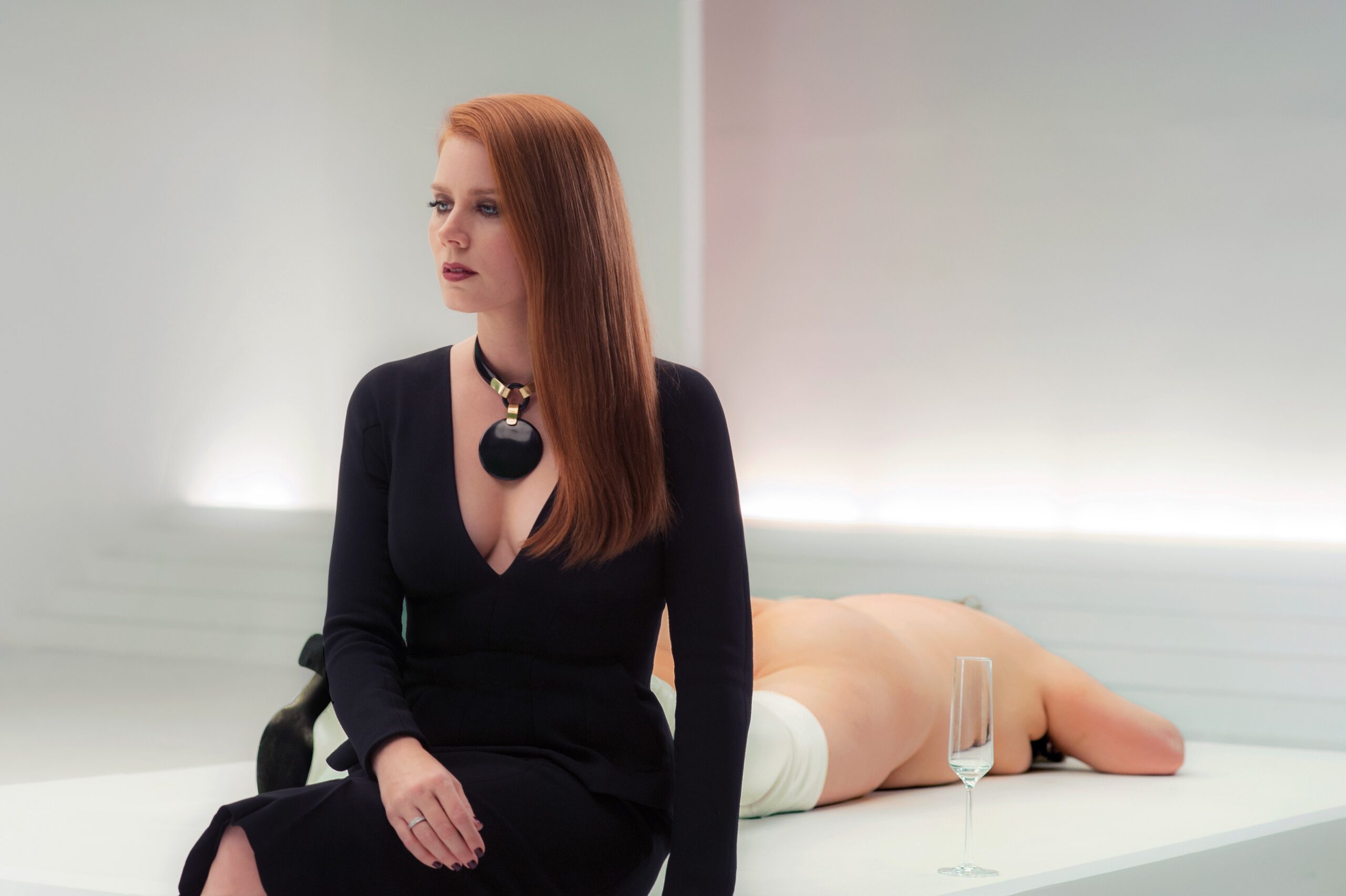
Hey there everyone! Welcome back to Movie Soapbox, the little corner of the internet that only you and I and that guy sleeping in the corner over there know about. This is the place where we find underappreciated films and make sense of them, the ones that crawl under your skin and stay there long after the credits have rolled and the theater has emptied out. Today? We are doing a full deep dive on Nocturnal Animals, a movie so precisely, coldly structured in its cruelty that the whole thing functions less like a film and more like a letter designed to destroy the person reading it.
Fair warning before we go any further. Everything from this point forward is a spoiler. Not the soft, careful kind either. We are walking through this entire movie beat by beat, and the ending especially requires full exposure of everything that came before it. If you have not seen Nocturnal Animals yet, close this tab, go watch it, come back. You will get more out of every single word below if you do. Still here? Good. Let’s get into it.
Nocturnal Animals and the Inner Workings
Before we crack the film open, there is something you need to understand about what kind of movie this was supposed to survive becoming. Tom Ford is a fashion designer who directed two films before this vanished into a very long silence. That resume, in a development office, reads as a liability. A second feature from a non-traditional director, adapting a difficult novel, with a fractured non-linear structure, no clean hero, and a third act that refuses to resolve in any commercially satisfying way? The notes that kind of project attracts are the notes that sand everything down. The ones that say “audiences need closure” and “can we make Susan more sympathetic” and “does Edward have to be so passive, can we give him a moment where he really confronts her.” The fact that this film lands exactly as cold and unresolved as it needs to be tells you one of two things. Either Ford had enough armor on this project, Amy Adams and Jake Gyllenhaal attached early enough, Focus Features trusting the material enough, that the note-givers backed off. Or he made his choices fast and cheap enough that by the time anyone panicked, the film was already locked. Either way, the movie you are watching is not the safer version. You can feel the shape of the safer version in its absence.
Nocturnal Animals Movie Walkthrough
Now. The timeline. Because this is the first place people come out of the theater spinning, and it is actually simpler than it feels in the moment. You have two reality layers and one fictional layer, all three running simultaneously throughout the film. The outer layer is Susan Morrow’s present, her gallery opening, her hollow marriage to Hutton, her increasingly sleepless nights with Edward’s manuscript in her hands. The inner layer is Susan’s memory, the flashbacks to how she and Edward met, how the marriage went wrong, what she chose and what it cost. And then you have the novel itself, Tony Hastings on a Texas highway, the encounter with Ray and his crew, Bobby Andes, the long slow hunt for justice that never quite arrives clean. The film cuts between all three constantly, and the editorial logic is always emotional, not chronological. You’re watching the novel bleed into Susan’s memory bleed into Susan’s present, because that is what reading a book written by someone who loved you and whom you destroyed actually feels like from the inside.
So. Susan. She is, at the film’s open, everything her mother wanted her to be, successful, connected, married to money, running in the right rooms. She is also visibly, quietly miserable in a way she has learned to perform her way around. Hutton is not home the night of her most important opening. He tells her he has to travel for work. He is sleeping with someone else. Susan knows, and says nothing, because the alternative is admitting what she traded away to get here. Then Edward’s manuscript arrives, and she starts reading, and the movie really begins.
The flashbacks show you the math. Edward was the struggling writer she loved before she loved the idea of the life her mother laid out for her. Her mother told her Edward would never amount to anything, that Susan was built for more, that love of the soft, inconvenient, financially unreliable kind was a trap. And Susan listened. She met Hutton. She had an affair while still married to Edward. She got pregnant by Hutton and had an abortion, and Edward found out, standing outside the clinic in the rain, knowing whose child that was and whose choice it was not. Susan chose, at every fork, the version of her life that looked like success and felt like nothing. Edward was collateral damage each time. Accumulated, quiet, total collateral damage.
The novel is his answer to all of it. Tony Hastings is Edward, and you know this because Edward is the kind of writer Susan told us he was, the kind who wrote about himself until she told him to stop. Tony’s wife Laura is Susan. Their daughter India is the child that never existed, the abortion that Edward watched happen from a parking lot in the rain. Ray and his crew are Hutton, the force that comes in and takes what Edward had, without asking, without consequence, with a kind of casual brutality that is almost worse for how mundane it is. And Tony, throughout the novel, is emasculated completely and continuously, helpless to stop any of it, exactly the way Edward felt in that marriage, in that parking lot, in every room where decisions about his life were made without him.
Bobby Andes is the one character in the novel without a clear one-to-one real-world equivalent, and that might be intentional. Bobby is the part of Edward that wanted someone else to carry the anger for a while. The part that wanted an older, harder, terminally ill man who had nothing left to lose to look at all of this and say yes, what happened to you was wrong, and I will help you burn it down. Michael Shannon plays him with the specific gravity of a man who has already decided. Every scene with Bobby is the fantasy of consequence arriving. And the novel ends with Tony getting that consequence, Lou dead on the floor, Tony walking outside and firing once into the air and then collapsing. Whether Tony dies from his wounds or from the pure cost of becoming someone capable of doing what he just did, the novel closes on a man who got his revenge and lost himself in the getting of it. Edward is not celebrating. He is showing Susan exactly what she made him capable of.
The Theories to Explain Nocturnal Animals
The theories about the ending exist on a spectrum, and they are worth laying out clearly.
Nocturnal Animals Explanation Theory #1 –
The first reading is literal and mechanical: Edward stood Susan up at the restaurant as a deliberate final act of rejection, the mirror image of every time she chose Hutton over him, and he simply does not come because he owes her nothing, not even closure.
Nocturnal Animals Explanation Theory #2 –
The second reading is darker and more interior: Edward wrote the novel, sent it, arranged the meeting, and never intended to show up, because the book was already everything he wanted to say, and showing up would have made it a conversation when it was always meant to be a verdict.
Nocturnal Animals Explanation Theory #3 –
The third reading, the one that gets floated in the forum threads, is that Tony’s death in the novel is literal autobiography, that Edward is telling Susan he is already gone in every way that matters, and possibly in ways that are more than metaphorical. The film does not confirm this. It does not need to.
Moviesoapbox’s Reading on the Movie Nocturnal Animals
The read I think is correct is the second one, with the third one casting a long enough shadow over it to make the whole thing feel like what it is. Edward is not there because he already said everything. The novel was the confrontation Susan spent years avoiding and Edward spent years unable to force. He is not going to sit across from her in a restaurant and watch her explain herself or apologize or try to reconstruct something out of the ashes. He sent her a book about what she did to him, made it beautiful, made it the work of art she never believed he had in him, and then did not show up for the part where she got to respond. That is not cruelty for its own sake. That is the cleanest possible form of letting someone live with what they chose.
And Susan, alone at the table, drink in hand, her husband somewhere else in someone else’s bed, her career a series of openings she has started calling junk culture to her own friends, she is sitting inside the exact life her mother predicted and she constructed, and she finally has to look at it without Edward there to absorb any of the weight. That final image is not ambiguous. She is alone in the most complete way a person can be alone, surrounded by everything she chose and none of what it cost her.
Nocturnal Animals is the kind of film that gets made because someone cared enough about the source material to fight for the version that doesn’t let anyone off the hook. No redemption arc. No reunion. No moment where the mess resolves into something you can walk out of feeling okay about. Just a very precise, very cold portrait of what it looks like when the person you wronged turns out to have been exactly who they said they were. Factory Hollywood would have given you the dinner scene. Would have had Edward show up. Would have given Susan something to do with her hands besides sit there and understand. This film was not interested in that. It knew what it was. It showed up anyway.
🎬 If You Liked This…
- In Bruges — a man processing guilt and moral failure through a story he keeps telling himself about what he deserves, the past refusing to stay in the past no matter how far away he runs from it
- Galveston — the same bruised noir register, a man at the end of everything trying to do one decent thing before the story he wrote for himself catches up with him
- My Cousin Rachel — the past bleeding toxically into the present through a man who cannot trust his own account of what happened, the same gorgeous surface covering something that won’t stop rotting underneath