
Hey there everyone! Welcome back to Movie Soapbox, the little corner of the internet that only you and I and that guy sleeping in the corner over there know about. This is the place where we find under-appreciated indie films and we make sense of them. Today we are doing a deep dive on Nine Days, a movie so quietly devastating, so committed to its own strange metaphysical premise, that the suits who greenlit it probably spent the entire marketing cycle trying to figure out how to sell a two-hour philosophical argument set in a house in the middle of nowhere with no car chases and a climax built around Walt Whitman.
They didn’t figure it out. The movie barely got seen. You should watch it anyway.
Fair warning before we go any further: everything from this point forward is a full-spoiler walkthrough. Every candidate, every choice, every note Emma leaves behind. If you haven’t watched yet, close this tab, watch the movie, come back. I’ll be here. I’m always here.
Still with me? Good. Let’s talk about what this film actually cost to get made and what it was up against before a single frame was shot.
Edson Oda, making his feature debut, with a premise that has no franchise hook, no IP spine, no sequel engine, and whose entire emotional payload depends on an audience caring deeply about a woman who dies in the first ten minutes and a soul who never gets born. The budget tier this film was working at, and you can read the production value on the screen if you know how to look, is the tier where the director usually gets one pass at the cut before someone else’s name goes on it. The fact that what ended up on screen feels so precisely, stubbornly like one person’s vision, down to the geometry of how the cameras move in that final scene, tells you either Oda had a protector somewhere in the producing chain, or he fought like hell, or both. Films like this don’t arrive intact by accident. They arrive intact because someone refused a very specific set of notes, probably more than once.
Nine Days Movie – What Is Actually Happening?
Will, played by Winston Duke with a gravity that the film absolutely requires and absolutely gets, lives in a sort of bureaucratic purgatory, a pre-life antechamber, a middle space between existence and nonexistence that the movie never over-explains and is smarter for it. He sits in a house surrounded by television screens, each one broadcasting the life of a person he selected to be born. He is an arbiter, a word the film uses precisely, a judge who interviews unborn souls and decides which ones get materialized into a human life.
When someone on Earth dies, a slot opens. Will interviews candidates. He observes their responses to footage of actual human lives, watches how they react to suffering and joy and mundanity, takes notes in a manner that reads less like a hiring process and more like a man building a case he’s never quite confident in. The ones he doesn’t select get a parting gift, one final experience of their choosing, a single memory they will carry for the seconds before they cease to exist entirely. That’s the architecture.
When the movie opens, one soul has already survived this process without being selected and without being erased. Her name is Kyo, and she has stayed on to assist Will. The film gives you this information without ceremony, and you either accept the premise or you don’t. If you’re still reading this, you accepted it.
Will’s favorite life on the screens is Amanda, a 28-year-old violin prodigy. He has watched her the way you watch something you love but know you have no claim on. Then Amanda drives into a bridge abutment and dies, and now Will has to replace her, and he is grieving, and the candidates arrive.
The Candidates, The Process, The Tells
Five souls cycle through Will’s house over nine days. He shows them footage of human lives and watches how they respond. He asks questions. He eliminates people for being too harsh, too dismissive, too quick to judge. The elimination criteria seem intuitive rather than procedural, which is the point, because Will is not a machine running a process, he is a flawed man running a process he invented out of his own experience of having been alive.
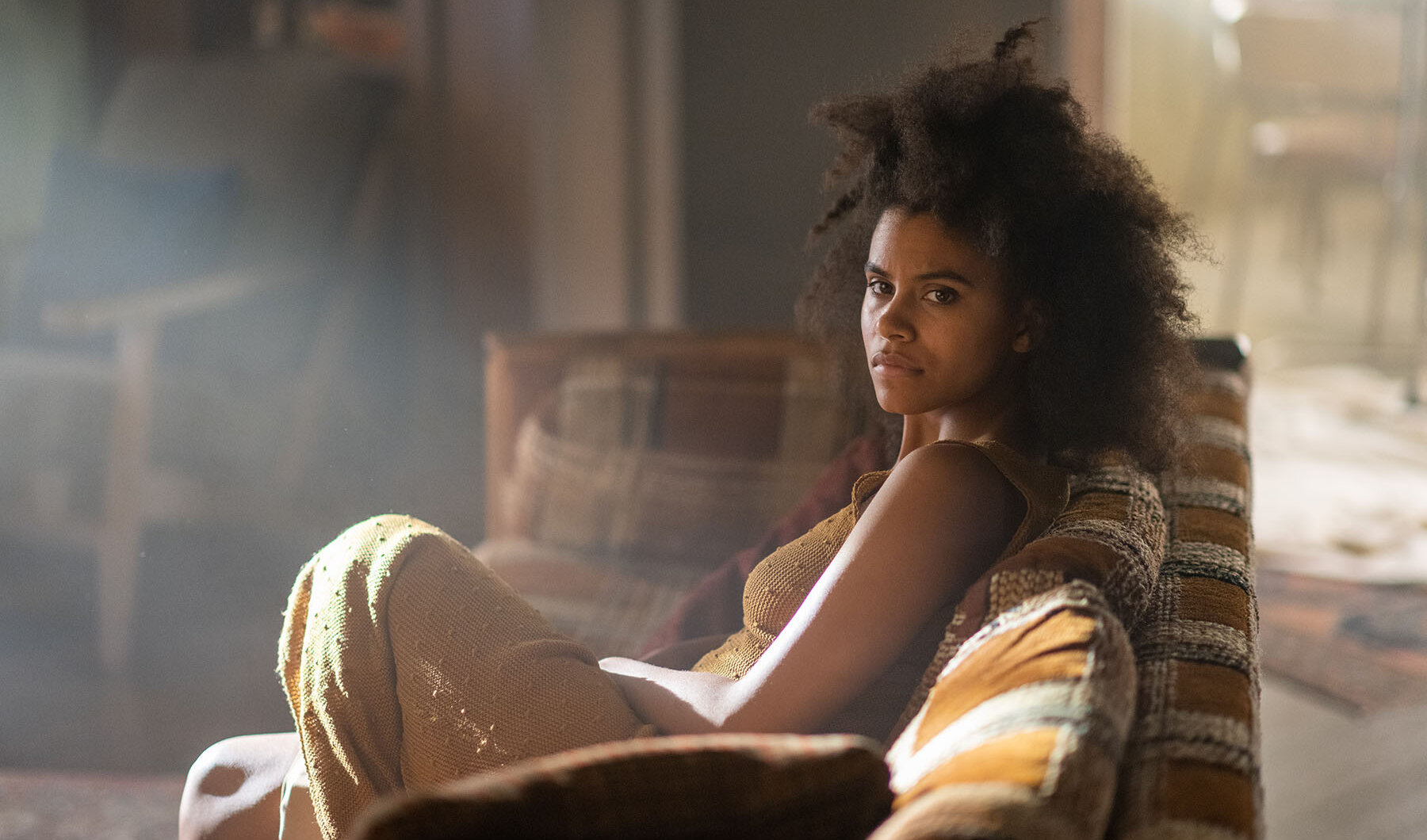
Emma, played by Zazie Beetz, is his obvious choice from almost the first scene she’s in. She is radically empathetic, curious in a way that reads as generosity rather than nosiness, and almost completely uninterested in impressing Will. She watches the footage of people’s lives and she feels it. You can see her feeling it. Beetz does something in this performance that is genuinely difficult, she plays someone who has never experienced anything and yet responds to everything as if she has always known it was coming. The other candidates want to be selected. Emma seems to be there for a different reason, one she couldn’t articulate if you asked her.
Kane is the last man standing against her. Kane is a pessimist in the precise, technical sense: he sees the world’s evil clearly, names it without flinching, and has resolved to push back against it. He is not naive. He will not be blindsided. He has, in Will’s framework, already done the work of understanding what life actually costs.
And then a wrinkle. Another arbiter arrives because Amanda’s cousin is up for selection on his side of the process, and he brings Will a video. Footage from after Amanda’s death. A suicide note. Amanda didn’t crash. She chose to. And now Will, who loved watching her live, has to sit with the fact that she chose to stop, and he never saw it coming, and all those hours of footage and he missed it entirely.
What this does to Will is the real engine of the movie. His obsession with Amanda was never just professional. He is a man who had a life, who had a chance on a stage, who felt fully alive exactly once and then let it go. He selected Amanda because she was what he could have been. And she is dead, by her own hand, and he didn’t know.
The Choice That Breaks Him
Will selects Kane. Kyo argued for Emma. The audience has been arguing for Emma for ninety minutes. And Will selects Kane, and the film lets him, and doesn’t editorialize about it, not immediately, because it understands that Will’s reasoning is internally coherent even if it is wrong. Kane won’t be blindsided by suffering the way Amanda was. Kane will see the darkness coming. Kane will fight it. Will has watched a soul he loved drive into a bridge because she was overwhelmed by something he never detected, and so he selects the man who will never be overwhelmed, because at least he’ll see it.
The decision says everything about Will and nothing about who Emma is. He is making a selection based on his own wound, his own failure of perception, his own guilt. He is a flawed arbiter. He has always been a flawed arbiter. The movie has been showing you this the whole time.
Emma gets her final experience. She tries to write down what she wants. Will says no, he won’t allow it, the request is off limits, he doesn’t say why. She walks into the desert and fades.
Then he finds the notes. Little slips of paper, all over the house, that Emma left behind. Gratitude. Warmth. Evidence that she was paying attention to everything, to him, to the process, to the beauty inside an experience that most of the other candidates were performing their way through. He reads them and he runs.
The Ending of Nine Days Explained
He catches her in the desert, and he does the thing he told her earlier he never did, the thing he had one chance to do when he was alive and walked away from. He performs. He takes Walt Whitman’s Song of Myself and he recites it, not to her, not at her, but with her, in a space where her silence is as loud as anything he says.
Oda, in interviews, described the scene as a dialogue even though Emma has no lines, and that is exactly right, because Beetz plays every word of Whitman landing on Emma like she is receiving something she always knew was real and is only now hearing named. The camera follows her movements, not Will’s, which tells you everything about whose scene this actually is.
They yell together. The sun comes. And Emma fades.
Whitman was the right poet for this because Whitman wrote about the body and the soul as the same argument, not as opposites. He wrote about grass growing from what’s buried. He wrote about stopping somewhere and waiting. The film earns the Whitman because it has spent ninety minutes building a case for why a man who had a life and didn’t fully live it would choose to give the truest version of himself to someone who never got the chance, in the last seconds she exists.
Will doesn’t redeem himself. He made the wrong call. He selected Kane, and Kane goes into the world, and Emma is gone. But he gives her something real in the only window he has left. And she knew he would. She left the notes because she already knew.
The Theories That Might Explain Nine Days
There are a few different readings of what the film is actually arguing, and they’re worth naming cleanly.
Theory Number 1 for Nine Days – The first is the straightforward emotional read: Will made a mistake, he knows it, the ending is his partial redemption through finally doing the thing he never did. The film is about regret and what you owe the moments you let slip. Emma is the purest version of what a life could be, and the film mourns her.
Theory Number 2 for Nine Days – The second reading pushes back on whether Will was wrong at all. Kane’s pessimism-as-resilience is a defensible philosophy. Blithe happiness, the reading goes, may be beautiful but it may also be fragile, and Amanda proved that fragility has consequences. Will, on this read, made a cold and tragic but not irrational choice. He selected for survivability. The film doesn’t vindicate him, but it doesn’t refute him either.
Theory Number 3 for Nine Days – The third reading is the one that sits underneath both of those: this is a film about the arbitrariness of who gets to be alive at all. The selection process is flawed because the selector is flawed, because any selector would be flawed. Every person alive was chosen by some process no one fully understood or controlled, and all the criteria we retroactively attach to that selection are stories we tell ourselves. Emma was worthy. She didn’t get born. That’s the condition.
Theory Number 4 for Nine Days – A fourth, quieter reading centers on Kyo, the soul who refused erasure and stayed. The film establishes that resistance is possible. Emma walked into the desert. She didn’t fight. Whether that was grace or surrender is something the film leaves open, and deliberately so.
Moviesoapbox’s Perspective on the Right Read
The third reading is the one that lands hardest and the one the film is actually built to support, but what makes Nine Days worth your two hours is that it holds all four of these simultaneously without forcing a resolution. The question Emma asks near the end, do any human beings ever realize life while they live it, is the question the film has been asking in every scene, through every candidate, through every selection Will made while he was alive and didn’t know what he had.
Will didn’t realize it while he lived it. He’s realizing it now, in a house between worlds, watching other people get the chance he couldn’t use. The selection process is his way of trying to matter retroactively. It doesn’t work. The Whitman scene is the one moment where something real passes between him and another soul, and it happens in the last thirty seconds before she no longer exists.
That’s the movie. That’s what it cost to make, and that’s what almost didn’t get made, and that’s why you should watch it.
Before You Go
This film got a limited release, a quiet VOD window, and an audience that found it mostly by word of mouth from people who watched it alone at midnight and then couldn’t stop thinking about it for three days. Edson Oda had a debut feature that was singular and uncompromised and built around a Black lead doing the most emotionally demanding work of his career to that point, and the machine looked at all of that and decided it didn’t know how to sell it. So it didn’t. Not really.
So tell someone about it. That’s the only distribution model that ever worked for films like this one, and it’s the only one it’s got.