
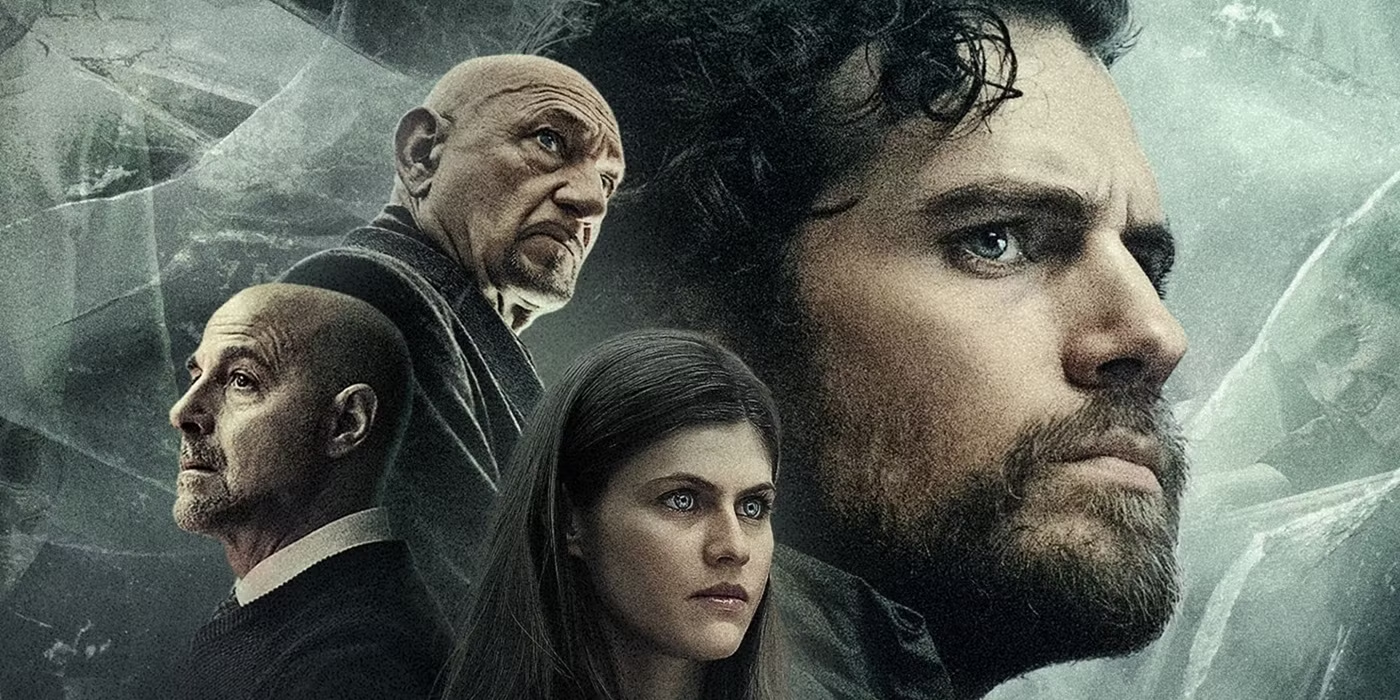
Hey there everyone! Welcome back to Movie Soapbox, the little corner of the internet that only you and I and that guy sleeping in the corner over there know about. This is the place where we find underappreciated indie films and we make sense of them. Today? We are doing a deep dive on Night Hunter, also released as Nomis, a movie so aggressively hated by everyone with a Rotten Tomatoes account that you’d think it personally owed them money.
Before we go any further, everything from this point forward is a spoiler. The whole movie. The twist. The twin. All of it. If you haven’t seen it and you want to stay clean, go watch it and come back. If you have seen it and you are here because the ending left you blinking at your television trying to figure out what you just watched, you are exactly where you need to be.
Night Hunter (Nomis) Movie Mechanics
So let’s talk about what kind of movie this actually is, and why the knives came out so fast and so hard for it. Because the pile-on for Night Hunter is, frankly, disproportionate to its actual crimes. You can feel, watching this thing, that it had a real idea once. A thriller about a vigilante judge running honeypot stings on predators, colliding with a police procedural, colliding with a serial kidnapper who turns out to be something stranger and more pathetic than the monster everyone assumed. That’s a legitimately interesting three-car pileup of a premise. Films like this, sitting at a budget tier where you can afford Henry Cavill and Ben Kingsley but not much margin for error in post, almost never survive their own ambition intact. A film at this level gets one shot at a third act. There’s no second unit pickup week when the test screening cards come back confused. When the audience doesn’t follow the mechanics of a reveal this late in the game, that’s usually the point where a distributor starts quietly cutting the connective tissue, and what you’re left with is a movie that feels like it’s hiding something even when it isn’t anymore. Watch the pacing around the twin reveal and you can feel exactly where the air went out. That’s not the director losing control of his story. That’s what happens when a film gets finished in a hurry.
Night Hunter Movie Walkthrough
The movie opens on a girl running through the cold in a shift, barefoot, clearly escaped from somewhere and clearly not going to make it back to safety in time. When she realizes she’s going to be caught again, she jumps off a bridge rather than go back. She lands on a lumber truck and isn’t found until the driver stops miles later. That image is doing real work and the film knows it. It’s telling you exactly what kind of captivity we’re talking about before anyone says a word about it.
Then we meet Judge Michael Cooper, played by Ben Kingsley, who has a side operation going: he runs honeypot stings on predators using Lara, his ward, played by Eliana Jones, as bait. It’s the kind of extrajudicial vigilante operation that would get the whole thing thrown out in any real courtroom, which the film either doesn’t care about or waves at briefly and then moves on. During one of these stings that goes sideways, Lara is actually taken. Marshall, Henry Cavill doing his best impression of a man who exists solely to locate missing people and look aggrieved about it, tracks her through a GPS chip in her earring, which is exactly as implausible as it sounds but the movie is moving fast enough that you mostly let it go. They find Lara. They also find a hidden network of captive young women inside a mansion belonging to Simon Stulls, played by Brendan Fletcher. Simon is brought in. He’s clearly not operating at full capacity, mentally scattered, difficult to interview, not holding together under questioning the way you’d expect a careful predator to hold together.
Then the film starts doing something genuinely smart, even if it doesn’t always execute it cleanly. Things keep not adding up. Officer Glasow’s infant is taken, which forces him to arrange Simon’s release from custody or his daughter dies. After Simon is freed, he tracks down and murders his own father, a man who raped his mother and triggered a suicide attempt, which tells you something about what’s driving this and it’s not what the police think it is. Then Simon is recaptured. And somewhere in all of this, Lara goes missing again, and nobody has a clean explanation for how.
Cooper, who has now lost Lara twice on his watch, goes completely off the rails and attacks the police transport carrying Simon himself. And that’s when both Cooper and the audience find out, at the same moment, that Simon is two people. Identical twins. One of them has been running the abduction network with genuine predatory calculation. The other is the mentally disabled, lost, barely-present man the police have been interrogating and getting nowhere with. The capable twin has been using his brother as a decoy, letting him absorb police attention while the real operation continued. It’s a bleak piece of engineering and the film deserves credit for not telegraphing it, even if the mechanics of how it functioned in practice require you to do some generous charitable work on the logistics. The twins murder Cooper. They take Rachel Chase, played by Alexandra Daddario, before they run.
Marshall tracks them to a frozen lake. The twins are holding Rachel and Lara on the ice. There’s a confrontation, Lara gets out, and Marshall captures the disabled brother. He uses that captive brother as leverage to get Rachel released. Then, and this is the moment the whole film has been building its quiet, terrible logic toward, Marshall convinces his captive to go give his brother a hug. The weight of two grown men on the ice cracks it. Both brothers go through. Neither comes back up. Marshall didn’t shoot anyone. He just understood the ice.
As the film closes, Lara reads a letter Cooper wrote to her before he died, thanking her. Marshall and Rachel visit his daughter, and the film suggests, without overplaying it, that these two people who have spent the whole movie standing over the worst things human beings do to each other have decided to try to be in the same room under better circumstances.
Night Hunter Various Confusions Explained
Now let’s deal with the things that actually confuse people, because the twin reveal, while the most dramatic surprise, is not actually the hardest thing to follow.
The primary confusion is the timeline of who has been doing what and when. The capable twin has been operating the network. The disabled twin has been, knowingly or not, serving as a kind of human smokescreen, someone who matches the general description, who can be found near the right locations, who scrambles the profile. The police procedural mistake is treating Simon as a single coherent person whose behavior doesn’t make sense, when the behavior doesn’t make sense because it belongs to two different people with two different functional capacities. Every time the evidence pointed one direction and Simon’s behavior pointed another, that was the seam between the brothers, and the film was showing it to you before you had the context to see it.
The second confusion is Glasow’s infant. This is the capable twin applying direct pressure to the investigation, forcing someone inside the police department to create an opening for Simon’s release. The abduction of the baby is leverage, and it works, which is the film’s most efficient demonstration that the person running this operation is not the scattered, confused man in the interrogation room.
The third confusion is Cooper. People read him as erratic. He’s not erratic, he’s a man who built his entire post-bench life around protecting one specific person, and he failed her twice, and the second time he decided the formal system was too slow and too careful for what he needed to do. His attack on the transport is a man abandoning the last institutional constraint on his behavior. The film earns that moment even if it doesn’t linger on it.
The competing reads on this film mostly come down to one question: is the disabled twin complicit? There are people who argue he understood exactly what his brother was using him for and allowed it, a kind of passive participation that makes the ice ending a form of justice for both of them. There are people who argue he had no idea, that he was as much a victim of his capable brother’s operation as the women in that mansion, just a different kind of captive, and the ice ending is therefore the film’s most genuinely uncomfortable moment, Marshall making a calculated choice to let an innocent man drown because the alternative was letting the guilty one walk. A third read says the film doesn’t actually resolve this and the ambiguity is intentional, that you’re supposed to leave uncertain about what you just watched Marshall do.
For my money, the disabled brother knew something. Not the full architecture of it, not the names and locations, but he knew his brother used him as a shield and he let it happen because his brother was the only person who had ever taken care of him. That’s not guilt in any legal sense. But it’s the kind of knowledge that makes Marshall’s read of the ice a defensible one, if not a clean one. The film is smart enough to make Marshall’s solution feel like a solution and leave you slightly sick about it at the same time. That’s the movie working exactly the way it was supposed to.
Night Hunter is not a perfect film. It’s a film that had a real idea and got it most of the way to the screen intact, which at the budget tier this thing was made at, with the release it got, is more than most films like it manage. Ben Kingsley is doing actual work here. The twin reveal lands. Marshall’s final move on the ice is the kind of ending that stays with you precisely because the film doesn’t explain it away. The fact that the critical consensus decided this movie was garbage says more about what critics expect from a Henry Cavill thriller than it does about what’s actually on screen. Some films survive the machine. Some films get chewed up and spat out looking worse than they are. This one came out the other side a little ragged but still standing, and that’s worth something.
That’s all for today. Find the ones that make it through. See you next time.