
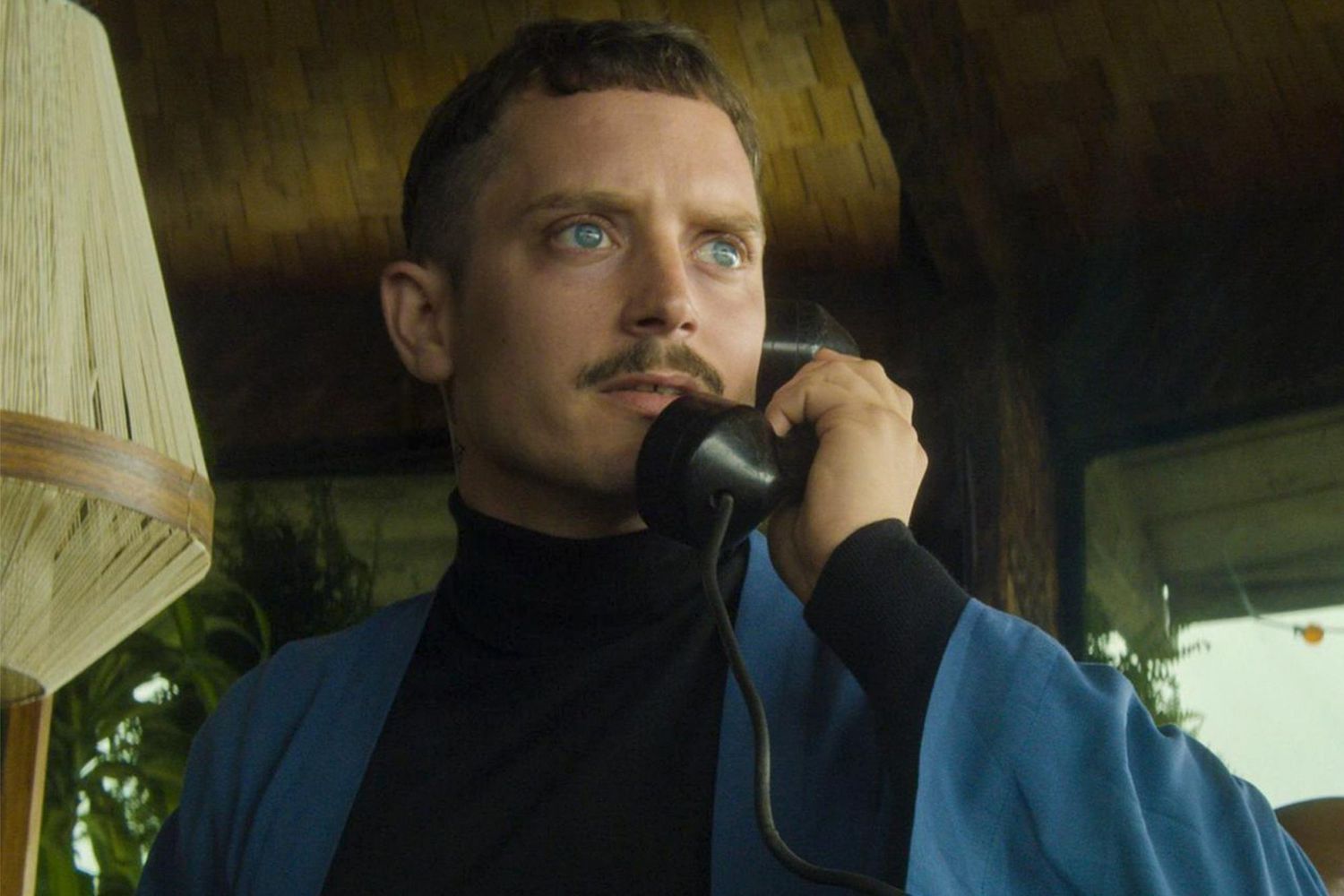
Hey there everyone! Welcome back to Movie Soapbox, the little corner of the internet that only you and I and that guy asleep in the back booth know about. This is where we find the films that got through the machine with their guts still intact, and we make sense of them. Today we are doing a full deep dive on Come to Daddy, a movie so quietly, methodically deranged that it takes about forty minutes before you realize it has been laughing at you the whole time you thought you were watching a quiet father-son drama.
Before we go any further, here is the trailer, because you need to see just how effectively it buries the lead.
Alright. If you have seen this film, you know what we are about to get into. If you haven’t, I want to be straight with you right now in Movie Mike’s voice, not in a content-warning-box voice: everything from this point forward is a spoiler, every single beat of this thing, the basement, the barbecue fork, the trunk, the dying confession on the beach, all of it. Go watch it first. It is on streaming right now and it is ninety-six minutes long and I promise you the runtime is not wasted. Come back when you’re done. I’ll be here.
For everyone still with me, let’s get into it.
Come To Daddy Movie Deep Dive Walkthrough
Norval receives a letter from a father who abandoned him at age five, and because Norval is the kind of fragile, painfully wishful person who still hasn’t made peace with that abandonment, he goes. He drives out through the Oregon coast forest to a cabin that belongs to a man named Brian, played by Stephen McHattie doing that thing he does where every line reading sounds like it was cured in brine for thirty years. The reunion is warm for approximately one scene, and then Brian starts pulling at threads in Norval, finding every soft spot left by the absence, and pressing into them until the whole thing erupts. Brian physically assaults Norval with a meat cleaver. And then, mid-struggle, has a massive coronary and dies on the floor.
Norval calls his mother. The coroner comes. And because this is a screenplay that has decided to take Greek Tragedy seriously as a structural commitment, the morgue sends the embalmed corpse back to the house because they don’t have the space. So Norval is now alone in a cabin on the Oregon coast with the body of the father who tried to split him open with a cleaver, listening to noises move through the walls of a house that apparently has a whole underground room nobody mentioned.
Here is the thing the film does that most films at this budget tier don’t get to do, and the reason it does it comes down to one decision someone made early in development. When a script is this structurally strange, this committed to a genre pivot that happens at the forty-minute mark, the notes process will usually sand it flat. You get a version of Come to Daddy that announces the basement earlier, that softens Brian’s menace in act one so the audience doesn’t check out before the reveal, that maybe recasts the father-son reunion as something warmer so the marketing has a hook. The reshoot scar on a film like this is usually visible: a scene that over-explains something the original draft was content to leave sideways, a performance that feels slightly out of register with the one surrounding it, a third act that has been tidied into a different movie’s ending. This film doesn’t have that scar. Ant Timpson directed it with the kind of assurance that suggests nobody got far enough into the approval chain to do real damage. That is rarer than it should be.
So. The basement. Norval finds his way through a hidden passage under the house and discovers a man chained up and bloody in the dark. This is his actual father, Brian, the real one. The man upstairs with the cleaver was Gordon, a performance of fatherhood, a hired mask. And Gordon’s crew, Jethro and Dandy and Gordon himself, have a history that lands on Norval like the second half of an equation he didn’t know he was solving. Years ago, Norval’s real father was part of a group that kidnapped the daughter of the wealthiest man in Thailand, collected the ransom, and then the real Brian double-crossed everyone, took the whole sum, and ran. He’s been running since. The affluent West Hollywood life Norval has been living? Funded entirely by stolen ransom money. Funded by an act of violence so far removed from Norval’s daily experience that it might as well be mythology.
Which, for the record, is exactly what the screenplay wants you to feel.
Jethro escapes the basement confrontation and promises to come back. Norval, with two dislocated fingers, frees his real father. They are now two men in a house full of complications, and Jethro is on his way. Dandy arrives first, and the fight between Norval and Dandy ends in a death involving a barbecue fork and Dandy’s anatomy that I will describe only as thorough and permanent. Then Jethro returns and Norval’s father proposes the single worst tactical plan in the history of plans, which is for Norval to hide in the car trunk and surprise attack when the moment is right. The screenplay is generous enough to acknowledge, in the beat before Norval climbs in, that this plan is going to fail. Jethro drives the car to a nearby motel. A woman Jethro hired holds Norval in a headlock while Jethro stabs him repeatedly and puts a crossbow bolt in his face. Norval, because he is an Oedipal hero and heroes do not die in motel rooms, had already punctured the tires. Jethro flees in the car, crashes it into a sign, and the sign takes off a portion of the top of his skull.
Sitting in the road with his brain partially exposed, Jethro tells Norval that his mother was a woman both Brian and Jethro had slept with. Norval processes this. Then he stabs Jethro in the exposed brain tissue. As he dies, Jethro says one word: Arthur. The name that opens the question of Norval’s actual paternity and closes it in the same breath, because it does not matter anymore who his biological father is. He has already become one of them.
Norval walks back to the beach. His real father dies there, on the sand, and Norval’s last words to him are an apology for never letting his mother get over him.
Roll credits.
Come to Daddy Movie Explanation Theories
Come to Daddy Movie Theory #1
The title of this film is doing a lot of work before a single frame rolls. Come to Daddy is the letter Norval received. It is also the Freudian stage direction for the entire film. Toby Harvard, the screenwriter, has said in multiple interviews that the script began as a response to sitting with his father’s corpse for several days, the specific, strange, trapped intimacy of that experience. He started autobiographically and then the myth took over, the way myth always does when you sit with something long enough and honest enough to let it mutate into its true shape.
Come to Daddy Movie Theory #2
The Oedipal architecture here is not a metaphor layered on top of a thriller. It is the load-bearing structure. Freud’s formulation of the complex runs through ages three to five, which is precisely when Norval’s father left. The abandonment happens at the exact developmental moment when a son is supposed to resolve his relationship with his father and come out the other side with a stable sense of who he is. Norval never got the resolution. He has been frozen in that unresolved phase ever since, performing a version of himself, the silver-spoon West Hollywood persona, the bowl-cut hair, that is entirely constructed around an absence. He does not know who he is because he never got to push against his father long enough to find out.
And what the film gives him is that push, in the most violent, compressed, mythologically overstuffed way possible. He fights. He kills. He survives things he should not survive. He becomes, in the space of a long weekend in Oregon, exactly the kind of man his father was. When Brian, the real father, says to Norval after the Dandy killing, it’s too late now, you already did it, he is not commenting on the legal situation. He is saying: you are me. The son who spent his whole life not-being-his-father has just become his father, and the tragedy is that it was always going to happen this way. The avoidance guaranteed the outcome. That is Oedipus Rex. That is Sophocles. That is the entire point, handed to you via barbecue fork.
Now, there are a few ways people read the ending specifically.
The first reading is the deterministic tragedy read: the film is saying that sons cannot escape their fathers, that the shape of who we become is set by forces we cannot see or access, and that the most we can do is apologize at the end. Norval’s final words support this cleanly.
The second reading is more generous, call it the liberation-through-violence read: by the time Norval walks back to that beach, he has actually finished something. He has done what his real father never could, faced the consequences of that original crime, neutralized its agents, and come out the other side. The apology is not defeat, it is completion. He is free in a way his father never was, because his father kept running and Norval stopped.
Come To Daddy Theory #3
The third reading, and this is the one the Oedipal title most aggressively points toward, is that the whole journey was unconscious wish-fulfillment at a mythological scale. Norval’s father-wound was so deep and so formative that the entire apparatus of the plot, Gordon, Jethro, Dandy, the cabin, the basement, materializes specifically to give Norval the war with his father that developmental psychology says he needed at age five and never got. The film is his psyche, externalized and made violent and real.
Moviesoapbox’s Take on the Movie
My read is the third one, with the second one folded inside it. This film is not a thriller that happens to have Oedipal themes. The Oedipal structure IS the thriller. Every plot mechanic exists to force Norval through a compressed, catastrophic version of the developmental reckoning that should have happened over years of difficult relationship with a difficult man, and instead had to happen in seventy-two hours in a house on the Oregon coast because his father sent him a letter and he was just wounded enough to go.
The apology at the end is real. It is grief for the version of his mother who spent decades not-getting-over Brian. It is grief for what that ongoing absence cost her, and by extension, what it cost him. And it is, underneath everything, an acknowledgment that the thing he was apologizing for was love. His mother loved a man who did not deserve it. Norval traveled to a coast to find a father who did not exist in the form he needed. Love is the engine of the whole tragedy. That is what makes it land instead of just being a very stylish midnight-film gross-out.
Elijah Wood understood this, which is why the film works. He plays Norval as genuinely fragile without playing him as weak, which is an extraordinarily specific needle to thread in a film that is going to put that character through this particular gauntlet. The bowl-cut, the affectations, the performed nonchalance over enormous want, all of it is Wood’s, all of it is right.
Films like this one, structurally ambitious, mythologically serious, genre-bending in ways that confuse marketing departments and confound test-screening panels, are the ones that tend to get quietly buried or quietly mangled in post. This one wasn’t. It came out the other side intact. The violence serves the myth. The myth serves the grief. The grief is real. That is the whole equation, and somehow, impossibly, the equation was allowed to stand.
Most films like it don’t get that lucky. Remember that next time you watch it.