
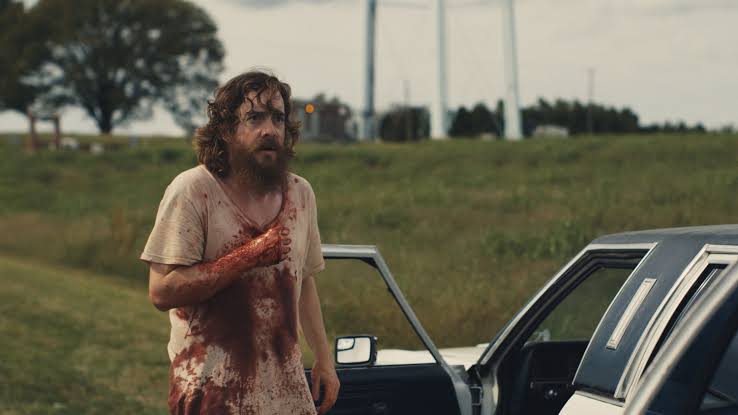
Hey there everyone! Welcome back to Movie Soapbox, the little corner of the internet that only you and I and that guy sleeping in the corner over there know about. This is the place where we find underappreciated indie films and we make sense of them. Today? We are doing a deep dive on Blue Ruin, a movie so quietly, methodically devastating that the studio system would have sandpapered every rough edge off of it before you ever got a chance to feel what it can actually do to you.
Alright, fair warning, and I mean this in the most sincere way possible: everything that follows is going to spoil this film completely, from the first kill to the last mumbled line, because there is no other honest way to talk about what Jeremy Saulnier actually built here. If you have not seen Blue Ruin yet, stop reading, go find it, watch it, then come back. I will be here. I am always here. Now. For everyone still with me, let’s get into it.
Blue Ruin Movie the Story Behind the Story
Before we walk through what happens on screen, here is something worth sitting with for a second. Blue Ruin was made for roughly $420,000, crowdfunded in part through Kickstarter, shot in roughly four weeks, and carried almost entirely on the back of Macon Blair, an actor with a face that looks like it has been worrying about something for thirty years and is finally getting around to doing something about it. At that budget level, at that cast tier, a director does not get notes from twelve VPs. He gets the film he fights for, or he gets nothing. What that also means is that every structural choice you see in this movie, the ambiguous backstory, the escalating incompetence of the protagonist, the refusal to let the revenge fantasy breathe, those are choices, not compromises. A film at this level lives or dies entirely on whether the director knew what he was doing. Saulnier knew exactly what he was doing. You can tell because there is no reshoot scar anywhere in this picture, no moment where the third act suddenly softens its grip because someone in a conference room got nervous about audience likability scores.
Blue Ruin Movie Walkthrough
You enter the movie, and you are already in the middle of it, which is the whole point. Dwight Evans, played by Macon Blair, is living in his car on a Virginia beach, eating out of garbage cans, bathing in strangers’ houses when they leave their back doors unlocked. We do not know why yet. We are not going to be told why for a while. What we know is that when a cop tracks him down to tell him something, his face does a specific thing, this particular collapse from blankness into grief, and then he drives to a prison parking lot and waits.
What happened twenty years ago: Dwight’s parents were murdered. Their killer, a man named Wade Cleland, took a plea deal and went to prison. And now Wade is getting out.
Dwight follows the Cleland family from the prison to a bar. He locks himself in the bathroom for a long time. When Wade comes in, Dwight kills him, brutally, quietly, in a stall, and then realizes he has left his car keys in the dead man’s pocket. So he steals the Clelands’ limousine to get out. Then he realizes there is a teenager in the back seat, a kid named William. He lets him go. And as William walks away, he tells Dwight something that should stop this entire story cold: you killed the wrong person.
Dwight does not stop. This is the whole movie.
He cleans himself up, drives to his sister Sam’s house, and realizes the murder has not appeared on the news, which means the Cleland family is handling this internally, which means they are coming for him and for anyone near him. He packs Sam and her kids off, tells them to disappear, and waits. The Clelands come. Dwight runs over one of them, a man named Teddy, throws him in the trunk, takes a crossbow bolt in the thigh in the process, and drives off. There is something almost slapstick about the violence in this film, not played for laughs but played for the specific horror of a man who has never actually done any of this before and is making it up in real time.
After a hospital visit, Dwight reconnects with an old friend, a survivalist named Ben, who sets him up with a rifle. During his interrogation of Teddy, the story bottoms out into its real shape: Wade did not kill Dwight’s parents. Wade’s father did. Wade Sr. murdered Dwight’s parents because Dwight’s father had been sleeping with Wade Sr.’s wife. Wade Jr. went to prison for a crime his father committed because the old man had cancer and the family did not want him dying behind bars. Dwight has murdered an innocent man, a man who went to prison voluntarily to protect a dying father, and has now set in motion a revenge cycle against people who, by at least one reading, have already suffered more than enough.
Teddy takes advantage of a moment when Dwight’s guard drops and goes for him. Ben, watching from a distance through a rifle scope, takes Teddy’s head off. Dwight, trying to keep Ben out of what is coming, steals his truck battery so he cannot follow. It reads as rude. It is the kindest thing Dwight does in the entire film.
Dwight finds the Cleland house empty. He dumps their guns in a lake. He leaves a message on their answering machine, telling them to leave Sam alone, that this is between him and them. When Carl, Kris, and their cousin Hope arrive and play the message back, it is obvious they have no interest in Sam’s safety. Dwight shoots Carl from hiding. He gets the women at gunpoint. He stands there with a gun on two people and cannot figure out what to do next, because he is not a killer, he is just a man who has been killing people.
Then William walks in. The teenager from the limo. He shoots Dwight with a shotgun, turns, tells the women on the way out the door that he is William’s half brother, the product of Dwight’s father’s affair with Wade Sr.’s wife. The whole catastrophe, the original murders, Dwight’s twenty years on the beach, every death in this film, all of it traces back to one affair and the chain reaction it set off across two families and two decades. Hope and Kris go after Dwight. He kills them both. Kris gets him first. Mortally.
Dwight dies on the floor of the Cleland house, alone, repeating to no one that the keys are in the car. It is the saddest possible thing to be saying at the end of your life. Practical. Considerate. Completely beside the point.
The Theories That Might Explain Blue Ruin
Blue Ruin – Cautionary Tale
The first read, and the most comfortable one, is the cautionary-morality-tale read. Dwight is an anti-hero who sins and dies for it. He killed an innocent man. He widened the circle of violence when he should have stopped. The film punishes him for this with a death that serves no one, saves no one, changes nothing. His sister is still out there, still displaced, presumably still in danger from whatever Clelands remain. His quest was just in intention and catastrophic in execution, and the film does not forgive him for that gap.
Blue Ruin – You Are the Problem
The second read is less forgiving of the audience. In this read, we are the problem. We went into this film wanting Dwight to be Hamlet, to be Death Wish, to be our cathartic stand-in for every time we swallowed an injustice and did nothing. Saulnier knows this. He is giving us what we want, the everyman avenger, the guy who looks like he shops at the same grocery store as us, rising up to confront evil, and then he is showing us exactly what that looks like in the real world, which is blood and accidents and innocent people dead and a man dying alone on a floor saying something about car keys. The film is a mirror held up to the revenge-fantasy genre, and it is not flattering.
Blue Ruin – Is All About Grief
The third read, quieter, is about grief and how it can consume a life without ever resolving it. Dwight did not go back to Virginia to get justice. He went back because he had not been able to live for twenty years. He was already dead on that beach. The murder was not a plan, it was a suicide attempt in disguise, an attempt to force the universe to either resolve the thing or finish him. It resolves it, in the worst possible way, and finishes him anyway.
Moviesoapbox’s Take on the Movie Blue Ruin
My read? All three of those things are true at once, and the reason the film earns that is because Saulnier never blinks. He does not pick one reading and underline it for you. He trusts you to sit with all of them, which is something that gets edited out of films by the time six rounds of notes have come down from the floor above the floor above the floor where anyone actually cares about cinema. The fact that you are sitting here asking what this film means, rather than having had the meaning explained to you in a scoring-heavy third-act monologue, is because a guy made this film for $420,000 and nobody could afford to make him explain himself.
Dwight Evans was not a hero. He was a man too broken by grief to stop moving once he started. The film honors that without excusing it, and that combination is almost impossible to pull off, and almost never gets made at any budget level, and the fact that this one did should make you furious about every franchise-prequel-soulless-IP-reboot taking up the screen real estate that films like this should occupy.
We’ll see you next time at Movie Soapbox. Stay in the corner with us.