
Hey there everyone! Welcome back to Movie Soapbox, the little corner of the internet that only you and I and that guy who just knocked over his coffee trying to find the pause button know about. This is the place where we find underseen, undersold, under-discussed films and we make sense of them together. Today we are doing a full deep dive on Little Joe, a 2019 Jessica Hausner film so quiet and so confident in its own dread that half the people who watched it couldn’t tell you whether they were scared or just… placid. Which is, of course, the whole point.
Full spoilers from this point forward. Everything. The ending, the infection, the award, all of it. If you haven’t seen the film yet, go watch it, come back, and we’ll be here waiting, just like Little Joe himself, patient, still, producing pollen you didn’t notice you were already breathing.
The Making of the Movie Little Joe
A film this controlled, this deliberately paced, this committed to refusing its audience the relief of a single loud scare, had to fight like hell to exist in the shape it’s in. You can feel it in the restraint. When a movie at this budget tier, with this cast, arrives this formally composed, this unwilling to explain itself or accelerate for your comfort, one of two things happened in production: either the director had enough cover from the financing structure to actually protect the cut, or somebody very smart picked their battles and let the third act stay strange while quietly surrendering something else. Hausner shot this in English, outside her native language, with a lead actress who won Best Actress at Cannes for a performance built almost entirely on suppression. Films like this don’t emerge from development unscathed. The fact that Little Joe arrives without a single scene that feels like it was added to reassure a nervous acquisitions VP is either a minor miracle or evidence that the right people looked at the wrong spreadsheet. Either way, you’re watching something that didn’t get flattened. Pay attention to that.
Little Joe Movie Walkthrough
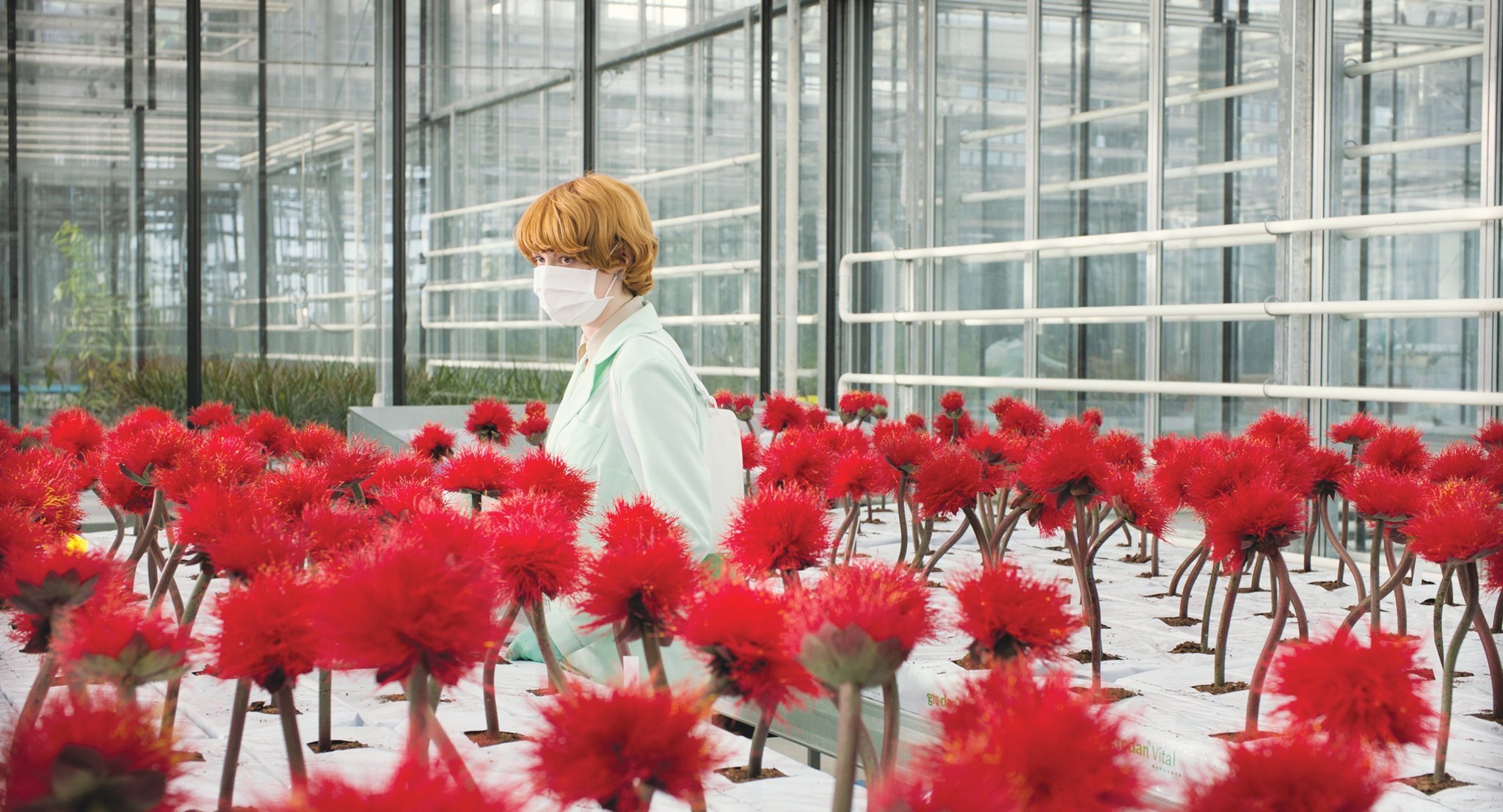
So. Alice Woodward, played by Emily Beecham, is a plant geneticist at a horticultural research lab, and the movie opens with her team on the edge of something genuinely impressive: a new strain engineered specifically to emit a scent that induces happiness in whoever smells it. Happiness, manufactured at the chromosomal level. Alice has done something extraordinary. She has also, in what any first-year film student will recognize as the load-bearing irony of the entire picture, engineered the plant to be sterile. It cannot reproduce on its own. She named the plant after her son, Joe, snuck one home for him as a gift, a small maternal warmth in an otherwise metronomic professional life, and the movie begins with this gift already in the house.
The plant is not sterile. Or rather, the plant found a workaround, and the workaround is you.
Bella, a colleague played by Kerry Fox, notices her dog has changed after spending time in the grow room. Changed is the right word, and the film earns it, because what’s changed is not behavior exactly, more a kind of replacement of interiority. The dog comes back, it functions, it just isn’t there anymore. Chris, played by Ben Whishaw, finds the dog in the grow room and also inhales the pollen. He is charming, warm, a little too attentive to Alice. He will shortly become one of the plant’s most effective agents, not because he turns monstrous, but because he stays pleasant.
This is the mechanism the film is actually about. The plant does not make you angry or violent or strange in any legible way. The plant makes you helpful. Happy. Accommodating. It replaces your preferences with a single directive: assist the plant’s survival and spread. And because happiness is what it offers and what it produces in those around the infected, there is no external evidence that anything has gone wrong. The infected pass every social test. They appear well. They advocate for the plant’s continued distribution with the enthusiasm of true believers, and from the outside, true belief and infection are indistinguishable.
Watch the film again with this filter running: every character who acts in the plant’s interest is infected, every character who moves against it is not. Yet. Karl, the lab administrator, begins arguing against containment protocols. Joe, Alice’s son, has a girlfriend named Selma, and both of them are performing a version of normalcy that has a new author. Bella, who initially sounded the alarm about the dog, later recants, and explains her earlier concern as the product of her history with mental illness. She has a documented psychiatric background, a history of suicide attempts, and the film is precise about the way this history is deployed against her credibility. The plant doesn’t need to discredit its accusers through force. The existing architecture of disbelief does it for free.
Alice is the holdout. She goes back through recorded test-session footage looking for evidence of behavioral change in prior subjects and she finds it, the same flat warmth, the same deflection of concern, the same gentle insistence that everything is fine. But the evidence keeps dissolving. Bella recants. Joe tells her the whole thing was a prank, that he and Selma made up the pollination story to tease her about her paranoia. Chris, charming Chris, feeds her just enough doubt to keep her from acting decisively.
Bella either falls or is pushed from a staircase. The film does not resolve this, and the refusal is deliberate. Karl uses the incident to argue for dropping safety protocols entirely. Alice decides to kill the plants by dropping the temperature in the grow room. Chris stops her, knocks her out, leaves her in the room with the pollen. The act is framed with the same quiet politeness that defines every action the infected take. He apologizes for it afterward.
The Ending of Little Joe Explained
The ending. Alice, now infected, learns that Little Joe has been nominated for a horticultural award and will be distributed to schools across Europe. She receives this news the way the film has conditioned you to receive it: with a smile that looks right. She kisses Chris. She allows Joe to move in with his father, a relationship she’d previously clung to, and returns to her work with a serenity that registers, to everyone around her, as personal growth. Loosening up. Finally letting herself be happy.
Theories to Explain the Movie Little Joe
What actually happened is that the last resistant intelligence in the room has been replaced, and the plant’s distribution network just went continental.
Theory #1 To Explain Little Joe
Two theories compete for what the film is actually doing with this ending. The first reads it as a fairly clean body-horror conclusion with a societal-collapse implication: the plant wins, the planet loses, cut to credits, enjoy your evening. The infection is real, it’s biological, it’s spreading, and the final image of Alice’s satisfied face is a horror image wearing a romantic comedy’s clothes.
Theory #2 To Explain Little Joe
The second reading is more uncomfortable, because it questions whether the infection is even the point. This reading argues that the film is using the plant as a metaphor for medication, specifically for the psychiatric medications that Bella is on, that Alice herself may resist, that the culture around the lab uses to dismiss Bella’s legitimate concerns. In this reading, the question the film keeps asking, the one Karl puts most bluntly when he says “who can prove the genuineness of feelings,” is never answered and cannot be. If a medication removes your distress and you can no longer remember clearly why you were distressed, were you fixed or were you changed? If the changed version of you advocates for the medication, is that evidence it worked or evidence it works? The plant and the pill are the same object in this reading, and Alice at the end is not a horror image, she’s a case study the film refuses to adjudicate.
Theory #3 To Explain Little Joe
The third read, which doesn’t get discussed much because it requires holding the other two simultaneously, is that Hausner wants both to be true and neither to be stable. The film was engineered to be sterile of resolution. The ending infects the audience with the same epistemological problem it gave Alice: you cannot tell, from the inside, whether your comfort at the conclusion is correct or compromised. If you feel satisfied by the ending, ask yourself why.
The Theory that Moviesoapbox Subscribes To
My read: the body-horror and the pharmaceutical metaphor are not competing interpretations, they’re the same statement. The plant works exactly like the best psychotropic compounds work, not by making you different but by making the version of you that serves its continued presence feel like the version of you that is finally, genuinely well. Alice at the end is not a zombie in any legible sense. She is, by every measurable standard, happier. That’s the verdict. The plant won, not by defeating her, but by becoming indistinguishable from her improvement. And in two weeks it’ll be in schools.
A film this strange, this formally committed, this willing to let its horror arrive as a warmth you can’t locate the source of, almost certainly doesn’t exist if it’s greenlit by a committee looking for a marketable comp title. It exists because someone protected it, somewhere in the financing chain, long enough for Emily Beecham to build a performance out of suppression and receive a Cannes prize for it. That’s the version you watched. Protect the ones that survive.
We’ll see you next time. Keep watching the weird ones.