
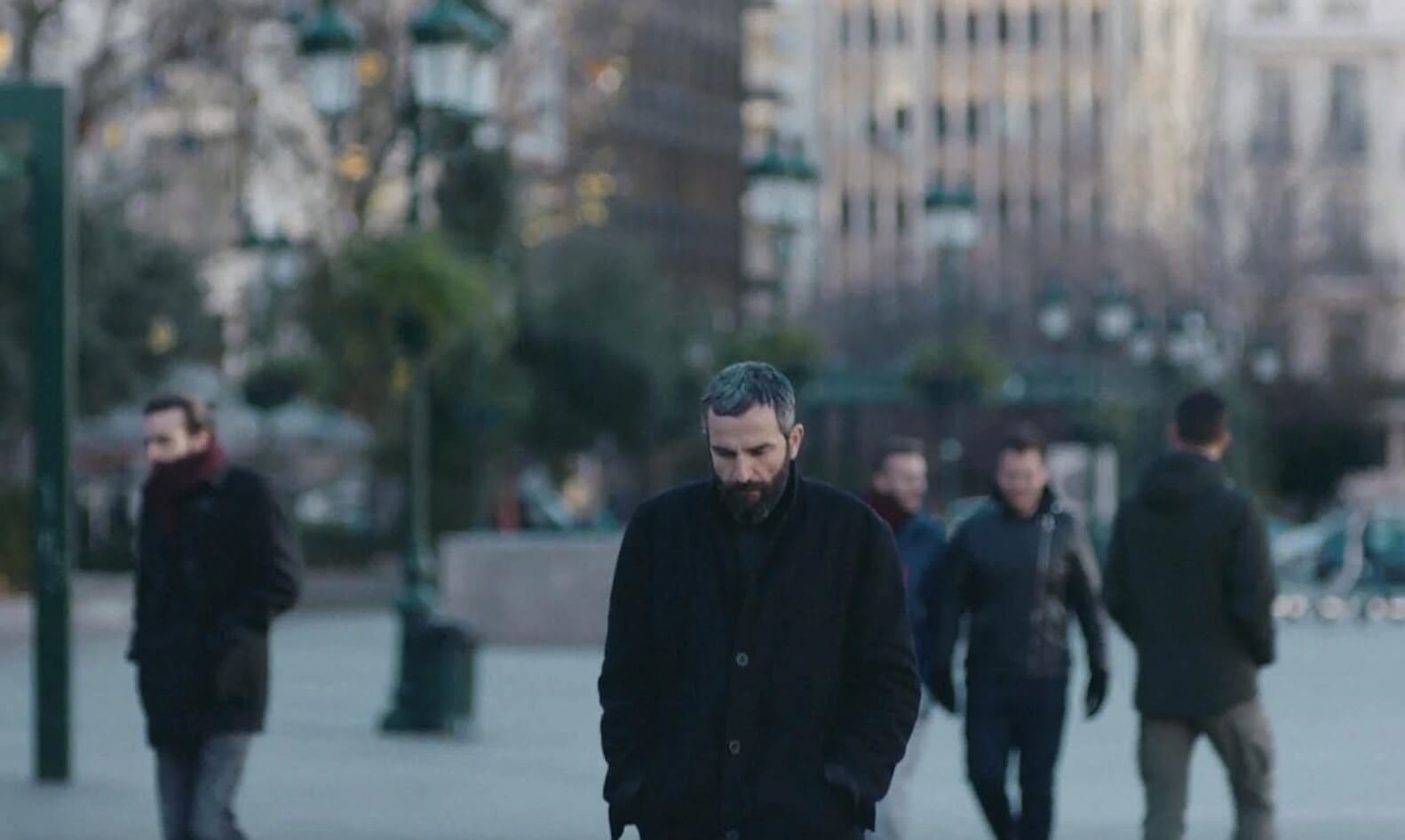
Hey there everyone! Welcome back to Movie Soapbox, the little corner of the internet that only you and I and that guy sleeping in the corner over there know about. This is the place where we find underappreciated indie films and we make sense of them. Today? We are doing a deep dive on Apples, a Greek film so deliberately, stubbornly quiet that a studio executive would have greenlit a rewrite after the first ten pages just to put some noise in it. Lucky for us, that did not happen.
Alright, before we go any further: everything that follows is a full spoiler walkthrough of this film. Every theory, every reveal, every detail Christos Nikou buried in the margins of this thing. If you haven’t seen it yet and you want to go in cold, close this tab, go find the movie, come back. We’ll be here. For everyone else, let’s get into it.
Now, before we walk the film beat by beat, here is what you need to understand about the kind of movie Apples is and what kind of movie it almost certainly wasn’t allowed to be in a different financing environment. A film like this, a deadpan, single-protagonist grief study with no thriller hook and no genre scaffolding to hang a marketing campaign on, survives in one of two ways. Either a director with enough short-film pedigree and festival goodwill gets handed the keys to something extremely small and cheap enough that no one powerful feels threatened by the result, or it dies in development as a quirky concept that someone’s VP of acquisitions decides needs a clearer ending and a love story with more heat. Nikou came up working on Before Midnight and in the orbit of Yorgos Lanthimos on Dogtooth, which is the kind of lineage that gets you trusted with uncomfortable silences and unresolved emotional logic. You can feel that trust in every scene. You can also feel, in how perfectly undisturbed the film’s tone is from first frame to last, that nobody with a quarterly target got their hands on it. The third act does not flinch. There is no reconciliation, no catharsis that gets handed to you on a plate. That is not an oversight. Films at this budget level and distribution tier either get that freedom by default or they get note-sessioned into something with an actual ending. This one got the freedom. Watch it knowing that.
So. Apples. Here is what you are watching.
Apples Movie Detailed Walkthrough
The film opens on a man named Aris, middle-aged, unremarkable in the way that is always, in Greek cinema, deeply remarkable, sitting in an apartment and banging his head against the wall. Not hard, not in distress exactly, more like a man testing whether anything still registers. He turns on the radio and hears a public service announcement about something called the Disturbed Memory Department, a bureaucratic response to what appears to be a worldwide pandemic of sudden, complete amnesia. People are losing themselves mid-sentence, mid-walk, mid-life. Aris heads outside shortly after and loses himself too, because of course he does, and because he is carrying no identification when it happens, he gets scooped up by an ambulance and deposited in a hospital where staff photograph him and post the image in the hope that someone, anyone, will come forward to claim him.
Nobody does.
After weeks of in-hospital evaluation, Aris shows no improvement and, more to the point, no family comes looking. The hospital staff offer him a slot in a new program, something outpatient and practical. They set him up in a small apartment with a stipend and a cassette player, and every day a tape gives him a task. Ride a bike, try a wheelie. Watch a horror movie. Crash a car into a tree. The logic is behavioral: manufacture experiences vivid enough that they might shake something loose, build a photo album documenting each one, create a new self out of new memories if the old self refuses to surface. Aris is diligent about all of it in the particular way that a man with nowhere else to be tends to be diligent about small, concrete tasks.
At the horror movie, he meets a woman enrolled in the same program. The credits name her Anna. The film almost never does. She is a few assignments ahead of him, and the two of them start doing her tasks together, which means Aris is running on her schedule, not his own. They crash a car together. They go to a party together. At the party, Anna leads him to a bathroom and undresses. Her task that day was to sleep with someone random. Aris is the random. Afterward, she disappears entirely from his life.
Aris keeps working. He catches up to where Anna’s tasks left off in the sequence, which is how we know his and hers were running on the same track. He is assigned the funeral task, befriend a terminally ill stranger, attend the death, attend the burial. Anna reappears and invites him to a funeral, same task, different timing. He declines. He closes the door on her. Then he turns off a tape mid-instruction and just stops. He goes and gets flowers. He visits a grave. The flowers on the grave are old, dried out, left by him, some time ago. He puts fresh ones down and walks away.
He goes to 135. Not his program apartment, number 8. His old address, the one he corrected himself on early in the film, the one he should not have remembered. He breaks back in. The apartment has a woman’s things in it: heels, lipstick, photographs. He moves through the space quietly and begins cleaning. He picks up her things and puts them away, methodically, like a man finishing something he started a long time ago. He goes to the kitchen, finds an old apple, cuts out the bruised and rotting parts, and eats what is left. Credits.
Theories to Explain the Movies Apples
Now. The apple detail. The film is titled Apples, Aris eats them constantly throughout the program period, and the moment he learns apples are good for memory he switches to oranges and never looks back. You do not need a lit degree to understand what that means. But what it means about the larger architecture of the film is where it gets complicated, so let’s lay out the competing reads.
Theory One: Aris Genuinely Has Amnesia and Gradually Recovers
The literal reading. Aris loses his memory, the program works slowly over time, he starts to recover fragments, including his address and the dog’s name, eventually recovers enough to go home, finds his partner’s belongings, understands she is gone, and the apple at the end signals that he is ready to remember again. Neat. Coherent. Also basically the least interesting version of every detail the film gives you. The deliberate apple-avoidance alone collapses this reading because a man genuinely trying to recover his memory does not quietly stop eating the one food he’s been told helps with memory. You can keep this theory if you want. I am leaving it here.
Theory Two: Aris Never Had Amnesia at All
Aris is married to a woman named Anna. She dies, or disappears, and he buries her, or an empty box standing in for her. He cannot function in the aftermath. So he simply stops. He walks out into the street without his wallet and lets the pandemic give him a legitimate exit from his own life. The hospital staff find no one to claim him because he has made sure there is no one to find. He goes into the program voluntarily, doing the work diligently because the work is easier than grief, and he encounters a woman also named Anna and briefly, disastrously, invests in that connection. She sleeps with him as an assignment and vanishes. He is crushed all over again. He goes home, puts his dead wife’s things away, and eats the apple, the one he has been avoiding, because he is finally willing to carry the memory of her again.
This is a very strong theory. It explains the willful apple-avoidance. It explains the address slip. It explains the dog. It almost explains everything, except for one problem that is not a small problem. The woman in the program is also named Anna. In a film this precise and this spare, that is not a coincidence anyone put in by accident.
Theory Three: Aris Fakes Amnesia to Find His Wife
Anna disappears due to the pandemic amnesia. Aris has her funeral, buries the box, does all of that. But he hears about the recovery program and understands that unclaimed amnesiacs get funneled through it. So he fakes it. He checks himself in, gets assigned to the program, and goes looking for her inside it. He finds her at the horror movie. She does not recognize him. He cannot bring himself to announce who he is, either because he is not sure yet or because he is afraid of the answer, so he just does the tasks alongside her. She sleeps with him for an assignment. Her own husband. He cannot recover from that. He stops. He goes home. He buries her for real this time, inside his own head, puts her things away, and eats the apple.
This is the theory I am going with, and here is why it earns the name Anna twice. If Anna in the program is the same Anna whose name is on the headstone, then you only have one Anna. The coincidence is not a coincidence because it is not a coincidence, it is the same woman. The film never gives you a moment where Aris openly recognizes her because Aris is not the kind of man who gives you moments. He stares at her in the theater. He watches her flinch at the horror on screen. For this character, in this register, that is the equivalent of falling apart.
The one thing this theory cannot fully answer is why he never tries harder. He finds her and just, does the tasks. But I think that is the point. He got there hoping she would find her way back to him. She did not. And he is too devastated and too passive to force a recognition that clearly is not coming. He watches her treat him like a stranger, and he decides she is right.
Theory Four: Aris Has Real Amnesia and Doesn’t Know Anna Is His Wife
The most brutal version. Both of them genuinely have amnesia. Both of them end up in the program. They find each other without knowing they found each other. They spend weeks together, fall into something that reads like connection without either of them understanding why it feels that way. She sleeps with him for a task, it wounds him in a way that seems disproportionate for someone he just met, and he walks away. His memory comes back gradually, enough to find his way home. He visits her grave with flowers. He does not know he just spent weeks with her. That final apple is him committing to memory without knowing what he is about to remember.
That one is almost too cruel to be wrong. And it is a Greek film. Cruelty dressed as coincidence is basically the house style.
My flag is planted with Theory Three. Aris went in looking for her, found her, and lost her a second time in the worst possible way, to her own indifference. The apple at the end is not optimism, it is a man deciding to stop running from the thing he already knows. The program asked him to build new memories. He built one that just confirmed the old wound. He goes home, cleans up the evidence of a life that ended, and finally eats the fruit he has been avoiding since the day he learned it would make him remember. The rotted parts of it are already cut away. What is left, he finishes.
That is what this film cost to be. A small, devastatingly controlled piece of work from a director who understood exactly how much silence the story needed and had the financing and the cast tier to protect that silence all the way to the final frame. Most films like this don’t make it out intact. This one did. Eat your apple.
If You Liked Apples…
OtherLife (2017) – A drug that lets you live entire lifetimes in minutes. When your memories can be manufactured, who are you? Same identity crisis Apples builds its whole world on.
Leave No Trace (2018) – A father and daughter living outside society by choice. Same quiet examination of what it means to rebuild a self from nothing when the old one is gone.
The Fall (2006) – A man in a hospital uses storytelling to construct a world that’s more bearable than reality. Apples rebuilds identity through photographs — The Fall does it through myth.