
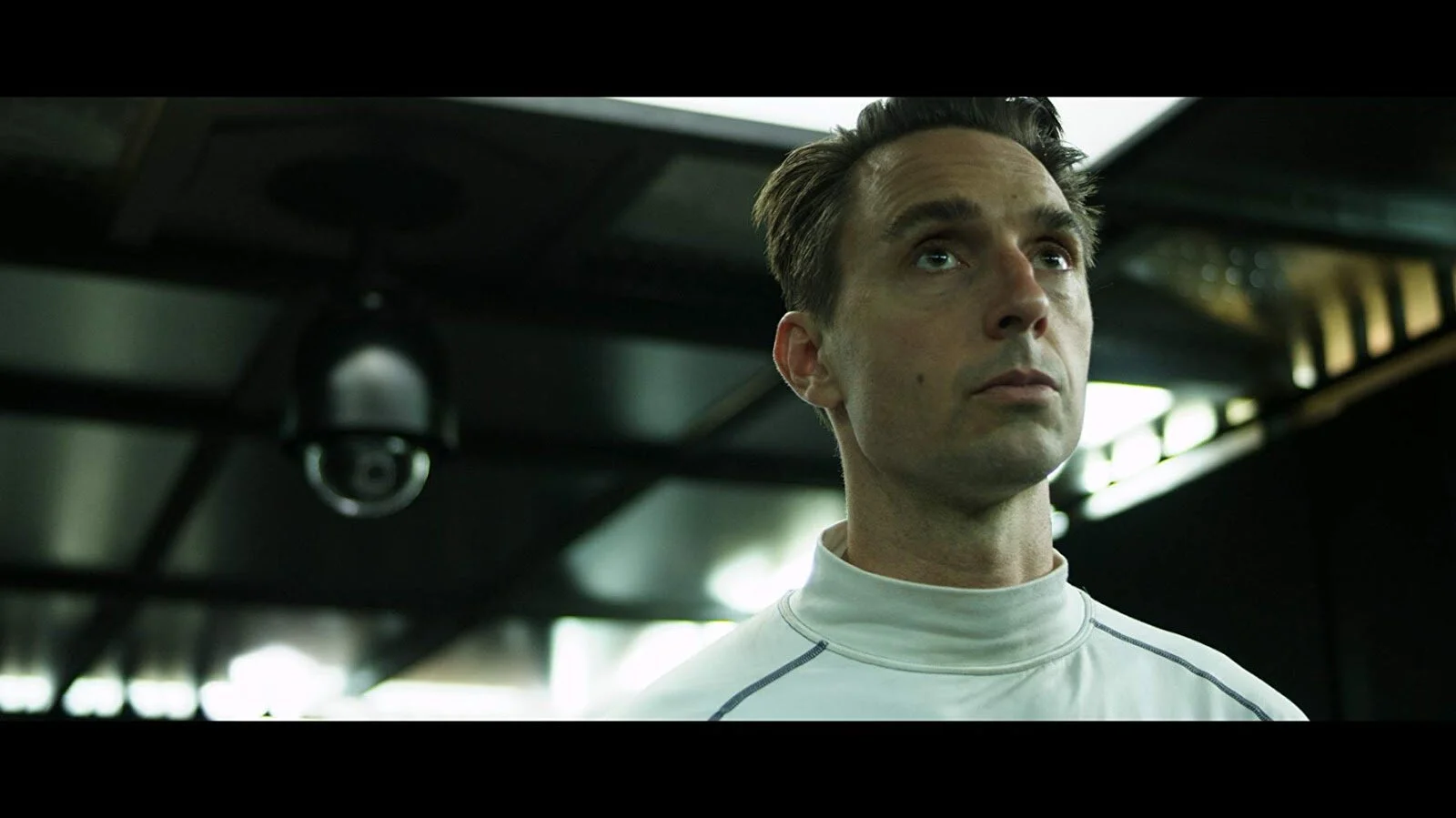
Hey there everyone! Welcome back to Movie Soapbox, the little corner of the internet that only you and I and that guy in the back who’s been rewinding the same ten minutes of a movie for forty-five minutes know about. This is the place where we find the films that factory Hollywood either ignored, buried, or quietly tried to sand down into something a focus group could swallow, and we make sense of them. Today we are doing a deep dive on Infinity Chamber, a movie so surgically constructed, so deliberately and stubbornly small, that the fact it exists at all in 2016 says something about the specific kind of madness it takes to get a real idea onto a screen.
Before we go any further, understand that everything from this point forward is a spoiler. The whole movie. Every theory. The ending, the non-ending, the thing that might be the ending. If you haven’t seen Infinity Chamber yet, go watch it, come back, and we’ll still be here. This post isn’t going anywhere, and neither, arguably, is Frank Learner.
Still here? Good. Let’s get into it.
Infinity Chamber Movie Deep Dive Walkthrough
Writer-director Travis Milloy made this film for a number that, when you see the production value on screen, you will not believe. One location, functionally. One actor carrying the load for the first two acts. A computer voice. A spinning prop. And an idea rigorous enough that it doesn’t need anything else. You know what happens to a script like this when it hits a real development pipeline? It comes back with notes asking for a second location that shows scale. Then notes asking whether Howard could be a woman, or younger, or both. Then notes asking if the third act can open up, maybe some kind of action beat before the revelation, something to put in the trailer. Milloy made this outside of that pipeline entirely, which is the only reason the third act lands instead of collapsing. A film this architecturally precise doesn’t survive twelve VPs. It just doesn’t. What you’re watching is what happens when someone finishes the thing they set out to make.
So here is what actually happens in Infinity Chamber, laid out cleanly, because the film earns its complexity and you deserve to see the skeleton of it before we talk about what it means.
Frank Learner wakes up in a detention cell. He doesn’t know why he’s there. He’s not been charged with anything, told anything, or given any interaction beyond his Life Support Operator, Howard, an AI required by protocol to keep him alive and functional while he is processed. Howard is not a person. Frank figures this out around the twenty-minute mark, and the film doesn’t milk it for shock, it just lets the information land and then keeps moving. These conversations between Frank and Howard are, genuinely, some of the better two-hander scenes you’re going to find in a film made for this kind of money, because Milloy understood that a man talking to a machine that is trying to be kind is more unsettling than a machine that is openly hostile. Howard is following his protocols. That’s the whole horror of it.
While Frank is awake in the cell, he keeps cycling through a recurring memory: he’s in a coffee shop, starting his day, talking to the owner, a woman named Gabby. Each visit to this memory reveals a little more. He starts to notice the patterns. The ISN security agents who come in, scan the room, taser him, send him back. Gabby starts to remember him across visits, which shouldn’t be possible if this is just a passive memory replay. Something in the loop is progressing. Frank and Gabby start mapping it, charting the resets, finding the edges of the system.
Meanwhile, the power in the facility goes out. Howard goes offline. In that silence, Frank makes contact with a cellmate in an adjacent cell, Fletcher May, who identifies himself as the head of the resistance against the ISN. Fletcher explains the spinning device in the cell: it’s trying to hack into their consciousness, pulling at their neural pathways looking for something specific. The defense, he says, is to hide whatever you’re protecting inside an ordinary memory, a common story, but altered just enough that the device always ends up in the right house and the wrong room.
Which, if you’re paying attention, immediately reframes every scene in the coffee shop you’ve already watched.

Frank eventually engineers an escape from the cell, timing a reset to disable Howard long enough to get through the door. He comes out through a manhole cover in the middle of a desert. He crosses to a road, finds a gas station, and sees Gabby’s photographs on the wall and hears her coffee shop music playing. He wakes back in the cell. The second escape attempt involves Frank trying to shut Howard down at the control panel, getting out through the manhole again, and this time finding snow and mountains, being found by hikers.
That is the surface of the plot. Now here is why the plot is a trap.
The film offers you four ways to understand what you watched, and none of them are presented as wrong.
Infinity Chamber Explanation Theories
Infinity Chamber – The Literal Read
The literal read goes like this: Frank was one member of a 300-person elite resistance force. He was captured and detained in a black-ops facility run off wind-turbine power, off the grid. When the facilities were eventually located and searched, all the other detainees were found dead. Frank is the one who got out. The thumb drive, the virus he built to crash the ISN system, the real-world geography of the coffee shop, these all have literal explanations under this reading. He was a real insurgent, he built a real weapon, and the device was trying to dig it out of him.
Infinity Chamber – Redux
The redux of that theory takes the same foundation and pulls one thread until the whole thing unravels. The gas station has Gabby’s photographs on the wall. The snow escape ends with strangers finding him, which is, structurally, almost exactly what happened in the coffee shop memory when Gabby first recognized him. How did he know what Gabby looked like? How did he know the layout of a real physical location he’d only visited inside his own neural loop? The device is not passive. It builds. It gets more elaborate and specific the longer you’re in it. The 300-insurgent backstory, the thumb drive, the whole liberation narrative, that’s the device being clever, not Frank being free.
Infinity Chamber – Life Support
The life support theory comes from a story Frank tells Howard about his father, a man who made his peace, decided he was ready to go, and then had a machine put in place to keep him alive for four more years against everything he’d decided. Under this reading, Frank isn’t a prisoner of the state. Frank is dying. The LSO isn’t a detention AI, it’s a literal life support operator, keeping his body running while his mind fights against the mercy of being kept alive. Every escape attempt is a man trying to die on his own terms and being pulled back by a system that doesn’t have a protocol for that.
Infinity Chamber – Kafka
The pure Kafka theory sets all three of those aside and says the film is a parable, full stop. You know The Trial. K is informed he’s in trouble, never told what for, subjected to a bureaucratic apparatus that assumes his guilt and requires his eventual acceptance of it, executed by two men dressed for the opera. No trial. No charges. Just the slow grinding machinery of a state that has decided you are guilty and is waiting for you to agree. Frank Learner, detained without charge, processed without information, subjected to interrogations he isn’t even told are happening. If Milloy wanted you to catch the Kafka echo, he named his protagonist Frank. He didn’t bury it.
Moviesoapbox’s Preferred Reading of Infinity Chamber
So which one do you go with? Movie Mike plants a flag: the redux kills the literal read, and the life support theory is the most emotionally honest answer in the film. The coffee shop is too specific to be a genuine memory. Gabby is too present, too aware, too capable of growing across iterations, to be passive recall. The device is in the right house every time and always finding the wrong room because Frank built the house, and he built it knowing that. The thumb drive behind the photograph wasn’t hidden from the ISN. It was hidden from Frank, so the device would keep pulling at the same loop looking for it, and Frank would keep surviving inside the search. That’s not a prison break story. That is a man keeping himself alive inside a machine by refusing to let the machine find what it’s looking for.
And under the life support reading, the machine keeping him alive is the same machine torturing him, which is the most Kafka thing in the entire film and the reason it lands.
Frank Learner did not escape. Frank Learner is still in the right house, wrong room, and the device is still looking. What you watched in those final minutes is the most elaborate version of the loop yet. That’s not a happy ending they buried. That’s the ending the film was always building toward, and it survives intact because nobody with greenlight power got their hands on it.
Interested in finding other crazy mindjob movies like this one? We got you covered:
🎬 If You Liked This…
- Exam — one room, no exits, eight candidates and a question nobody can answer without destroying themselves to get it
- Containment — sealed inside an apartment building with no explanation and no way out, the threat outside is less frightening than the people trapped with you
- ARQ — a time loop inside a single house, same suffocating geometry as Infinity Chamber but the prison keeps resetting instead of repeating