
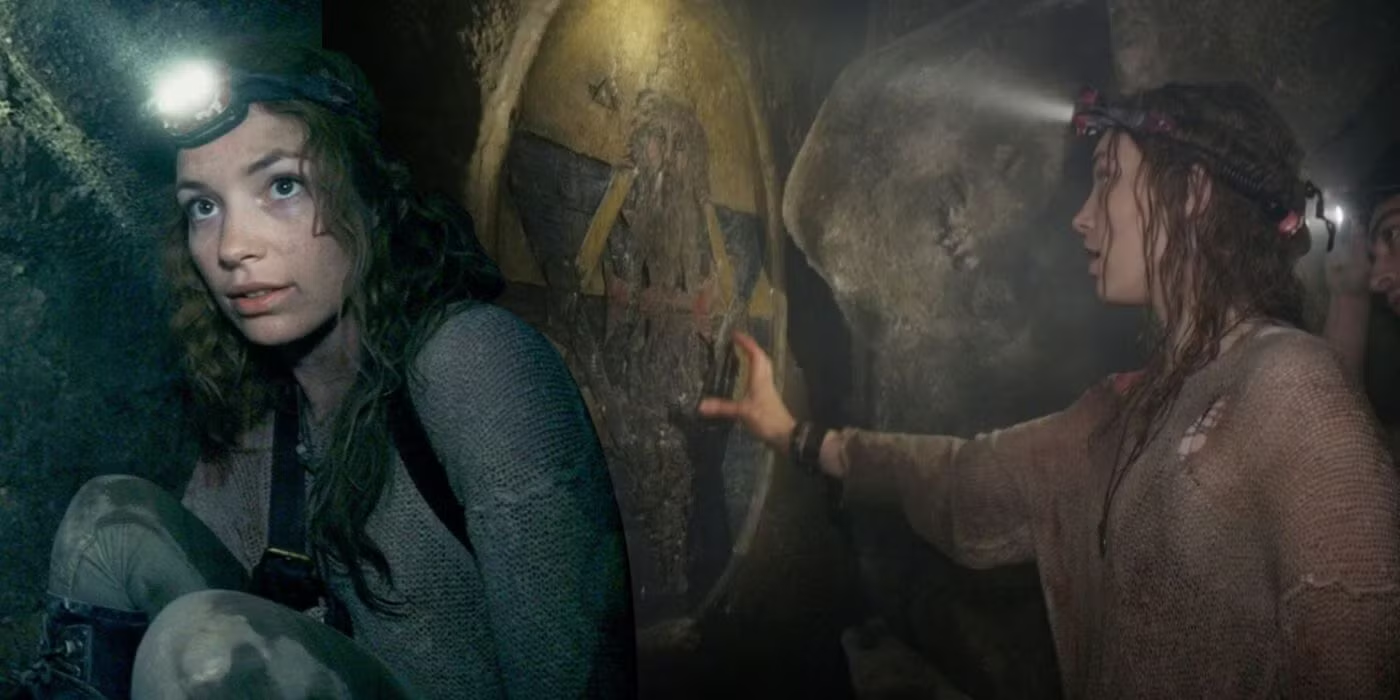
Hey there everyone! Welcome back to Movie Soapbox, the little corner of the internet that only you and I and the guy in the back who keeps rewinding the catacombs sequence know about. This is where we find the films that slipped through the cracks, survived the machine, and somehow landed on your screen still breathing. Today we are doing a full deep dive on As Above, So Below, a movie so relentlessly committed to its own internal logic that the suits who stamped it probably thought they were buying a found-footage jump-scare delivery vehicle and got something genuinely stranger instead.
Full spoilers from here. Everything. The mirror, the blood, the hanged father, all of it. If you haven’t seen this film, go watch it, come back, and we’ll be here waiting in the dark.
The Making of As Above So Below Movie
The film opens in Iran, not Paris, not the catacombs, not where any distributor’s marketing deck told them to start, and that choice alone tells you something about what John Erick Dowdle was actually trying to make. You can feel, in those first ten minutes, the shape of a movie that had a specific vision before anyone with a greenlight got involved. The found-footage wrapper is a strategic concession, a genre costume that let this thing get financed, and Dowdle wears it gracefully enough that you mostly stop noticing it. What he traded for that costume was creative camouflage. The studio thought they were making Paranormal Activity in France. They were not.
What they were actually making, and what almost certainly would have been sanded down to nothing if a more recognizable name had been attached to the lead, is a film about the specific psychic weight of inherited obsession. Scarlett Marlowe, played by Perdita Weeks with a kind of coiled, relentless intelligence that the role absolutely required, is not a Final Girl. She is a woman who has swallowed her father’s madness whole and is three-quarters of the way through digesting it before the movie even starts. The Iran sequence is her proving she will go anywhere, risk anything, destroy anything in reach, to complete a dead man’s project. That is the wound the whole film is organized around, and Dowdle establishes it fast, before the horror grammar kicks in, before the catacombs, before the found-footage shaky-cam becomes the dominant register. You know exactly what kind of damage you are dealing with before you ever go underground. A director who trusted his third act got to do that. A director who had already survived the note session that said get to the scares faster and lost, wouldn’t have.
The production shot in the actual Parisian catacombs, at least in part, and that is not a trivial detail. It costs something to do that, not just money, logistics, the physical reality of working 300 feet underground with a small crew, and what it buys you is a texture that no stage build hands you. The walls are real. The bones are real. The claustrophobia is real in a way that reads on camera even when the audience doesn’t consciously register it. There are films made for three times this budget where the sets feel hollow. This one does not.
As Above So Below Movie Walkthrough
Scarlett has been chasing the Philosopher’s Stone, the alchemical MacGuffin that promises transmutation of base metals into gold and, in the version of history this film borrows from, immortality. She’s following the trail of Nicolas Flamel, a real 14th-century French scribe who, through centuries of accumulated legend, got recast as history’s most successful alchemist. His headstone in Paris is real, he designed it himself, and the film uses that detail correctly and smartly. The Rose Key she recovers in Iran is the first piece of a puzzle that Flamel’s headstone, she believes, will complete.
In Paris she recruits George, played by Ben Feldman, an old collaborator with whom she has the specific history of people who almost got each other killed once already and never fully processed it. She also recruits Benji as cameraman and translator. They connect with Papillon, a local urban explorer, and his girlfriend Souxie, who know the illegal sections of the catacombs well enough to guide them. The ensemble has the shape of a heist crew, competent people assembled around a specific objective, and Dowdle uses that structure deliberately because what the catacombs are going to do is dismantle it.
The descent starts as an adventure and begins its turn almost immediately. They encounter a chamber with what appears to be a genuine cult in active worship, not the historical kind, the present-tense kind, which is your first signal that the tunnels are not behaving like tunnels. A blocked passage forces them through a shaft where Papillon’s friend La Taupe reportedly died. La Taupe is there. He should not be. He tells them the only way out is down.
They find a Knights Templar knight, a pile of treasure, and Flamel’s Philosopher’s Stone. Scarlett takes it. The tunnel collapses. La Taupe is buried and the group moves on, and Scarlett uses the stone to heal the injuries from the cave-in, which means the stone works, which means everything her father believed was true, which means she has now inherited both the gift and the curse of being right.
Then they pass through a door marked with the Dante line, “Abandon all hope, ye who enter here,” and come out in an identical, mirrored room. This is the film’s structural hinge. Whatever the catacombs were before, they are something different now. They are inside something.
What follows operates on a precise psychological logic. La Taupe attacks the group and kills Souxie. Benji is killed by the cult worshippers. Then Papillon encounters a burning car that is specifically his, from a story he told earlier, the one where his brother died and he didn’t. An occupant of the car reaches out and pulls him under. Not a random monster. His specific unresolved thing, wearing a physical body.
A statue grabs George and he says a word, “vitriol,” that he shouldn’t know, a fragment of the Flamel headstone riddle that Scarlett never shared with him. She recognizes it. She understands then that the stone has to go back. She has to return it to where she found it.
On the way back she sees a hanged man in the tunnels. It is her father. She nearly drowns in a pool of blood. She finds a polished mirror and looks into it, her face covered in blood, and the film gives you its thesis statement in the most literal image it could possibly have constructed: you are looking at yourself, covered in the consequences of your own choices, and there is no one else in the frame. She returns the stone, she kisses George and heals him, and she understands that the way out is not up, it is through. Each of them has to face what the tunnels showed them. The ones who do make it out. They climb, literally, upward through a shaft, breaking through the Paris street surface into daylight.
As Above So Below Movie Theories
Theory One: It’s a straight horror movie
The catacombs are haunted, or cursed, or the group stepped into something genuinely supernatural, and the personal-history details are either coincidence or the entity feeding on their memories. There’s nothing more to decode. This reading is defensible because the film is legitimately scary on purely mechanical terms and because not everything has to mean something.
Theory Two: It’s about accumulated historical trauma
The catacombs contain the bones of six million people. That is not set dressing, that is the premise. The argument here is that the film is meditating on what it means to walk through a place built from industrial death, and the horror is the weight of human history pressing down on people too distracted by their treasure hunt to respect what they’re walking through. It’s a reading, and there are worse ones, but it doesn’t account for the specificity of the personal-history manifestations, which are too precise to be purely atmospheric.
Theory Three: Catharsis and grief
Everyone in this group has a specific, unprocessed loss. The catacombs externalize those losses and force a confrontation that the characters couldn’t manage on their own in daylight. The film is a grief mechanism dressed as a descent narrative. This is closer. It accounts for the structure. It doesn’t quite account for the moral dimension the film keeps insisting on.
Theory Four: You built this
This is the one the film is actually making, and it earns it by being rigorously consistent about it. The things that appear in the lower tunnels are not random horrors. They are each character’s specific moral debt, wearing a physical form. Papillon’s brother. George’s piano with the missing key, a detail that had to come from something George did or didn’t do. Scarlett’s father. The stone itself, which heals wounds but also serves as the object around which every bad decision in the film clusters. The catacombs are a system of moral accounting. The deeper you go, the more specific the bill becomes. The way out is not to outrun it, it is to acknowledge it and put back what you took.
That is the reading the film’s title insists on. As above, so below. The Hermetic principle. What happens in the outer world is a reflection of the inner world, and vice versa. The catacombs are not separate from these people. They are these people, arranged spatially. Every tunnel is a thought they haven’t finished having.
Movie Soapbox’s Take on As Above So Below
I really think Theory Four is the true solution to this movie. But I have to give the amendment that the film’s third act partially squanders what it builds. Dowdle is meticulous and genuinely smart about establishing the moral architecture right up through the mirror scene. Scarlett’s realization, her blood-covered face reflected back at her, is exactly the right image at exactly the right moment. But then the film converts that reckoning into something simpler: think positive thoughts, forgive yourself, and the geometry of hell will reverse itself. The mechanics of the escape feel earned in structure but thin in substance. The diagnosis was precise. The prescription was a fortune cookie. You can feel the moment where a room of people decided the audience needed something hopeful and actionable in the final ten minutes, and you can feel what it cost the film.
Still. What it is before that moment is remarkable, and the fact that it exists at all, shot in actual catacombs, with a director committed to a genuinely strange psychological thesis inside a found-footage horror wrapper, is the kind of thing that happens because someone moved fast enough that the system didn’t catch it in time. John Erick Dowdle got something real onto the screen. Most films chasing this exact genre slot ended up as a shakier, louder, emptier version of something you’d already seen. This one went somewhere. The ending flinched. The rest of the film did not.
If You Liked As Above So Below…
Pandorum (2009) – Waking up in the dark with no memory and descending deeper into something that shouldn’t exist. The claustrophobia is suffocating and the twist earns itself.
The Alpines (2021) – A group retreat where sin is the architecture and nobody leaves clean. If the catacombs judged you, this cabin will sentence you.
Hard Candy (2005) – A descent into moral darkness where the predator becomes the prey. Two people, one house, and a reckoning that never stops tightening.