
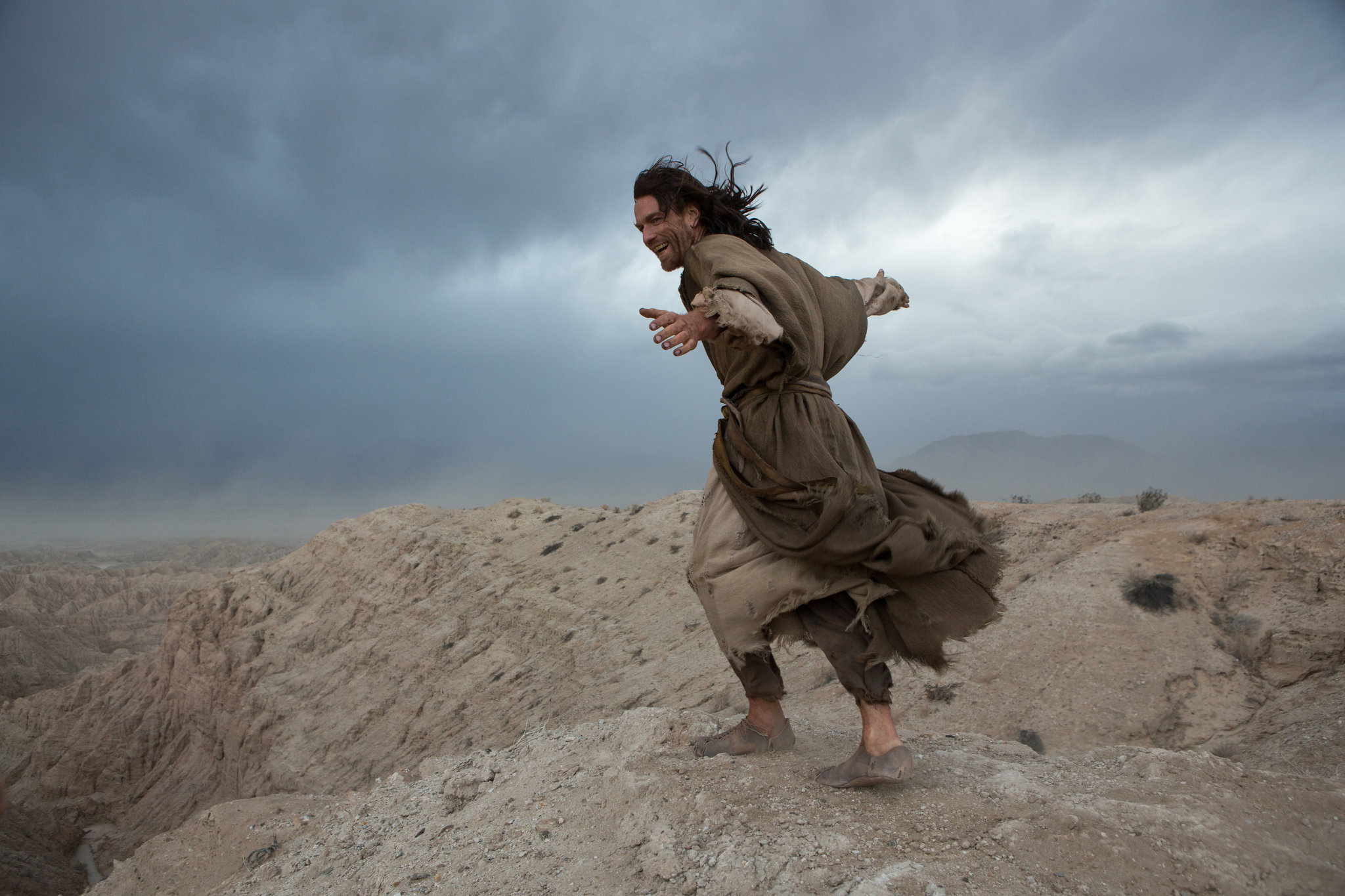
Hey there everyone! Welcome back to Movie Soapbox, the little corner of the internet that only you and I and that guy falling asleep in the back booth over there actually know about. This is the place where we find under-appreciated indie films and we make sense of them, the ones that slipped out of a film festival and into a VOD queue and never got the conversation they deserved. Today we are doing a full deep dive on Last Days in the Desert, a movie so quietly, stubbornly committed to its own vision that it somehow managed to alienate every single audience that might have loved it, and still, still, contains about forty minutes of genuinely great filmmaking buried inside it like a note inside a wall.
Before we go any further, here is the trailer, so you know exactly what we are walking into today.
Fair warning, and I mean it: everything that happens in this film is about to be on the table. Every choice, every ending, every moment where Rodrigo Garcia either earned his shot or left it on the floor. If you have not seen Last Days in the Desert yet and you want to go in clean, close this tab, watch the movie, come back. Everything past this point is a spoiler and I am not going to tiptoe around it.
Still here? Good. Let’s get into it.
What This Film Had to Survive to Exist
You know what kind of film Last Days in the Desert is, on paper? It is the kind of film that a studio development executive reads as a two-page treatment and immediately starts suggesting ways to make it more accessible. A desert. Two Ewan McGregors. A dying woman. A father and a son who cannot speak to each other. No action. No resurrection. No miracles. Forty days condensed into what feels like four. You can hear the note session from here, the ones about whether audiences will understand who Jesus is if he never does anything Jesus-ish, the ones about whether the ending lands, the ones about whether we need one more scene to make the Satan-as-Jesus-double conceit legible to the widest possible quadrant.
Rodrigo Garcia got this film made anyway. Shot by Emmanuel Lubezki, the man who was coming off Gravity and heading into The Revenant, which means someone with serious leverage believed in what Garcia was doing enough to put one of the most expensive cinematographers alive in a desert for a few weeks. Films like this, quiet and theologically ambitious and resistant to easy consumption, usually get quietly restructured into something safer somewhere between the first cut and the release date. The fact that Last Days in the Desert looks and sounds exactly like a film that was allowed to be itself, for better and for worse, tells you something. Garcia had enough armor around the project to protect it. He just could not protect it from its own central miscalculation, and that is what we are actually here to talk about.
The Setup, Which Is Actually Good
The Biblical text Garcia is working from is thin, deliberately so. Matthew gives you maybe eight verses. Jesus in the wilderness. Forty days. Satan shows up, makes three specific moves, gets rebuffed three times, leaves. Angels come. End scene.
What Garcia does with that space is smart, at least structurally. He invents a family camped in the desert, a father who has decided that cities corrupt the soul and refuses to let his son leave for one, a mother who is dying slowly and can see the damage this standoff is doing to both of them, and a boy who carries the weight of wanting something he cannot name out loud without it becoming a betrayal. It is a beautiful little pressure cooker of a premise. Father, son, the ghost of what the mother used to be before the illness took her, all three orbiting each other and unable to break the pattern. Jesus wanders into this and cannot extract himself. He cares too much about all three of them and has too little power, or too little willingness to use it, to actually fix anything.
And Ewan McGregor plays both Jesus and Satan. At the same time. In the same scenes. Which, as a pure craft challenge, is genuinely interesting. Is Satan choosing the face of the man he is tormenting? Is this Jesus’s doubt made flesh? Is it something else? Garcia leaves that deliberately open, even as McGregor himself has said on record that he was playing two distinct beings, the Son of God and a fallen angel, not one fractured psyche. We will get to the theories. But sit with the setup first, because the setup is where this movie earns its existence.
Where It Starts to Come Apart
The family is the movie. Every frame that belongs purely to the father and the son and the dying mother is alive in a way that the film cannot quite sustain when Garcia pivots back to Jesus and Satan circling each other. The father’s silence. The boy’s hunger for something beyond the canyon walls. The mother’s lucid, terrible clarity about exactly what is happening to her family. If Garcia had made a film about only these three people, some wandering holy man from a neighboring settlement stumbles into their orbit for a few days, nobody has to negotiate the theology of the Incarnation, that is a film that earns every minute of its runtime and probably wins a cinematography award with no argument from anyone.
But Garcia was not interested in that film. He wanted the specific weight that comes from this being Jesus. He wanted the question of whether the Son of God could be genuinely helpless, genuinely uncertain, genuinely unable to speak the right words at the right moment. And that is a legitimate question worth a film. The problem is the answer Garcia arrives at, which is a Christ so fully human that he has shed almost every quality that would make his divinity legible or interesting. We are given a Jesus who second-guesses his own sentences, who chastises himself out loud for talking too much, who at one point asks Satan to show him the boy’s future. Asks Satan. For help. Rodrigo clearly believes this is Jesus, and yet has written a Jesus who would be more naturally played as a well-meaning but overwhelmed young teacher with no particular claim on the audience’s larger attention.
The Satan-as-showman counterweight is interesting precisely because Garcia gave him the better end of the argument. Satan in this film is mobile and contemptuous and gives a very good speech about a God who keeps running scenarios like a man who cannot stop refreshing a tab, replaying choices, watching the butterfly survive and then die and then survive again. It is a genuinely unnerving portrait of a God who cares about particulars. And Jesus has no real answer for it. He deflects. He endures. He waits for Satan to get bored and leave, which Satan eventually does, complaining that his feet hurt.
That is your ending. Satan leaves because he is tired. No dismissal. No angels. Just a resignation that lands less like a spiritual victory and more like a standoff where both parties ran out of things to say.
What the Biblical Text Actually Gives You
Because it matters for the theories, let’s be clear about what the source material specifies, and what Garcia kept and discarded from it.
In Matthew and Luke, the temptations are three and they are specific. Turn stones to bread. Throw yourself off the temple and let the angels catch you. Worship me and I will give you every kingdom on earth. Jesus refuses all three with scripture citations. Satan leaves. Angels arrive. Done.
The interesting thing the source text preserves, and that the film actually honors, is that Satan has powers in this story. He transports Jesus to the top of a temple. He shows him all the kingdoms of the world in what must be some kind of vision or miracle of scope. Garcia takes those supernatural capabilities and runs with them, which is one of his better instincts. The Satan in this film floats above a cliff edge, shows Jesus visions of the boy’s future, flickers in and out of the physical world with the casualness of someone who has been doing this a long time. That much tracks.
What does not track is the ask. Jesus, in the Bible, never requests anything from Satan. He does not negotiate, does not seek information, does not treat the encounter as a dialogue between equals. Garcia’s Jesus asks Satan for a vision. Garcia’s Satan obliges. Whatever else you want to say about the theology, that specific beat is the one that collapses the architecture, because it makes the power dynamic legible in exactly the wrong direction.
The Theories, Laid Out Straight
There are three real interpretive frameworks people bring to this film and they are worth walking through honestly before I tell you which one holds up.
Theory One: Loose Adaptation. Garcia took the desert temptation passage and re-imagined it in his own terms. The three temptations are present but refracted through the family story rather than delivered literally. Food, power, and dominion are all somewhere in the emotional landscape of the film if you are willing to look for them sideways.
The problems here are specific. The title itself is Last Days in the Desert, which implies the film is claiming temporal precision about this particular section of the forty days, not a loose thematic relationship to them. And the three temptations as Garcia renders them are so oblique that two of them essentially disappear. Jesus is never depicted as hungry. Jesus is never offered dominion over anything. The closest we get to a temptation is Satan speaking through the dying mother’s voice, which is a creative choice, but as the film’s primary dramatic engine for the Satan-Jesus conflict, it is too slender to carry the weight.
Theory Two: Thin Slice. We are watching a few days inside the forty, either after the three temptations have already occurred and Satan is still lurking while the formal encounter winds down, or in the middle of the forty before the canonical temptations happen. The family encounter is simply something that could have happened during the time the text does not account for.
This is the theory with the most structural flexibility and the least problems. It does not require the film to replace the Biblical temptations, only to exist alongside them in the silence the text leaves open. There is one small visual cue that supports the end-of-the-forty reading, a moment that looks like Jesus takes something into his mouth and swallows, which would suggest the fast is either ending or already over. If the three temptations are already in the past, Satan hanging around to needle Jesus through a family’s pain is a reasonable extension of the encounter. It explains why the Satan-Jesus dynamic feels like a cooling conflict rather than a building one.
Theory Three: Full Allegory. Satan is Jesus’s doubt, made externally visible. The temptations never happened as external events. The whole film is an interior landscape, Jesus’s mind working through his uncertainty about what he is and what he is about to begin.
This is the most cinematically interesting interpretation and it is the one the film almost supports visually. It is also the interpretation that McGregor has directly contradicted on the record. He was playing two beings, not one split psyche. And if McGregor’s own understanding of what he was performing rules it out, and Garcia never positioned it as an allegory either, then the Allegorist is reading a film that nobody on set actually made. You are welcome to find that film inside the one that exists. But you should know you are doing your own work there, not the filmmakers’.
Moviesoapbox’s Specific Take On Last Days in the Desert
Theory Two holds, specifically the end-of-the-forty permutation. The temptations are over. Satan lost the formal engagement and knows it and has not left yet because he does not want to, and because there is a family in the desert he can still use as leverage over a man who cares too much about the people in front of him to walk away. That reading makes the family the actual battlefield, the place where Jesus is tested not on questions of identity or power but on something quieter and in some ways harder, whether he can be present to human suffering without being able to fix it.
In that reading, Garcia almost has something. The problem is not the concept. The problem is that he undercut the central figure until that concept cannot fully land. A Jesus who is uncertain about his own words is interesting. A Jesus who asks his adversary for assistance is a different thing entirely, and Garcia seems not to have noticed the difference.
The family, though. The family is genuinely worth your two hours. The father’s silence and what it costs his son, the way the mother sees everything clearly from the edge of dying, the boy who wants a world his father has decided is forbidden. Strip the theology, put a wandering stranger in Jesus’s place, give that stranger just enough wisdom to see the problem and not enough authority to solve it, and you have a film that earns the Lubezki photography and the Emmanuel string score without having to negotiate around a theological miscalculation at its center.
Garcia made the film he wanted to make. He protected it well enough to get it made without someone sandpapering it into a safer shape. That matters. Not every film that gets this kind of protection uses it well, and Last Days in the Desert is not a failure because it was tampered with. It is a near-miss because Garcia’s own conception of Jesus could not carry the weight Garcia was asking it to carry. The suits did not do this one. The director did. Which, in its own way, is the more interesting story.
Thanks for being here. We will see you next time, right back in this little corner of the internet, for another film that almost got away from everyone who tried to make it or kill it. Take care of yourselves out there.