
Hey there everyone! Welcome back to Movie Soapbox, the little corner of the internet that only you and I and that guy in the back who hasn’t blinked in twenty minutes know about. This is the place where we find the films that slipped through the cracks, or got buried, or just never got the kind of attention they earned, and we make sense of them. Today we are doing a deep dive on The Invitation, a movie so precisely, deliberately slow that half the audience checks out right before it detonates on them, which, if you think about it, is exactly the point.
Fair warning before we go any further: everything below this line is a spoiler. Every. Single. Thing. The twist, the cult mechanics, the red lanterns, the backyard, all of it. If you haven’t watched The Invitation yet, close this tab, go find it, come back when you’re done and feeling a certain kind of unsettled. I’ll be here. I’m always here. Still with me? Good. Let’s get into it.
The Invitation Movie Baseline Setup
What you need to understand before anything else about how this film exists is what it survived to get made. The Invitation runs on a single location, a small cast, and sixty minutes of accumulated dread before it shows you a single body. That is a pitch that gets you laughed out of a studio development meeting in under four minutes, because the coverage note practically writes itself: “stakes unclear until page 80, protagonist passive, no clear act two turn, recommend reconceive.” A film like this gets greenlit because someone with enough clout attached themselves to it before the suits could sand it down into a home invasion thriller with a ticking clock and a car chase. You can tell by the finished product that the people who made this actually got to make it, the pacing is so specific, so committed to its own tempo, that any meaningful studio interference would have left fingerprints all over it. There are no fingerprints here. That is rarer than it sounds. Now. Let’s get to it.
The Invitation Movie Deep Dive Walkthrough
Will and Eden were together. They had a son. Their son died, killed accidentally by another child, a family friend with an aluminum baseball bat, and that detail sits in the film like a splinter under the skin, never fully surfaced, just felt. That loss destroyed the relationship. Will got out, grew a beard, started over with Kira. Eden did not get out, not at first, she went somewhere dark enough that Will counts himself lucky to have left when he did. Then she met David, and they went to Mexico, to a retreat, and something happened there that we aren’t told in full because the film knows that telling you directly would flatten it. Eden came back different. Lighter. Resolved. And she and David have invited everyone back to the old house, Will’s old house, Eden’s old house, for dinner.
That is the potential energy this whole film is built on, and Karyn Kusama understands exactly how to hold it there, right at the top of the hill, for an hour, without letting it tip.
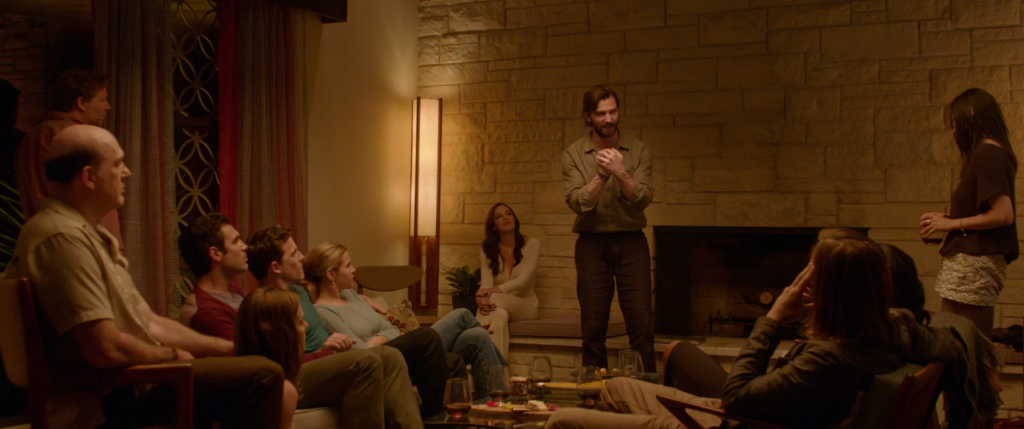
The dinner party moves the way real dinner parties move when something is wrong but nobody is ready to say it yet. Will keeps catching things that don’t add up, a locked door, a guest who appears from nowhere, a video played for the group that sits wrong in the stomach. Everyone else is warmer to Eden and David than the situation seems to warrant, and Will is the one who keeps flinching, keeps reading the room, keeps doing the math. The film frames him as possibly paranoid, possibly still not over Eden, possibly projecting his grief onto a gathering that is actually, genuinely, just a dinner party. Maybe the guy with the beard and the dead son and the new girlfriend is the one who can’t let go. Maybe Will is the problem here.
That is the bet the movie is making with your discomfort for its entire first hour, and it wins it.
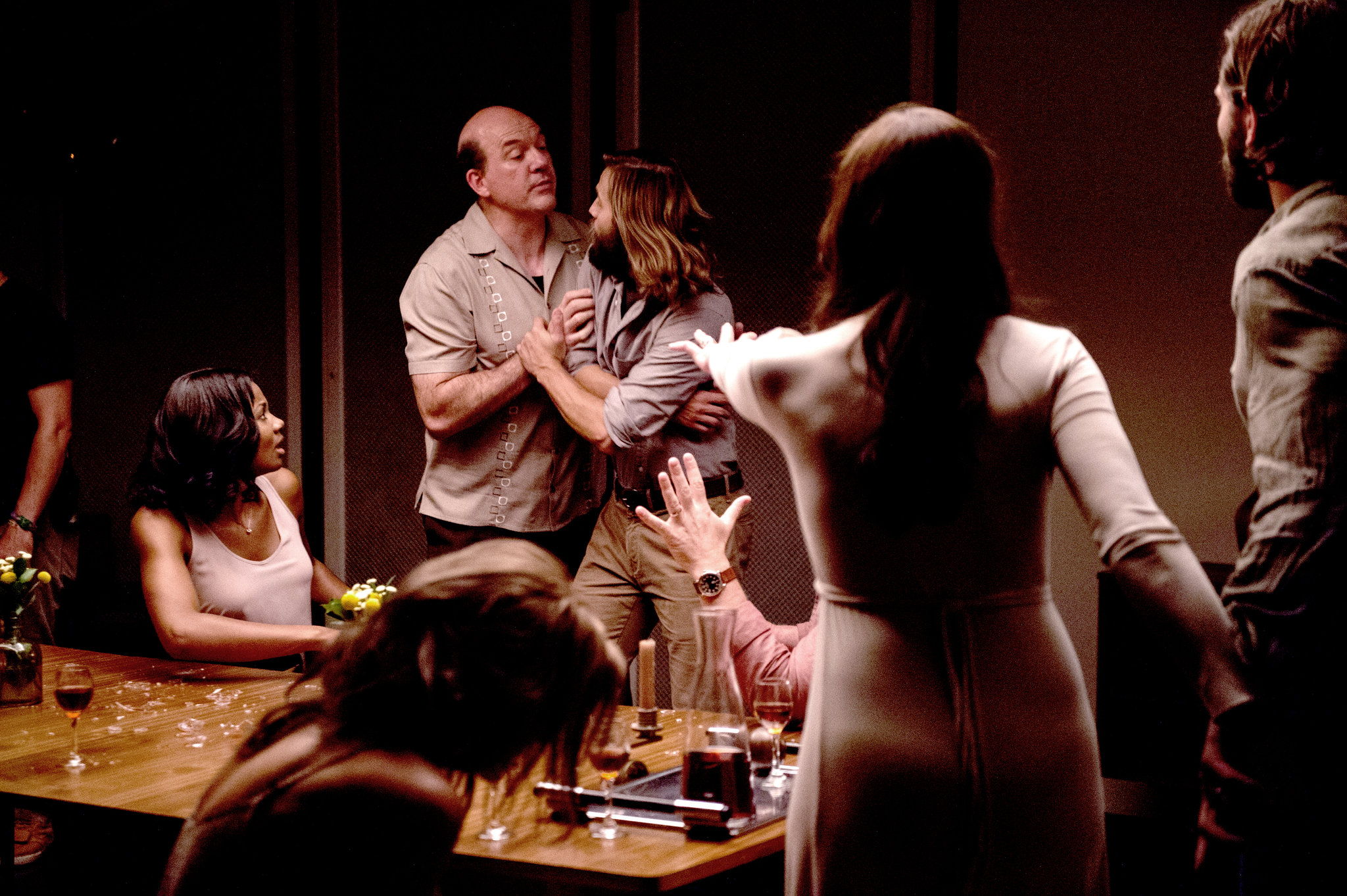
Then comes the toast. David makes a toast and Will refuses to drink and knocks the glass out of someone’s hand and everyone is furious at him for ruining the moment and humiliating Sadie and then Gina hits the floor, foaming, and Will was right about everything. The potential energy becomes kinetic in about ninety seconds flat. Gina is down. Miguel tries CPR and David shoots him. Pruitt takes the gun. Choi gets shot. The exits don’t open the way they should. Ben and Kira and Will are trying to move through a house that has been designed, for this specific evening, to prevent exactly that.
The cult mechanics matter here because the film is specific about them. This isn’t a simple murder-suicide pact. The belief system, as pieced together from the video they showed the dinner guests and from what David says when he learns Eden died, is that killing someone else transfers your pain and sin onto the victim, a living sacrifice who carries your burden so you can ascend. When David hears Eden is dead and says “she’s with them now,” he means it as a completion, as the thing going right. Eden dying was not a tragedy in his framework. It was the destination. That understanding is what recontextualizes every warm, forgiving, letting-go thing Eden said during the evening. She wasn’t healed. She was prepared.
Now, let’s get to that crazy red lantern. David walks to the backyard, lights a red lantern, hangs it up, walks back inside. Calm. Methodical. And then, in the final minutes of the film, Will looks out across the canyon and the hills of Los Angeles and there are red lanterns everywhere. Dozens of them. Maybe more. That image is the film’s last and loudest statement, and it opens three distinct reads on what exactly is happening to the world outside that house.
The Invitation Movie Theories to Explain It
The Invitation Theory One
This is the maximalist read: this cult is enormous, globally organized, and tonight is the coordinated date. Every cell throws its party simultaneously. The red lanterns are a signal across the entire network that the work is done. The math on this one is genuinely difficult, the numbers you’d need to actually meaningfully reduce the world’s population through dinner parties are staggering, and the logistics of keeping a global simultaneous event secret long enough to execute it don’t hold up under much scrutiny. News travels. Time zones create a rolling exposure problem. If parties in Tokyo go sideways at 8pm local time, the rest of the world has hours of warning before their own 8pm arrives. Theory one is the most cinematic read. It is probably not the intended one.
The Invitation Theory Two
This theory pulls the scope back to the regional: this is a Los Angeles operation, maybe California-wide. The cult seeded itself through the industry and the wellness-adjacent culture that runs through that particular geography, the kind of place where a retreat in Mexico with transformative results would raise zero red flags among a certain social circle. This is a more surgical operation, targeting a specific population in a specific area. The lanterns visible from the canyon are consistent with this read. You don’t need 700 million parties to light up a hillside.
The Invitation Theory Three
This theory treats the night as a proof of concept, a first wave. A beta run. The cult runs the Los Angeles operation, observes what they learn, and then phases out to the next city, the next date, a new set of hosts with a new set of invitation lists. This theory actually holds together the best structurally, it allows the cult to be large enough to be terrifying and organized enough to be credible without requiring the logistical impossibility of theory one. It also leaves the world intact enough that the horror of the ending registers properly, because the horror isn’t just that Will survived the house. The horror is that Will survived the house and the house was one of hundreds, and nobody outside yet knows what a red lantern means.
Moviesoapbox’s Preferred Take On the Invitation
My read is theory three, with a strong lean toward theory two as the immediate operational scope. The film isn’t trying to depict the end of the world. It’s trying to show you the beginning of something that could become that, and letting you sit with the distance between those two things. The final shot isn’t apocalypse. It’s the moment just before you understand what you’re looking at.
That is a hard image to earn. Karyn Kusama earns it because she spent sixty minutes making you doubt the one character who was right the whole time. A studio film gives Will a gun in act one. A studio film puts the body in the pool at minute forty so the audience doesn’t fidget. A studio film does not trust you to sit with dread this long without a release valve, and it sure as hell does not end on a hillside of quiet lights with no explanation and no resolution and no sequel hook dressed up as closure. The Invitation got to be exactly what it is because the people who made it protected it. Most films like it don’t get that. Most films like it become something else entirely before they reach you. Remember that when you’re watching those lanterns come on across the canyon.
That’s all for today. Thanks for hanging out with us in this little corner of the internet. If this one hit right, tell someone who you think can handle it. And if it didn’t hit right, give it another watch and pay closer attention to every moment Will almost convinces himself he’s wrong. Want a couple other movies in the same space as The Invitation?? Moviesoapbox has you covered.
🎬 If You Liked This…
- Coherence — another dinner party that begins as social discomfort and ends as something you cannot explain to anyone who wasn’t in the room
- Time Lapse — a small group of people who discover something they should have walked away from, and the slow creep of paranoia as trust between them collapses
- Primer — two people who thought they understood what they were doing to each other, discovering too late that they didn’t, built on a shoestring and smarter than anything with ten times the budget