
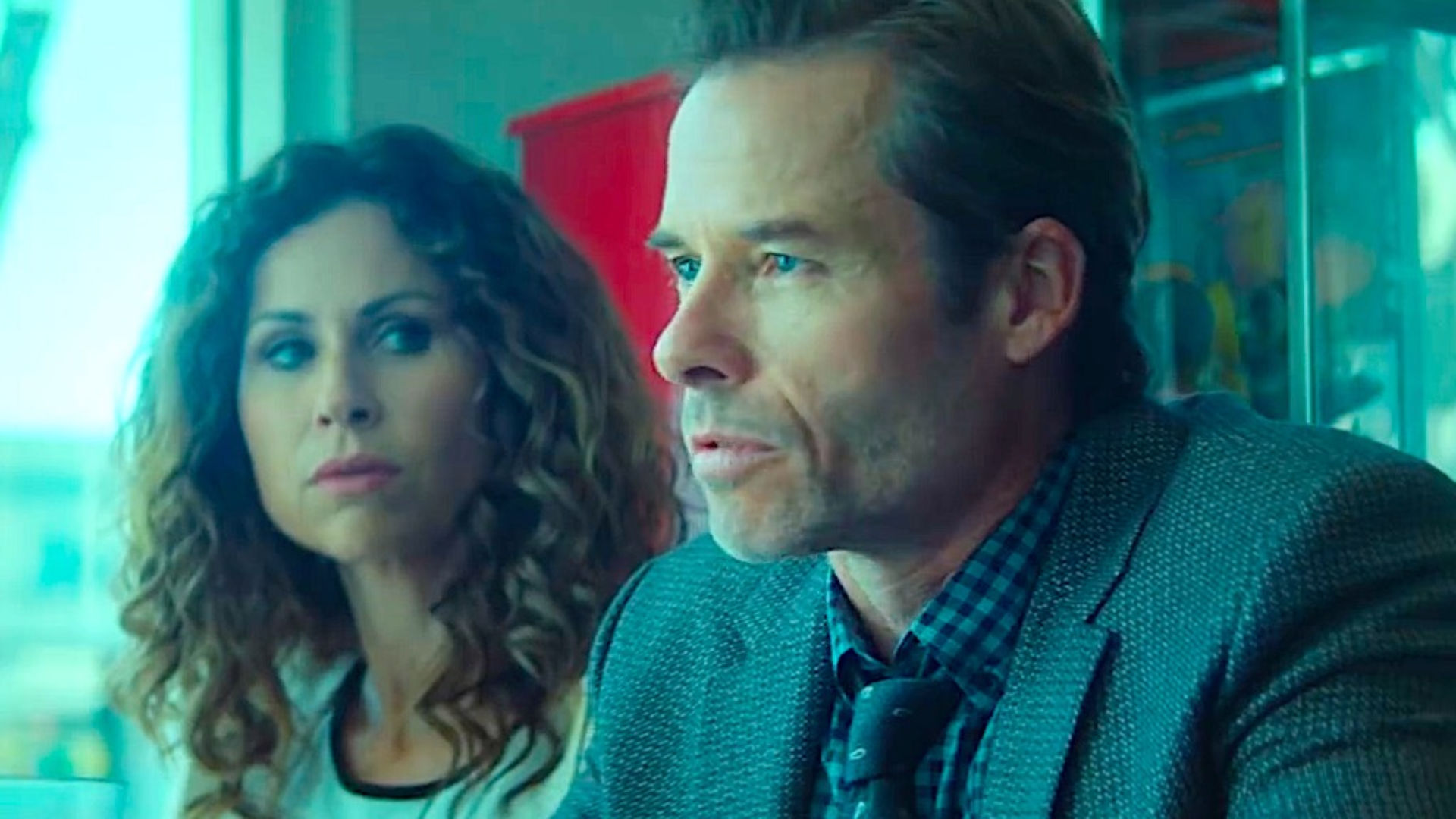
Hey there everyone! Welcome back to Movie Soapbox, the little corner of the internet that only you and I and that guy sleeping in the corner over there know about. This is the place where we find underappreciated indie films and we make sense of them. Today? We are doing a deep dive on The Spinning Man, a movie so quietly, stubbornly ambiguous that the suits who greenlit it probably still aren’t sure what they paid for.
Fair warning: everything from this point forward assumes you’ve seen the film. If you haven’t, go watch it, come back, and we’ll be here. What follows is going to walk through the whole thing, the ending included, and I’m not going to slow down for you.
The Making of The Spinning Man Realities
What you need to understand before we go any further is what this film’s entire journey looked like before Guy Pearce was ever on set. The novel came out in 2003. The New York Times called it elegant and unnerving. Leo DiCaprio’s people called. Bruce Willis’s people called. George Clooney’s people called. They all read it and then they all passed, because there are no car chases in it, no third-act confrontation, no cathartic release valve. Producer Steve Golin, the same man behind Eternal Sunshine of the Spotless Mind and Babel, optioned it and then couldn’t get it financed. A UK company tried to turn it into a TV series and that collapsed too. It took until 2016, thirteen years after the book landed, for an independent producer named Rob Arnold to get funding in place. Thirteen years. That is not a story about a project that sailed through the system. That is a story about a project that the system kept spitting back out until someone stubborn enough came along to catch it.
When a film like this finally gets made on a budget where a significant chunk clearly went to Brosnan, Pearce, and Minnie Driver, you can read the whole production in those constraints. A film at this budget tier with this cast usually means the director retained meaningful creative control, because the names on the poster are doing the heavy lifting that marketing dollars would otherwise buy. Simon Kaijser wasn’t there to execute a studio vision. He was there to make the thing before anyone changed their mind. You can feel that in the film’s willingness to leave the penultimate car scene genuinely, frustratingly unresolved, no coverage to smooth it over, no ADR line to clarify what we just saw. A director with a nervous financier in his ear would have added the clarifying line. Kaijser didn’t. Whether that was conviction or whether it was the budget running out, the effect is the same: the film keeps its teeth.
The Spinning Man Deep Dive Walkthrough Movie Details
So. A philosophy professor named Evan Birch, played by Guy Pearce in full coiled-ambiguity mode, gets pulled into a detective’s orbit after a teenage girl goes missing near the lake where he was parked. He shouldn’t have been there. He can’t quite explain why he was. He has a history with female students that his wife knows about in the vague, unasked-about way that spouses sometimes do. And Detective Malloy, played by Pierce Brosnan doing his most interesting work in years, starts circling him the way a man circles a locked door, not sure if he wants it to open.
Evan’s life before Malloy shows up is a man performing respectability with the small daily anxiety of someone who knows what’s underneath it. He teaches philosophy. He asks his students about the nature of perception and memory. He has a beautiful, watchful wife played by Minnie Driver, and she has learned to watch carefully. When the girl, Joyce, goes missing and Evan can’t account for his afternoon, the detective doesn’t come in loud. He comes in patient. Brosnan’s Malloy is the most dangerous kind of investigator in fiction, the one who isn’t trying to catch you lying, he’s just waiting to see what you do when no one’s accusing you of anything yet.
The film intercuts Evan’s present-tense anxiety with sequences that may be memories, may be fantasies, may be confessions his mind is making that his mouth hasn’t made yet. The most contested of these is a scene in a car with a female student where something physical is happening and then she falls, or is pushed, onto the parking lot pavement. She appears badly hurt. Then she gets up and walks away. The scene is not dated. It is not labeled. You are not told whether it happened or whether Evan is imagining it happening or whether he is imagining it not having been as bad as it was. The author of the novel, George Harrar, has said publicly that even he found the screenplay confusing on first read and asked his wife whether Evan did it. That is not a filmmaker failing to communicate. That is a filmmaker deciding that Evan’s interiority should feel exactly as unreliable to you as it feels to Evan.
The story behind the story is worth knowing because it explains the ambiguity at the source level. Harrar started writing after a real 2000 disappearance in Massachusetts, a sixteen-year-old lifeguard named Molly Bish, where a white car was spotted and the driver never came forward. He deliberately stopped following the case so the real outcome couldn’t constrain him. He writes organically, meaning he didn’t know the ending when he started and didn’t choose ambiguity as a device so much as arrive at it as the only honest conclusion to a story about a man who may not fully know himself. The body was found three years later. Suspects were identified. No one was charged. The white car driver was never found. Harrar built his novel in that exact shape: a question that doesn’t close.
The Spinning Man Movie Theories to Explain That Ending
Theory one: Evan did it. He was at the lake. He cannot account for his time. He has a documented history of pursuing female students. The film’s fantasy sequences show a version of him that escalates. His confession to Malloy at the end, when he walks into the detective’s office and simply says he killed her, is read under this theory as a man who has finally stopped lying to himself. The confession is the most honest thing he does in the film. His whole philosophical framework, all that talk about perception and memory and whether we can know anything, has been an elaborate structure built to keep him from looking directly at what he is.
Theory two: Evan didn’t do it but confessed anyway. Malloy himself, in the film, says the physical evidence doesn’t support Evan as the killer. She appears to have fallen. There is no evidence of violence consistent with Evan’s presence. Under this theory, Evan confesses because he is a man drowning in guilty thoughts he cannot separate from guilty deeds. He has lust in his heart, as Harrar has put it. He has fantasized. He has probably done things with students he shouldn’t have. He has, in his own head, rehearsed versions of worse things. When the pressure reaches a breaking point, he takes confession as a psychological exit, an admission that he is the kind of man who could have done it, which feels true even if the act itself isn’t. False confessions are real. They happen at documented rates under interrogation pressure, and Evan has been under low-grade interrogation pressure for weeks, much of it self-generated.
Theory three: the film refuses the question on purpose. What Kaijser and the screenplay are actually doing is putting you in the position Malloy is in, and the position Evan’s wife is in, and the position Evan is in. You have incomplete information. You have a man who cannot reliably narrate his own interiority. The question of whether he did it is less important than what it costs everyone around him to live inside the uncertainty. This is the most philosophically consistent read, given that Evan literally teaches epistemology for a living, and it is the read that makes the film’s refusal to clarify feel earned rather than evasive.
Moviesoapbox’s Preferred Take on the Spinning Man
My read: I’m going with theory number two… fullon. Evan didn’t kill Joyce. Malloy’s evidence reading is the film’s one reliable data point precisely because Malloy has no reason to protect Evan and every professional incentive to close the case. What Evan confesses to is the version of himself he’s been running from, the man in the car, the man at the lake, the man who has made himself the most plausible suspect in a room full of his own thoughts. He confesses to being that man. That man and the man who killed Joyce are not the same man, but they live close enough together in Evan’s head that he can’t feel the distance anymore. The confession is real. The crime isn’t. That is what makes the film genuinely unbearable in the best sense, because it means the investigation closes, the detective walks away satisfied, a real killer is presumably never found, and Evan goes home having confessed to a version of himself that is true enough to stick.
Minnie Driver read the source novel before shooting. She told Harrar as much on set, and he was surprised. That detail is small and it matters. A cast that comes in having done that kind of work is a cast that trusted the material enough to prepare for it seriously, and that trust is visible on screen. The film that The Spinning Man could have become after five more rounds of studio notes, with a clarifying third act and a definitive answer and a score that tells you how to feel, would have been unwatchable. The one that survived is the one where everyone, the director, the cast, the author watching over Kaijser’s shoulder into a monitor on a West LA street, decided the ambiguity was the point and held the line on it. Most films like this don’t make it. This one did, barely, thirteen years late, on a budget that required Pierce Brosnan to finish his shoot before the author even arrived on set. That’s what it cost. Go watch it knowing that.
Love ambiguous ending movies like The Spinning Man? Well, Moviesoapbox has you covered… check out these really fantastic amibiguity riddled flicks!
🎬 If You Liked This…
- My Cousin Rachel — did she do it or didn’t she, the film builds an airtight case for both answers simultaneously and then refuses to choose, same maddening structure as Spinning Man
- Enemy — a man who may or may not be who he thinks he is, reality that keeps slipping, an ending that lands like a gut punch and explains nothing
- The Survivalist — another film where trust between characters is the entire question and the answer is withheld until it’s too late to matter