
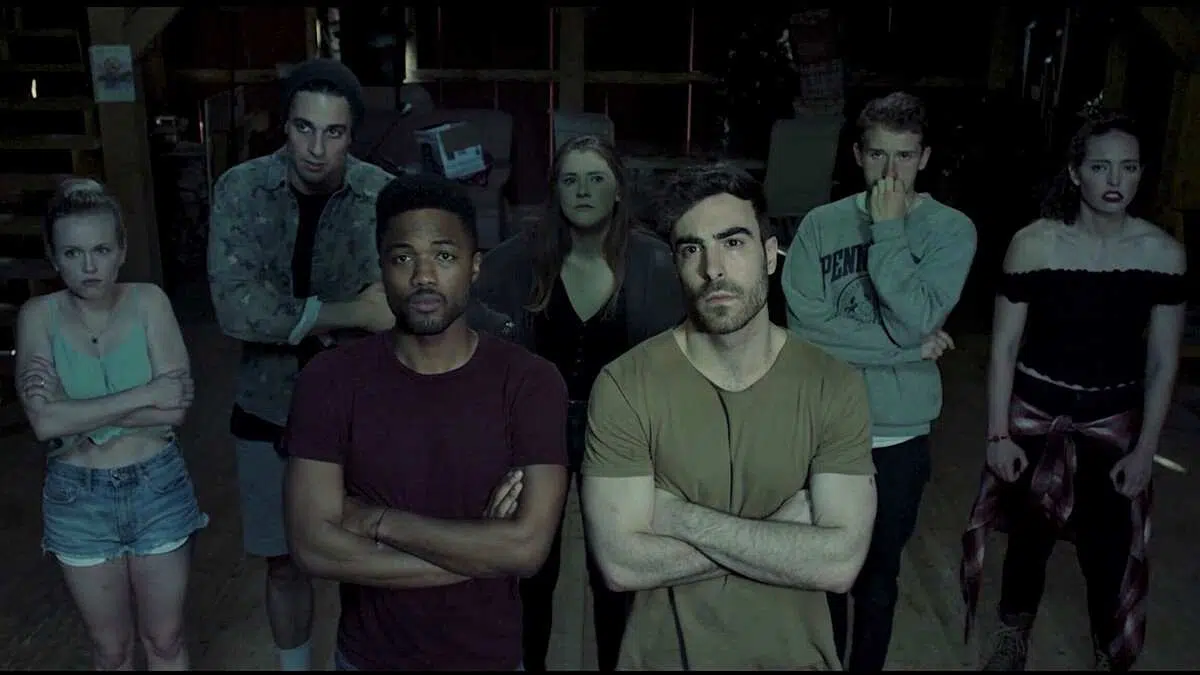
Hey there everyone! Welcome back to Movie Soapbox, the little corner of the internet that only you and I and that guy stress-eating trail mix in the back row know about. This is the place where we dig up the films that the algorithm buried, the ones that got two screens and a prayer, and we make sense of them. Today we are doing a deep dive on The Alpines, a movie so quietly vicious, so carefully constructed from the ground up to detonate in your face at the seventy-minute mark, that when it finally goes off you feel stupid for not having spotted the fuse.
Before we go any further, I need to be straight with you. Everything from this point on is a spoiler. Every single piece of it. The mechanism, the reveal, the thing that makes this movie worth sitting through the first hour of escalating social discomfort, it all gets named here. If you have not watched The Alpines yet, stop reading, go find it on Apple TV or whatever service has it this week, and come back. I will be here. I am always here.
Gone? Good. Let’s talk about what writer-director Mally Corrigan actually built.
The Alpines Movie – and How It Got Made
Before the walkthrough, a word about what this kind of film costs to make and what it usually costs to survive. A closed-box thriller with seven characters, one location, no franchise IP attached, and a screenplay that asks its audience to hold contradictory information for seventy minutes without tipping its hand is exactly the kind of project that gets strangled in development. Not by malice, but by the accumulated weight of coverage notes that say things like “the protagonist’s motivation is unclear” and “consider adding an external threat in act two.” You can feel, watching The Alpines, that the screenplay survived those notes without being gutted by them. The structure is too precise, the misdirection too intentional, for this to have been committee-flattened. A film like this either gets made with a director who retained enough control to keep the trick intact, or the trick gets explained in act one and the rest is just watching dominoes fall. Corrigan kept the trick. That is not nothing. That is, for this budget tier and this genre, genuinely rare.
The Movie The Alpines and the Deep Dive Walkthrough
Seven friends. A cabin. Years of separation behind them, enough accumulated damage between them to salt the earth, and yet here they all are, getting back together again. The film opens with Zack in therapy, unable to give his counselor what she’s asking for, bolting out of the session with this barely contained energy that reads as grief at first, then need, then something else entirely. He’s heading to the cabin. He’s excited. That’s your first tell, if you’re watching closely enough, and almost nobody is.
The group reassembles and the film does what this genre does best, it turns up the heat one degree at a time. James slept with Andy before he married Rowan and never told her. Rowan has been sleeping with her yoga instructor for a year. Gil has been feeding Roger drugs specifically to sabotage Roger’s relationship with Logan. The revelations stack like kindling, each one adding a little more oxygen to the room, and you’re watching it thinking this is a movie about the specific cruelty of old friendships, about the debts we accumulate in our twenties and try to outrun in our thirties. That’s what you think it’s about.
But Zack. You keep coming back to Zack. He loved Andy from the moment he met her, sat on that love for years while the men around him used her and moved on, never made his move, never said the words. And this weekend, finally, he tries. She doesn’t believe him. Who could? Who holds something that long and then just says it out loud over wine in a cabin? So that read fails, and you think, okay, Zack is the sad one, the passive one, the one the film is using to anchor our sympathy while the more volatile characters eat each other.
Wrong. This entire weekend was Zack’s architecture. He organized it. He chose who to invite through, knowing which members of the group could be leveraged to convince the reluctant ones. He wrote the threatening notes on the walls. He left photographs of James and Andy for Rowan to find in the bathroom. He put lipstick confessions on the mirror. He covered Andy in blood while she slept, a reference to the abortion she had after sleeping with James, a secret only Zack knew. Every degree of temperature in that cabin, Zack turned the dial. He was not the passive one. He was the architect. The man in therapy at the beginning of the film, unable to speak, was not processing grief. He was managing countdown anxiety.
The plan, as far as Zack had one, was to get James to confess to Rowan about Andy, and to have that confession blow the whole group apart the way Zack had been blown apart by years of watching these people take what should have been his. What he did not account for was how close to the edge James already was. When Rowan’s own confession comes out in the same breath, James comes apart completely and kills her. The fire Zack had been feeding for months burned hotter than he’d modeled.
Logan, methodical and controlled as she is, works it backwards. She knew about Andy’s abortion. She knew Andy hadn’t told anyone. The only other person who knew was Zack. She connects it to the notes, the photographs, the orchestration of the whole weekend, and she gets there. Zack, cornered, hands James a gun and asks to be killed. He has thought about this. The vertical scars on his wrists are not incidental detail. He wanted to be his own John Doe, wanted James to be his Mills, wanted the mechanism of his own grief to become the instrument of his death. James doesn’t give him that. So Zack shoots James, and then the film becomes very fast and very loud, and the accounting is difficult to follow because the film is not interested in clean accounting at that point.
And then the narrator speaks.
“Humans are extremely simple creatures. Each individually formulated by a mixture of light and dark. Both good and evil. Most are balanced of the two, and the others? Not. But then there are the immoral, the messages, the warnings to the rectifiable, though forgiven by God are damned to a life of predetermined torment for their sins.”
The Characters and Their Mappings to the 7 Deadly Sins
Roger. Gil. James. Rowan. Andy. Zack. Logan.
Gluttony. Greed. Wrath. Envy. Lust. Sloth. Pride.
You had been watching the seven deadly sins the entire film and Corrigan never once waved the flag. Every character, every injury, every revealed secret mapped onto a centuries-old moral taxonomy and the film just let you sit in it without the annotation. That reshoot scar that shows up in lesser films when the studio decides the audience won’t get it and demands an expository scene to explain the concept? Absent. The film trusts you, which is the single most endangered behavior in contemporary genre filmmaking.
The Alpines Movie Framework
A note on the framework itself, because this one is worth knowing. The seven deadly sins are not a biblical list. They were catalogued by Evagrius Ponticus in the fourth century, a monk working from Greek cosmology, organizing eight logismoi against eight planets. When the Catholic Church absorbed and formalized the concept, Ponticus’s eight became seven, and they became central to confession and penance in a way that calcified them into something that feels ancient and doctrinal even though it’s largely institutional architecture. Dante put them in Purgatory. Chaucer put them in the Parson’s Tale. Fincher put one of them in a box and handed it to Brad Pitt. The sins are everywhere because they’re a map of appetites, not a divine list, and a map of appetites is universally legible.
What Corrigan does with that map is anchor it to something true about group dynamics and old friendship specifically. You are not watching seven archetypes. You are watching seven people who became their worst quality over time because nobody in the group had enough distance or honesty to interrupt the pattern. Roger’s gluttony and Gil’s greed and Logan’s pride aren’t exotic pathologies, they’re the grooves that people fall into when their social world stops challenging them. This is a film about what happens when a group of people have been enabling each other’s worst selves for long enough that those selves are all that’s left.
The Alpines Movie 2 Competing Theories
On the competing interpretations, there are really two ways to read the narrator’s closing statement and the film’s finale. The first is that Corrigan intends the seven sins framework as pure structure, a formal device that gives shape to what would otherwise be a very messy ensemble unraveling, and the moral overlay is meant to be legible but not prescriptive. The film is not a sermon, on this read, it is a writer using an existing architecture the way a screenwriter uses three-act structure, because it works. The second read takes the narrator’s language seriously, particularly the line about being “damned to a life of predetermined torment,” as a genuine statement about moral determinism, that these characters were always going to end here because their sins had been compounding long before the cabin, and the cabin just accelerated the accounting. On this read the film is not just formally structured around the sins, it is arguing that the sins are actual fate.
The Moviesoapbox Read on the Movie The Alpines
Movie Mike’s read is the first one, but with a qualifier. Corrigan is clearly a writer who believes the taxonomy has real moral weight, the film is too careful with its assignments for this to be purely formal. But the thing that makes The Alpines land is that it never asks you to condemn the characters from the outside. Zack is Sloth, yes. He is also the person whose genuine feeling got ignored and used and wasted by every other person in his life for a decade. The sins here are not abstract. They are the specific mechanisms by which real people hurt each other over time, and that specificity is what keeps the film from being a parable and makes it feel like a document.
Mally Corrigan made a film that should have been smoothed down into something more comfortable and it isn’t. It is sharp in the places that most films at this budget level get sanded. It exists because someone kept the trap door mechanism intact all the way through production and didn’t let anyone replace it with a twist that explains itself. In the factory version of this film, Logan figures out Zack’s plan in act two and confronts him and there’s a tense negotiation and maybe two people die and there’s a final scene where someone is in therapy again and we cut to black on an ambiguous expression. That film gets made twelve times a year. This one got made once.
🎬 If You Liked This…
- The Invitation — the same slow-burn dread of a group of old friends trapped in a house together, old wounds reopening under the surface of polite conversation until the room itself starts to feel like a trap
- The Party — a gathering of people who thought they knew each other disintegrating in real time as the secrets everyone agreed not to mention finally get mentioned, the social performance collapsing in one airless evening
- Long Lost — another isolated house, another group of people hiding something from each other, the tension building through what isn’t being said until the whole architecture of the visit reveals itself as something sinister