
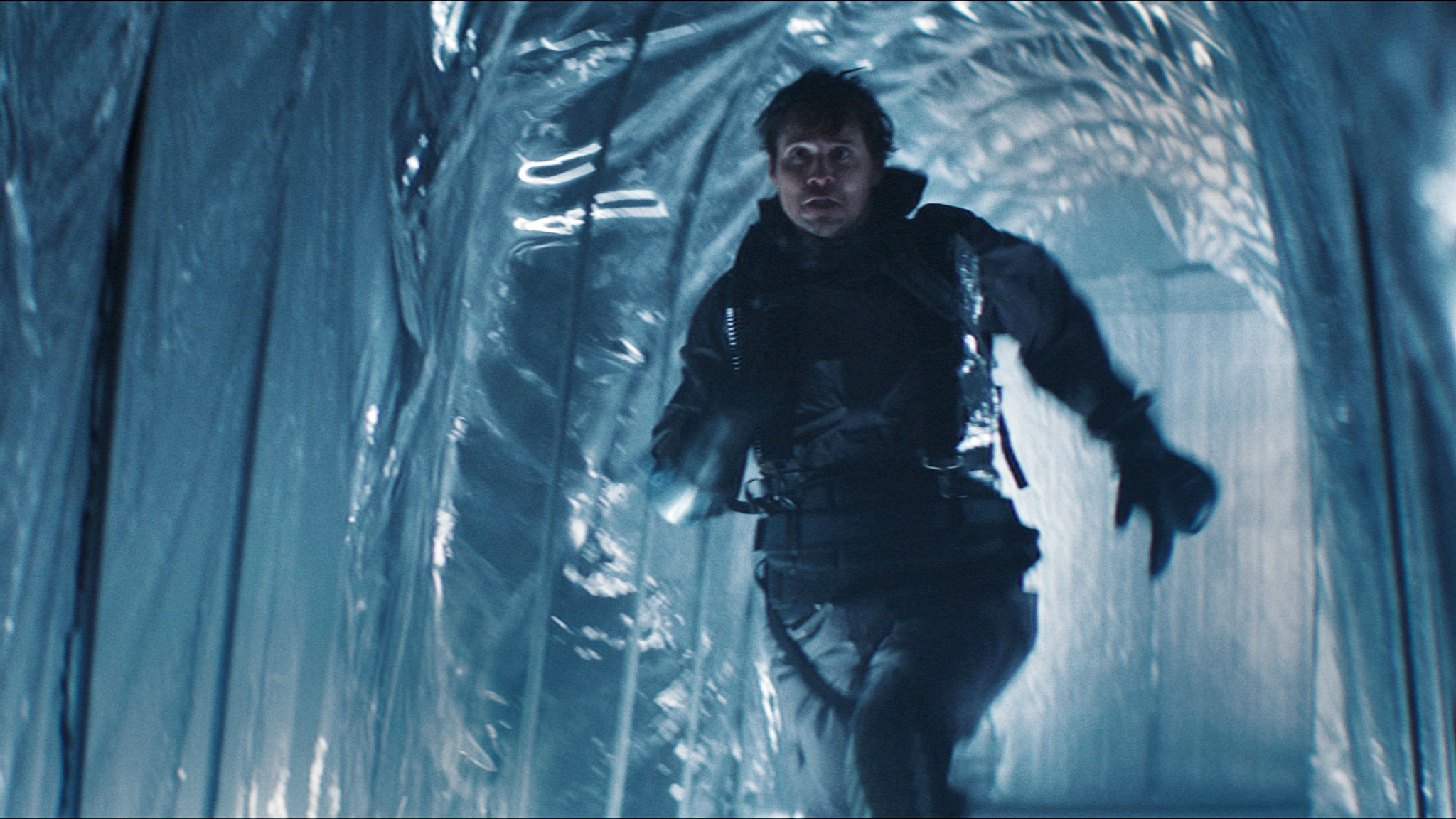
Hey there everyone! Welcome back to Movie Soapbox, the little corner of the internet that only you and I and that guy sleeping in the corner over there know about. This is the place where we find underappreciated indie films and we make sense of them. Today? We are doing a deep dive on Synchronicity, a movie so quietly, stubbornly committed to making your brain sweat that even the people who greenlit it probably didn’t fully understand what they were getting into, and that, honestly, is the only reason it survived intact.
Alright. If you have not seen Synchronicity yet, close this tab, go watch it, and come back. What follows is a full autopsy of this movie, every layer of the onion, every competing theory about what that ending actually means, and why the whole thing works at all. I’m not going to dance around the plot. You’ve been warned. Now let’s get into it.
Synchronicity Movie and the Making Of
Before we walk the timeline, here’s what you need to understand about what kind of movie this actually is and what that means for how it got made. Synchronicity was shot on a micro-budget, which in practical terms means the director, Jacob Gentry, retained the kind of creative control that a $40 million greenlight would have surgically removed by the second round of notes. You can always tell when a film like this comes out of a system that had real leverage over it, because the third act gets sanded down, the ambiguity gets explained in an extra scene, someone insists on a cue that tells you how to feel. Synchronicity does none of those things. The ending sits there and stares at you and refuses to blink. That is a low-budget gift. At a bigger number, with more voices in the room, you get a title card. You get a voiceover. You get something that costs the film everything it earned. Gentry didn’t have that problem, because he didn’t have those people in the room, and the movie you’re about to have explained to you is what that freedom actually looks like.
Synchronicity Movie Timeline Walkthrough
Now, the timeline. When I walked through this the first time I considered just going fetal and quitting, but I’m going to give you a workable map. The movie’s own naming conventions are a mess, so I’m using superscripts: Jim1, Jim2, and so on, and when the loops stack past the point of clean numbering I’ll call them Jimx and Jimx+1. Bear with me.
The film opens on Jim1, Chuck, and Matty running their wormhole experiment in a lab that looks like someone built Blade Runner inside a storage unit, which is not a complaint, that’s a budget working for its movie instead of against it. Investor Klaus Meisner shows up to watch. The experiment fires. Jim1 blacks out, sees auras. Meisner leaves, convinced it failed. But a dahlia appears, fresh, out of nowhere, which is the first signal that something very much did not fail.
Jim1 runs into Abby outside, smoking. They end up at Meisner’s dinner. Abby and Helen do a full Edison-versus-Tesla round at the table, which the movie is using to tell you exactly who everyone is before anyone admits it. Jim1 goes home with Abby. He finds an identical dahlia in her apartment. He gets a call from Chuck, gets pulled back to the lab, starts getting the auras, passes out for eight hours. When he goes back to Abby’s, another man answers the door. That man is Jim2. We just don’t know it yet.
Abby says to Jim1, and this is the line that opens the whole movie up if you’re paying attention: “The man who gave me the dahlia gave me everything I ever wanted except a minute of his time.” She’s not being poetic. She’s been through this before. She’s giving him a line she has given, or received, or both, in some form, more times than either of them can count.
Jim1 gives the dahlia back, leaves the choice to Abby. Meisner finds out about them, wants to charge Jim 99% of everything. Abby comes with Meisner to the next experiment. Jim1 runs the dahlia into the machine: “You may own the dahlia, but you don’t own me.” And Jim2 enters the story, already in motion, watching from a bathroom as Jim1 collapses. Jim2 goes to Abby’s, sees her notebook, realizes what she’s been doing. He falls asleep. She goes for coffee. The intercom goes off and he answers it, talking to Jim1 from across the loop.
Jim2 finds a box of coasters with notes on them, all from various versions of himself across various visits he doesn’t remember making. He goes to the bar to steal the coaster Abby wrote on. “Time is our only currency.” That’s the moment he decides he’s going to beat Jim1 to her, that he’s not going to just let the loop run. He goes to get her diary. He starts throwing up violently. Jim1’s migraines stop simultaneously. The dahlia Chuck has been watching starts dying, browning, because two versions of the same lifeform are occupying the same timeline and one of them is losing.
Chuck and Jim2 explain to Abby what’s happening. Jim2 takes Chuck’s place in the suit for the next run. They try to send Jim2 back again. And then Matty, in the single most consequential accidental dial-turn in any time travel film I can think of, goes right instead of left.
Cut to Jimx, standing outside, disoriented, trying to figure out where and when he is. Chuck finds him. “You are still chasing after her?” Chuck says it the way a man says something he has said a hundred times, to a hundred versions of the same man, and has stopped being surprised by. Jimx heads out of the city at random, picks a hotel, and is told he’s already checked in. He goes up to the room and finds Jimx+1 dead in the bed.
Abby finds Jimx. She’s with him at the end. Another jump happens. This time he reads the notebook all the way through, every version of himself documented in Abby’s handwriting. Abby mentions another time traveler named John, whose lab exploded in fire. Jim says: “That’s a coincidence. My name is John.”
That line is the key to everything that follows in the theories, so hold onto it.
Synchronicity Movie Mechanical Details
Before we get to interpretations, let’s clear up the two biggest mechanical revelations the movie makes, because both of them reframe everything you watched before them.
The first is Abby. The film sets her up as the potential corporate spy, the woman stealing Jim’s plans. What she’s actually doing is the inverse of that. She has been listening to every version of Jim, compiling everything they say, every detail, every symptom, every pattern, building a body of research across dozens or hundreds of loops with one purpose: to find the version of him who can survive the temporal sickness. She is the only continuous presence across all the loops who retains memory and intent. She is not the antagonist. She is the only person in this movie with a coherent plan.
The second is the machine itself. Jim thinks he’s going backwards five days in time. He’s not. The machine is an interdimensional displacement device, each jump landing him in a parallel timeline that resembles but does not identically reproduce the last one. This matters because it means there is no single loop being closed. There is a branching series of near-identical worlds, each one slightly different from the last, each one populated by a version of Jim who is going to go through this same process again. One of those worlds gets an extra Jim every time. One of those worlds is now short a Jim. You can think about that as long as you want and it will not get more comfortable.
The sickness rule: when two versions of the same lifeform occupy the same timeline, one of them degrades and dies, almost always the one who traveled in, the terminus identity. The closer they get in proximity, the faster it accelerates. The auras Jim keeps seeing are not artistic flourishes. They are proximity warnings. He is near himself. The dahlia browning is the same process at plant-scale, which the movie shows you early precisely so you understand what’s coming for Jim before it arrives.
Theories to Explain the Movie Synchronicity
Now. The theories. There are four worth taking seriously, and I’ll give each one its full fair shake before I tell you which one I actually believe.
Theory One: SNAFU, Nothing Catastrophic, Just a Different Broken Dimension. The simplest read of Matty’s wrong-direction dial turn is that the jump worked the same as every other jump, just into a timeline that was already further along in the degradation cycle. Jimx is not experiencing anything structurally different. He just landed in a dimension where enough versions of himself had already cycled through that the hotel already had him checked in and one of him was already dead in the room. The night sky when he emerges is the atmospheric signal that something is off, not proof of a forward jump. The Chuck scene supports this, Chuck asking “still chasing her?” like it’s the most tiresome thing in the world, which it would be if Chuck has watched this particular man walk out that particular door an unknowable number of times.
Theory Two: Flash Forward. Matty’s wrong turn sent Jim2 forward in time instead of back. A few days forward, maybe more. This would explain the night, it would explain the temporal disorientation, it would explain why Jimx seems genuinely lost in a way the other transitions didn’t produce. The problem is the dead man in the hotel bed. If we jumped forward and Jimx is the first Jim here, who checked in? Who died? This theory requires you to also accept a very large loop number, Jim28 or Jim352 or something on that order, with enough prior iterations that the check-in and the corpse can both exist. The notebook Abby has, full of accumulated research across countless encounters, supports the idea of a very high iteration count. But it doesn’t cleanly resolve the mechanics of who died before Jimx arrived.
Theory Three: Sisyphean Ongoing Cycles, The Movie Starts in the Middle. The movie doesn’t open on Jim1. It opens on Jim142, or Jim352, or some iteration deep into a loop that has been running far longer than we’re shown. The box of coasters with notes from multiple Jims isn’t an anomaly to explain away, it’s evidence that we are not watching the beginning. We are watching one iteration of a process that has been grinding forward without us. The problem this theory has to answer is that Jim reads as genuinely new to all of this: surprised by Abby’s appearance, confused about the machine’s behavior, apparently without memory of prior loops. That selective amnesia either has to be structural to the jumping mechanism, the way 12 Monkeys treats temporal inevitability, or it has to be explained as the kind of cognitive reset that comes with dimensional displacement rather than simple time reversal. This theory doesn’t cancel out Theory One or Two. It can coexist with either of them as an additional layer underneath.
Theory Four: The Happily-Ever-After, Also Known as Theory Four-A and Four-B. When Jim says “that’s a coincidence, my name is John,” he reveals that at some point in the iteration chain the man became John, not Jim. John who died in the lab fire is the version Abby has been trying to prevent. This John, Jimx or John27 or whatever you want to call him, is the version who read the complete notebook, who has every piece of accumulated research from every prior version of himself, and who therefore has the best possible chance of not dying in a fire, not dying in a hotel bed, not dying from temporal sickness at all. Theory Four-A, the Disney version, says this is the one. He’s the convergence point Abby’s entire project has been building toward, he survives, she found her person, the boulder finally stays at the top of the hill. Theory Four-B says no. He is one more John in a long line of Johns, and Abby is still with him at the end the way she has been with all of them, because she doesn’t know yet whether this one is different. The movie ends before she finds out. The movie ends before you find out.
The Moviesoapbox Read on the Movie Synchronicity
My read? Theory Three is the foundation. This loop has been running for a very long time before the film opens, and the amnesia is structural, not coincidental. Matty’s wrong-direction jump is a flash forward, landing us deep into an iteration count high enough that Chuck has adopted the weary patience of a man who has seen this play out so many times that he’s past being dramatic about it. The John reveal at the end is real and it matters. The notebook is the variable. The question of whether reading the complete notebook is finally enough is the question the movie is deliberately leaving open, and the correct answer is that the movie does not know either, and any version of this story that claimed to know would be lying to you.
What Synchronicity is, underneath all the temporal mechanics, is a love story about a woman who decided to try to save the same man an indefinite number of times, documented everything, and kept going. The corporate espionage framing is a shell. Meisner is furniture. The machine is not the point. The point is that Abby built a research project out of grief and repetition and refused to stop, and that somewhere in a very long chain of failures there might be a version of this man who read the whole notebook and walked out of a hotel room alive. Jacob Gentry made that film for almost nothing, and because he made it for almost nothing, nobody got to soften that ending into something you could leave the theater feeling good about. That’s what this film had to survive to exist. In factory Hollywood, Abby gets a speech at the end that explains everything and John smiles and the music swells and you don’t have to sit with the uncertainty for even thirty seconds. This version trusts you to sit with it. That’s the whole thing.
Thanks for coming by Movie Soapbox today. We will be back with another one soon. Take care of yourselves out there.
🎬 If You Liked This…
- Primer — the closest cousin Synchronicity has, two engineers who build something they don’t fully understand and then use it to fix mistakes until the mistakes are all that’s left, low budget and merciless about it
- Time Lapse — the same fatal temptation of seeing ahead and the same slow realization that knowing the future doesn’t give you control over it, just a more specific way to fail
- Predestination — time travel as a closed loop with no exit, identity folding back on itself until the origin point and the endpoint are the same impossible thing, the kind of film Synchronicity wishes it had the nerve to fully commit to