
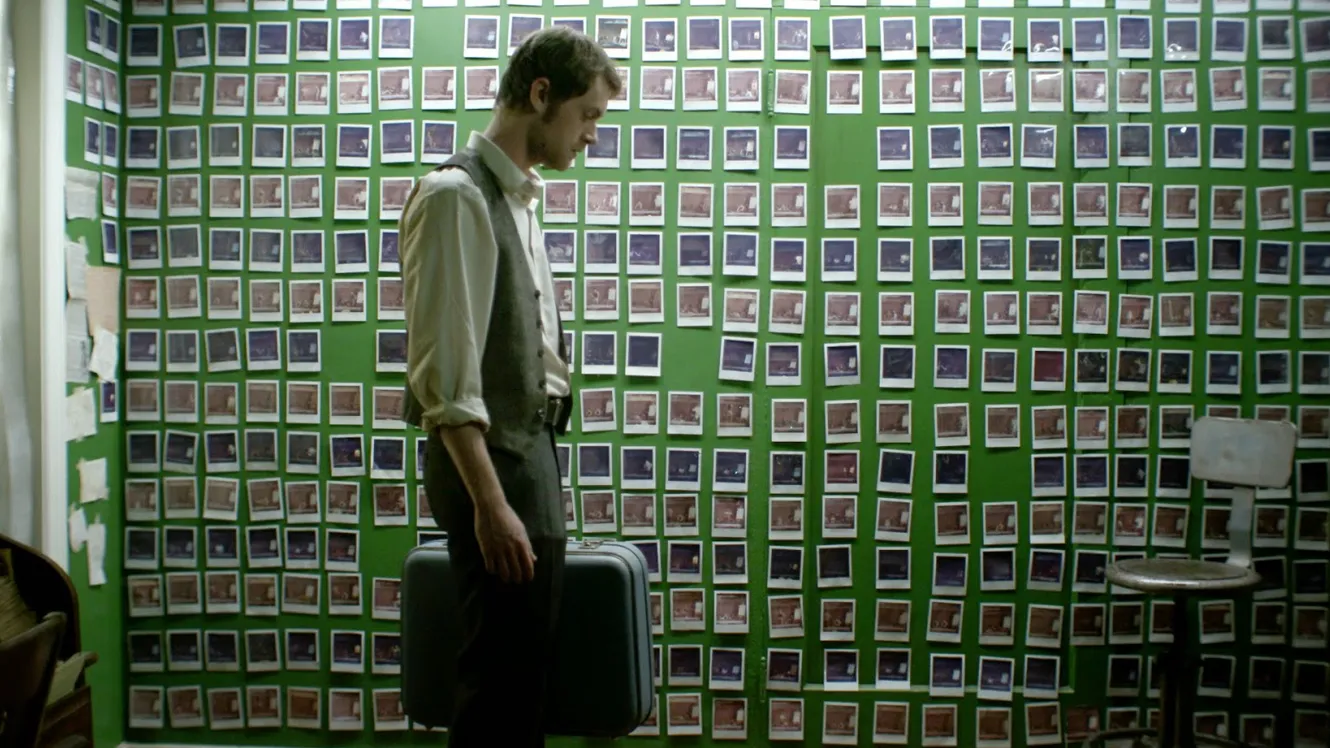
Hey there everyone! Welcome back to Movie Soapbox, the little corner of the internet that only you and I and that guy who fell asleep with his laptop open know about. This is the place where we find the underseen, the undersold, and the underestimated, and we make actual sense of them. Today we are doing a full deep dive on Time Lapse, a movie so quietly, surgically constructed that the people who greenlit it probably still do not understand what they were looking at when they said yes.
Fair warning from your friend Movie Mike: everything from this point forward is a full, unblinking spoiler walkthrough of Time Lapse. Not a taste. Not a tease. The whole machine, cracked open, parts on the table. And this is an amazing indie film you really do not want to have spoiled for you. Trust me on this one. This one goes down in the pantheon alongside Primer, Timecrimes, and Interstellar – Cough – I mean, Coherence.
So you have seen it. Good. Let’s go.
Time Lapse Movie the Making Of
BP Cooper and Bradley King wrote a script that a smarter distribution landscape would have put on a hundred thousand screens. A fridge-sized camera pointed at your apartment window, shooting Polaroids of your living room twenty-four hours into the future, the deceased inventor’s experiments still humming along on their automated schedule after he is gone. Three people in a lease, one painter in a slump, one girlfriend who is running a longer con than anyone around her can see, one guy who looked at temporal predetermination and immediately thought about betting on horses. That is your triangle. That is all you need. What happens next is a controlled demolition, and the filmmakers know exactly which bolt to pull last.
Now here is the part the source materials never tell you, because they are not written by someone who has watched development offices turn things like this into something else entirely. A script with this kind of internal logic, this many moving parts, this much dependence on the audience actually tracking a double timeline without a single expository cheat, that script gets notes. It gets notes from people who will tell you that the “twist” needs to arrive earlier so the audience does not feel lost, which is a note that would functionally destroy the film. It gets notes that suggest Callie’s manipulation arc should be “signposted more clearly,” which is a note that would telegraph the ending to anyone paying attention in act one. At a budget tier this low, on a shoot this compressed, the only reason those notes do not win is that there is no time and no money for the reshoot that would implement them, and occasionally that is the best possible outcome for a film. You can see it in the finished cut: no flinch. No softening. The third act lands exactly as hard as it was written to, because nobody had the budget to sand it down.
The Setup, The Machine, The Three People Who Should Not Be Trusted With It
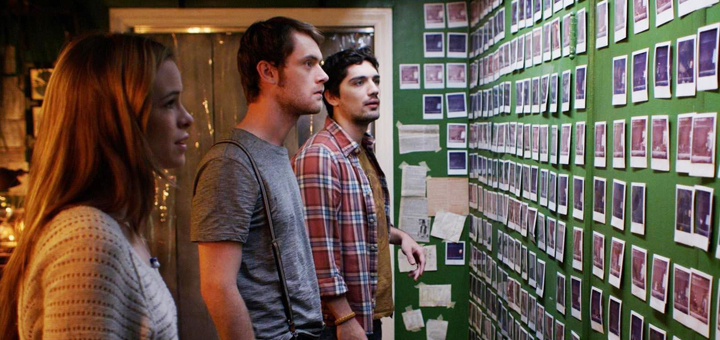
Finn is an apartment manager who used to paint and has lately been doing neither particularly well. His roommates are Callie, his girlfriend, and Jasper, her boyfriend, and yes, that sentence is grammatically correct, it is also the whole movie in a clause. They find their deceased neighbor Mr. B’s camera, a unit the size of a refrigerator aimed directly at their living room window, and they find the Polaroids it has already taken, which show their own living room the following night at eight p.m. with enough specificity to be actionable.
Jasper, because Jasper is Jasper, immediately wants to use it to bet on horses. So they do. And because the photo of them holding a racing form came true, and because the photo showing Finn’s new painting came true, they begin to treat the pictures as locked. As prophecy. As something that, if defied, will collapse their existence entirely. The movie lets them believe this. For a while, so do you.
The timeline they are living in operates on a simple enough mechanism: the machine photographs the window at eight p.m., the photo arrives, it shows them what they will be doing the following night at eight p.m., and they comply. They pose. They become the image. The machine takes the next photo. The loop closes. What nobody in the apartment is saying out loud, and what the film is in no hurry to clarify for you, is that there is a second cycle running underneath the one they think they understand.
The Machine Takes Two Photos a Day. One of Them Is Callie’s.
The eight p.m. photo is the one the trio is staging their lives around. But the real secret here is that the machine also takes a photo at eight a.m., and Callie found that out before either of the men did, and she kept it to herself, and that is the entire movie.
Think about what that means. The eight p.m. timeline is, as far as Finn and Jasper know, a locked deterministic rail. You see the photo, you become the photo, you do not deviate because deviation means nonexistence, or so they have convinced themselves. That is fear-based compliance. That is a cage they built for themselves out of one reading of the machine’s implications.
The eight a.m. timeline is different. Callie treats it as a correction mechanism. An undo button. You do something tonight, you see the consequences at eight the next morning, and if you do not like what you see you hold a message up to the window telling your past self to do it differently. You walk the cat backwards. You adjust. The morning photos are not prophecy to Callie, they are correspondence. She has been mailing herself instructions.
So while Finn and Jasper are white-knuckling through a locked destiny, Callie has been running a parallel operation in which almost nothing is permanent. Kiss Jasper a little too long, make Finn jealous, rekindle something that had gone cold, swap one photo for another before the eight p.m. clock hits, adjust, correct, keep pulling the string. The thing that the movie builds to is not just a twist, it is a revelation of authorship. Callie wrote this. The other two were in it.
What Actually Happens, Beat by Beat
Callie finds the machine first, checking on Mr. B after he stops responding. The machine is already running, the photos are already being taken, the cycle has already started. She tells the others. Jasper, predictably, monetizes the situation. Ivan, Jasper’s bookie, eventually learns about the machine and begins extorting the trio into staging photos for his benefit. Jasper kills Ivan’s associate Marcus. Then he kills Ivan. Bodies go into Mr. B’s storage. The walls are closing in on all three of them by the time Dr. Heidecker, Mr. B’s colleague, shows up having received a photo in the mail, a photo showing blood on the window and Mr. B’s hat, which Mr. B sent before his death as what appears to be a warning.
Finn finds a photo of Callie and Jasper together. He tries to prevent it from happening. Jasper locks him in the storage unit with the bodies. Finn breaks out, threatens to destroy the machine, Jasper and Finn fight, and Callie kills Jasper to stop the escalation. Then Finn, having just learned about the morning photos and what Callie has been doing with them, decides he is still going to destroy the machine. Callie shoots Finn. Blood hits the window. That is the photograph Mr. B mailed to Dr. Heidecker. The loop closes from an angle nobody standing inside it could see coming.
Callie is not panicking. She has done worse than this and walked it back. She needs to get a message to her previous self telling her how to undo the last two hours, and she has a plan, and then Big Joe, the former building security guard who just got hired as a police officer, walks in and finds her standing in a room with Jasper’s body and Finn bleeding out, and the message she taped to the window, her one lifeline, slides down the glass and falls.
One piece of tape. That is where it ends.
The Mechanics, Untangled
The question people get stuck on is the recursion. If the morning photos let you send corrections to your past self, can you not theoretically fix anything? Yes, in theory. The film does not argue against this. What it argues is that the system has a physical requirement: you have to be able to get to the window at the moment the photo is taken. Callie in custody cannot do that. The note falling removes her ability to stage anything. She is now subject to the eight p.m. timeline like everybody else, locked into the image that has already been taken and sent to Dr. Heidecker, the one showing blood and Mr. B’s hat, the one that already came true the moment she pulled the trigger.
The second piece people misread is the determinism question. The film lets Finn and Jasper believe that the photos are absolute, that deviating will erase them. This is never confirmed. It is a story they told themselves to justify compliance. Callie never believed it, which is why she felt free to use the morning cycle as a scratchpad. The movie does not resolve which interpretation is correct because it does not need to, the ending makes the point through action rather than argument. Callie’s version of freedom, the one where everything is reversible, turns out to have exactly one failure mode, and she hits it.
The machine’s range is also wider than the trio realizes. Mr. B was photographing further into the future than twenty-four hours, the photo he mailed to Heidecker is evidence of that. The duo built a deeper system than they survived to explain. Everything the three roommates understood about the machine was a subset of what it could actually do, and they ran their entire operation on incomplete information, which is another way of saying: Callie’s undo loop had edges she never found until it was too late.
The Competing Reads
The first reading, the one most first-time viewers leave with, is that this is a closed causal loop. The photos create the events, the events create the photos, the loop has no origin point you can access, everyone inside it is a passenger. Mr. B built the machine, the machine took the photos, the photos drove the behavior, the behavior produced the images, the cycle predates and postdates any attempt to intervene. On this read, Callie’s belief that she could fix things was always an illusion, the morning messages were themselves part of the loop, and the tape falling was not bad luck but inevitability.
The second reading is that the loop was always mutable, Callie was right about the mechanism, and the tragedy is purely operational. She had the right tool and lost her grip on it. One piece of tape where two would have held. On this read the universe is not punishing her, she just failed at a physical task at a critical moment, and everything that follows is contingent rather than fated.
The third reading, which requires more attention to Callie’s arc than most people bring on a first watch, is that Callie always knew the system had limits she had not yet found, and she kept escalating anyway, kept treating consequences as temporary, kept deferring the moment of reckoning further down the timeline until the timeline ran out of room. This reading makes the ending less about the tape and more about the cumulative weight of every action she refused to treat as real. The tape is just the last invoice in a stack she had been letting pile up for weeks.
Moviesoapbox’s Take on the Movie Time Lapse
We love the third explanation here. The tape is a physical metaphor for a psychological problem. Callie is a person who stopped believing that anything she did was permanent, and people who stop believing their actions are permanent do not become free, they become dangerous, they become the thing in the room that nobody can predict because even they have stopped tracking their own trajectory. Every murder, every deception, every message to her previous self was a bet that she would have one more morning photo to fix it with. She ran out of mornings. The ending is not a cosmic punishment, it is a character arriving at the logical terminus of her own operating assumptions, and the filmmakers had the discipline to let her get there without softening the landing or giving her a redemption beat she had not earned.
BP Cooper and Bradley King wrote a villain who is also the most competent person in the film, the most structurally sophisticated thinker in every scene, the only one who actually understood the tool they were all living inside. The fact that she is also the one who ends up locked in a room with four bodies and no way out is not irony, it is the whole argument. The machine did not destroy Callie. Callie used the machine to build the exact conditions required for her own destruction, one correction at a time, until the morning she ran out of tape.
That is the film. That is what survived the process of getting made on whatever they had to make it on, with no safety net, no second unit, no committee of VPs ordering them to make the ending more hopeful. What you watched is what they intended. A lot of movies can say that. Not as many as you would think. Time Lapse is one of them, and if you have never seen it, you now owe yourself a viewing, and if you have, you owe yourself another one where you watch Callie the whole time instead of Finn.