
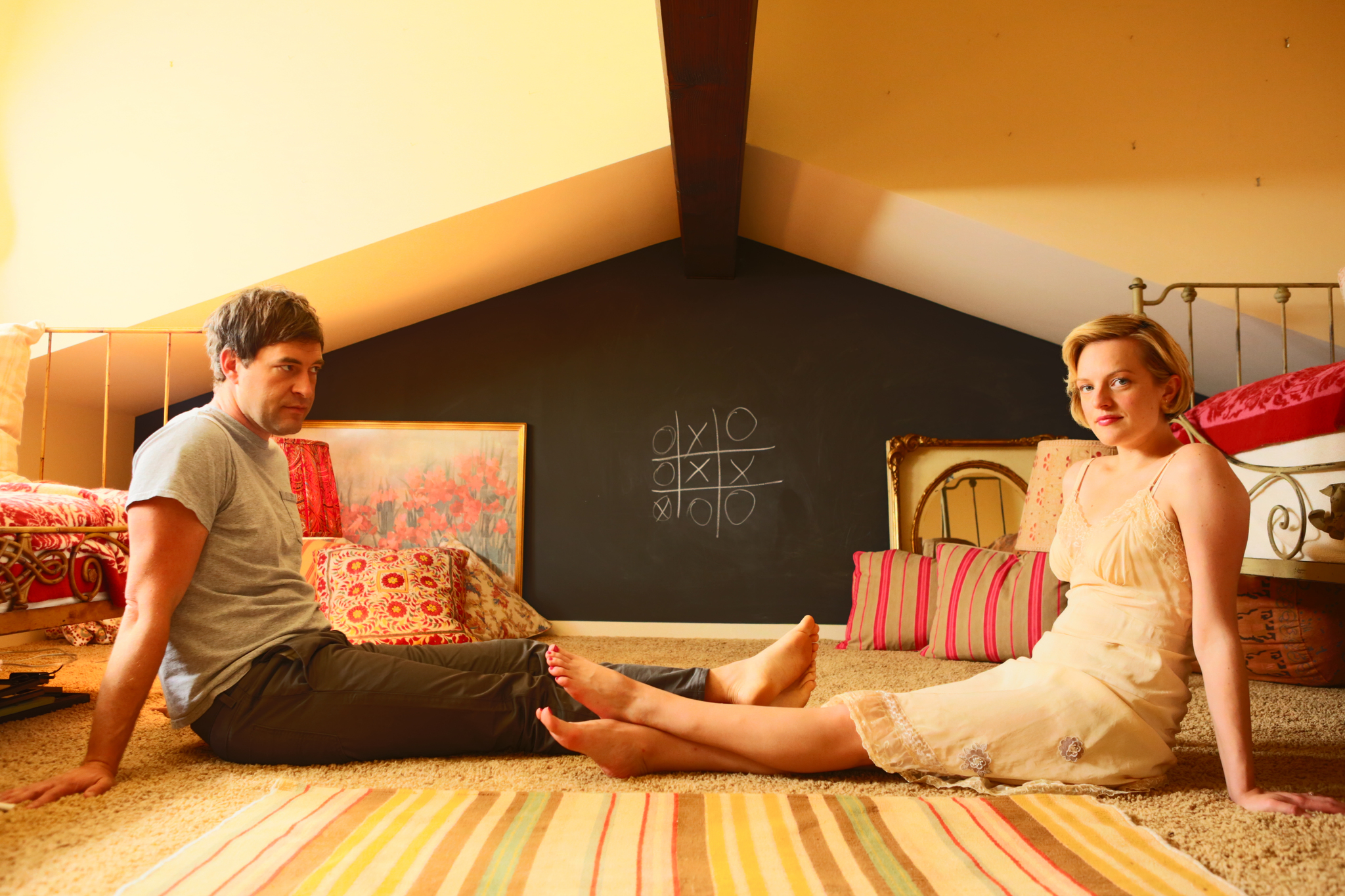
Hey there everyone! Welcome back to Movie Soapbox, the little corner of the internet that only you and I and that guy with the lukewarm coffee in the back know about. This is the place where we find the films that slipped through the cracks, survived the machine mostly intact, and actually had something to say when they came out the other side. Today we are doing a deep dive on The One I Love, a 2014 marriage-horror-sci-fi thing so quietly devastating that the studio suits who acquired it at Tribeca probably still aren’t totally sure what they bought.
Before we go any further, here is the trailer.
Alright. Stop here if you haven’t seen this film. And I mean actually stop, not the thing where you keep scrolling while telling yourself you’ll be careful. You will not be careful. You are about to ruin one of the greatest Indie movies of all time. Don’t do that. You will ruin the single best structural surprise this movie has, which arrives about eight minutes in, and you will never get that experience back. Go watch it. Come back. The rest of this will be waiting.
Still here? Good. You’ve seen it. Let’s work.
The One I Love Movie Unpacked
So before we walk through what actually happens in this film beat by beat, there is something you need to understand about how The One I Love got made, because it tells you everything about why it works the way it does and almost didn’t work at all. Justin Lader came to Mark Duplass with a concept and no screenplay, just a detailed structural outline, fifty pages of plot architecture with zero dialogue written in. Every word you hear in this film, every fumbling confession, every moment where someone says exactly the wrong thing in exactly the right way, was improvised on set against a scene-by-scene roadmap. Now, you know what happens to a film like that if the wrong producer gets hold of it mid-development? You know what happens when a financier starts getting nervous about “no script” and starts demanding pages? You get a polish. Then another polish. Then a dialogue consultant. Then the whole thing sounds like a marriage counseling pamphlet instead of two people eating each other alive in a guest house in Ojai. The fact that this film made it to screen with Duplass in the producer chair and the outline intact is the reason it still has any teeth. Most films structured like this one get their teeth pulled before they reach the multiplex.
The One I Love Movie Detailed Walkthrough
Now. The setup, fast, because you’ve seen it: Ethan (Mark Duplass) and Sophie (Elisabeth Moss) are in couples therapy with a counselor played by Ted Danson, who is in this film for exactly six minutes and then evaporates, which is either brilliant or the most expensive six minutes in low-budget indie history. The counselor sends them to a retreat center in Ojai to try to save their marriage. The marriage is in bad shape. Ethan cheated. Sophie knows it. They both know the other one knows it. They arrive at the retreat, walk the grounds, start to thaw a little, and then, eight minutes in, everything you thought this film was going to be stops being that thing.
The geography of this retreat center matters more than almost any other element in the film, so let’s lay it out plainly. There is the Main House, the sprawling primary residence where the bedrooms and dining room are. Outside the Main House, separated by a pool and a stretch of lawn and some fruit trees that seem to exist specifically to make this all look idyllic while being completely sinister, there is the Guest House. The Guest House has a kitchen, an office, spare bedrooms. Two buildings. A pool in between. That physical separation is the operating rule of everything that follows.
Because what Ethan and Sophie gradually discover is that they are not alone at this retreat. There are other versions of themselves on the property. Not younger versions, not fantasy versions, but specifically the versions of themselves they were when they first fell for each other: more confident, more present, more in possession of whatever quality made the other one think this person was worth upending a life for. For the purposes of keeping this sane to discuss, call them Ethan-A and Sophie-A for our couple, the ones who arrived with the failing marriage, and Ethan-B and Sophie-B for the ones who were already there.
The Rules and Mechanics of The One I Love
The rules of this place, as they emerge across the film, work like this. The B versions cannot leave the building they inhabit. The A couple cannot be in the same building as a B version simultaneously as a couple. When the A couple is repaired, the B couple is permitted to leave, and the A couple then cycles into the role of helping the next broken pair. The entire retreat is a closed system, purpose-built to run this particular repair process. That’s what it is. That’s all it is. Until Ethan-B decides he doesn’t want to be part of the system anymore.
Two moments in this film are where it stops being a puzzle and becomes something that actually hurts to watch. The first is a conversation between Ethan-A and Sophie-B, when Ethan-A is unraveling, when he’s sitting there watching his wife fall for a version of himself that is, as he puts it, twenty percent cooler and twenty percent more emotionally present than he is. He tells Sophie-B she’s not a real person. She doesn’t argue. She just says, quietly: “It wasn’t just this weekend.” And when he asks how she knows that, she says: “Because as your wife, I know these things.” That line is the moment you realize Sophie-B is not a prop in someone else’s therapy. She is a person who has been here, with this man, and she knows what he is, and she still stayed.
The second moment is the kitchen confrontation between the two Sophies after the four of them end up in the same room, which breaks the rules the whole retreat was built around. Sophie-B tells Sophie-A that she knows what’s happening, that Sophie-A has been falling for Ethan-B, that the nice pleasantries about shoes and hairstyles are not going to be enough cover. What this moment does is collapse the comfortable framework Sophie-A had been using to manage her guilt. The B couple were supposed to be harmless. They were supposed to be a game. Sophie-B makes it clear they are not a game, and that she will not behave like one.
The guestbook in the Guest House is worth your attention if you’ve seen the film and want to dig into the mechanics of who the B couple actually are. The photos in the book appear to be taken after each couple transforms into whoever they’re doubling, which means the faces in those photos aren’t their original faces. Ethan himself confirms this when he sees the last photo in the sequence and says he never took it. If you assume the photos run chronologically, which is a reasonable assumption given how Ethan pages through them, then the couple in the second-to-last photo are the closest approximation of what Ethan-B and Sophie-B looked like before they became Ethan and Sophie. The couple standing near the counselor. That’s the working theory. The film doesn’t confirm it and was clearly not interested in confirming it, which is the right call.
The Ending of The One I Love Explained
Then we get to the ending, which is the thing everyone who has seen this film is still arguing about, and has been arguing about since 2014, and will probably still be arguing about at some point in the future when someone stumbles across it on a streaming platform and texts their friend at midnight.
Here is what happens mechanically. Sophie-B, realizing that Ethan-B has flipped for Sophie-A and is planning to leave with her, goes to Ethan-A in the Guest House and tells him everything. That Ethan-B slept with Sophie-A and decided she was his way out. That this breaks how the retreat is supposed to work. She is not doing this out of altruism. She is doing this because she does not intend to be abandoned. The four of them end up facing each other. Ethan-B looks at Sophie-A, seems to read the distance in her face, looks at the gate, and runs for it. He hits whatever contains this place and goes down hard. And then the three of them are standing there, Ethan-A looking at two women who are dressed identically because they were all going to go for a hike, and the film refuses to tell you which one is which. One of them is staring at the fallen Ethan-B. One of them is staring at Ethan-A. He grabs the one looking at him. They get their things. They drive out.
In the car, he asks her for a kiss. She gives him one. He says that won’t do it. She offers to make breakfast. He tells her not to move, don’t ruin it, just drive. And from the other room he calls out: what are we having? And she says, “Oh, I don’t know. Maybe some bacon and eggs.”
The Two Readings of The One I Love Unpacked
The first is that Ethan-A left with Sophie-A, his actual wife, who finally chose him, who finally saw that she had done to Ethan what Ethan had done to her, and who offered bacon and eggs because she had decided to become the person she needed to be for this marriage. She learned the offer. She grew into it. Call this the earned ending, the one where the repair actually worked.
The second reading is that Ethan-A, whether he knew it or not, drove away with Sophie-B. That Sophie-A was the woman staring at Ethan-B’s body, still attached, still ruined by what she’d felt in that guest house. That Sophie-B was the one who looked at Ethan-A because she was the one determined not to be left behind. And bacon and eggs is her tell, not Sophie-A’s growth, because the bacon and eggs was always Sophie-B’s move, the version of domestic warmth that Sophie-A never offered. In this reading, Ethan-A got exactly what he wanted and absolutely not what he asked for, and the retreat worked, technically, just not the way anyone would describe as a success.
The One I Love Post Script
Duplass was asked about this directly and said something that sounds like an answer and is not one. He said the more interesting answer is not the heavy answer. Which could mean the Disney ending is right, or could mean the question itself is the wrong frame. He knows what he made. He’s not telling.
Moviesoapbox’s Preferred Reading of this Film
My read: Ethan left with Sophie-B. The film earns the darker interpretation at every level of its structure. The whole engine of the retreat is that you get a version of your partner who is better at being your partner than your actual partner is. Ethan-B was better at being Ethan than Ethan was. Sophie-B was better at being Sophie than Sophie was. The retreat didn’t fix Ethan and Sophie. It replaced them. And Ethan drove away with the replacement and is going to spend the rest of his life not being entirely sure why things feel slightly different now, slightly cleaner, slightly less like himself. That’s the film. That’s what it cost to make sense of.
What The One I Love understood, and what most films with this premise never figure out, is that the horror of being replaced is not that the replacement is worse than you. The horror is that the replacement is better. A film that knew that, that was written as a structural outline and improvised into life by two actors good enough to find the real thing inside a fake marriage, that came out of Tribeca and found its audience without a single explosion or a franchise attached to its back. It shouldn’t exist. Films like it mostly don’t. This one does, and you should watch it again.