
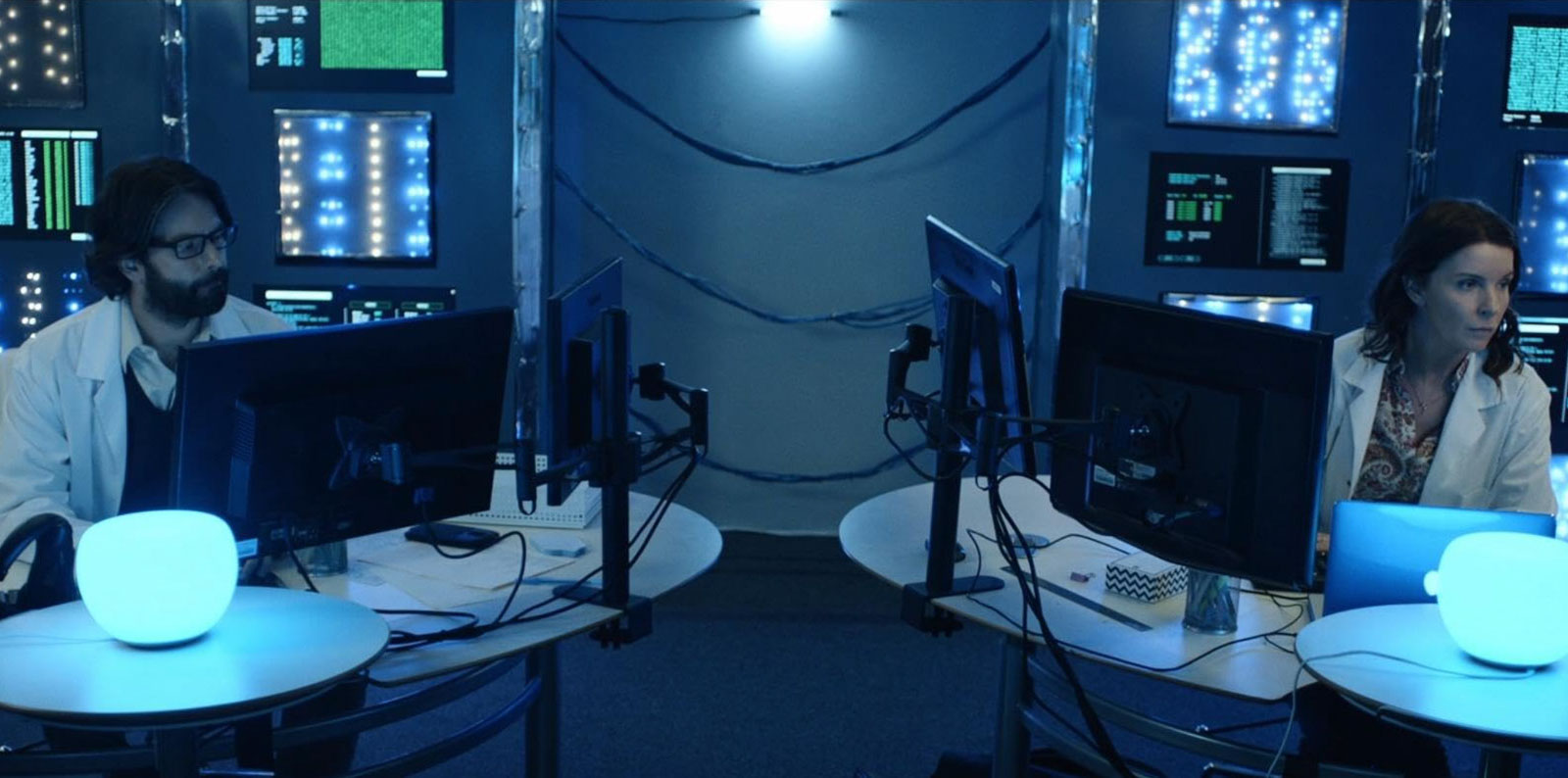
Hey there everyone! Welcome back to Movie Soapbox, the little corner of the internet that only you and I and that guy sleeping in the corner over there know about. This is the place where we find underappreciated indie films and we make sense of them. Today? We are doing a deep dive on Alpha Gateway, a movie so committed to making your brain fold in on itself that the ending doesn’t just confuse you, it makes you retroactively unsure about everything that came before it. Low budget. Australian. Parallel universes stacked six deep. Let’s get into it.
Real quick before we go any further: this movie will not be fun to discuss if you haven’t seen it. Seriously. Go find it, watch the whole thing, come back. Everything from this point forward burns the ending to the ground and doesn’t apologize for it. Still here? Good. You asked for this.
Alpha Gateway Move Walkthrough
So the film opens with Jacqueline McKenzie as Jane, a physicist who has apparently been spending an amount of energy that would make a national power grid weep trying to get a multiverse teleporter functional in what looks like a converted garage. And before the film lets you settle in, it starts throwing Tegmark’s Mathematical Universe Hypothesis at you, which is either the most ambitious thing a low-budget Australian sci-fi has ever attempted or a very confident bluff, and honestly, in a film like this, those two things are not mutually exclusive.
What you need to know about where this film came from before we go scene by scene: a movie operating at this budget level, built around a cast you don’t immediately recognize, leaning this hard into theoretical physics as its structural skeleton, does not get made in a system that is paying attention. Nobody at a major studio greenlit this. Nobody ran it through a committee. There were no twelve VPs debating whether audiences could handle Tegmark alongside their popcorn. The reason this film is as strange and as committed as it is, the reason it doesn’t sand down its own weird edges, is precisely because nobody with final-cut leverage had a financial stake in making it safe. You can feel the absence of interference in every scene where the film refuses to explain itself. A studio note would have killed this movie and replaced it with something that felt like every other dimension-hopping thriller you’ve already forgotten. Instead you got this. Appreciate that for a second.
Let’s Build a Map of the Alpha Gateway Universes
Tegmark’s Framework, Fast
The film leans on Max Tegmark’s Mathematical Universe Hypothesis, which is the theory that external physical reality is a mathematical structure, not merely described by math but actually constituted by it. Within that framework, Tegmark lays out four nested levels of multiverse. Level 1: same physics, same constants, just different initial conditions, different outcomes. Level 2: same quantum rules, different branches. Level 3: different equations entirely, reality starts to get genuinely alien. Level 4: different mathematical structures, all bets are off, the word “different” stops being adequate. The film uses this as its scaffolding. Every universe Jane visits is in principle one level further out from home. The further you go, the less the rules you know still apply. That’s the engine.
Universe Prime
This is Jane’s home. The universe the film starts in. The baseline. Jane’s husband Matt is dead before the story begins, killed during her research, and that loss is what’s driving all of this, the grief underneath the science. Prime is where everything originates and, as the film will make increasingly clear, where almost nothing successfully returns.
Universe Secunde
The first proof of concept. An apple gets teleported. Somewhere out in the multiverse there is a universe that received a piece of fruit it didn’t ask for. Secunde is the first destination the machine successfully reaches. A minor miracle in a converted garage. The film lets this land as triumph before it starts taking everything away.
Universe Tertie
Jane makes her first personal jump and finds Matt. Not her Matt, a Matt. Matt Tertie. And because grief does not care about the fine print on multiverse travel, she brings him back to Prime with her. Here is where the film starts to get genuinely dark underneath its science-fictional surface: Matt Tertie didn’t lose Jane to an accident. He killed her. He killed Jane Tertie because he was jealous of Regg, her lab assistant. The film drops this without fanfare. One moment you think Jane has found something to hold onto. The next you understand she has imported a murderer into her home and her children’s lives.
Matt Tertie, once he realizes he’s been figured out, does what a man like that does. He kills Regg Prime. He destroys the lab equipment in Prime, cutting Jane off from her way home. Regg Tertie, the version of Regg who is still alive, shows up and tells Jane he has his own setup. They cobble it back together, Jane jumps, and lands somewhere she was not trying to go.
Universe Quarte
Jane walks out of Regg Tertie’s machine into a house where Jane Quarte is alive and standing in her own kitchen and Matt Quarte is there and the kids are there and everyone is fine. Wrong world. Dead end. Regg decides to stay here, because there is a Jane in this world and there isn’t one in his anymore. That’s a quiet devastating beat the film doesn’t linger on and probably should have, but it doesn’t have time, and honestly the restraint works.
Universe Quinte
Regg, from Quarte, catapults Jane toward Prime. She lands and finds Regg’s lucky shirt, the one Jane told him needed washing at the top of the film. Callback. Confirmation signal. She’s home. She has to be home. The film wants you to feel the relief land clean.
Matt Tertie is still in Prime. He’s about to kill her. Jane gets the kids hidden. Matt Tertie comes for her in the bedroom and Jane’s son knocks him cold. They box him up, dial the machine to whatever level puts you somewhere genuinely awful, and send him to a world the film can only gesture at, something that looks like a wasteland, call it Universe Sexte, the film’s small mean gift to a man who had it coming.
And then Regg walks in and tells Jane she is not in Prime. She is in Quinte.
The Alpha Gateway Movie Ending Explained
Here is the mechanism, as cleanly as the film allows you to reconstruct it: the machine’s destination appears to be calibrated by energy output. Dial it to a certain petawattage and you arrive at a specific universe. Every jump from Quarte onward was aimed at Prime but didn’t have the precise calibration to actually land there, because there is a crucial asymmetry built into the whole system. They know how to leave Prime. They have records of what settings got them to Secunde, Tertie, Quarte. But they have never traveled TO Prime from outside it. They’ve only ever departed from it. So they don’t have the coordinates for home the way you’d need them for a clean arrival. Every attempt to return is an educated guess with catastrophic variance.
Which means Jane’s son knocked out Matt Tertie in Quinte, not Prime. And Matt Tertie’s wasteland prison is Septime. And Jane is one universe off from home with no obvious way to know if the next jump fixes it or pushes her one step further out.
The film does not follow its own rules with perfect consistency, and that’s a fair criticism. The petawatt calibration logic gets gestured at more than it gets demonstrated. But the emotional logic is airtight: Jane set out chasing a version of Matt to replace the one she lost, and the film ends with her in a universe that looks exactly like home and isn’t. That’s the horror. Not the machine. The grief that drove her into it.
Different Theories to Explain the Alpha gateway Movie
One camp reads the ending as genuinely open, that Regg could be wrong, that Quinte is close enough to Prime that it functionally doesn’t matter, and that the screwdriver-and-lucky-shirt callbacks are the film’s real confirmation signals, not Regg’s announcement. Under this read, Jane is home, or home enough, and the film ends on something that resembles repair.
A second camp takes Regg’s announcement as definitive and reads the film as a tragedy about the impossibility of recovering what grief makes you reach for. Jane jumped universe to universe chasing a husband who was already gone and the machine that was supposed to bring her back delivered her to an almost. The ending under this read is cruel in a very quiet Australian way.
A third read, less common, argues the film’s internal inconsistency is intentional, that Jane’s subjective experience of returning home is the point, and the film is asking you whether the distinction between Prime and Quinte even matters if no one in Quinte can tell the difference.
Where Moviesoapbox Thinks Alpha Gateway Lands
Regg is right. Jane never made it back. The calibration problem the film sets up is real and the film does not give you the out. You can feel it in the way the reveal lands: not as a twist designed to thrill you, but as the last quiet piece of a machine that was always going to end this way. A woman who built a door to everywhere except the one place she needed to go. The lucky shirt is real. The confirmation signal is real. Quinte is just close enough to Prime that the shirts match and the kids are the same and the grief looks identical from the inside. She is one universe off from home, and she has no way to know if she can close that gap, and the film ends there, not cruelty for its own sake, just the honest weight of what it was always actually about.
This is a small film. It got made in a garage, essentially, by people who cared more about Tegmark than about their marketing quadrant. It is imperfect and its rules wobble and the petawatt stuff will make you laugh. And it stuck its landing on the thing that actually mattered. A lot of films with ten times the budget and a hundred times the committee oversight cannot say the same thing. Remember that the next time someone asks you why you watch these little weird movies from the far corner of the genre shelf. This is why.
We’ll see you at the next one. But in the mean time, if you are looking for other movies in this same genre… Moviesoapbox has got you covered:
🎬 If You Liked This…
- Another Earth — another version of reality where the worst thing didn’t happen, and the unbearable question of whether you deserve to go there
- Coherence — parallel versions of the same reality bleeding into each other at a dinner party, the horror of meeting the version of yourself that made different choices
- The One I Love — a couple who discover an alternate version of themselves and have to decide which reality they actually want to live in