

Hey there everyone. Welcome back to Movie Soapbox, the little corner of the internet that only you and I and that guy sleeping in the corner over there know about. This is the place where we find underappreciated films, often ones that never got a domestic marketing budget or a recognizable face on the poster, and we make sense of them. Today we are doing a deep dive on The Invisible Guest, known in Spanish as Contratiempo, a movie so ruthlessly constructed and so quietly confident in its own machinery that the whole thing feels like watching a chess grandmaster play against someone who thinks they’re watching checkers.
You have not seen this movie. Or if you have, you didn’t see it coming. Nobody does.
Fair warning before we go any further: everything that follows is a full spoiler walkthrough of The Invisible Guest, including the ending, the twist, all of it. If you haven’t watched it yet, go find it, come back. The movie deserves to land on you clean. Still here? Good. Let’s get into it.
Before we walk through what actually happens scene by scene, you need to understand something about where a film like this sits in the development food chain, because it tells you something real about why it works the way it does. A movie built entirely on layered, contradictory testimony, where every version of events replaces the last one, is exactly the kind of project that dies in an American development office on the third note pass. Some VP of creative reads the coverage and writes “confusing, audience can’t track who to root for, needs a cleaner protagonist arc by page 30” and that’s it, the whole engine of the film gets pulled apart and replaced with something that tests better in Burbank. What Oriol Paulo was able to do here, building a screenplay that gets more additive and more brutal with every layer it reveals, is the kind of tonal control that requires a director who retained actual creative authority. You can tell by the confidence of the construction. Nobody panicked and softened the ending. Nobody punched up the third act with a redemption beat for Adrián that wasn’t earned. This film got to be exactly as cold as it needed to be, and that does not happen by accident.
So. The Invisible Guest. Here is what happens.
The Invisible Guest Movie Deep Dive Walkthrough
A wealthy Spanish businessman named Adrián Doria is found in a hotel room. His head is split open. His lover, a woman named Laura, is dead on the floor next to him. There is no sign of the intruder who killed her. This is the locked room, and the question of how the killer got out is the first shell in a shell game that has already been running for twenty minutes before you realize you’re playing.
The film opens on Adrián meeting with Virginia Goodman, a veteran defense attorney brought in specifically to prepare him as a witness before his trial. She is, we’re told, the best in the business, the kind of lawyer who retires undefeated and takes one last case out of pure professional pride. She is there to get the truth out of Adrián so she can build a story around it that will hold up in court. And so they begin. Version one: Adrián and Laura were having an affair, they got into a car accident, a young man named Daniel Garrido died in the crash, they panicked and hid the body, and later someone found out and set them up. Clean. Plausible. Virginia doesn’t buy a word of it.
She throws a newspaper on the table. What about the passerby? What about the father? Adrián adjusts. Version two is larger, incorporates more moving pieces, accounts for the witness. Virginia still doesn’t buy it. She pushes again. Each time she pushes, Adrián peels back another layer of what he’d been protecting, and each layer reveals that the version beneath it is worse for him than the one above.
The film works in the key of accumulation. Director Oriol Paulo makes a very specific structural choice here, one that separates this from a dozen lesser puzzle-box thrillers: the revisions are additive, not contradictory. When Adrián’s story changes, it doesn’t erase the previous version, it extends it. A happened. Then, no, A plus B happened. Then: A plus B plus C, and C is the part he was hoping you’d never ask about. The genius of this approach is that the audience never loses their footing entirely. You always have something solid under your feet, you just keep finding out the ground goes deeper than you thought.
So let’s trace the actual chain of events as they are finally revealed, stripped of the layering.
Adrián and Laura were having an affair. Driving back from a rendezvous, they hit Daniel Garrido’s car. Daniel is seriously injured. Rather than call emergency services, because they cannot explain to their respective spouses where they were, Laura convinces Adrián to put Daniel in the trunk of his own car and dispose of everything. Adrián drives Daniel’s car to a lake. Here is the critical detail: Daniel Garrido was not dead when Adrián pushed that car into the water. He was unconscious. Adrián drowned him. This is the crime that Virginia has been excavating toward for ninety minutes, and when she finally gets it, it recontextualizes everything that came before. The hit-and-run was a tragedy. Pushing a living person into a lake is murder.
Meanwhile, Laura, stranded on the road, is picked up by a helpful older man who turns out to be Tomás Garrido, Daniel’s father, searching for his missing son. She doesn’t know who he is. He doesn’t yet know what she is. The phone rings in the couch. The whole encounter is excruciating.
When the Garridos begin pressing closer, Laura takes further action, hacking Daniel’s bank account using information Adrián provides through his own lawyer, stealing fifty thousand euros to make it look like Daniel ran away voluntarily. And when Laura herself begins to feel the trap closing and decides she wants out, she sets a trap of her own: she contacts Adrián and threatens to expose everything unless he confesses to his wife. Adrián arrives at the hotel. There is an argument. Adrián kills Laura in the room. He has now gone from witness to a panic, to active participant in covering up an accidental death, to a man who has murdered two people, one of whom he drowned while unconscious in a car at the bottom of a lake.
And this is the man who has spent three hours being methodically gutted for information by someone he believed was his most powerful ally.
The ending. Virginia concludes their session. She has what she came for: the location of the lake, the confirmation that Daniel was alive, the full confessional map of everything Adrián did. She leaves. And then the real Virginia Goodman arrives at the door.
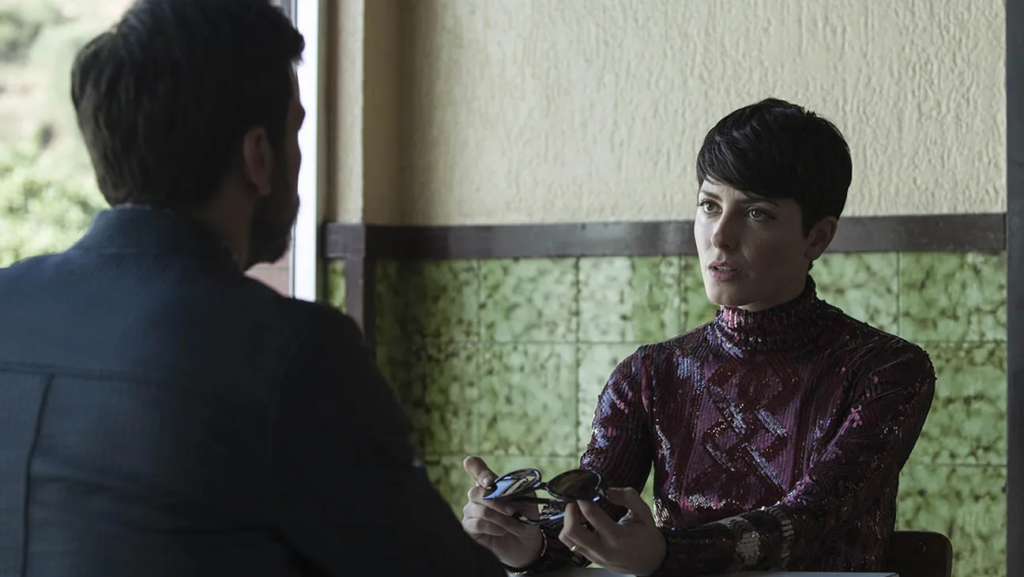
The woman who spent three hours in that room with Adrián was not his lawyer. She was Mrs. Garrido. Daniel’s mother. She came not to build a defense but to extract a confession, to find out where her son’s body was, to get Adrián on record saying what he actually did, presumably with evidence rolling. Every theory she floated, every alternative version of events she walked Adrián through, was bait to get him to correct the record in increasingly damning detail. She played a grieving mother playing a ruthless lawyer, and she did it better than Adrián’s actual ruthless lawyer ever could have, because she had something the real Virginia Goodman didn’t: she knew exactly what happened. She just needed him to say it.
The Invisible Guest Ending Explained
The title, which the film holds back from fully paying off until the final frame, refers to exactly this: the invisible guest in the room was always Mrs. Garrido. Adrián spent the whole film trying to figure out how the killer got out of the locked hotel room without being seen. The actual invisible guest was the one sitting across from him, pouring him water, coaching him through his story, the whole time.
The Invisible Guest Theories
A few things worth untangling for clarity, because the film moves fast and the layers stack.
The theory that Mr. and Mrs. Garrido were actually working in the hotel and physically set the trap that killed Laura, the one Virginia floats as a possibility partway through, that one is not true. It is a lure. Virginia, meaning Mrs. Garrido, floats it to see how Adrián responds when he thinks someone else might take the blame. He takes the bait, runs with it, and in correcting her version, fills in blanks he’d been protecting.
Laura’s plan to trap Adrián into confessing to his wife was real. That part of Adrián’s story holds up. She did set the hotel meeting as a kind of ultimatum. What he left out was what he chose to do when he got there.
The prosecution’s secret witness, mentioned early and seemingly discarded, is presumably tied to the confession Mrs. Garrido has now secured. The film doesn’t spell this out, but you don’t need it to.
Now, the competing reads. There are a few, though honestly less debate around this film than you’d expect, because Paulo is unusually precise about what he wants you to take away.
One reading: the film is primarily about class impunity, and Mrs. Garrido’s operation is a working-class family’s only recourse against a wealthy man who can simply buy his way out of accountability. Under this reading, the locked-room mechanics are just the delivery vehicle for a story about who gets to tell the story.
A second reading: the film is about layers of complicity, and every character, including Laura, including the real Virginia, is implicated in systems of self-protection. The film isn’t interested in heroes, only in varying degrees of culpability.
A third, thinner reading: the twist is primarily a genre exercise, a very well-executed one, and the thematic content is secondary to the craft of the reveal. Paulo as a technician first, moralist second.
Moviesoapbox’s Preferred Reading of The Invisible Guest
Movie Mike’s pick: the first reading, but complicated by the second. The film earns its coldness precisely because nobody is clean. Laura wasn’t innocent, the real Virginia makes her living helping guilty people escape consequences, Adrián is a murderer who assumed his wealth would protect him, and it almost did. Mrs. Garrido wins not because the system worked, but because she went around the system entirely and built her own trap. The film respects her for it, and so do I. A grieving mother with nothing left to lose is the most dangerous person in any room, and the film understands that completely.
Spanish cinema gave us a locked-room thriller that uses the locked room as a metaphor for the closed world of male impunity and then has a woman dismantle it with patience and grief and three hours of meticulous performance. That is what got to the screen here. That is what survived. Some films like this don’t make it, they get softened, they get a final scene where the detective explains everything to camera, they get a third act that lets the audience off the hook. This one didn’t blink. Find it. Watch it twice. The second time you’ll see her everywhere.
🎬 If You Liked This…
- Exam — one room, eight candidates, one question with an answer nobody sees coming until the film pulls it out from under you
- Spinning Man — another film where the final answer depends entirely on whether you trust the narrator, and you probably shouldn’t
- In Darkness — a blind woman overhears something she shouldn’t, and the twist that follows is the kind studios spend three rounds of notes trying to sand down into something safer