
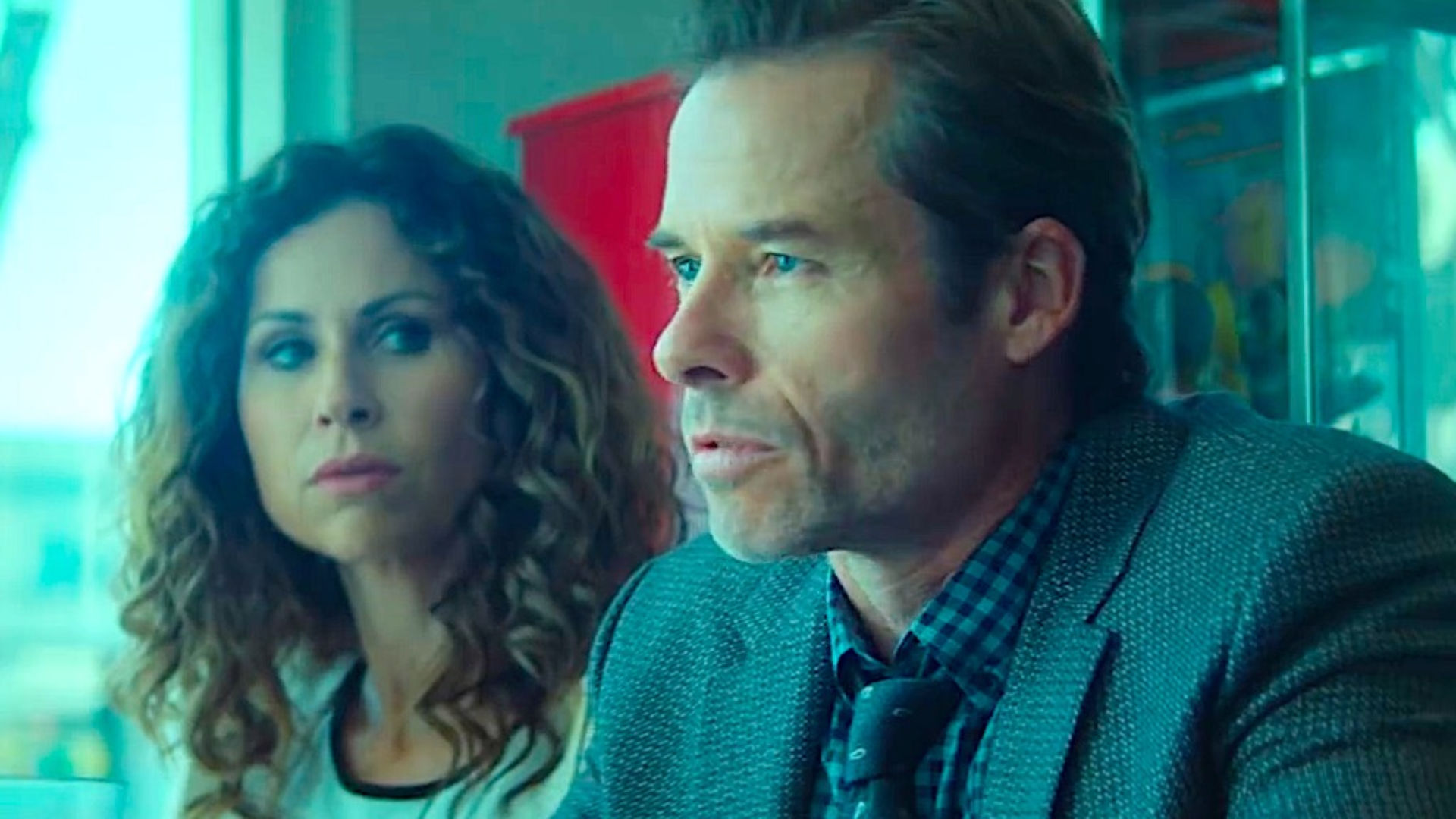
Hey there everyone! Welcome back to Movie Soapbox, the little corner of the internet that only you and I and that guy sleeping in the corner over there know about. This is the place where we find underappreciated indie films and we make sense of them. Today? We are doing a deep dive on Spinning Man, a movie so quietly, methodically destabilizing that by the time it hands you an answer you have completely lost confidence in your ability to receive one.
The Spinning Man Trailer
Fair warning before we go any further: everything from this point forward is a spoiler. The ending, the confession, the cliff, the lip balm in the backseat, all of it. If you have not watched Spinning Man yet, close this tab, go find it, come back. You will want the full hit of this one before you let me tell you what it means, because the meaning only lands if the confusion landed first.
Still here? Good. Let’s get into it.
The Spinning Man Walkthrough
Before we walk the timeline, you need to understand something about what kind of movie this actually is, and what kind of movie it almost became instead. A film with Guy Pearce, Pierce Brosnan, and Minnie Driver attached does not arrive at your streaming queue by accident. That cast is a life raft. At the budget tier this film was working in, a director with a psychologically slippery, genuinely ambiguous script, one that refuses to resolve cleanly, is one bad test screening away from a recut third act that hands the audience a killer with a motive and a close-up confession and a tidy little bow. The fact that Spinning Man made it to you with its ending intact, with the ambiguity still breathing, tells you something. Name talent creates a ceiling under which studio interference has to work a lot harder to justify itself. You can tell when a film has survived that pressure because the ending still feels like it belongs to the director. This one does. Barely, maybe, but it does.
Now. The timeline. Because this movie runs three threads simultaneously and the first quarter is designed to make you feel like you are losing your grip, so let’s nail it down before we go further.
Thread one is the oldest, the crime itself. Joyce, a high school cheerleader, is excited, waiting for someone. Her diary, which we learn about later, describes an older man. We see a figure in tweed stepping out of a Volvo, but the camera gives us only his back, only enough to suggest. Joyce ends up dead at the bottom of a lake.
Thread two is the bulk of the film, the investigation, Evan Birch’s life slowly coming apart under Detective Malloy’s pressure. Evan is a philosophy professor at a small unnamed college, the kind of academic who has strong opinions about the limits of knowable truth, which turns out to be enormously convenient for a man whose alibi keeps shifting.
Thread three is the film’s opening image and its ending, Evan walking into Malloy’s office, sitting down, and asking, “Do you ever have issues remembering things?” The movie plants that question like a mine in the first five minutes and then spends ninety more minutes walking you toward it.
There is arguably a fourth thread, Evan and his wife Ellen leaving their previous position at a college near Chicago following an allegation of an affair with a student, but we will get to that because it matters more than the movie initially signals.
So thread two. Evan is questioned about Joyce’s disappearance because his Volvo was spotted near where she was last seen. He refuses to let police search it, citing the Fourth Amendment with the particular confidence of a man who knows there is something in the car. When they eventually impound it, they find a strand of Joyce’s hair in the backseat. Then Evan’s daughter Zelda finds Joyce’s lip balm. His lawyer, presented with this evidence, does not look like a man who believes his client.
The film keeps loading the chamber. A camp counselor confirms that Evan was forty minutes late picking up Zelda the day Joyce disappeared. He has no account for those forty minutes that satisfies anyone, including, eventually, himself.
The Spinning Man Deep Dive
Now. The philosophy. Because this is not a thriller that uses academic content as decoration. Evan teaches Zeno’s Paradox to his students, the idea that movement toward a point can be subdivided infinitely, so arrival is theoretically impossible. Applied to this movie, it means that complete truth is theoretically unreachable. You can get closer and closer to what happened, but you never arrive. Evan also lectures on Wittgenstein, specifically using Wittgenstein’s habit of arguing the limits of moral truth in academic settings while having sex with men in parks at night, as evidence that a person’s philosophy and a person’s behavior exist in separate compartments. His student Anna finds this monstrous. Evan finds it interesting. That gap tells you everything about how Evan has structured his inner life, and it sets up everything that comes next.
Because what Evan has built, whether consciously or not, is a philosophy that pre-justifies his own behavior. If truth is only what you can perceive, and perception is unreliable, and memory is the most unreliable form of perception, then nothing you did that you cannot clearly remember is fully, morally yours to own. That is not a philosophy. That is a coping mechanism with footnotes.
The mousetrap thread. It is not useless, even though it looks like a detour. Evan gets humane traps for the mice, they fail, he upgrades to the real ones. Zelda’s rabbit gets loose. The rabbit ends up caught in one of the traps. Evan disposes of the body, says nothing, and the next day helps Zelda put up Missing Rabbit posters around the neighborhood. On the other side of one of those telephone poles: a Missing Joyce poster, same format, same heartbreak. Evan looks at both of them. The movie does not underline this. It just lets you sit with it. A man who disposed of a small dead animal and told nobody, standing in front of a poster asking for information about a dead girl. Take that however you want. The movie will not tell you how.
Then the faculty party. Evan and Ellen argue. She leaves. He wanders off, drinks more, and the film does something formally interesting here, women’s faces begin overlapping, bleeding into each other, a visual representation of Evan’s unreliable interiority. He ends up in a car with Anna, his former student, and they are kissing. Anna says she loves him. Evan shoves her out of the car. She hits the pavement on the back of her neck. And Evan sits there in the dark, alone, suddenly very aware of what his hands are capable of.
And then he walks into Malloy’s office and confesses.
He says he must have forgotten. He says it was an affair, it went wrong, he shoved her, she hit her head, he panicked and put her body in the lake. Malloy listens to the whole thing and then says, no. The physical evidence does not support it. No signs of sexual contact. There was a cliff nearby. Her injuries are consistent with a fall, broken neck, broken arms. You did not do this.
So now you have to decide what you just watched.
The Spinning Man Theories to Explain the Movie!!
The mechanism Evan fell into has a real clinical name, Memory Distrust Syndrome, first described by Gudjonsson and MacKeith, and it is exactly what it sounds like: a person loses trust in their own memory to the point where external pressure, a detective’s certainty, a lawyer’s doubt, a wife’s accusation, becomes more credible to them than their own recollection. The result is a false confession that the confessor genuinely believes. Evan did not confess to get the pressure to stop. He confessed because he had convinced himself it was true. That is the pressured-internalized variant. That is what this movie is arguing happened.
Whether you buy that argument is where the film splits the room. Here are the four serious readings.
Theory One: Joyce died accidentally, Evan is innocent. Take the film at its word. Evan’s memory is compromised. Malloy’s pressure, combined with Ellen’s years of suspicion about the Chicago affair, eroded Evan’s trust in his own perception of events so thoroughly that he absorbed the guilt for something he did not do. The forty missing minutes are real, but they are just a man who spaced out and drove around and then panicked when he realized what being late looked like. The hair in the car? She got a ride at some point, plausibly, he was a professor at a nearby school. The lip balm? Same explanation. The cliff exists. She fell.
Theory Two: Evan killed her. Forget Malloy’s conclusion. We never see the cliff. Joyce’s diary describes an older man she is enamored with. We see Evan’s pattern, the hardware store fantasy, the Chicago affair allegation, Anna, forty missing minutes. Malloy’s physical evidence reading could simply be wrong. A sexual encounter does not always leave traceable forensic evidence, and the injuries from a shove and a fall near a cliff and injuries from a fall off a cliff look the same. Evan is a man who is capable of convincing himself he did not do things he did. The confession is not the distorted version of events. Everything before the confession is.
Theory Three: Ross did it. Ross is the professor who, early in the film, floats the hypothetical of sleeping with a student if there were no consequences. He is the man who gives Evan rides after the car is impounded, he is close enough to the situation to be watching it carefully, and the figure we see meeting Joyce is identifiable only by tweed, which means it could be anyone with a faculty wardrobe and a Volvo. Ross has no stated alibi. He has the right philosophy, which is to say no philosophy at all. If you want a killer who is not Evan and is not an accident, Ross is the cleaner fit than the movie lets on.
Theory Four: Ellen. Stay with this. Ellen and Evan left Chicago because of an affair allegation. She has been watching him for years. She notices him giving Joyce and her friends a ride. She follows him on the day he is supposed to pick up Zelda. Suppose Evan and Joyce did meet that day, maybe it was nothing, maybe it was something, and then Evan left. And Ellen, who has moved cities once already for this man’s behavior, who cannot move again, who is standing on a cliff with a girl she believes destroyed her marriage, makes a choice. The scene of Ellen driving, unprompted, down to the lake where Joyce’s body was found, spotted by Malloy, is either meaningless or it is the most important scene in the film. It is not nothing. The movie does not include it as nothing.
Moviesoapbox’s Personal Read
Theory Four does not have enough architecture to stand alone, but it is the right instinct poorly aimed. Ellen’s drive to the lake is guilt behavior, or grief behavior, and the film refuses to distinguish between them. The version I believe: Evan met Joyce that day, it was an encounter that did not go where he wanted it to, and she left. On her own. Walked toward the cliff because she was upset, fell. Evan was late because he sat in his car for forty minutes trying to decide what it meant that he had been there at all, trying to decide whether anything had happened, unable to trust his own account of his own behavior long before Malloy ever got to him. That self-doubt, the Memory Distrust that is Evan’s philosophical inheritance from years of convincing himself his desires are theoretical, is what Malloy’s investigation detonated. The confession is real in the sense that Evan believes it. It is false in the sense that the cliff was real and Joyce fell.
What this movie survived to get to you is a third act that refuses to let the detective be right, refuses to let the confession be true, and refuses to tell you which man’s epistemology won. Most films at this level get a producer note somewhere around draft six that says the audience needs to leave knowing. Spinning Man did not take that note. That is the whole film.