
Hey there everyone! Welcome back to Movie Soapbox, the little corner of the internet that only you and I and that guy sleeping in the corner over there know about. This is the place where we find underappreciated indie films and we make sense of them. Today? We are doing a deep dive on Exit 8, a movie so quietly devastating that the Cannes crowd gave it eight minutes of standing ovation, and the studio system had absolutely nothing to do with it getting made, which is the only reason it works at all.
Fair warning before we go any further: everything that follows is going to spoil this film completely and without apology. If you have not seen Exit 8 yet, close this tab, go watch it, come back. It runs 95 minutes. You have the time. What you do not have is the ability to unsee what the ending does to you once you know it’s coming, so go in clean. I mean it.
Right. Still here? Good. Let’s get into it.
Director Genki Kawamura made this film from a source with no story, no characters, and two NPCs, a game you can speedrun in five minutes, and turned it into something that screened at Cannes and received one of the longer standing ovations in recent memory. You want to know what that means, functionally, in terms of what this film had to survive to exist? A Japanese independent production built around a game that Western distributors had never heard of, a concept that pitches as “man walks down a hallway repeatedly,” no franchise IP, no sequel runway, no algorithmic comfort food anywhere in its DNA. The committee that greenlights movies in 2024 would have killed this thing in the room. Kawamura had to make something so formally precise and emotionally true that the film itself became the argument for why it should exist. That is a harder fight than it looks. And he won it.
Now. The setup.
Exit 8 and The Test
The film opens on a Tokyo subway car, and the very first thing it shows you is a choice being unmade. A mother boards with a crying baby. A man starts loudly berating her, the kind of public aggression that makes every bystander on a train suddenly very interested in their shoes. Our protagonist, credited only as The Lost Man because the film is not interested in letting you keep comfortable narrative distance from him, watches. Takes his earbuds out. Listens. Then puts them back in.
He does nothing. File that away.
He gets off the train, his phone rings, his girlfriend tells him she is pregnant, and she needs an answer from him: do they keep the child? He is rattled, vague, promises to come to the hospital, the call drops, and he walks toward Exit 8. The word “Test” appears briefly on screen. Then it fades. Then we begin.
Exit 8 and The Rules
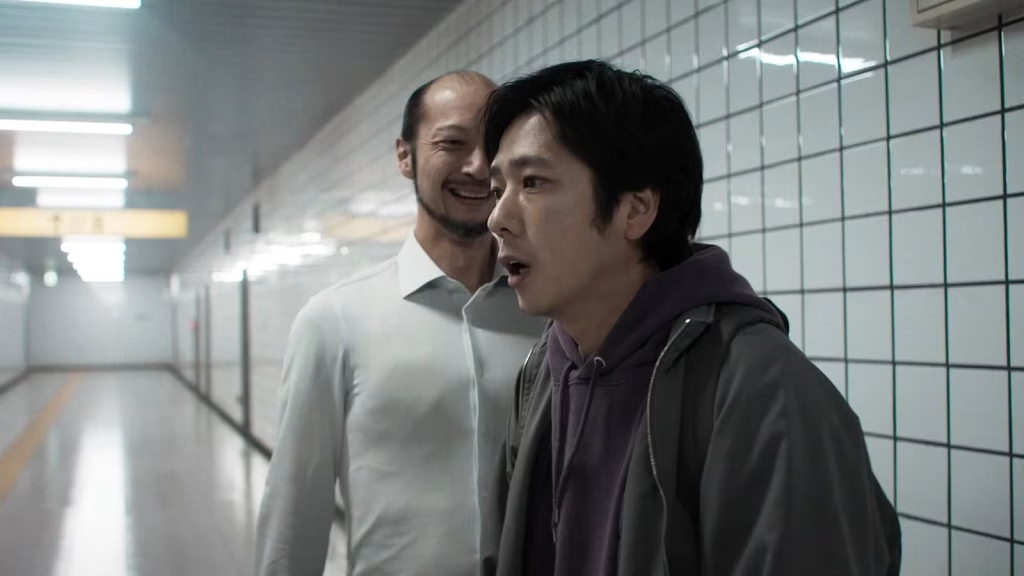
The corridor is fluorescent, sterile, the kind of institutional non-space that exists in every major city subway system and that you have walked through a hundred times without ever really seeing. One other figure appears in every loop, the Walking Man, expressionless, moving in the same direction at the same pace, every single time. Except when he isn’t. Except when something is wrong.
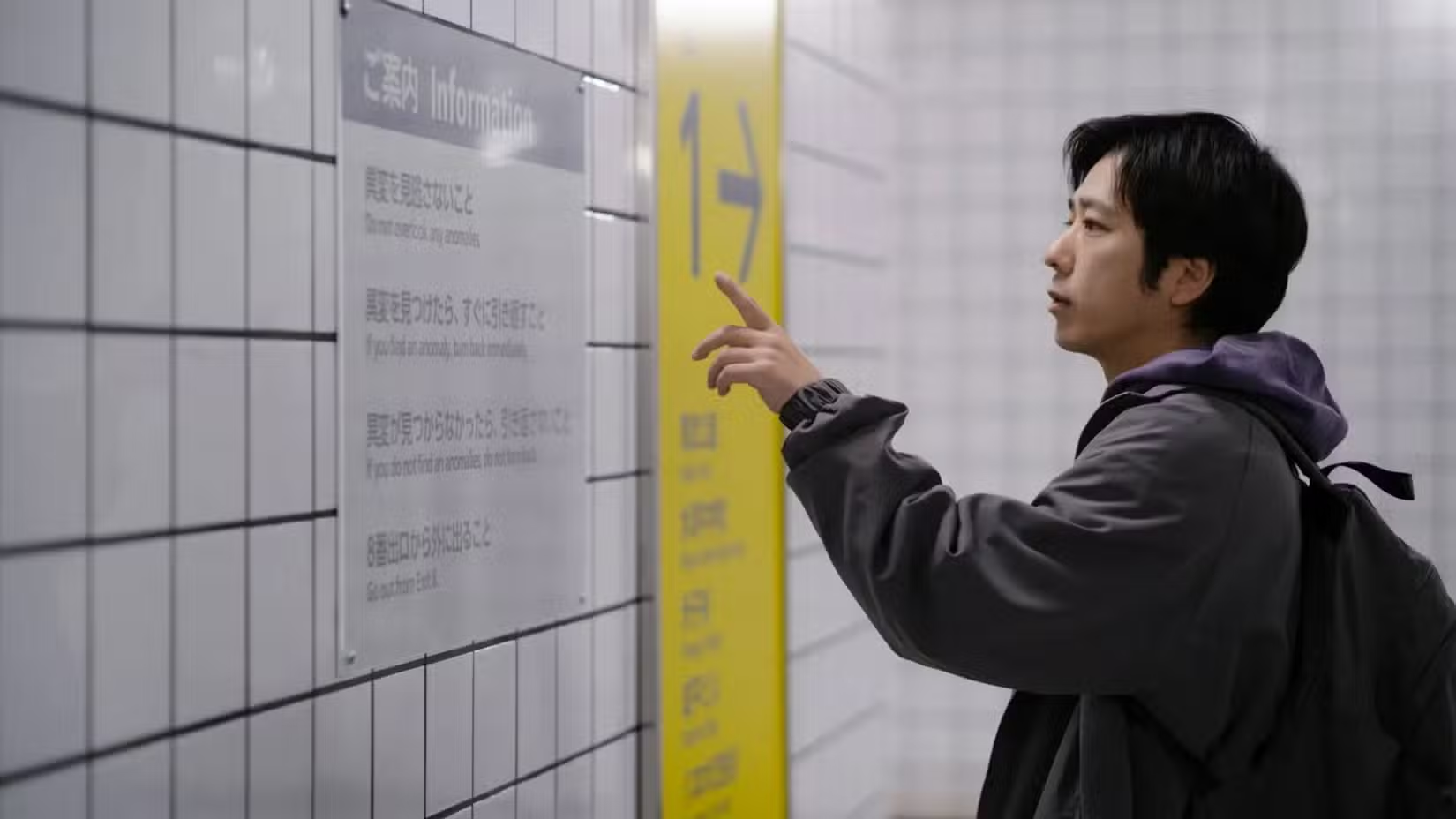
The Lost Man eventually finds the rules posted on the wall like an OSHA notice that somehow governs your entire moral existence. Do not overlook any anomaly. If you find one, turn back. If you find none, keep walking. Exit through Exit 8. The counter on the sign tells you how many you have gotten right in a row. Eight clean loops and you are out. One mistake and the counter goes back to zero.
The anomalies escalate. A doorknob where there was none. Blood from the ceiling. The Walking Man grinning directly at your face. The Lost Man starts photographing everything compulsively, building a mental map, scanning the subway manners poster, the dentist ad, the lockers, the fire hydrants. You start doing it too, whether you meant to or not. Kawamura has you playing the game inside the movie without ever asking your permission. That is the devilish move, and it is completely deliberate.
Exit 8 and The Phone Call
Around round six, something unprecedented happens. His phone rings. Girlfriend again. He takes the call and he tells her, right there in the corridor, that he did not defend that mother on the train, that he does not know what kind of father he could possibly be, and when he turns the corner the sign reads: Exit 0.
The phone call was the anomaly.
That is the moment this film earns everything it is asking of you. The corridor does not care about your intentions. It does not grade on effort or self-awareness. His emotional avoidance, his inability to say the true thing to the person asking the real question, that is the miss. The loop does not reset when he misreads the corridor. It resets when he misreads himself. The corridor and the man are running the same test.
Exit 8 and The Boy
In a later round, a boy appears. Small, calm, completely out of place. The Lost Man’s instinct is to treat him as an anomaly and drag him back, which tells you exactly how conditioned we get to misreading what is actually in front of us once a system teaches us to be afraid of surprises. But the boy talks. He has a history. He tells our man, quietly, that he separated from his mother on purpose, hoping she would come looking. That he has never met his father.
And there it is.
The two of them form a team. The boy spots anomalies the Lost Man keeps missing: an upside-down ceiling sign, a door that opens onto a reflection of the subway bystander moment, the exact frame where The Lost Man chose not to act. Exit 5. Exit 6. The counter climbs. The mutant rats, nightmare creatures with baby-cry mouths that look like something a fever dream subcontracted to a practical effects team, are a trial they white-knuckle through together. Then a flood tears through the corridor and in the chaos, without thinking, The Lost Man grabs the boy and hoists him up to the ceiling sign at Exit 7, keeping him above the water. The flood takes The Lost Man. He does not calculate that sacrifice. He just makes it.
When the water clears, the boy is alone at Exit 7. He looks down the corridor. No anomalies. He walks forward.
Exit 8 Ending Walkthrough Explanation
The Lost Man surfaces separately. He finds no anomalies. He walks to Exit 8 and takes it.
Back in the real world, he goes to a vending machine, buys a water bottle, drains the whole thing in one long pull like a man who has been somewhere for a very long time. He calls his girlfriend. He tells her he is coming to the hospital, and you can hear in three seconds of audio that something has shifted, that this call is not like the last one.
He boards a train. The same mother is there. Same crying baby. Same man, launching into the same berating tirade that opened the entire film, beat for beat, word for word. The Lost Man stands there. He listens. He tears up.
And then he turns toward them. The film cuts before we see what he says or does. It does not need to show us. We know. The screen goes dark. That is Exit 8.
What the Ending of Exit 8 Means
The boy is almost certainly not a real boy, or he is both, real within the film’s logic and simultaneously a vision of the child his girlfriend is carrying. The metaphors are too precise to be accidental: both have absent fathers, both separated from their mothers, both are waiting for someone to choose them. When The Lost Man hoists the boy above the flood, he is making the choice he could not make on the train platform. He just did not know it until after he made it.
The corridor’s rules were never confined to the corridor. The loop is life. The anomaly is you, failing to show up, failing to act, failing to turn toward the thing instead of away from it. Exit 8 is the moment you stop doing that. The film ends the second he makes the turn because everything before it was practice. Every loop was practice.
One note on the Walking Man: his arc is interesting but slightly underbaked. What the film does reveal is significant, that he was once a regular person trapped in the same corridor who fell for a false exit and got absorbed into the loop itself, became part of the mechanism. The same fate found the High School Girl. The corridor is not just a puzzle. It is a presence. It keeps the people who do not make it. That is a darker dimension than the film fully develops, and the limited-budget CGI on those mutant rats does not help the moments where it needs to be scary on a technical level, but neither of those things undoes what the film builds.
Kawamura made a video game adaptation that works by completely letting go of the game. He kept only the rules and the atmosphere, stripped everything else, and used what remained to tell a precise, human story about fatherhood and guilt and the ordinary heroism of showing up for people. A film adaptation of a five-minute walking simulator premiered at Cannes and received an eight-minute standing ovation because the right director, with the right instincts and enough creative control to actually use them, can make a film out of anything. The system would have turned this into a franchise concept with a named protagonist and a post-credits tease. Kawamura made something that ends in the dark and trusts you to sit in it. That is the difference. That is always the difference.
If Exit 8 hit you in the right in the face, then you definitely need to check out these films next:
If You Liked Exit 8…
Coherence (2013) – A dinner party where reality fractures and nobody can tell which version of themselves is the original. Same claustrophobic dread, same “wait, what just changed” energy.
Timecrimes (2007) – A man trapped in a loop that tightens with every pass. If Exit 8 made you feel like the walls were closing in, Timecrimes will finish the job.
ARQ (2016) – A closed-box loop film where every reset changes the rules. Netflix buried this one and it deserved so much better.