
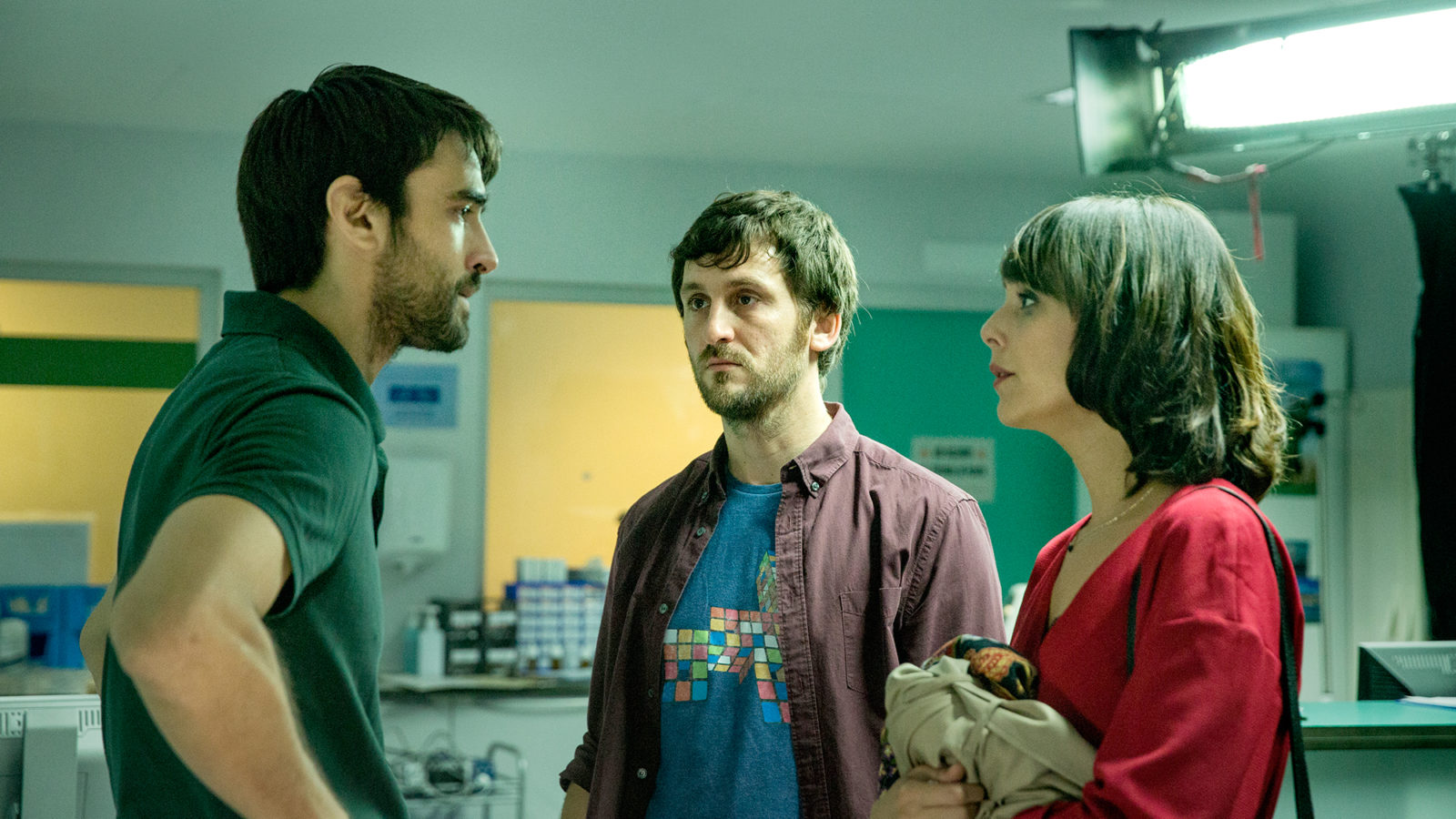
Hey there everyone! Welcome back to Movie Soapbox, the little corner of the internet that only you and I and that guy sleeping in the corner over there know about. This is the place where we find underappreciated indie films and we make sense of them. Today? We are doing a deep dive on The Warning, known in its original Spanish as El Aviso, a movie so quietly ruthless in its structure that you almost forgive it for the places where it loses its nerve.
Fair warning before we go any further: everything that follows is a spoiler. The whole mechanism. The curse, the math, the death Jon didn’t have to manufacture but did anyway. If you haven’t seen it, close this tab, go watch it on Netflix, come back. The film earns the confusion it creates in the first half and you want to experience that without me standing in your ear telling you where it lands. Go. Come back. I’ll be here.
Alright. Here’s what almost happened to a movie like this, and you can see the scar tissue if you know what you’re looking for. A Spanish-language genre thriller built around a schizophrenic mathematician tracing a century-long murder pattern through a single address, with a climax that hinges on a man manufacturing his own death to close a loop nobody else even believes exists, that is a film that, in the wrong hands at a mid-level streamer with two rounds of notes still pending, becomes a procedural. Becomes a detective story. The mathematician gets a partner who grounds him. The supernatural ambiguity gets explained in a monologue. The ending gets an extra scene where Nico, as an adult, understands everything. You can feel the places in this film where someone pushed for exactly that and director Daniel Calparsoro held the line, or held it mostly. The caterpillars stay strange. The final scene stays small. Whatever argument happened in post, the film came out on the right side of it, barely, and that matters.
The Movie Architecture of The Warning (El Aviso)
So here is the architecture. Keep this in your head as a scaffold while we walk through it: The cycle begins with Ezequiel, who killed four people and committed suicide in 1913. Then, 42 years later, a woman aged 42 dies. 21 years after that, a man aged 21 dies. 32 years later, a man aged 32 will die.
The Warning (El Aviso) Movie Walkthrough
The film opens on Nico, nine years old, a few days from turning ten. He is being bullied with the specific creativity that only children deploy, and the bullies send him to steal a magazine from the local convenience store. The owner catches him, lets him buy a gaming magazine instead, and slips a handwritten note inside. The note tells a ten-year-old not to come to the store on his birthday. If he does, he’ll die.
Nico’s mother assumes the bullies wrote it. Then she assumes the store owner wrote it. Neither is true. The note was placed in that magazine ten years earlier, by a man who hasn’t written it yet from Nico’s perspective. That’s the temporal hook the whole film turns on, and the movie drops it on you in the first ten minutes without ceremony, which is the correct instinct.
Ten years prior, Jon goes to pick up his friend David and they stop at the convenience store for ice. David walks in. An attempted robbery goes wrong, David gets shot, and he ends up in a coma. Jon, who is a schizophrenic and a mathematician, which in movies are apparently the same job description, starts pulling the thread. Three previous violent incidents at this same address. All of them except David’s occurred on April 12th. All of them had five people present: a ten-year-old and four adults aged 21, 32, 42, and 53. Jon is also seeing swarms of caterpillars and moths everywhere he goes, which the film presents as either symptom or signal and never fully commits to distinguishing between the two. That ambiguity is doing real work. Leave it alone.
Jon traces it back to 1913. A man named Ezequiel González, recently back from the war in Africa, desperate for money to pay for his daughter’s surgery, robbed a bank at that address. He killed the bank manager and three other people before killing himself. Four deaths. One child witnessed it and survived. The reverberations from that event propagate forward through history in mathematically precise intervals, each time finding a new ten-year-old standing at ground zero.
1913: the bank, four dead, a child born who will grow up to run an inn on the same site.
1955: 42 years later, the inn owner, age 42, is murdered by her ex-husband in front of her ten-year-old son. A child is born.
1976: At the same location, ETA operatives attempt to assassinate a general. A 21-year-old guard dies protecting a ten-year-old boy. The general survives. A baby is born, named Jon.
2008: Jon watches his best friend get shot. He becomes convinced David is the person fated to die in this cycle, the 32-year-old who completes the pattern. He is wrong about that in the most painful way possible.
David’s family decides to pull his life support on April 12th, which lands exactly where the pattern predicts. Jon goes to Andrea, David’s girlfriend, and tells her this is how it has to go. The math is perfect. April 12th. It all aligns. And then David wakes up.
David recovers. The numbers are broken. The pattern doesn’t have its 32-year-old. Jon, whose schizophrenia has been pulling him deeper into the logic of the curse for weeks, arrives at a conclusion that is both mathematically coherent and completely insane: he has to be the one. He writes the note. He gives it to the store owner and tells him to put it in a magazine for a boy named Nico in ten years. Then he goes back to the store, assumes the man inside is there to rob it, takes the owner’s gun when the robbery doesn’t materialize, and waits for the numbers to complete themselves. A cop arrives. The numbers are right. The cop shoots Jon. Jon dies. The cycle closes.
Or does it close? Jump forward ten years. Nico is turning ten. His mother, who has read the note and decided her son needs to face his fears rather than be ruled by them, takes him to the store on April 12th. Inside, a man pulls a gun on the cashier. The cashier pulls a gun back. Nico looks into a mirror and sees Jon standing in the store ten years earlier. Jon screams at him to run. Nico runs. The two men shoot each other. Nico walks out. And when his mother asks him how he feels, he says he wasn’t afraid.
What is the Film The Warning (El Aviso) Actually Doing?
That’s the film. Now let’s talk about what it’s actually doing.
The curse is not the point. The curse is the pressure. What the film is actually asking is whether a pattern, mathematical or supernatural or just the accumulated weight of human suffering repeating itself through a location, has any power over a person who decides to refuse it. Jon couldn’t refuse it. His schizophrenia made the numbers feel more real than the world. He saw the pattern so clearly that he became part of it, willed himself into the slot the pattern needed to fill. Nico, warned by Jon’s death, sees the pattern too, and runs. Same location. Same date. Same mechanism. Two different outcomes based entirely on what the person inside the pattern does with the information.
That is a free-will argument dressed in curse-logic clothing, and it is a reasonably elegant one.
Now, the reincarnation question. Jon explicitly tells the store owner to watch for a boy who will be just like him, same kind of geeky t-shirts, same kind of mind. And Nico does fit that description, Minecraft shirt where Jon had a Rubik’s cube shirt, both of them drawn to patterns and games. Jon believed David was his reincarnated soul being cycled back through the location to close the loop, and when David survived, he recalibrated and decided it was himself. The film leaves open the possibility that the curse is Ezequiel’s soul cycling through bodies, paying for the four deaths in penance, moving through the Inn owner and the guard and Jon and finally Nico, each iteration slightly less catastrophic, the violence slowly bleeding out of the pattern until a ten-year-old just runs out a door and goes home.
That reading works. It’s tidier than the free-will reading in some ways, grimmer in others, because it means Jon never had a choice at all, just the subjective experience of choosing while the gears were already set.
The free-will reading is messier and more interesting. Jon manufactured his own death. The robber never materialized. The gun he picked up was the store owner’s. He created the circumstances that killed him because the math told him it had to happen. Nico, given the same information, chose differently. The curse had no power over Nico. It had all the power over Jon, but the power was coming from inside Jon the whole time.
Moviesoapbox’s Read of The Movie The Warning (El Aviso)
My read: the free-will frame is what the film earned, and the reincarnation frame is what it’s using as scaffolding to get there. Ezequiel’s crime set a trauma into a location. That trauma pulled vulnerable people toward it across a century, people at the ages that matched the original casualties, and it kept finding ten-year-olds to witness it, to carry the story forward. Jon was the last person the trauma found who couldn’t resist it. Nico was the first one who could. The cycle ends not because the math completed itself, but because someone finally refused the math. Jon’s death wasn’t inevitable. It was a choice made by a man whose illness made the pattern feel like gravity. The film is honest enough to show you that, even if it doesn’t shout it.
What this film had to survive to exist in this form is the version where the schizophrenia is a red herring, tidied up by a third act that explains the supernatural element definitively one way or the other. The ambiguity between illness and genuine curse is the whole engine. Kill that ambiguity and you have a competent puzzle box with a clean solution. Keep it and you have something that actually bothers you for a day or two after. Calparsoro kept it. The film is messier for it in places, the caterpillar imagery never fully integrates, the Jon-sees-moths sequences feel like they belong to a slightly different movie, but the mess is the point. Jon’s reality was messy. His certainty was the problem, not the pattern. A tidier film would have missed that entirely.
The Warning definitely isn’t the movie Pi, nothing is Pi, but it’s doing something real with the same raw material, and a movie that ends with a ten-year-old saying he wasn’t afraid deserves better than to get lost in a streaming queue behind the franchise sequels. That’s all this place is about. Finding the ones that almost didn’t make it out.
🎬 If You Liked This…
- Mirage — the other Spanish-language puzzle-box thriller with parallel timelines bleeding into each other, same tight structure and same reveal that recontextualizes everything you thought you understood about the story
- Dark Season 1 — the same obsessive pattern recognition across multiple timelines, a protagonist following a shape nobody else can see to its inevitable conclusion, the same discovery that the pattern was always pointing somewhere specific
- Predestination — the same mathematical inevitability of a timeline folding back on itself, the same discovery that the pattern the protagonist has been following was always pointing directly at them