
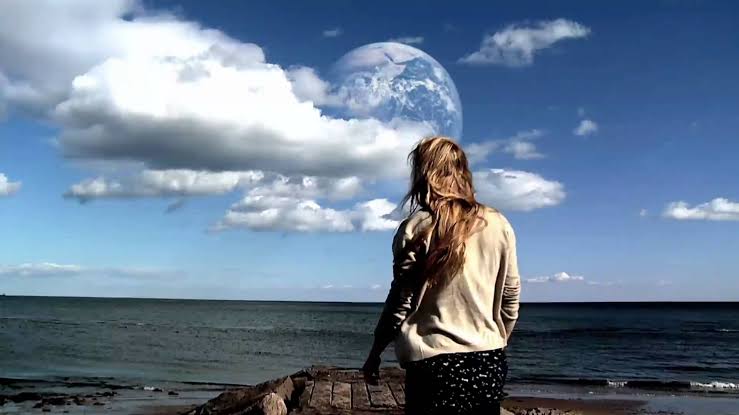
Another Earth Movie Explained Brit Marling’s Gut Punch. Hey there everyone! Welcome back to Movie Soapbox, the little corner of the internet that only you and I and that guy sleeping in the corner over there know about. This is the place where we find underappreciated indie films and we make sense of them. Today? We are doing a deep dive on Another Earth, a movie so quietly devastating, so stripped-down in its ambitions and so enormous in what it actually pulls off, that the fact it exists at all in the form it exists in is something close to a miracle.
Before we go any further, I need you to understand that everything from this point forward is going to spoil this film completely, top to bottom, ending and all. If you have not seen Another Earth yet, close this tab, go find it on whatever service is currently hosting it, watch it, and come back. This post will be here. I will be here. We will do this properly.
OK. You’re back, or you’ve already seen it, or you’re the kind of person who reads the last page of a novel first and I’ve accepted that about you. Either way. Let’s get into it.
What you need to understand before you understand a single scene in this film is what kind of film it almost was, and what kind of film it would have been in any other version of its own story. A first-time feature director, Mike Cahill, co-writing with his lead actress, shooting on consumer-grade HD video with a budget that wouldn’t cover a single day of craft services on a mid-tier studio production, going out to Sundance with a film that has a science-fiction premise and zero science-fiction money. You know what happens to that film in a development office? It comes in as a quiet, personal grief story with a cosmic metaphor at its center, and it leaves that office as a thriller about parallel-world invasions with a third act that tests at a 74 in Kansas City. The fact that Another Earth retained its entire spine, that it stayed a film about guilt and self-perception dressed in the clothes of a sci-fi premise rather than the other way around, tells you everything about how little studio machinery was able to get its hands on it. The budget was the protection. The obscurity was the protection. When nobody powerful thinks you’re making anything worth controlling, you get to make the thing you actually meant to make.
Another Earth Movie Detailed Walkthrough
The surface plot is simple enough that you could fit it on a napkin. Rhoda Williams, played by Brit Marling, gets accepted to MIT, goes to a party, gets drunk, drives home, and runs a red light into a family. The husband, John Burroughs, played by William Mapother (yes, Ethan from Lost, yes, that was bothering you, you’re welcome), survives after an extended coma. His wife, his son, and his unborn child do not. Rhoda goes to prison for four years. John loses his career as a music professor at Yale, loses his direction, loses pretty much everything that wasn’t already taken from him at the crash site.
The night all of this happens, the same night Rhoda gets her MIT acceptance letter, is also the night Earth’s astronomers confirm that the object that has been sitting in the sky is not a moon, not an asteroid, not a weather event. It’s another planet. It’s another Earth. And as they get the first radio signals back from it, they realize the voice on the other end sounds exactly like one of the scientists trying to contact it, because it is. Same planet, same civilization, same people, mirror-copied and hanging up there in the sky like God left a window open.
Rhoda gets out of prison four years later and she cannot put herself back together. She had a trajectory, MIT, astronomy, the kind of future that bright kids from good families are supposed to have, and she detonated it herself at nineteen years old. So she takes a janitorial job at a local high school and she works with her hands and she tries not to think. She can’t stop thinking.
She finds John. She watches him from outside his house, this broken man, this stranger she destroyed, and she goes to his door intending to apologize, intending to take the hit she’s been carrying for four years and hand it directly to the person who deserves an explanation. She knocks. He opens the door. And she folds. She cannot do it. So instead, she invents a story about a cleaning service running a free trial, and he lets her in, and she starts cleaning his house every Friday, not cashing any of the checks he leaves, just absorbing whatever proximity to him she can manage as a form of punishment she’s designed for herself.
Meanwhile she enters an essay competition for a civilian seat on the first manned mission to Earth 2. And meanwhile, the radio shows and think-pieces are churning out what becomes known as the Broken Mirror Theory: the two Earths were perfect copies of each other right up until the moment they became aware of each other, and at that moment of mutual discovery, the mirroring broke and each world began diverging. Free will entered the picture for both planets simultaneously. Which means, for Rhoda, a very specific and devastating implication. The accident happened after the discovery. Which means Rhoda 2, on Earth 2, may have had a completely different night. Celebrated differently, or not at all. Didn’t get in the car. And John 2’s family might still be alive.
She wins the competition. John, who by now has let her into his life in the way that isolated grieving people let in the one consistent presence they can tolerate, asks her not to go. She tells him she’ll let him decide after she tells him a story. Then she tells him who she is. What she did. The full thing.
He throws her out. Physically. He is, by any reasonable standard, entitled to a much stronger reaction than that.
She comes back one more time. He chokes her, briefly, and she lets him, because she has been letting him punish her in slower ways for months and this is just the most direct version of the same thing. When he stops, she tells him about the Broken Mirror Theory, about Earth 2, about the possibility that his wife and son are alive up there in that other sky. And she leaves him the ticket.
Four months later, she’s back in her family’s driveway. And standing there, looking at her, is Rhoda 2.
Another Earth Movie Mechanics
The Broken Mirror Theory is the load-bearing wall of everything the film wants to say emotionally, so it’s worth being precise about what it actually implies, and where the logic gets a little convenient.
If the two Earths were perfect mirrors until the moment of mutual discovery, and the discovery happened the same evening as Rhoda’s accident, and the accident happened after the discovery, then the divergence had already begun before the crash. Rhoda 2 may have had a completely different night. No accident. No prison. No demolished future. She might be, at the moment Rhoda 1 is standing in that driveway as a former convict with a janitorial job, an MIT graduate, maybe already working in the field she always wanted. The delta between these two versions of the same person, across five years of divergence from that single night, is enormous.
That is the mechanic that works. Here is the mechanic that the film quietly asks you not to think too hard about. John 1 takes the ticket to Earth 2. His hope, the hope Rhoda planted in him, is that his family is alive up there. And they may well be, because John 2’s wife and children survived a crash that never happened. But John 2 also exists. He is up there, on Earth 2, with his family, having presumably had a very different five years than the man who just boarded a spacecraft. So John 1 lands on Earth 2 looking for his wife, and his wife is there, but she is married to John 2, and John 2 is not going to find this situation as heartwarming as the ticket made it sound. The gift Rhoda gives John is a real gift, her intentions are clean and her sacrifice is genuine, but the actual logistics of what she’s handed him are complicated in ways neither of them paused to work through. The film doesn’t ask you to pause either, and for the most part the emotional current is strong enough that you don’t. But it’s there.
Another Earth Movie Theory #1
There are essentially two ways people read the ending of this film, the appearance of Rhoda 2 in the driveway, and they are not actually in conflict with each other so much as they are operating at different altitudes.
The first read is the purely mechanical one. Rhoda 2, who did not cause the accident, who had the life Rhoda 1 lost, has come to Earth 1 to find her counterpart, presumably because she is curious about who she would have been if things had gone differently, the same curiosity that drives the whole film from the other direction. They are now face to face with the version of themselves produced by a single night’s divergence. This reading treats the ending as a science-fiction payoff, the mirror finally reflecting directly.
Another Earth Movie Theory #2
The second read treats Rhoda 2 as a purely symbolic figure, the externalization of the self-confrontation the whole film has been building toward. Rhoda 1 has spent five years unable to forgive herself, unable to see herself clearly, doing increasingly desperate and self-destructive things in the service of guilt she cannot metabolize. The film plants this reading early, there is a shot that lingers on an Asimov Foundation novel in Rhoda’s bedroom, the Foundation series being specifically concerned with determinism, with whether individuals have genuine free will or whether their paths are set by forces larger than any single choice. The film is asking whether Rhoda is defined by one drunk night at nineteen or whether she has any freedom of self-determination left. Purdeep, the blind janitor who poured bleach in his own eyes and ears, functions as a kind of stripped-down spiritual figure in this reading, his advice to empty herself, to be present, paired with his own radical act of sensory erasure as a path to clarity. When Rhoda writes FORGIVE on his palm in the hospital, she is writing herself a note. The arrival of Rhoda 2 at the end is the moment the note finally lands.
Movie Soapbox Another Earth Movie Read
The second reading is the correct one, and the first reading only exists to carry it. Cahill and Marling built a science-fiction scaffolding specifically so it could do the structural work of putting Rhoda in front of herself, because the thing this film is actually about, the thing it is almost painfully, relentlessly about from the first frame to the last, is the impossibility of forgiving yourself for the worst thing you’ve ever done, and the necessity of doing it anyway. The planet is never a planet. It’s a mirror, it’s named a mirror in the text of the film’s own radio broadcasts, and the ending is the mirror finally becoming literal. Rhoda 2 is not a science-fiction visitor. She is Rhoda 1’s first real look at herself from the outside, the version of herself that didn’t have to carry this, standing in a driveway on a clear day, and whatever she says next, whatever she’s going to say in the scene the film deliberately does not show you, it starts with: you have to let this go. The film ends there because that conversation is the whole point and you don’t need to hear it. You already know what needs to be said. You’ve known since before Rhoda knocked on John’s door and lost her nerve.
A studio version of this film, and there would have been one if anyone powerful had noticed it earlier, would have ended with the spacecraft, with the reunion, with John finding his family on Earth 2 in a way that resolved the grief in a visible, earned, conventional way. It would have been fine. It would have tested well. It would have cost Brit Marling and Mike Cahill the entire point of the exercise. They kept the point. That almost never happens. Remember that the next time someone tells you low budgets are a handicap.
If You Liked Another Earth…
Sound of My Voice (2011) – Brit Marling again, playing a woman who claims she’s from the future. Same low-budget brilliance, same refusal to confirm whether any of it is real.
The Discovery (2017) – A scientist proves the afterlife exists and the world falls apart. Same “what if the impossible were true” premise, same emotional fallout.
I Origins (2014) – Science and spirituality collide when a molecular biologist finds evidence that shouldn’t exist. That ending will hit you the exact same way Another Earth’s mirror does.