
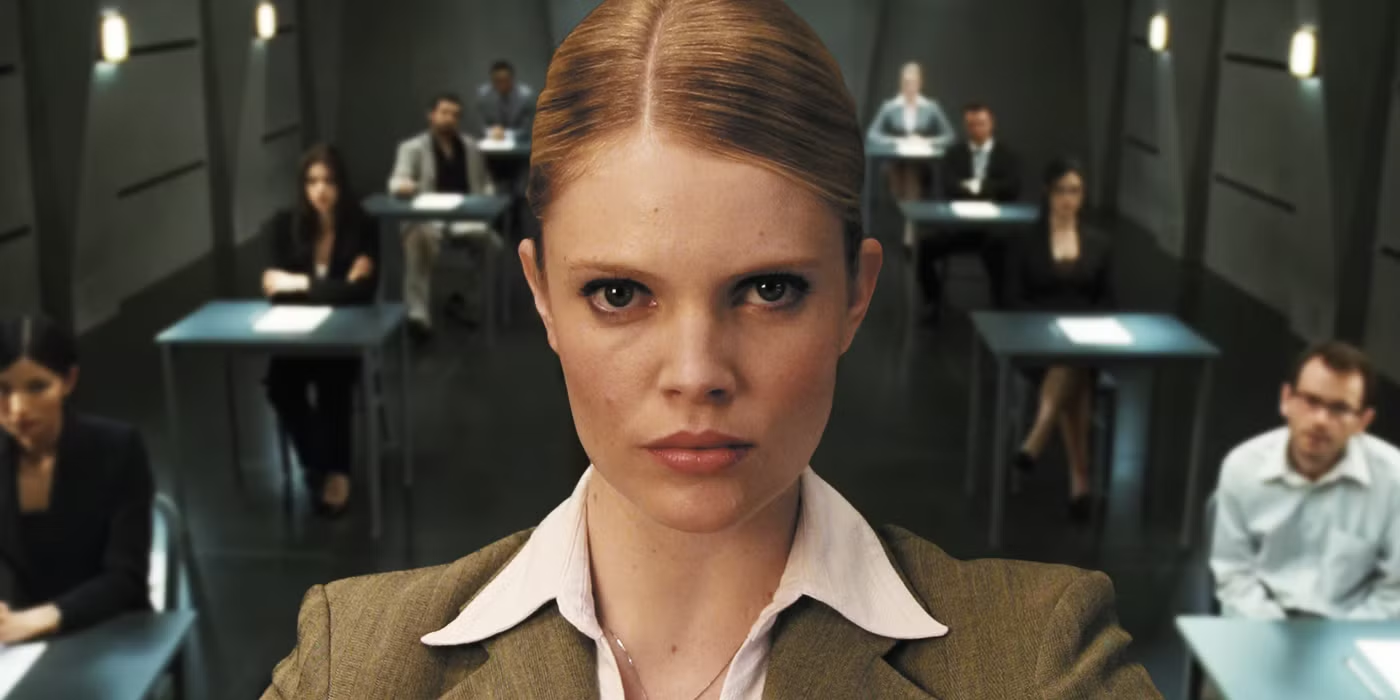
Hey there everyone! Welcome back to Movie Soapbox, the little corner of the internet that only you and I and that guy sleeping in the corner over there know about. This is the place where we find underappreciated indie films and we make sense of them. Today? We are doing a deep dive on Exam, a 2009 British closed-box thriller so quietly ferocious that you can watch the whole thing in one sitting and spend the next three days arguing with yourself about what it actually meant.
Quick word before we go any further: everything that follows is going to pull the entire film apart, from the opening thirty seconds to the moment the answer becomes obvious in retrospect. If you haven’t watched Exam yet, close this tab, find the film, come back when you’re done. You’ll thank yourself. The rest of you, settle in.
Exam Movie Walkthrough
So. Eight candidates. One room. One blank sheet of paper. And a writer-director named Stuart Hazeldine who somehow convinced everyone around him that this was a real movie and not a one-act play with a cinematographer attached. Here’s what that actually means in industry terms: Hazeldine was operating at the budget tier where the director is also the last line of defense against every note, because there is no second-unit team to absorb the damage, no producers’ row of executive vice presidents demanding a chase sequence in act two. When a film lives entirely inside a single room and depends on eight performances and the architecture of one piece of dialogue, either the script is airtight or the whole thing collapses in the first fifteen minutes. Films at this level don’t get rescued in post. They don’t get a test-screening-mandated voiceover to explain what the audience missed. What Hazeldine put on the page is what ended up on the screen, more or less intact, because there was no machine large enough to grind it into something safer. You can feel that in every frame. The movie has the texture of something that survived by staying too small to be noticed.
The setup is this. Eight people, coded by the film as White, Black, Brown, Dark, Blonde, Brunette, Deaf, and Chinese, because the movie gives them no names and neither will we, are ushered into a featureless examination room by a man called the Invigilator. One guard stands at the door. They each receive a single sheet of paper, numbered for their seat. The Invigilator delivers his speech, precise and unhurried, and then the clock starts. The Chinese woman is ejected within seconds for breaking a rule nobody spelled out explicitly. And then the remaining seven look down at their sheets and realize there is nothing on them. No question. No instructions. Just white space.
What follows is essentially a behavioral dissection. Phase one is pure confusion, the candidates circling each other like they’ve all just realized the floor might not be solid. Phase two is when someone figures out that the rules themselves are the map, that the Invigilator’s speech wasn’t throat-clearing, it was the exam. The boundaries get tested. A candidate goes down here, another there. The film is very precise about this, each elimination feels like a proof-of-concept, here is what the rule actually means in practice, not just in theory.
Phase three is the brief window of collective reasoning, the part that feels almost optimistic, they pool resources, they try light sources, they work the paper from different angles looking for hidden text. This is the movie’s most generous twenty minutes, and Hazeldine earns it by not letting it last. Because phase four is when the mask comes off. Once the rules are understood fully, the calculus shifts from how do we solve this together to how do I outlast everyone else. The trickery starts. The manipulation starts. One man ends up beaten unconscious. Another is shot. The Invigilator told them at the top that there is no law in this room but the company’s law, and at the time that sounded like corporate bluster. By the midpoint you understand he was simply being accurate.
Phase five is the film arriving at its actual subject, which was never a job interview. It was always a question of who survives the conditions the powerful create and then walk away from, leaving a guard at the door and a ticking clock on the wall.
The Exam Movie Ending Explained
Now. The ending. The thing that drives the searches, the thing that sends people to forums at one in the morning. When the answer is finally extracted from the paper using broken glass as a lens, what it reveals is this: Question 1.?
Which sounds like nothing until you go back to the Invigilator’s speech and find the moment where he says, exactly: Any questions? Best of luck, ladies and gentlemen. Begin. The question the candidates needed to answer was sitting in plain sight inside a sentence they had all processed as procedural, as empty formality, as a rhetorical gesture toward politeness. The answer required was simply: No. Said aloud, or written on the paper, at any point after the clock started. Hazeldine confirmed this directly when asked, any candidate who had responded to that question, verbally or in writing, would have walked out with the job. The other seven would have been escorted out. It was that clean.
The brutality of this is not in the twist mechanics. The mechanics are elegant but that’s not the point. The point is what the test reveals about everyone in that room, including you watching it. Every one of those candidates was sophisticated enough to make it through a grueling multi-stage selection process run by a company powerful enough to have its own laws. They were, by definition, the best available. And not one of them heard the question when it was asked, because they were all already too deep inside the assumption that power speaks in riddles and complexity and hidden tests. None of them could conceive that the answer might be simple and immediate and human, just a person saying no, actually, I’m fine, I don’t have any questions. The company selected for people who would survive a brutal room, and in doing so guaranteed that whoever they hired had already proven they could stop trusting the plain meaning of words. That’s the job. That’s what they wanted.
Exam Movie Explanation Theories
Exam Theory Camp Number One
On the theories: the competing reads mostly sort into two camps. The first is that the film is a pure meritocracy parable, the test is designed to find a specific cognitive type and it works as designed, the violence and manipulation are features not flaws, the company is operating exactly as intended and the horror is that their logic is internally consistent.
Exam Theory Camp Number Two
The second read is that the test is designed to fail everyone, that the company doesn’t actually want any of these eight people, that the real selection happened in earlier rounds and this room is either punishment or ritual, a final hazing that demonstrates the applicants’ willingness to dehumanize each other on command. Under this reading, the blank sheet isn’t a puzzle, it’s a mirror.
The director’s own confirmation of the answer, that any candidate could have won by simply responding to a polite closing question, actually complicates the second read in interesting ways. Because it means the test was winnable. The mechanism was fair, in the narrow technical sense of that word. Which makes it worse, not better. The company gave everyone a real shot and the real shot required only that someone resist the gravitational pull of the room they’d been placed in. Nobody did. The room itself was the selection pressure.
Moviesoapbox’s Own Personal Read
My read is the first one, sharpened. The company knows exactly what it’s doing. The pandemic raging outside those walls, the vague dystopian context Hazeldine keeps deliberately foggy, isn’t background noise, it’s the explanation for why the company needs the specific person who can hear a polite formality and recognize it as a loaded question. In a world where institutions are failing, you want the person who assumes every word from power is functional, is load-bearing, is meant. The other seven assumed the Invigilator’s closing line was social lubricant. One person in that room, ultimately, understood the environment well enough to survive it. The film is cold about this. It doesn’t celebrate the survivor. It just shows you the machine working.
Stuart Hazeldine made this film, kept it inside four walls, kept it running on performance and language, and got something true onto the screen about how institutions select for the people who will maintain them. He did it for essentially nothing, in a room, with a cast good enough to carry the weight. The version of this film that goes through five rounds of studio notes has a second location, a backstory for the Invigilator, a character who figures out the answer at the end of act two and gets killed for it so the lesson lands harder, and a score that tells you when to feel uneasy. That film doesn’t exist because Hazeldine stayed too small and too fast for anyone to get their hands on it. That’s the whole story.