
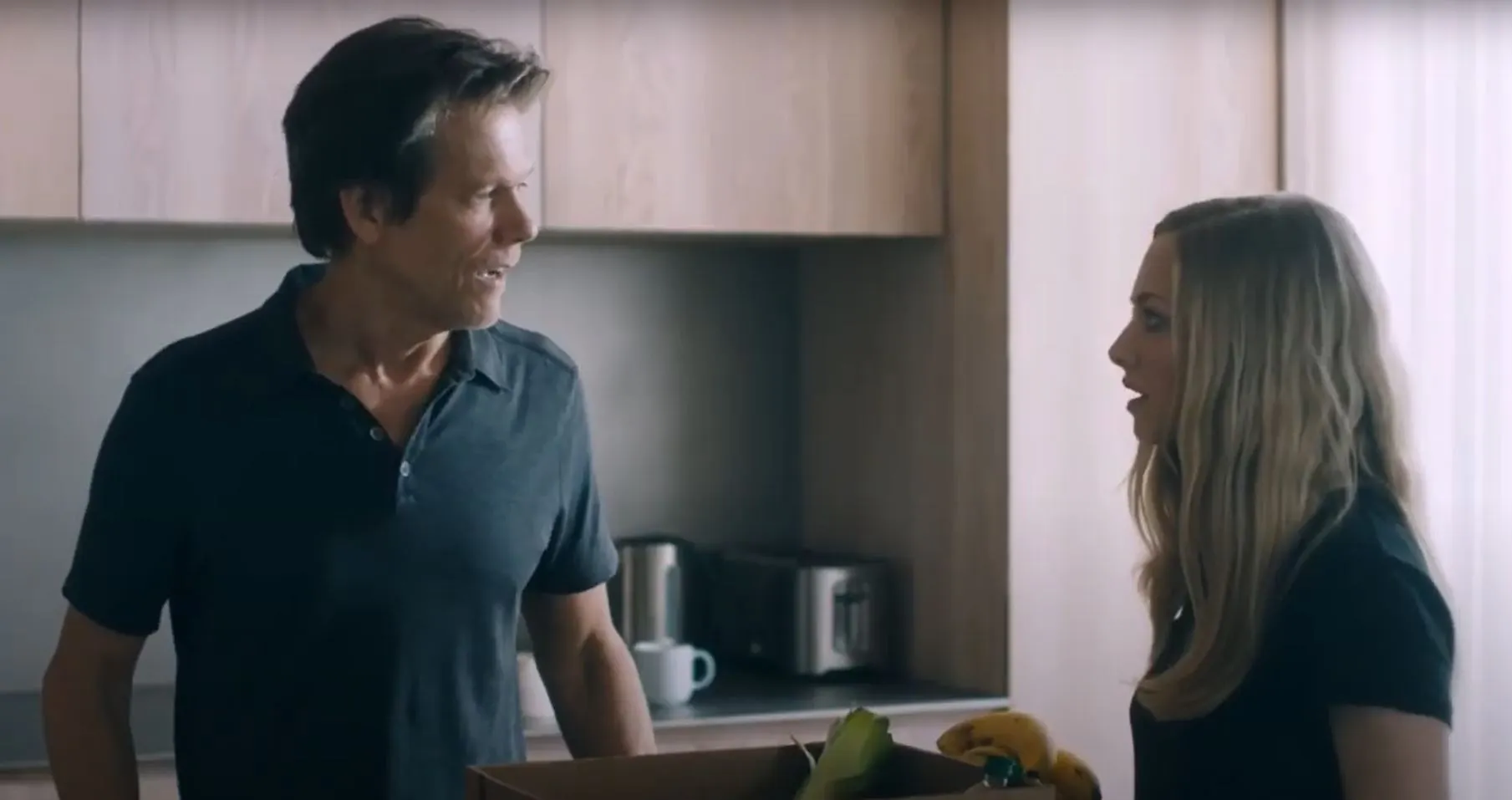
Hey there everyone! Welcome back to Movie Soapbox, the little corner of the internet that only you and I and that guy sleeping in the corner over there know about. This is the place where we find underappreciated films and make sense of them together. Today we are doing a deep dive on You Should Have Left, a movie so quietly, methodically cruel that by the time you realize what it is actually doing to you, you are already inside it and the hallway has gotten longer behind you.
Before we get into it, the trailer. Watch it. Then come back, because what follows is going to reframe everything you thought you just saw.
Alright. We are going full spoilers from this point forward, every reveal, every gut-punch, every implication. If you have not seen the film and you want to walk in clean, this is the last safe exit on this particular road. Close the tab. Go watch it. Come back. The door will still be here, and knowing this place, it will probably be a little further from the stairs than you remember leaving it.
Still here? Good. Let’s go in.
The You Should Have Left Walkthrough
The film opens on a nightmare, and it matters that you register it as a nightmare within a nightmare, a Russian doll of dread, because that layered structure is the entire architecture of what you are about to watch for the next ninety minutes. Ella, Theo’s daughter, is dreaming of an old man. Except the nightmare is not hers. It belongs to Theo. The old man is in Theo’s dream, and Ella has somehow slipped inside it, which tells you everything about how this house is going to behave before you’ve seen a single room.
Theo is Kevin Bacon, and Bacon does something here that a lesser actor, one attached to this project under different financing circumstances, would have fumbled completely. He plays guilt not as a performance of guilt but as a posture, a man who has been carrying weight so long he no longer stands fully upright and has stopped noticing. We are told, circuitously at first and then with increasing directness, that Theo’s first wife died in a bathtub. Drugs. She slipped under. And Theo watched.
Before the film drags that fact into the light, though, we get the texture of Theo’s present. He shows up on a film set to find his current wife, Susanna, played by Amanda Seyfried, and he is turned away at the gate. He journals obsessively. He listens to self-help recordings the way a man bails water from a boat with a teacup. He is surveilling Susanna’s devices with the particular obsessive energy of someone who already knows what he will find and keeps looking anyway, because the finding has become the punishment he believes he deserves. He eventually finds the second phone. The affair. He sends Susanna away, alone, in a house that has already started doing things houses should not do.
That first night, Theo closes up the house and somewhere in the closing of it, five hours disappear. Not quickly, not dramatically, just gone. The house is larger on the inside than the outside. Corridors extend past where the walls should be. A door appears that was not there the night before. He follows a stairwell down and finds a wall of Polaroids of himself and his daughter, and then he finds Ella soaked and blue and the whole image collapses into the memory of his first wife dead in the water. He stabs himself to break what he assumes is a dream. It is not a dream. It is a room, and he is already deep inside it.
What This Film Survived to Exist
You Should Have Left was produced and released in June 2020, straight to premium VOD, during a period when the entire theatrical ecosystem had essentially ceased to function. Blumhouse was behind it, which matters, because Blumhouse is one of the very few structures in contemporary Hollywood where a contained, idea-forward horror film can still get made without a committee of twelve VPs demanding a mythology expansion and a mid-credits scene setting up a franchise. The budget is small enough that the film does not have to be anything other than what it is. That is rarer than it sounds. At the budget tier where studios start feeling comfortable, the pressure to sand down an ending as bleak and unresolved as this one, to give Theo a way out, to let him earn redemption through action rather than accept damnation through conscience, that pressure becomes enormous. The fact that this film ends the way it ends, with a man voluntarily walking back into his own eternal punishment because there is no other honest conclusion available to him, is a minor miracle of production context as much as it is a screenwriting choice. A larger budget, a different producing structure, a test screening with a card that says “I did not find the ending satisfying,” and you get a different film. You get Theo running. You get the house destroyed. You get Ella saved by action rather than sacrifice. You get a lie. What you actually get instead is the truth, uncomfortable and fully committed, and that is because the film was small enough that the suits could not afford to care enough to ruin it.
The You Should Have Left House as a Mechanism
The source novel is by Daniel Kehlmann, and the film wears its literary influences without embarrassment. The house that is larger on the inside than the outside has a lineage. Mark Z. Danielewski’s House of Leaves built an entire recursive horror mythology around that premise. Jeff VanderMeer’s Annihilation used a similar spatial impossibility to talk about nature consuming the human need for taxonomy and control. But the house in You Should Have Left is doing something categorically different from either of those, and the difference is the thing worth contemplating.
In House of Leaves, the expanding interior is essentially a void, an absence that generates its own gravitational pull, indifferent to the specific humans it consumes. In Annihilation, the zone is transformative, it is doing something to the people inside it, but that something is ecological and impersonal. The house in You Should Have Left is personal. It was built for Theo. Stetler tells him this directly: there has been a room here for him for a very long time. The house is not a general-purpose horror mechanism. It is a specific moral accounting. It knows what Theo did. It has been waiting for Theo to show up and settle the bill.
That distinction matters because it reframes every bit of non-Euclidean strangeness in the film. The corridors that extend past where they should end, the five missing hours, the temporal slippage where Theo’s watch jumps forward and backward, these are not symptoms of a haunted place. They are the architecture of a debt instrument. The house is structured around the shape of what Theo owes, and what Theo owes is enormous and unpayable in any normal denomination.
The You Should Have Left Temporal Loop and What It Means
Here is the mechanism the film is asking you to hold in your head, and it is worth being precise about it because the film gestures at it rather than diagramming it, which is the correct artistic choice but occasionally leaves viewers uncertain about what they actually saw.
The house traps its occupants in a loop, moving forward and backward through time simultaneously. When Theo walks in on himself journaling, when he watches Susanna arrive as a past version of himself observes, these are not visions. These are other temporal positions of the same Theo, already embedded in the house’s structure. The older, haunting figure that Ella dreams about at the film’s opening, the old man who terrifies her, that is Theo. Future-Theo, post-sacrifice Theo, Theo-as-Stetler, already living inside the house in whatever eternal present the house has assigned him. The film’s opening nightmare is not foreshadowing. It is a report from a future that has already happened by the time the film begins.
Which means that Theo, when he first arrives at the house, is already being haunted by himself. The dark form watching through the windows as he and Ella try to walk away and end up back at the front door, that is him. The presence in the hallways, the lights that turn on without cause, the polaroids on the wall below the staircase, all Theo. The house has collapsed his timeline into a single occupancy, past and future Theo sharing the same space, the punishment and the punished coexisting.
What the film leaves graciously unstated is the question of how many times this loop has run. Stetler tells him he has had many names, many faces, many houses. Theo is not the first. The house has processed other men with other specific unpayable debts. This particular Stetler, the one Theo speaks to, was presumably once a man like Theo, standing in a hallway like this one, being told by a prior Stetler that the room has been ready for a long time. The house does not generate evil. It collects it.
The Competing Reads of You Should Have Left
There are a few genuinely distinct interpretive frameworks floating around this film, and they are worth laying out before committing to one.
The You Should Have Left – The supernatural literalist read: Everything the film shows you is real and operating by consistent internal logic. The house is a genuine supernatural mechanism for trapping morally condemned souls. Stetler is a real entity, or a prior condemned man now serving as the house’s custodian. Theo’s sacrifice is a real sacrifice, his soul is genuinely trapped, and the film’s ending is an actual damnation with no metaphorical exit ramp. This is the most straightforward read and also, honestly, the most disturbing one, because it requires accepting a universe with no redemption architecture and no proportionality to its punishments.
The You Should Have Left – The psychological collapse read: Theo’s guilt over his first wife’s death has been compounding for years and the house is an externalization of his disintegrating mental state. The temporal loops are dissociative episodes. Stetler is a projection. The non-Euclidean architecture is what severe unprocessed guilt looks like when it finally cracks the load-bearing walls of a psyche that was never built to carry it. Under this read, Theo’s final choice to stay is a suicide, or a breakdown so complete it functions as one, and Susanna driving away with Ella is not a supernatural rescue but a woman leaving a man who has finally come apart entirely.
The You Should Have Left – The moral framework read: The film is functioning as a parable about the weight of unwatched sin, specifically the particular horror of the sin of omission, of watching something terrible happen and choosing not to intervene. Under this read, the supernatural machinery is the film’s language for a moral truth: that certain failures do not get forgiven, do not get recovered from, and do not release their hold on you regardless of how many self-help recordings you queue up. The house is what accountability looks like when every other mechanism has failed.
The You Should Have Left Moviesoapbox Theory Pick
The psychological collapse read is the coward’s way out and I want no part of it. Films that build an entire consistent internal logic over ninety minutes and then offer you the option to dissolve it into metaphor at the end are usually doing that because someone in development got nervous and wanted plausible deniability. This film’s internal logic is too rigorous to be a metaphor. The opening nightmare is temporally specific, Theo-as-Stetler is already in the house before Theo arrives, and that is a structural fact the film commits to, not a symptom of a breakdown. You cannot have a breakdown that is temporally prescient in a way that requires the breakdown to have happened in a future that hasn’t occurred yet.
The read I am taking is the moral framework one, fused with the supernatural literalist one, because the film earns them simultaneously and does not ask you to choose. The house is real. It is also a moral truth made architectural. Both things are true and neither one cancels the other out. Theo watched his wife die and did nothing, and the universe in this film has a mechanism for that, a place where the cost of that specific inaction gets paid across an eternity of forward-and-backward time, and Theo, to his minimal credit, walks into it voluntarily rather than running. He cannot save himself. He saves Ella instead. That is the only redemption the film believes in, the partial kind, the kind that costs you everything and leaves you with nothing except the knowledge that at least the child got out.
The most honest line in the film is Theo’s last one before he turns back to the house. “All those years being angry, I should have left, but I didn’t.” He is not talking about the cabin in Wales. He was never talking about the cabin in Wales. The title of this film is a confession that takes ninety minutes to reach its full meaning, and when it lands, it lands without flinching, which is something the factory does not make anymore and genuinely does not know how to greenlight when it stumbles across it.
That is You Should Have Left. A small film that made no concessions and paid for that integrity by going straight to your living room instead of a theater, which is a shame, and also, given the year it was released, probably the only way it was ever going to reach you. We will take it. Thanks for being in this corner of the internet with me. See you next time.
🎬 If You Liked This…
- The Ritual — a remote location that seems to be responding to the psychological state of the people inside it, the same dread of a place that is aware of you in a way places shouldn’t be
- Hallow Road — an isolated house where something is wrong with the space itself, dread building through architecture and atmosphere rather than visible threat, same slow horror of a location that shouldn’t work the way it works
- A Dark Song — a house as a ritual space where something is being summoned through sustained psychological pressure, the building itself as the site of confrontation with whatever the protagonist can’t face about themselves