
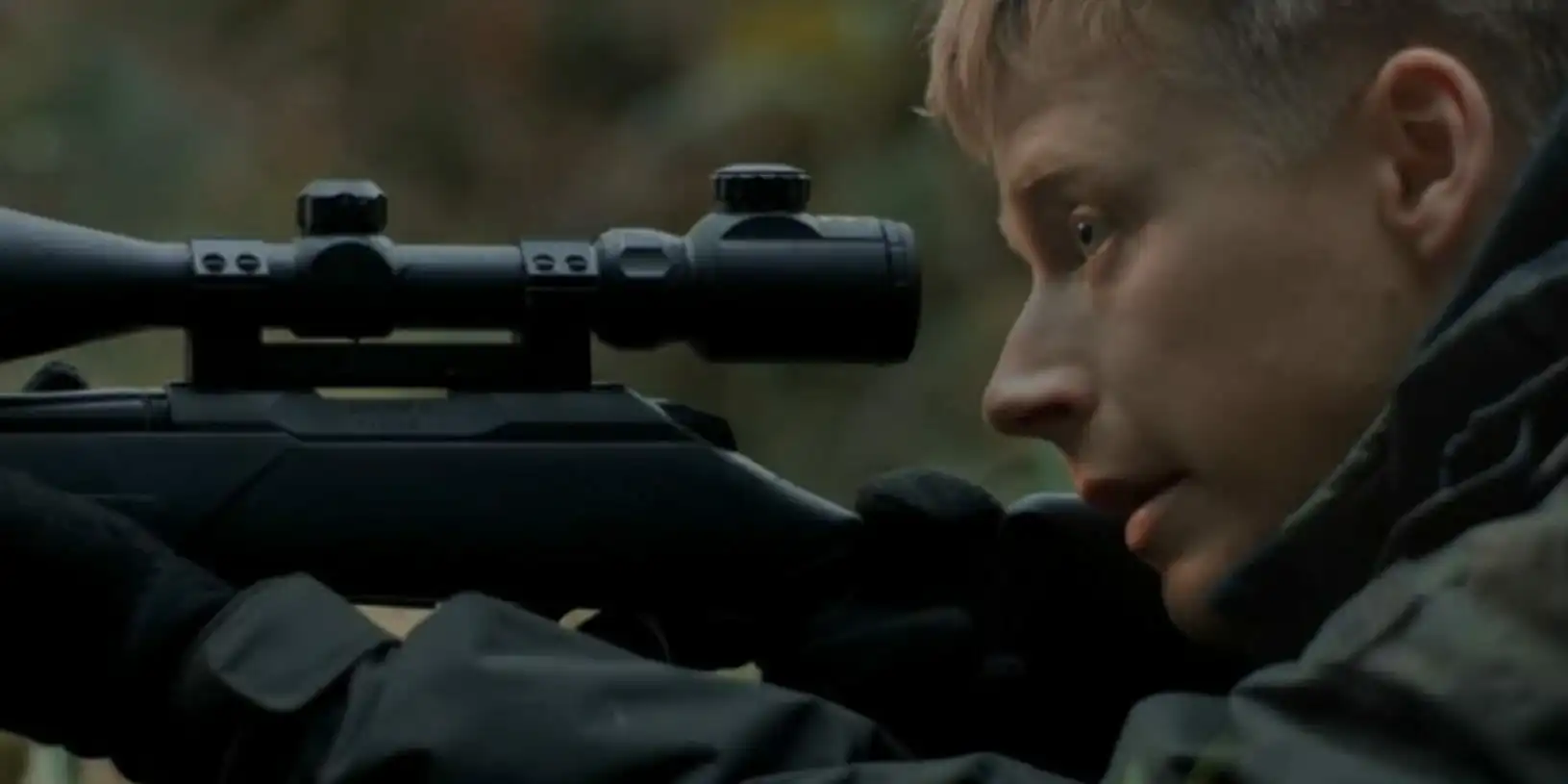
Hey there everyone! Welcome back to Movie Soapbox, the little corner of the internet that only you and I and that guy sleeping in the corner over there know about. This is the place where we find underappreciated indie films and we make sense of them. Today? We are doing a deep dive on Calibre, a movie so quietly, methodically brutal that even the people who greenlit it probably still can’t explain why they said yes, and thank god for that.
Alright. Before we go any further, I need you to understand something: everything from this point forward is a spoiler. Every single beat. Vaughn. Marcus. The boy. The father. All of it. If you have not watched Calibre yet, close this tab, go watch it, and come back. It is on Netflix and it will cost you ninety-six minutes of your life that you will spend the next several days quietly thinking about on your commute. Go. I’ll wait.
Still here? Good. Let’s get into it.
Calibre and the Making of This Crazy Movie
So a movie like Calibre lands in a very specific place in the development ecosystem, and you can feel exactly where it almost got broken if you know what to look for. This is a sub-two-million-pound production, Scottish Film talent fund money, the kind of project where the director, in this case Matt Palmer, is also the writer, because no studio is cutting a separate check for those two jobs at this budget level. That matters because it means nobody got to file a round of notes saying the ending needs to be more hopeful, or that the moral framework needs to be legible to a multiplex audience in the American Southeast. When a film this uncomfortable arrives fully intact, with no visible reshoot scar on its third act and no studio-mandated moment of cathartic release that lets the audience off the hook, it almost always means one of two things: either it got made so cheaply and so fast that the machine never had time to notice it, or somebody fought like hell to keep it from being sanded down. With Calibre, my read is both. Now. The movie.
Calibre Movie Detailed Walkthrough
Vaughn and Marcus are two friends heading into the Scottish Highlands for a hunting trip. One of them, Marcus, knows what he is doing. The other, Vaughn, demonstrably does not, and the film tells you this in a single image before a word of dialogue has established anything: Vaughn lines up a shot at a deer and aims for the head. You shoot a deer in the chest, behind the front leg, where the heart and lungs are. Aiming for the head means you are not a hunter, you are a man who has watched hunting on television. The cinematographer put that detail in the frame deliberately, and if you missed it on first watch, you missed the film telegraphing its entire thesis in about four seconds of screen time.
The deer moves. A boy is standing where the deer’s head was. Vaughn fires.
This is the first of seven moral collapses, and it is the only one that is genuinely an accident. Every single thing that follows is a choice.
Collapse One: The accident that isn’t a crime.
There is a real legal question buried in this setup that the film wisely does not stop to answer. Vaughn fired at what he believed was a deer, in a place where he had a legal right to hunt, and a child was standing in the kill zone. In most jurisdictions, including Scotland, unintentional killing in circumstances like this falls somewhere in the gray territory between criminal negligence and pure accident, and that legal ambiguity is part of what makes the film work. Because here is the thing the movie understands that a lot of morality-tale films fumble: Vaughn’s culpability at this exact moment is genuinely arguable. What happens next is not.
Collapse Two: Marcus shoots the father.
The boy’s father rounds the bend and sees his dead son, and he does what any father would do, which is pick up a rifle and point it at the man responsible. He is operating on pure animal grief. His aim is probably not great. He might not even pull the trigger. And Marcus, from a hundred yards out, drops him with a single shot to the chest.
Every argument Marcus will make for the rest of the film, and he will make several, starts here. He will tell Vaughn he saved his life. He is not wrong. He will imply that Vaughn owes him. He is not wrong about that either. What Marcus will never say out loud, because he is too smart to say it out loud, is that he just made himself Vaughn’s permanent hostage-taker, and Vaughn is the hostage. From this moment forward, Vaughn cannot go to the police without implicating Marcus, and Marcus knows Vaughn knows this. A hundred-yard shot in a moment of crisis is a very clean piece of leverage disguised as a rescue.
Collapse Three: They don’t go to the police.
This is the one that breaks the whole structure open. Vaughn knows they need to go to the police. You can see him knowing it. The film lets you watch him override the knowledge in real time, which is significantly more disturbing than just having him be stupid or corrupt. He is not stupid. He is scared, and scared people make the calculation that feels like survival even when it is the thing that will destroy them. Marcus, who is sharper than Vaughn and has clearly decided what they are doing before Vaughn has finished his first sentence, steers him toward going back to bury the bodies, and Vaughn follows because Vaughn has been following Marcus since before this trip started. That dynamic, established in the first twenty minutes, is what makes the ending legible.
Collapse Four: They dig the graves.
They go back. They bury a boy and his father in the Scottish dirt. And Marcus, because the bullets will trace back to his rifle, carves one out of the child’s skull with his hands. I am not going to editorialize on what that image does to you. You’ve seen it. You know what it does.
Collapse Five: They join the search party.
When the village realizes the man and his son are missing, Vaughn and Marcus are not suspects yet. They are visitors. And Brian McClay, who runs the town with the particular authority of a man holding a community together by sheer will while its economic foundation rots underneath him, asks them to join the search. So they do. They drive out with the search party and breathe when the vehicles pass the turnout where the bodies are buried. And then the dogs come, and the dogs are not interested in the turnout the way Vaughn and Marcus hoped, and for a minute you think the movie is going to let them walk.
It is not going to let them walk.
Collapse Six: The truth comes out.
Vaughn gets caught, beaten, and tells McClay everything. The film shoots this confession over a visual callback that deliberately buries the dialogue, because the exact words Vaughn uses are not the point. The point is the body language, the posture of a man who has been carrying something too heavy for too long and has finally put it down. The relief and the terror arriving simultaneously. McClay’s face as he processes what he is being told.
And then McClay does something very smart and very cold. He thinks it through. He does not make a grief-driven decision. He makes a civic one. If the McClays kill Vaughn and Marcus, it will be investigated. Investigators mean press. Press means the already-dying tourist economy of this town disappears completely. So he offers Vaughn a deal that is not a deal: kill Marcus yourself, or we kill you both.
Collapse Seven: Vaughn pulls the trigger.
He does it. He shoots Marcus in the chest. The man who started the cover-up, the man who carved a bullet out of a child’s skull, the man who held Vaughn’s fear in his hand like a tool for two days, dies at Vaughn’s hand. And the film does not frame this as justice. It does not frame it as release. Marcus was Vaughn’s best friend, and Vaughn chose to survive rather than protect him, and the movie just holds that fact up and looks at it without commentary.
The seventh collapse is the one the film saves for its last image, because it is the only one still happening. Vaughn is home. There is a newborn baby. He turns and looks directly into the camera, a thing that stops a production, that costs money, that gets retaken until the actor breaks the look, and the film keeps the take. On purpose. He is looking at you, specifically, and asking you whether he confesses to his wife, to the police, to Marcus’s family. Whether any version of his life that continues without confession is actually a life. The film has the nerve to not answer, because it already gave you the answer in every frame that preceded this one.
Any road other than the police station ends here. That was always true. Vaughn just spent ninety minutes proving it.
There is no competing interpretation of Calibre worth arguing about, not really. Some viewers read McClay as a kind of brutal pragmatist hero, a man protecting his community by any means available, and there is something to that read, but it flatters him more than the film intends. McClay is not wrong in his logic and he is not monstrous in his methods, which is what makes him the most unsettling figure in the film. He is a man who encountered an extraordinary moral horror and managed it. Managing it is not the same as surviving it cleanly. The town goes on. The bodies stay buried. The deal holds. That is not resolution. That is the thing that happens when everyone involved is too scared and too practical to pursue the truth.
The Moviesoapbox Read for the Movie Calibre
My read: Vaughn confesses to nothing, ever. He becomes the seventh moral collapse extended across the rest of his life, every day he wakes up and decides again not to say anything. The final image is not him contemplating whether to come clean. It is him understanding, for the first time with complete clarity, that he will not. That’s a harder ending than a confession would have been, and a smarter one, and a film this small and this well-made earned the right to that ending specifically because nobody with a marketing slate told them to soften it.
This is what Calibre survived to be: ninety-six minutes of a moral philosopher’s exam question, rendered in mud and low light and two lead performances that have no business being this good for a production this size, delivered to you completely intact, without a single scene designed to make you feel better about what you just watched. You should be glad it exists. Films like it don’t usually make it out.
🎬 If You Liked This…
- Blue Ruin — the same ordinary person cornered by a violent mistake they can’t take back, rural isolation amplifying every bad decision until the whole thing collapses under the weight of what was never said
- I Don’t Feel at Home in This World Anymore — two unlikely partners bonded by circumstance sliding into a situation that escalates past anything they were equipped to handle, the tone shifting under your feet before you realize how far in they are
- Nocturnal Animals — guilt as a slow poison that restructures everything around it, the psychological cost of a single catastrophic moment that no amount of distance or time actually buries