
Hey there everyone! Welcome back to Movie Soapbox, the little corner of the internet that only you and I and that guy sleeping in the corner over there know about. This is the place where we find underappreciated indie films and we make sense of them. Today? We are doing a deep dive on Surge, a 2020 British film so quietly, methodically devastating that the studio notes on a movie like this, if there ever were any, would have smoothed it right into something unwatchable. It survived. We should probably talk about how.
Before we go any further: everything from this point on is a full spoiler walkthrough of Surge, soup to nuts, ending included. If you haven’t seen it yet, go find it. VPN if you have to. You want to come back to this with the film already in your chest, not in your head.
Still here? Good. Let’s get into it.
Surge Movie 2020 Full Walkthrough
A first feature like Surge exists in a specific and precarious zone, the kind of film where the director has a singular vision and just enough creative control to wreck himself with it, or to make something real. Aneil Karia got the latter, and you can tell by what isn’t in the film. There are no explanatory scenes. No dialogue that exists purely to tell you how Joseph is feeling. No third-act reversal where the movie decides to be about something more palatable. What you’re looking at is a film that went into post the same way it came out of script, somebody had a point of view and nobody with final cut managed to flatten it. At Ben Whishaw’s level of profile, you still don’t get that automatically on a debut director’s first feature. You get it because the vision is specific enough, and cheap enough to produce, that the machine couldn’t justify caring enough to interfere. That’s not a compliment to the machine. That’s just how it works.
Surge opens with Joseph, played by Ben Whishaw with a kind of controlled internal combustion that you just do not see this precisely executed very often, running a security lane at a British airport. And Karia spends real time here. Not setup time, not let-me-establish-the-character time, actual lived-in time where you feel the sensory overload of the job before any plot has happened. Millions of people moving through a controlled space, all of them shedding shoes and pulling laptops from bags with that particular glazed stupidity that travel produces. Joseph is processing them. Absorbing them. The camera is tight on Whishaw’s face for a lot of this and you start reading microexpressions you didn’t know you were reading until much later.
Then he misses the 5:22 train home, and we meet his parents. His father is one of those screen presences that makes you genuinely uncomfortable in the way only good casting can, not a movie villain, just a man who has spent decades making another person smaller as a reflex, a habit so deep it doesn’t even register as cruelty from the inside. You sit with this scene and you understand something that the rest of the film takes for granted: Joseph has been carrying this his entire life. The airport was just today’s installment.
The next day the stress gauge goes from a manageable bad to a structural failure. Joseph is chewing things compulsively. He’s sending two bags through when the rules say one. He drinks a traveler’s water. He spits water. He climbs on something. His supervisor closes his station and sends him home and whether this is a suspension or a termination the film doesn’t bother to clarify, because Joseph doesn’t go back either way, and the distinction stops mattering almost immediately.
What follows is the “if you give a mouse a cookie” sequence, and the film earns that metaphor without ever stating it. Joseph needs a cable for Lily’s TV, a woman he clearly cares about, and to get the cable he needs money, and to get money he needs his card, and the ATM keeps his card, and to get a replacement he needs identification, and he doesn’t drive, and he doesn’t have identification, and the teller behind the glass explains the system to him in the particular tone that people who work within the system use when the system is failing someone standing right in front of them and there is nothing to be done. Outside the bank the ambient sound design makes a move here that is one of the better craft decisions in recent British indie filmmaking: the world just gets louder. Not dramatically. Not with a sting. Just louder, like a dial someone turned up a quarter-inch while you weren’t watching.
So Joseph writes a note and robs the bank. He implies a gun he may or may not have. He takes the money. He walks out. He buys the cable. He fixes Lily’s TV. He kisses her. They laugh. It may be the only moment of uncomplicated human warmth in the entire film, and Karia doesn’t hold on it long enough for you to settle into it. Then Joseph goes and robs another bank.
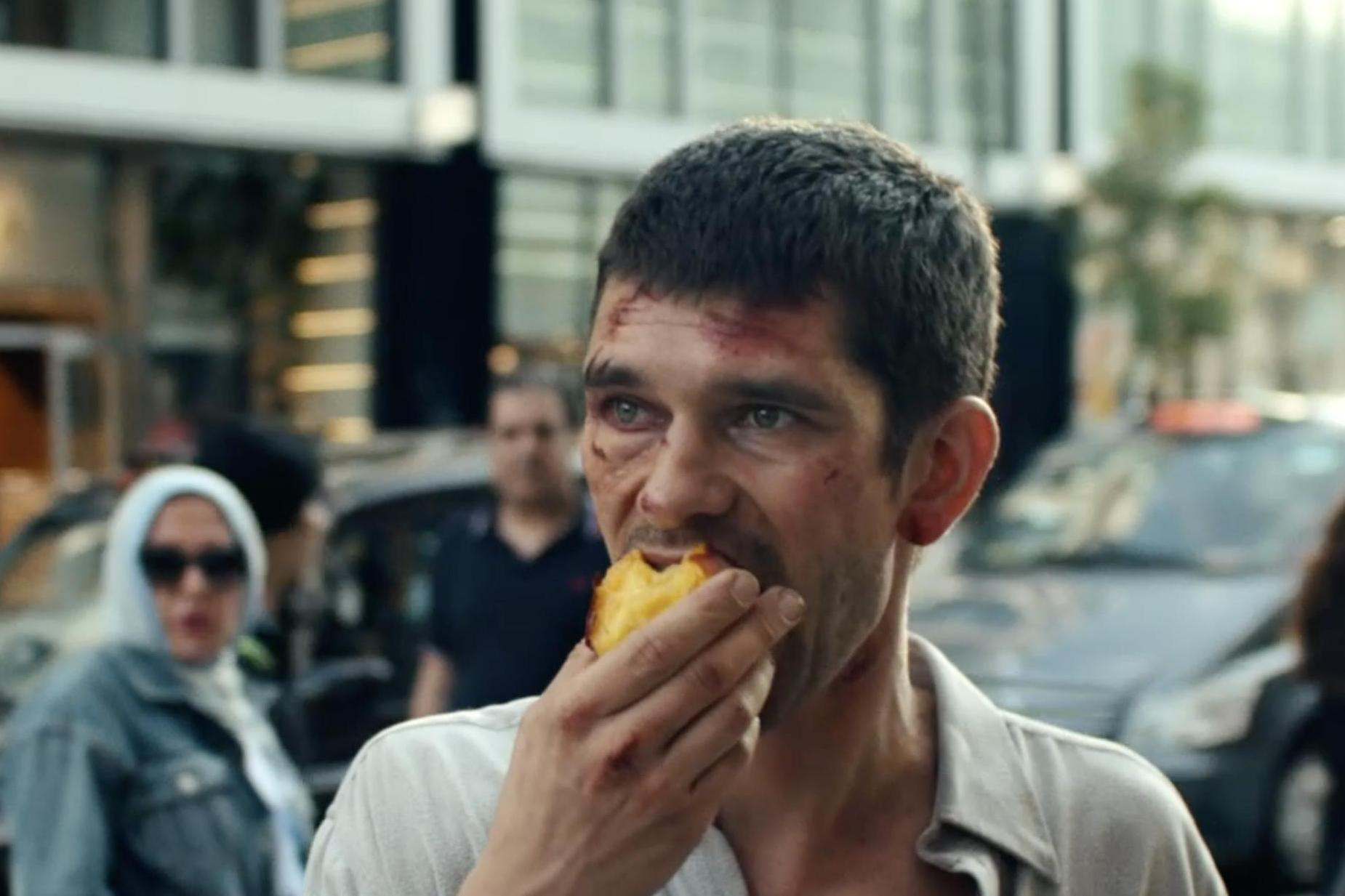
Let’s clarify the mechanics here because they matter: Joseph is not a robber. He does not want money. He has more cash than he can carry and he buys a banana and a nectarine the next day, total spend under a pound. The money is not the point. The point is that the system said no, and for the first time in Joseph’s life he found a mechanism for saying no back. The surge of the title is that, the neurological and emotional hit of having a self that the system cannot process. He’s not taking money. He’s taking room.
After the second bank, which dyes him red via a smoke canister, Joseph gets a hotel room. He does not lay low in any recognizable sense of that phrase. He dismantles the room. Tears up the mattress, destroys the TV, turns the entire space into a material expression of what his interior has looked like for thirty-odd years. Then he crashes a wedding, and the film drops a moment it deliberately refuses to explain: he whispers something to the bombing best man and the best man lets him stay. You don’t find out what he said. The film doesn’t care what he said. What matters is that Joseph has discovered he has a voice that other people respond to, and this is new information.
He steals a running quad bike from outside his apartment building, an act the film practically editorializes in favor of, because the guy who owned it had been revving it at all hours and deserved it. This leads to the crash sequence, Joseph flying off the bike and hitting pavement in a shot that raises legitimate questions about how a film at this budget level pulled it off with that much visceral impact. The crash feeds into a fight, and the fight feeds into more of the same neurological high, Joseph finding surges wherever the system punctures him back.
He ends up at his mother’s. She is genuinely frightened by what she sees and she says something to him that lands hard: “Every morning before I get up, I say, just keep him safe, that is all.” And then: “This is not what a good life looks like.” The scene between them is the emotional center of the film and Whishaw earns every second of it, communicating through glances and proximity in a way that most performances this interior could not sustain. Then the father arrives, calls the police, and Joseph leaves.
He robs one more bank. When the teller begins handing over cash, he says, “No, that’s enough.” She locks him in the vestibule between the inner and outer doors, a glass box, and Joseph sits down and waits. Credits.
The Competing Theories on Explaining the Movie Surge
Now let’s run through the competing reads on what this ending means, because it’s doing multiple things simultaneously and the film doesn’t rank them for you.
Surge Movie Theory #1 – The most common read is the systemic capture reading: the machine has reasserted itself, Joseph has run his course of resistance, and the ending is a tragedy wearing the costume of an arrest. He sits down because the energy is spent, the surges are gone, and all that’s left is the glass box that was always waiting for him.
Surge Movie Theory #2 – The second read, and the one Karia’s own comments in interviews point toward, is more ambivalent. His line, “I’m not quite an anarchist, but,” followed by a genuine reckoning with how narrow the window of acceptable human behavior has become, suggests the ending is less about defeat and more about the logic running out. Joseph didn’t hurt anyone. He never did. He destroyed property and frightened bank tellers and stole a quad bike and crashed it and took money he didn’t spend. When he says “that’s enough,” it reads less like surrender and more like a man who has made his point to himself, if not to anyone else, and decided the demonstration is complete.
Surge Movie Theory #3 – The third read focuses on the suicide that doesn’t happen. When Joseph is trapped in that glass box, a man who has been escalating through exactly the kind of behavioral spiral that ends with a gun in a parking lot in lesser films, he sits down. He waits. He does not end it. Given how rigorously the film has withheld comfort from him up to this point, that choice to live, even into an arrest, reads as the film’s most quietly radical statement.
Moviesoapbox’s Read on the Movie: I’m leaning heavily on both the second and third reads. Both are operating at the same time and that’s the point. Joseph has no politics. He didn’t set out to demonstrate anything. But the demonstration happened anyway, in the only language available to someone with no institutional leverage and no social language for the weight he’s been carrying. “That’s enough” is the first moment of genuine self-determination he’s had in the whole film. He decides when it ends. The system gets him, yes, but he decided when to sit down, and for Joseph, that is the entirety of what winning looks like.
Aneil Karia made a film about the narrowness of the window we’ve built for each other, and he made it without flinching, without softening the ending, and without giving Joseph a moment of external validation that the real world would never have provided. That the film exists in this form, lean and specific and uninterested in redemption arcs, is a minor miracle of the kind that only happens when a first-time director gets just enough rope and doesn’t waste a foot of it. Most films like this get the rope taken away in post. This one didn’t. Watch it.
🎬 If You Liked This…
- You Were Never Really Here — the same fragmented, claustrophobic dive into a man coming apart at the seams, violence as the only language left to a person whose interior world has already collapsed beyond repair
- Buster’s Mal Heart — another ordinary man unraveling in real time, the mundane pressure of a life that doesn’t fit slowly cracking the container, identity dissolving before anyone around him notices it’s gone
- Run Rabbit Run — repression finally surfacing in ways that can’t be managed or explained away, the psychological pressure of something buried too long finding its own exit whether you’re ready or not