
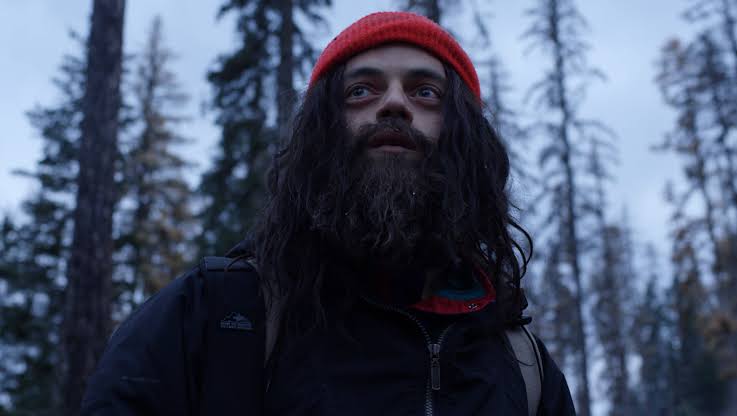
Hey there everyone! Welcome back to Movie Soapbox, the little corner of the internet that only you and I and that guy sleeping in the corner over there know about. This is the place where we find underappreciated indie films and we make sense of them. Today? We are doing a deep dive on Buster’s Mal Heart, a movie so quietly, stubbornly strange that it managed to star one of the most watchable actors working right now and still land in the void like a stone dropped into deep water. Nobody heard the splash. That’s what we’re fixing.
From here on out, every single thing that happens in this film is on the table. Every twist, every reveal, every fracture in Buster’s skull. If you haven’t watched it, go watch it, come back, and we’ll be here. You’ve been warned in the only way that matters: directly.
Before we get into the timeline weeds, sit with this for a second, because it matters for everything that follows. A film like Buster’s Mal Heart arrives at a specific budget tier where the director either got to make the film or got to make a version of the film, and those are two completely different things. This one, written and directed by Sarah Adina Smith, has the texture of a film where someone actually protected the cut. You can tell because the ambiguity is load-bearing. The film’s refusal to explain itself isn’t a gap, it’s structural. When a distributor panics in post on a film like this, you see it in the third act, things get explained that shouldn’t be explained, a character says out loud what the images were already saying, the loop gets a caption. Buster’s Mal Heart doesn’t do that. Smith got her film out intact, which at this budget level, with this degree of narrative strangeness, is genuinely not a given. What you’re watching is the thing itself, not a sanded-down version of it.
Now. The film.
Movie Buster’s Mal Heart Movie Walkthrough
It opens on Buster already running, already shot, already at the end of something, cornered in a cave and on the wrong end of a police standoff. Then it jumps backward ten days, and what you get for the next ninety minutes is a film operating on at least three temporal planes simultaneously, none of them clearly labeled, all of them insisting on equal weight. You’ve got Buster the hotel night manager, exhausted and devout and quietly coming apart at the seams. You’ve got Buster the fugitive, bearded and feral, breaking into empty vacation homes across a winter mountain landscape. And you’ve got a man alone on a raft in the open ocean, adrift, watching frogs appear in the boat, waiting for something to end or begin, he can’t tell which.
The Prophet shows up at the hotel desk like a man who escaped from a different, louder movie. He’s fast-talking, unhoused, philosophically unhinged in the specific way that sounds like nonsense until it doesn’t. The Babong. The first inversion. Binary logic. Termite control. He’s describing a world riddled with bugs, a simulation running errors, and he refuses to give his name because names are how the system tracks you. “I am the last free man,” he says. Buster hears this and something in him recognizes it the way you recognize a word you’ve been trying to remember. He doesn’t get the Prophet’s name. The movie treats this like the important thing it is.
What follows is Buster’s gradual absorption of the Prophet’s framework, his growing conviction that the system is rigged, that land ownership is freedom and rent is slavery, that something is deeply, structurally wrong with the world and also with his heart specifically. “I feel like my heart isn’t made right,” he tells the Prophet. His wife Marty wants to buy land and raise their daughter Roxy somewhere real. Buster wants the same thing but can’t hold the want together long enough to act on it. He’s a man dissolving at the edges while performing function at the center.
His boss suggests a staycation. Invites Marty and Roxy to the hotel. The Prophet comes back. Buster gets tangled up working. He arrives at the hotel room and finds his family dead.
And here is where the film stops being one kind of movie and becomes another.
The cop tells Buster he watched the security footage. The Prophet isn’t on it. There’s no one else there that night. The look on Rami Malek’s face in that scene, and I want to be careful here because this is not a small performance, this is a man registering the full structural collapse of his own reality in real time, is the performance that the film is built around. Everything radiates outward from that moment. The cave, the boat, the split, all of it is downstream of that one terrible recognition.
The Prophet isn’t real. He never was. He’s Buster’s Tyler Durden, his Frank the rabbit, the externalized architecture of a mind that needed someone else to blame for what it was doing. And what it was doing was killing his wife and daughter. Buster killed them. The Prophet is the part of Buster that made a philosophy out of the impulse before it happened, so that when it happened, there was a framework waiting to absorb the guilt. “The system did this. The inversion. The bug.” The Prophet didn’t vanish from the security tape because he’s supernatural. He vanished because he was never there.
Now, the boat. This is where people lose the thread and I want to pull it tight. You have two options for what the ocean scenes are, and one of them is dull and one of them is the movie.
The dull option: Jonah, Buster’s real name, was literally lost at sea before the events of the film. He drifted for over a thousand days. He washed up, started a new life, met Marty, became Buster. The ocean scenes are flashbacks. This reading is technically defensible and completely misses the point of why the scenes are there and why they look the way they look and why frogs appear in the boat and why two versions of Buster end up in it together.
The real option: the boat is the interior. Every time you’re on that water, you’re inside Buster’s consciousness, specifically inside the part of it that is trying to hold two irreconcilable truths at once. The Id and the Super-Ego, if you want the textbook framing, or just: the part that knows what he did, and the part that cannot survive knowing it. The boat is where they meet. The frogs are the plagues of Egypt, the biblical weight of transgression bearing down on a man named Jonah who is very much in the belly of a whale. The film is not being subtle about this. Jonah ran from God’s assignment, was thrown overboard, spent three days in the whale, was spat onto the beach. Buster killed his family, fractured mentally, spent an indeterminate stretch in the whale of his own guilt, and in the final image, a shaved, clean version of him washes up on a beach. Ready to go back. Ready to do it again.
That’s the loop. That’s what “eternal reoccurrence of the almost same” means when the Prophet says it, which is to say when Buster says it to himself, which is to say when the film says it to you. This is a man who cannot escape the circuit. Every iteration begins with Jonah adrift, ends with Buster in the cave, and resets. The optimistic read is that the loop has an exit condition, that one iteration he gets far enough from the edge that Marty and Roxy survive. The film doesn’t confirm this. It doesn’t deny it either. Smith leaves that door exactly one inch open, which is the correct amount.
The Theories to Explain Buster’s Mal Heart
So let’s lay out the three readings cleanly, because there are genuinely three, and two of them are worth holding.
The Literal Reading: Jonah survived months at sea. Washed ashore. Met Marty. Became Buster. Befriended a real drifter prophet, gave him a hotel room, came back to find his family murdered by that real man, fractured under the weight of it, went fugitive, died in the cave. This is what the film’s surface says. It’s also, as a complete interpretation, the least interesting thing the film is doing.
The Psychological Reading: The Prophet is a delusion. Buster killed his family in a dissociative break, created the Prophet as an alternative perpetrator, fractured into two selves at the funeral, and has been replaying the loop ever since, the fugitive self and the boat self representing the two halves of a mind that cannot reconcile. This is the reading the film most heavily supports and the one the cop scene is specifically designed to confirm.
The Metaphysical Reading: The loop is real and eternal. The “inversion” framework the Prophet describes, bugs in the simulation, the system running errors, is a genuine cosmological condition, not a delusion. Buster is trapped in a Sisyphean recursion not because he’s mad but because the universe is structured this way for people like him. The film’s biblical scaffolding, Jonah, the plagues, the whale, supports this reading by refusing to reduce the mythology to mere metaphor.
Moviesoapbox’s Reading of the Movie Buster’s Mal Heart
Movie Mike’s flag goes in the second reading, with the third reading allowed to breathe around the edges. Here’s why. The film earns the psychological reading mechanically, through the cop and the security tape, and then earns the metaphysical texture on top of it through the Jonah architecture. These aren’t competing. Buster is genuinely mad AND the film is using his madness to describe something true about guilt and repetition and the way a person can be swallowed by what they’ve done. The whale is real. It’s just inside him.
What Rami Malek does here, in a film that should have had ten times the audience it got, is carry all three of these readings simultaneously in his body. You believe the hotel manager. You believe the fugitive. You believe the man on the boat. He never tips his hand toward any one interpretation, which is the exact right performance for the exact right film. This is the work that gets buried when a movie doesn’t have the marketing spend behind it, when it sits on a streaming shelf with no one to explain what it is to the people who would love it. The suits who passed on giving this a real release were looking for something that tested better in the third act. What they passed on was the third act working exactly as intended. That’s the loss. That’s what this film had to survive, and in the end, mostly survived intact, which is more than most films this strange can say.
Go find it. Watch it twice. The second time you’ll see the Prophet differently, because you’ll know what you’re actually looking at, which is a man talking to himself in the only language his fracture left him.
🎬 If You Liked This…
- Take Shelter — a man convinced something catastrophic is coming that nobody else can see, the film refusing to tell you whether he is a prophet or a man coming apart, same unbearable question of which version of reality is true
- Starfish — a protagonist unmoored from the normal flow of time and identity, parallel realities bleeding into each other, the same dreamlike dread of a person trying to hold onto themselves while everything dissolves
- The Bothersome Man — a man trapped inside a life that looks normal from the outside and is quietly killing him from within, the same existential horror of suburban existence as a form of slow suffocation