
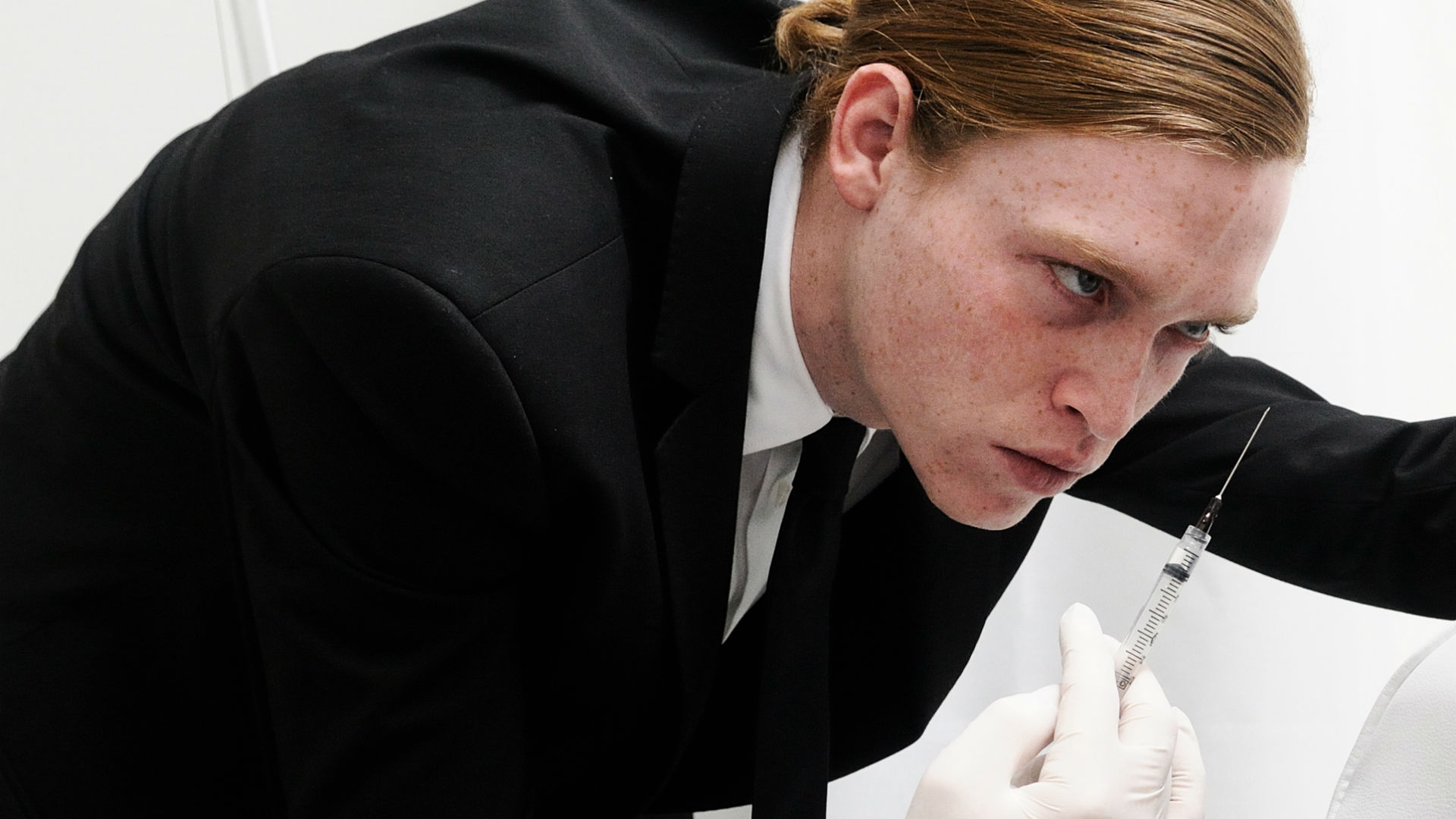
Hey there everyone! Welcome back to Movie Soapbox, the little corner of the internet that only you and I and that guy sleeping in the corner over there know about. This is the place where we find underappreciated indie films and we make sense of them. Today? We are doing a deep dive on Antiviral, a movie so close to the world we actually live in right now that the discomfort isn’t atmospheric, it’s diagnostic.
Here is the trailer. Watch it, then come back, because we have a lot of ground to cover.
Alright. If you haven’t seen Antiviral yet, this is your exit. Everything from this point forward is spoiler-forward, scene-by-scene, nothing held back. Go watch it, come back, and we’ll be here waiting for you. If you’ve already seen it and you’re still confused, good, that’s exactly why we’re here.
The Making of Antiviral Movie
Antiviral is the debut feature from Brandon Cronenberg, son of David, and if you think that parentage is irrelevant to understanding why this film exists and what almost happened to it, you haven’t spent enough time watching how the industry treats first-time directors who aren’t making something with a recognizable IP attached. A debut feature this cold, this deliberately repellent in its premise, this uninterested in giving the audience a character to root for in any traditional sense, lives or dies on one thing: whether a distributor decides the festival buzz is worth the commercial risk. Films like this get picked up, get a small theatrical run, get buried in a streaming library within six months, and the director spends the next three years pitching watered-down versions of their second idea to people who want to know if it can be made for under twelve million and whether there’s a franchise angle. The fact that Cronenberg got this thing made and released intact, with that ending, with that tone held all the way through, with zero concessions toward making Syd March someone you actually want to survive, is the quiet miracle the film never announces about itself. You can’t tell where the studio notes landed, because there don’t seem to be any. That’s either luck or leverage, and on a debut feature, it’s almost always luck.
So. Antiviral. Near future. Not far enough in the future, which is the whole point.
The Movie Antiviral Movie Walkthrough
The world of this film is one degree of separation from ours, and the one degree is this: celebrity obsession, which already exists as a massive, monetized, deeply strange cultural apparatus, has been extended one logical step further into the body. In this world, clinics sell celebrity pathogens. You can buy the cold that Hannah Geist had. You can pay to be infected with the flu that passed through a famous person’s cells and into yours, and the intimacy of that transaction is treated, by the people in the film, as completely normal commerce. The film doesn’t explain how we got here. It doesn’t need to. You already know how we got here.
We open on Syd March, played by Caleb Landry Jones in a performance so internally still and so visibly deteriorating across the runtime that it functions as a kind of slow-motion document of a man being consumed, which is exactly the metaphor the film is running. Syd works at the Lucas Clinic, one of the foremost celebrity pathogen retailers in the world. Lucas holds an exclusivity agreement with Hannah Geist, played by Sarah Gadon in a role that is almost entirely composed of a face on screens and a body in a bed, which is itself a comment on what celebrity actually is, a projection surface, a hallucination agreed upon by enough people to become real. Lucas can sell Hannah’s illnesses. Nobody else can. Syd’s job is to go to Hannah, take samples, bring them back, and let Lucas process and sell them.
What Syd is also doing, on his own time and at significant personal risk, is injecting himself with the illnesses before he ever delivers the samples, carrying them home in his own body, extracting and distilling them using a contraband console hidden behind a wall in his apartment, and selling the cracked copies to a man named Arvid at a meat market. A literal meat market selling bioengineered, reproduced celebrity flesh. The film drops this detail with total deadpan commitment and then moves on, which is the correct choice. The comedy here is not satirical exaggeration. The comedy is recognition.
The copy protection on these viruses, once cracked, renders them incommunicable from the buyer to anyone else. You can’t spread what you paid for. The disease is yours, and only yours, a product with built-in planned obsolescence, a subscription service with your bloodstream as the delivery mechanism. Syd understands all of this and does it anyway, because the premium Arvid pays is worth the risk, and because there is something in Syd that the film never fully names but keeps gesturing toward, a compulsion, a closeness he needs to something larger than himself, a way of being inside the same cellular experience as a person the whole world watches.
When the man who originally collected Hannah’s samples, Derek Lessing, gets caught stealing and fired, Syd steps in. He collects Hannah’s latest illness, injects himself immediately, and tries to run the crack on his console. The console breaks. When he wakes up the next morning from the fever, the news is reporting that Hannah Geist is dead. From this disease. The disease that is currently replicating inside Syd March’s body.
This is where the film shifts registers. What was a slow-burn satire about commodity and celebrity becomes something with actual urgency, because Syd is now carrying a lethal pathogen, he’s visibly deteriorating, his piracy network immediately recognizes the market value of what’s living in his blood, and every single person around him wants a piece of him in the most literal sense possible. Levine, who runs the piracy operation Arvid feeds into, abducts Syd to negotiate access to his blood. When Syd refuses, Levine takes the blood anyway. The demand for the Hannah death-virus is astronomical, and the only legal supply chain just died with her, which means the only distribution channel for this product is Syd’s circulatory system.
Syd gets picked up by two men who take him to a house in the woods. And here the film delivers its central pivot: Hannah Geist is not dead. The death was fabricated. Whether this was protective cover for Hannah or a market manipulation to spike the value of the virus is left usefully ambiguous, and both readings are correct, because in the world of this film there is no meaningful distinction between protecting a valuable asset and treating a person as a valuable asset.
The trail Syd follows leads to Derek, who sold the engineered pathogen to Lucas’s rival clinic, Vole and Tesser, who patented the disease before it ever entered Hannah’s system, doing an end-run around the exclusivity agreement entirely. The virus was designed with anti-analysis code built in, which is what destroyed Syd’s console and which is why the crack failed. Vole and Tesser own this disease. They manufactured it, introduced it into the body of the most famous woman in the world, and now they own every cellular descendant of it, including the ones living in Syd.
Levine kidnaps Syd again with the intention of broadcasting his death live, a compensatory spectacle for the audience that never got to watch Hannah die on camera. Syd stabs Levine in the face with a syringe and escapes. He goes to Vole and Tesser, negotiates his way in, and helps them build a cell garden from Hannah’s living tissue that will allow them to produce an endless supply of Hannah-infected pathogens. The supply chain problem, solved. And then the film ends on Syd pressing his mouth to the wound on Hannah’s arm, and the image holds, and the credits roll.
What you just watched is a film about celebrity culture that refuses to exempt the audience from the diagnosis. Cronenberg has said the central idea came from a real fever, a real illness, a real moment of delirium in which he became fixated on the physicality of infection, the fact that something in his cells had come from another body, and the weird intimacy in that. He thought: who would want that intimacy on purpose? And the answer the film arrives at is not a monster. The answer is a person shaped exactly like the culture that produced him.
The scene that does the most work in the middle of the film is the one where a Lucas clinic spokesperson is asked what they say to critics who claim the disease they’re really selling is a cultural one. The response: celebrities deserve to be famous. Celebrities aren’t people. They are group hallucinations. The film doesn’t editorialize after this. It doesn’t need to. The rest of the runtime is just the logical consequence of that sentence played out in blood and white rooms and Caleb Landry Jones getting progressively more skeletal.
Now. The theories.
Theories to Explain the Movie Antiviral
Read one: Syd as pure product of the system. In this read, Syd has no interiority beyond what the system produced in him. His desire to be close to Hannah, to carry her cells in his body, to ultimately press his mouth to her wound, is not a psychological aberration, it’s the logical endpoint of a culture that has commodified physical proximity to fame. He is not a deviant. He is a consumer who found a more efficient delivery mechanism. The tragedy is that there is no tragedy. He ends up exactly where the system wanted him.
Read two: Syd as failed human being trying to feel something real. The whiteness of the world, the clinical sterility, the transactional nature of every relationship in the film, positions Syd’s obsession with Hannah as a grotesque but genuine reaching toward connection. He wants to be inside something that matters. He chose the wrong vector entirely, but the impulse underneath the pathology is recognizable. This read makes the ending sadder and the film more compassionate toward its protagonist than it probably intends to be.
Read three: the film as self-consuming satire. The source post raises this and it’s worth sitting with. Does Antiviral reproduce what it critiques? Does filming Sarah Gadon as luminous and untouchable and constantly shot as an object of desire while the film talks about the fetishization of celebrity just make the film itself a participant in the mechanism? Yes. Cronenberg knows this. The double-back is deliberate. The film is already infected by the thing it’s describing, and it knows it, and that’s the last layer of the joke.
Moviesoapbox’s Read on the Movie Antiviral: I’m going with read one and Read two, and the film is most interesting when you hold all three at once. But if you force me to plant a flag, Syd is a pure product of the system, and the film’s final image is not horror, it’s completion. He arrived where he was always going. The system worked exactly as designed. That’s not a tragedy. That’s a product review.
Brandon Cronenberg made this movie without softening the premise, without giving Syd a redemption arc, without flinching on the ending, and without anyone in a studio meeting convincing him to add a scene where somebody says out loud what the film is about. Most films like this don’t survive the development process with all of that intact. This one did. Go watch it again knowing that, and tell me the whiteness of those rooms doesn’t feel like something that was protected.
🎬 If You Liked This…
- Infinity Pool — the other Cronenberg Jr. film, same cold body horror and same argument about what people will do to themselves in pursuit of something that disgusts and thrills them in equal measure
- Level 16 — bodies as commodities, an institution that harvests people for what their physical selves are worth, the same clinical horror of flesh reduced to product by a system that never pretended to care about the person inside it
- Lapsis — the gig economy as body horror, people renting their physical presence to a system that views them as interchangeable units, the same cold satirical register applied to the machinery of late capitalism instead of celebrity culture