
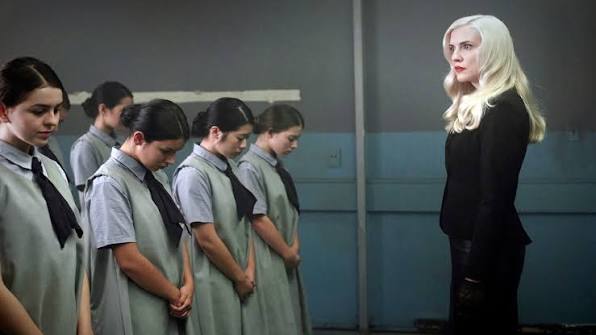
Hey there everyone! Welcome back to Movie Soapbox, the little corner of the internet that only you and I and that guy sleeping in the corner over there know about. This is the place where we find underappreciated indie films and we make sense of them. Today? We are doing a deep dive on Level 16, a movie so quietly brutal, so methodically suffocating in how it builds its premise, that even describing it at a dinner party sounds like you made it up to disturb people.
Fair warning before we go any further: everything that follows is a full spoiler walkthrough. The ending, the reveal, the skinning, all of it. If you want to go in clean, close this tab, find the film, come back. If you have already seen it and need someone to walk you through what the hell just happened, and why this small Canadian genre picture managed to land something that a dozen bigger-budgeted dystopian YA adaptations completely fumbled, you are in exactly the right place.
Level 16 Movie and That Script
Before we get into what happens on screen, let’s talk about what kind of movie Level 16 is, in industry terms, because that context changes how you watch it. This film belongs to a very specific tier: low-budget, single-location, high-concept genre work with a female-led cast and a first-time-feature director, Danishka Esterhazy, working from her own script. That combination, in the current market, has exactly one path to survival. The concept has to be so clean, so pitchable in a single sentence, that no executive can convince himself it needs five more rounds of development. “Girls raised in a facility to have their skin harvested for wealthy clients” is that sentence. It fits on a Post-it. And you can tell, watching the film, that the idea survived largely intact, because a movie that had been through the full studio notes cycle would have added a love interest, softened the ending, and explained the mythology in a second-act montage delivered by a character who exists solely to deliver that montage. None of that is here. This film got to the screen close to what it was conceived to be, and that is rarer than it sounds.
Level 16 – How the Place Actually Works
Let’s get the mechanical stuff out of the way first, because the film does make you work for this and it’s worth having it laid out cleanly. The Vestalis Academy runs on a rotating shift system keyed to the girls’ ages. Level 16 is for the sixteen-year-olds, and within each level there are three groups. Each group is conscious for seven hours, then chemically sedated for the next seventeen. Run the math and you get three hours somewhere in the cycle where all three groups are under simultaneously, a window the facility uses for maintenance, transfers, whatever the staff needs to do without witnesses. The film doesn’t over-explain this, and it probably shouldn’t, but it also doesn’t spell it out early enough for some viewers to track, which is where the confusion tends to hit. We also learn that the girls were kept in continuous sedation for long stretches before the “schooling” phase was introduced, and once you understand what the facility actually is, the reason there was any internal argument about waking them up at all becomes obvious. Conscious inventory is complicated inventory.
Level 16 Movie Walkthrough
We open on a floor of Brutalist architecture that could, genuinely, be anywhere. A ship. A bunker. Orbit. The set design earns that disorientation on purpose. Our lead, Vivien, is reunited on Level 16 with Sophia, her former best friend, who once betrayed her in a way the film parcels out slowly. The two of them, wary of each other in that specific way that only people who were once very close can be wary, begin to notice the seams in the system. There are pills administered at every meal. There is lotion, constant lotion, applied with a kind of religious regularity the staff enforces as virtue. There are vitamins. There are couples who come to look at the girls, not interact with them, just observe, the way you might walk through a gallery. And there is a ceiling on information so absolute that the girls have been taught the air outside is toxic, that the world beyond the walls ended, that they are here for their own protection.
Vivien gets her hands on a security card. Gets to a window. Sees the moon. Real moon, real sky, real outside that will not kill her. She doesn’t run yet, she doesn’t have the full picture yet, but the lie has cracked. Then a girl named Rita disappears into punishment and comes back wrong, comes back looking like something was removed from her rather than done to her. Vivien follows the thread down through the facility and finds the sign: Vestalis Clinic. Skin treatment. And then the whole architecture of the place snaps into focus, ugly and complete.
The girls are livestock. Specifically, they are skin farms. The lotioning, the vitamins, the careful limited wakefulness, all of it is husbandry. The wealthy clients of the Vestalis Clinic are buying the transplanted skin of sixteen-year-old girls who have never seen sunlight, never smoked, never stressed, never aged a day beyond what the facility allowed them to age. The women who receive the treatment carry faint seam scars at the neck, which the film uses as its planted visual clue before the reveal, and which also functions, if you want to be uncharitable about the premise’s internal logic, as a pretty significant product liability issue. But we’ll get there.
The escape gets its moral accelerant when a guard who has been abusing the girls while they sleep is killed. The film needs this beat to give Vivien and Sophia the push past the point of no return, and it works emotionally even if you notice the screenwriting mechanism underneath it. The girls run. The doctor who runs the facility catches up to Vivien and delivers the villain’s speech: he saved her from poverty, from parents who were going to sell her anyway, he gave her safety and food and purpose. “You are not like the other girls.” She answers him flat: “I am exactly like them.” And then, with the investors’ men arriving to collect the asset, Vivien takes a blade to her own face, destroying the product, making herself worthless to him in the only currency he understands. The doctor gets dragged away by the money. The girls walk out.
What the Movie Level 16 Is Actually Saying
The cosmetics industry reading is the obvious one and the film doesn’t try to hide it, the entire premise is a literalization of “what if the beauty industry actually consumed young women instead of just economically consuming them.” Snow White is the older folklore skeleton underneath it, the aging woman’s terror of a younger face, the desire to possess and destroy what she can no longer be. The film is not subtle about any of this and it doesn’t need to be. The allegorical layer exists to give the horror weight beyond the horror.
The more interesting reading, the one that sits with you past the credits, is about consent and the stories institutions tell their captives to make captivity feel like care. The girls are not just imprisoned, they are educated into believing imprisonment is love. The vitamins are for their health. The lotioning is a virtue. The sleep is rest. The school teaches them to be “pure” in the Vestalis sense, docile, clean, grateful. The reveal is horrifying not because the institution was secretly monstrous but because it was openly monstrous with a thin layer of language over it, and that language was enough. That is the part that doesn’t wash off.
The Seam Problem (And Why It Doesn’t Actually Matter)
You will notice, if you are thinking like a consumer and not like a horror film, that the Vestalis product has a visible scar line at the neck, which is not a feature you would expect to survive focus groups. A luxury skincare treatment that leaves a permanent seam around your head is not the kind of product that moves units at that price point. The film knows this. The seam is a storytelling device, a way of planting evidence for the audience before Vivien finds the clinic sign, a way of letting you figure out what’s happening half a beat before she does. The product’s commercial viability is not the point. The point is what the scar represents: the literal mark of one woman’s skin being taken and worn by another. If you let the horror-logic handle the logistics, the film rewards you. If you want to stress-test the business model, you are watching the wrong genre.
Moviesoapbox’s Take on Level 16
Some people read the ending as ambiguous about whether the girls actually escape cleanly, given how many operational layers the clinic presumably has beyond one facility and one doctor. That reading has some merit. The investors dragging the doctor away suggests a network that predates him and will outlast him, and Vivien’s face-slicing, while satisfying as a gesture, only takes her off the board, not any of the others.
My read is that the film earns its ending precisely because it doesn’t pretend the system is destroyed. The doctor is gone. The girls are out. The machine is still running somewhere. Vivien knows that, on some level, and she runs anyway. The face-slicing is not a victory lap, it’s a refusal, the one act entirely within her own authority, and the film is smart enough to frame it that way rather than as triumph. She didn’t save the world. She saved herself and the girls she could reach. That’s the ending a writer gives you when she respects the premise enough not to lie about it. That’s what almost never survives the notes process intact. The fact that it did is the whole reason we’re talking about this film at all.
Think about how many films with the same budget, same concept, same ambition, got one more round of executive feedback and came out the other side with a chase sequence in a parking garage and a sequel hook. Level 16 got out clean. Most of them don’t.