
Hey there everyone! Welcome back to Movie Soapbox, the little corner of the internet that only you and I and that guy sleeping in the corner over there know about. This is the place where we find underappreciated films that the algorithm will never surface for you, and we make sense of them. Today we are doing a deep dive on Funny Games, a movie so deliberately, methodically unpleasant that Michael Haneke basically built a trap, bolted it to the floor of a lake house, and then sat back and watched to see which of us would walk into it. Spoiler: we all walked into it.
Before we go any further, understand that everything from this point forward is a full spoiler walkthrough. Every death, every game, every moment where the movie turns around and looks you dead in the eye. If you haven’t seen Funny Games yet, close this tab, find it, watch it alone, then come back. You are going to want to have done that before you read the rest of this. I mean it more than I usually mean it.
Funny Games Movie Deep Dive
Now. The Farbers. George, Ann, and their son Georgie are heading up to their lake house for some rest, and Haneke spends exactly enough time establishing this family as the kind of people who casually say “the lake house” the way the rest of the world says “the grocery store.” He is not asking you to like them. He is asking you to recognize them as a stand-in, a clean placeholder for your own vague mental image of “the wealthy family on vacation,” because this film is not actually about the Farbers. You should know that going in. They are props in an argument Haneke is having with you, specifically, about what you came here to watch.
Two young men, Peter and Paul, show up at the neighboring property with good manners and polo shirts and the specific kind of pleasantness that immediately registers wrong in your gut. Paul comes to the door to borrow eggs. Then a golf club. Ann gets frustrated and slaps him, and without missing a beat, Paul breaks George’s leg with that golf club. Just like that, the Farbers are hostages in the house they paid too much for, and the games begin.
Here is the thing that gets buried in every mainstream conversation about this film, so let me give you the frame before we go deeper into the plot. Funny Games is a shot-for-shot American remake of Haneke’s own 1997 Austrian film, and the reason Haneke remade his own movie in English, with a recognizable cast, on an American budget, is not artistic. It is prosecutorial. The original film landed in Europe and disappeared. Haneke looked at the audience that didn’t show up and realized he had aimed at the wrong target. The audience he actually wanted to indict, the one he said explicitly he built this film for, was the English-speaking market for violence-as-entertainment product. So he reloaded the exact same weapon and fired it again. When you watch the 2007 version and feel like the film has a cold, clinical quality, like it was assembled with surgical precision rather than directed with passion, you are reading the film correctly. This was constructed to function, not to move you. The warmth was removed on purpose. A film made to make you feel complicit in violence does not benefit from a score that helps you feel safe.
Back in the lake house, Paul’s primary activity is toying with the family in ways that are designed less for his own entertainment and more to produce specific reactions in you, sitting wherever you are sitting right now. He proposes a bet: will the family still be alive by 9 AM tomorrow? He and Peter tell contradictory stories about who they are and where they came from, which is Haneke lifting a page directly from Nolan’s Joker, or more accurately, Nolan later lifted it from here. The backstory that keeps changing is not a mystery to be solved. The absence of origin is the point. These two exist to function as a mechanism of plot, and Haneke wants you to notice that.
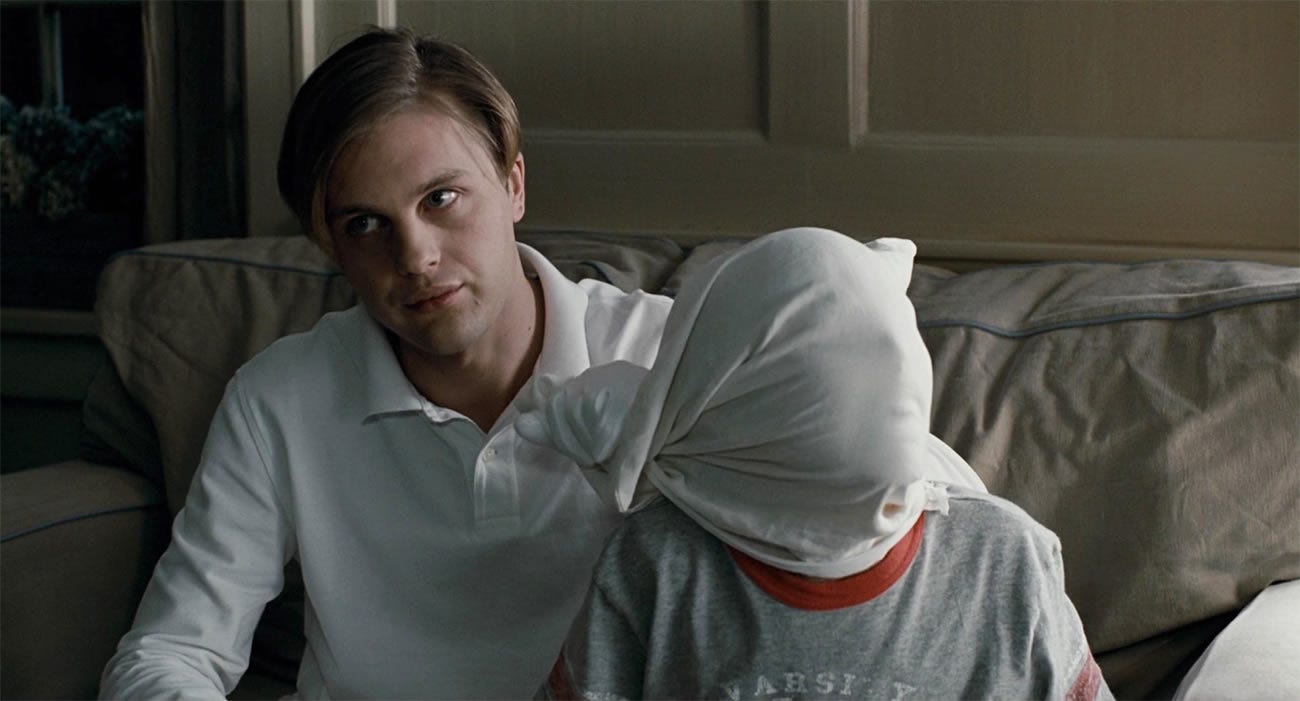
The sequence that kept a lot of people away from this movie for years, myself included in spirit if not in fact, is the one where Georgie gets a bag put over his head and Ann is told to undress or the boy suffocates. She eventually complies, George begs her to, and throughout the entire scene Haneke cuts to Ann’s face. Her face. Not what Peter and Paul are seeing. Not what you were, let’s be honest, half-expecting the camera to give you. Naomi Watts’ face. Her humiliation, not her body. And in that single editorial choice, Haneke turns the camera around and points it at you, at whatever part of you leaned forward slightly when the scene began. The film is not punishing Ann. The film is catching you in the act of anticipating the wrong thing.
Georgie eventually makes a run for it to the neighboring property and finds only corpses. He gets hold of a hunting rifle. Paul urges him to shoot. The trigger pulls and nothing happens. Paul and Georgie return to the house. Then Peter and Paul play an eenie-meenie-miney-mo game to decide who dies, with Paul in the kitchen afterward, casually raiding the fridge. “Anybody want anything?” A gunshot from the other room. Thrashing. Wailing. Paul continues fussing with the food. That sound you are hearing is Georgie dying offscreen while a psychopath in loafers decides whether he wants a snack, and Haneke holds on Paul in the kitchen long enough to make you understand that the film’s indifference to this child’s death is not accidental. The violence being offscreen is not mercy. The nonchalance is the whole statement.
George and Ann, grieving and destroyed, decide to survive. Ann flees to call for help. She is brought back. George is stabbed. Paul tells Ann to pray, listens to her prayer, tells her it wasn’t earnest enough, and asks her to do it again. Then he gives her a choice: shotgun or knife. While he’s talking, Ann grabs the shotgun and shoots Peter dead.
You felt that. You felt relief, you felt a surge of something, because every framework every movie has ever handed you told you this was the turn, this was the moment the third act kicks in and the survivor fights back. Haneke knows exactly what you felt. Paul pulls out a TV remote and rewinds the film. Literally. The footage runs in reverse, Ann un-fires the shotgun, Peter un-dies, and Haneke takes his revenge on your expectations with the casual efficiency of a man who has been waiting for that moment since the first frame. Now Ann never fires. George gets shot in the head. Paul looks at the camera, comfortable, unhurried.
The rewind is the argument in its most naked form. You wanted that ending. You sat through everything that came before it because some part of you was waiting for the turn, for the earned release, for the catharsis that exploitation filmmaking trains you to expect as your reward for enduring the darkness. Haneke sees that want, names it in front of you, and destroys it. Not because he’s cruel. Because that want is what the film was about the whole time.
Paul and Peter take Ann out onto the sailboat, the one they helped unload at the start, and she tries to cut the ropes binding her. It doesn’t work. They toss her into the lake. On the boat, the two of them discuss, in passing, a movie where a father gets bounced into a false parallel universe while his family is stuck in reality, whether both can exist on screen simultaneously. Then they pull up to the next house on the lake to start the whole thing over. Roll credits.
Now let’s untangle the mechanics, because a few things in this film confuse people on first watch and they shouldn’t.
Peter and Paul’s contradictory origin stories are not a continuity error. They are a signal that these two are not meant to be understood as real characters with psychology and history. They are instruments. Haneke gives them preppie clothes and good manners specifically because the violence-in-entertainment genre usually codes its predators as Other, as visibly wrong, as something you would have spotted coming. These two look like they summered here. That is the costume. The comfort you feel before things go wrong is part of what the film is harvesting.
The dog dying at the start is not gratuitous, it is structural. There is an unwritten law in mainstream film that the dog survives, that the child survives, that these are the protected categories the genre will not touch because the audience will not forgive it. Haneke knows the law. He kills the dog first. Then the child. He is announcing, from the very first act, that none of the usual contracts between this film and its audience are in effect. Every safety net you rely on to watch violence entertainingly has been cut.
Paul addressing the camera directly before violent events is not a stylistic flourish. It is Haneke making you complicit. He is telling you what is about to happen. He is taking you out of the diegesis, making you aware you are watching, and then letting it happen anyway. Because you kept watching. That is the indictment. Paul doesn’t need a third accomplice. He has the audience.
The Theories to Explain This Crazy Film Funny Games
Now the interpretations. There are essentially three ways serious viewers read this film.
Funny Games Theory Number One –
The first is Haneke’s own stated read, which he was never shy about: this is a film about the audience’s appetite for consuming violence as entertainment, addressed specifically to the English-speaking market that had turned that appetite into an industry. On this read, everything, the refusal to show Ann’s body, the nonchalant kitchen scene, the rewind, is a formal argument against the grammar of the exploitation genre.
Funny Games Theory Number Two –
The second read treats the film as a meditation on narrative control and the illusion of agency in fiction. The rewind is the key here. The film doesn’t just break the fourth wall, it demonstrates that the fourth wall was always a one-way mirror. The director controls what happens, the characters cannot save themselves, and neither can you save them by wanting them to. On this read, Paul is less a character than a personification of authorial power, and the cruelty is the cruelty of the form itself.
Funny Games Theory Number Three –
The third read, the one that gets less attention but deserves more, is that Haneke’s critique collapses under its own weight, because Funny Games is itself a formally precise, well-crafted, deeply watchable film that delivers the tension and craft of the genre it claims to be indicting. People who love brutal thrillers watch this film and enjoy it as a brutal thriller. The metacommentary, on this read, is window dressing on a product that does exactly what it pretends to condemn.
Moviesoapbox’s Take On the Movie Funny Games
My read is the first one, and I hold it without apology. Haneke said it plainly enough, “A film can do nothing, but in the best case it can provoke so that some viewer makes his own thoughts about his own part in this international game of consuming violence, because it’s a big business.” He is not being coy. The target of this film is the business model, and the business model’s customer, which is us. The third read is clever, but it misunderstands what Haneke is willing to sacrifice. He is willing to make an unpleasant film. He is not trying to give you a good time while lecturing you about good times. The discomfort is the mechanism, not a side effect.
Here is what I want to leave you with. Funny Games exists in a very specific category of film, the category of things that got made because one specific person with a specific argument was angry enough and credentialed enough to force it through. It is not a film that survived studio development because studio development would have added a third act where Ann escapes and the sheriff shows up and the rewind never happens. It is a film that exists because Haneke had already made it once in German and had enough standing in the international film world to remake it in English on his own terms, with Naomi Watts and Tim Roth attached, which is the exact level of cast you need to get a film like this financed without the notes that would have gutted it. Remove those names from the poster and this film does not get made in English. Or it gets made with a real ending.
That’s what you were watching. A filmmaker who knew exactly which levers to pull to get his indictment of your entertainment habits in front of you, using the machinery of the entertainment industry to do it. Haneke out-gamed the game. Whether that makes the film brilliant or just very clever is, honestly, up to you. But it got made. And you watched it. And now you have to sit with what that means.
See you next time.