
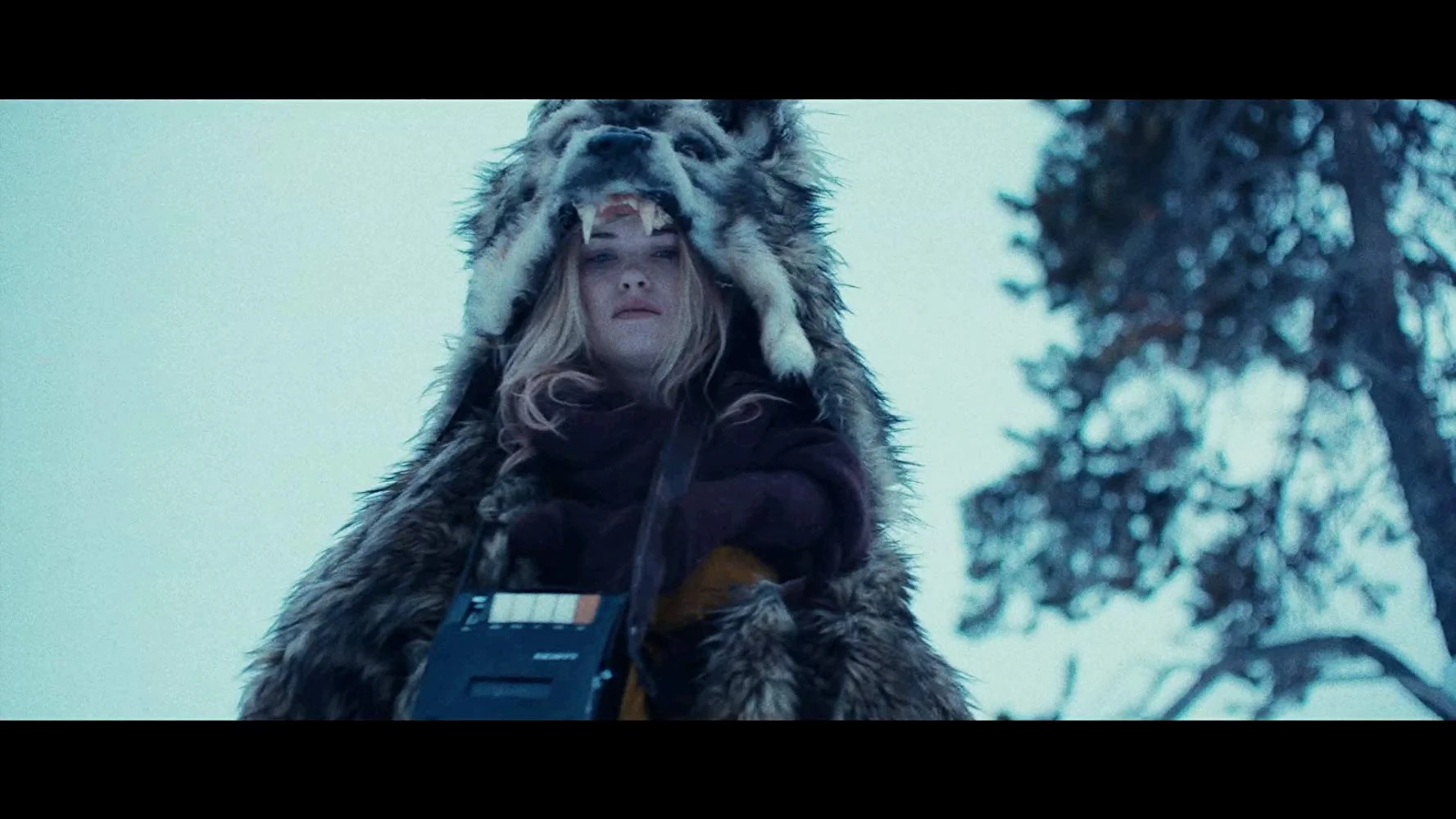
Hey there everyone! Welcome back to Movie Soapbox, the little corner of the internet that only you and I and that guy sleeping in the corner over there know about. This is the place where we find underappreciated indie films and we make sense of them. Today? We are doing a deep dive on Starfish, a movie so quietly, stubbornly its own thing that the studio apparatus that could have gotten hold of it would have sanded it into something completely unrecognizable and called it a win.
Before we go any further, here is the trailer, for the uninitiated.
Fair warning, and I mean this with more urgency than your average boilerplate spoiler notice: do not read past this paragraph if you have not seen Starfish. The whole architecture of what A.T. White built here depends on you not knowing what’s coming. The experience of being genuinely disoriented by this movie is the movie. You spoil it, you halve it. Go watch it, come back, and then we will talk.
Still here? Good. Let’s get into it.
Starfish Movie – The Making Of
What you need to understand before the walkthrough, the thing the original write-ups on this film tend to skip over in their excitement, is what a film like Starfish looks like to a distributor’s risk committee. A single-location grief drama with an alien apocalypse threaded through it, a non-linear structure, a score that functions as plot mechanism, a lead performance that has to carry about eighty percent of the film alone, and a third act that deliberately refuses to resolve. You can feel, watching certain moments of this film, that nobody ever made A.T. White change those moments. The fourth-wall fracture in the library stacks, the way the tape-number chapter titles rhyme with the narrative beats, the unresolved identity of the man in the water. None of that has the smell of a note on it. And that is genuinely rare. Films at this budget tier, when they find any distribution at all, tend to carry at least one reshoot scar in the third act, one moment where the suits demanded something more legible. Starfish doesn’t have that scar. Whatever White gave up to get this made and distributed the way he wanted, the film itself appears to be whole.
Movie Starfish Deep Dive Walkthrough
The film opens with a title card: Based on a True Story. Tuck that away. We are coming back to it.
Aubrey, played by Virginia Gardner, attends the funeral of her closest friend Grace, gets overwhelmed, retreats. An English cousin of Grace’s catches her on the way out and mentions a letter, a song Grace kept playing on loop, something Aubrey would understand. So Aubrey goes to Grace’s apartment. What she finds there is a scavenger hunt, seven tapes hidden at locations that map Grace and Aubrey’s shared history, and the implicit suggestion that if she can collect all seven and play them together, something important happens. Whether that something is salvation or catastrophe is the question the film spends ninety minutes refusing to answer directly.
Meanwhile, outside Grace’s apartment windows, the world is ending. Creatures that seem to operate on sound, on signal, on frequency, are moving through the streets. The apocalypse and the grief are happening simultaneously, and the film never bothers to draw a clean line between them, because that line is not the point.
The first time Aubrey is in real danger, a man she’s been communicating with over Grace’s walkie-talkie saves her, not with a weapon, with sound. He plays something across the airwaves and the creature at the door stops. This is not a throwaway detail. Sound is the load-bearing structural material of this entire film, Grace’s research, the alien signals, the tapes, the radio station where Aubrey once worked and where the final tape is waiting. The creatures are not just vulnerable to sound; they are made of it, communicate through it, cross between worlds through it. Grace figured this out, whatever Grace was, whatever Grace was doing, she figured out the frequency.
As Aubrey works through the tapes and the locations, she starts encountering her past. The guilt. The failure. The thing she did that cost her the friendship. At some point in a school or library, she has a conversation with Grace herself, which she knows is a projection, a hallucination, a grief construct, and which Grace confirms flatly: I’m dead, stupid. But the conversation is real in the ways that matter. Aubrey is disassociating. She cannot feel her fingers. She is wearing a ring she will not take off because it is a reminder of what she did wrong, everything she has to make up for. And Grace’s projection tells her something Aubrey knows and cannot accept: she cannot make it up. Whatever it is, it cannot be made right.
Then Tape 4 plays, and the fourth wall cracks open. Aubrey walks behind a camera. The film set is visible. Virginia Gardner, or is it Aubrey, steps outside the frame of her own story. The chapter-number and the wall-break rhyming is A.T. White doing something precise and structural, and the precision of it is what makes it land rather than read as a gimmick. He earned it.
The beach flashback sequence is where the guilt gets its most visceral image. Aubrey watches herself drown a man in the water. A past-Aubrey observes as a present-Aubrey does it. This is not literal, it is psychological, it is her mind attacking the memory, and the man in the water is almost certainly Grace’s boyfriend, the person at the center of whatever betrayal fractured the friendship. The film never names him, never fully shows him. You get a flash of an image just before he goes under. That withholding is intentional.
Aubrey eventually finds the last tape at the radio station, behind a photo of herself and a man. She takes all seven tapes. She plays them across the station’s broadcast frequency, out into the open air, amplified to the whole signal range. And when it is done, she tells the radio it is finished. She has closed all the doors. The survivors who respond are horrified. She didn’t close anything. She boosted the signal. She may have opened more doors than Grace ever did. Then she walks into one of the domes the broadcast created.
That is where the film leaves her.
Movie Starfish Questions Outstanding
Now, the outstanding questions, because this film generates them the way a wound generates heat.
Who was the man on the radio? No clean answer exists. He had intimate knowledge of Grace’s research and of the tapes. He could be the man Aubrey sees through the telescope. He could be the man in the water, which would be something darker and stranger than the film needs to confirm. The ambiguity is the answer.
What did Aubrey do to Grace? Two main reads. One, Aubrey and Grace were in a relationship and Aubrey cheated on Grace with a man. Two, Aubrey fell in with Grace’s boyfriend, and Grace lost both of them at once. The water scene tilts toward the second reading, but the film does not lock it in. What the film does lock in is that Grace felt abandoned, and that Aubrey was absent when Grace needed her most.
How did Grace die? A.T. White donated the film’s proceeds to cancer research. The film is dedicated to Sayako “Grace” Robinson, 1987 to 2014. The film is called based on a true story. You can draw the line yourself. Cancer, diagnosed while Aubrey was gone, while their friendship was fractured. Grace had time to make the tapes, to hide them, to create the scavenger hunt. She did all of this while she was dying, for a friend who had left. The weight of that is the entire film.
What does the title mean? Starfish appear when Aubrey feeds Grace’s jellyfish tank. Whether we are the starfish, small and slow and being consumed by something massive and signal-based moving through our atmosphere, is one of the film’s open questions. White doesn’t close it. He is right not to.
What happened when Aubrey played all the tapes? Here is where the theories split.
Theories to Explain the Movie Starfish 2018
Theory one, the literal reading: Grace discovered the alien signal frequency, encoded it across seven tapes, and intended for them to be assembled and broadcast as a weapon or a door-closing mechanism. Aubrey misunderstood the instructions, boosted the signal rather than containing it, and may have accelerated the invasion rather than ended it. The dome she walks into is a portal, and she has teleported somewhere else, possibly toward whatever is on the other side of the doors.
Theory two, the grief hallucination reading: The alien invasion is not real. Or not literal. The creatures are the physical manifestation of Aubrey’s grief, her guilt given mass and predatory instinct. The tapes are real recordings Grace left behind, music, messages, pieces of a person who died. Playing them all together does not close an alien door. It completes a grieving process that Aubrey has been unable to finish. She closes the doors inside herself. The dome is not a portal. It is a reckoning.
Theory three, the both-are-true reading: The film earns this one most. The alien invasion and the grief are not separate phenomena that happen to coexist. They are the same event described at two different registers. The signal that opens the doors is the same frequency as unresolved loss. Grace found the alien frequency because she was already living in it, dying and abandoned. The creatures come through grief. That is why the film is based on a true story. Death tears open the world. Something terrible comes through.
Moviesoapbox’s Preferred Reading of the Movie Starfish
That third reading is the one I believe. White is too precise a filmmaker to have staged these visual and structural rhymes accidentally, the way the tape-chapter numbers map to the wall-break moment, the way the alien signal and Grace’s music research are inseparable, the way Aubrey closing the doors inside herself and Aubrey closing the doors on the world are the same action with different consequences. He built a machine where the psychological and the literal cannot be cleanly separated, because grief does not permit that separation. That is the mechanism. That is the film.
Virginia Gardner carries a version of this role that most working actors in the studio system never get the chance to attempt, because the studio system does not make films that require it. A performance this interior, this reliant on the audience tolerating extended ambiguity, this willing to be unsympathetic in her guilt and her damage, does not survive twelve rounds of VP notes. It gets flattened into something more legible, more likable, more focused-group into a character arc with a visible spine. Gardner’s Aubrey has no visible spine. She is all internal weather. That A.T. White shot and cut this performance the way he did, that it survived all the way to the screen intact, is the fact worth being grateful for here.
Grief is a machine for generating hallucinations. Starfish understands that, and it understood it because it was built around a specific real loss, a real person, a real absence. The alien invasion is not a metaphor bolted onto a grief story. The grief and the invasion are the same event, described twice, and the film is exactly as unresolved and permanent as the thing it was made to process.
That is what it cost to make this film. That is what it took to get something this honest onto the screen. Most films about grief tell you the grief ends. Starfish tells you the doors stay open. We are lucky it exists the way it does.
Thanks for spending a little time here at Movie Soapbox today. We will see you on the next one.
🎬 If You Liked This…
- Hallow Road — isolation, something leaving evidence of itself in the spaces around a grieving protagonist, the same sense of reality thinning at the edges until something else starts showing through
- A Ghost Story — grief as the literal architecture of the film, time dissolving, a presence that cannot move forward because the loss it’s anchored to won’t release it, the same cosmic loneliness as Starfish at its quietest
- The Discovery — grief driving someone toward something metaphysical they cannot explain, the same emotional engine of loss that refuses to resolve into something comfortable