
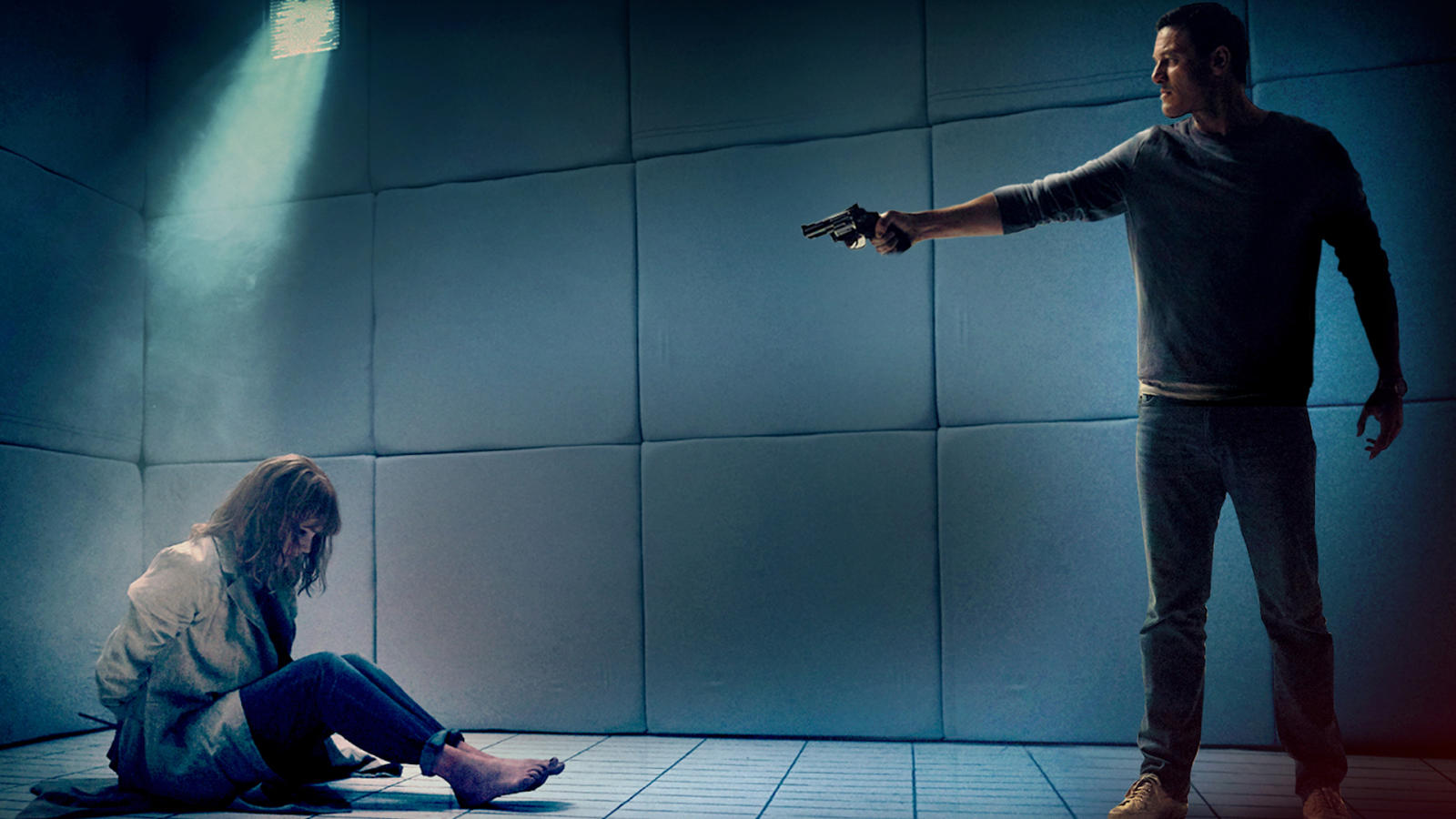
Hey there everyone! Welcome back to Movie Soapbox, the little corner of the internet that only you and I and that guy sleeping in the corner over there know about. This is the place where we find underappreciated indie films and we make sense of them. Today? We are doing a deep dive on 10×10, a movie so morally slippery and so quietly vicious that by the time you understand what it’s actually about, you’ve already been complicit in something you probably shouldn’t feel good about.
Before we go any further, you should know that everything from this point forward is a spoiler. Every beat, every reveal, every name-swap and moral gut-punch. If you haven’t seen 10×10 yet, close this tab, watch the film, come back. I’m not going to hold your hand through a mystery you haven’t let yourself experience yet. Go. I’ll be here.
Still here? Good. Then you already know that this movie isn’t what it looks like for the first twenty minutes, and the version you think you’re watching in the opening act is a ghost the film quietly buries by the halfway point.
10×10 Movie Deep Dive Overview
So let’s talk about what 10×10 actually is, and more importantly, what it took to get it here in any coherent form.
A two-hander psychological thriller with a morally compromised protagonist, a female antagonist who is also a victim, and a third act that refuses to let the audience off the hook, that is not a film that makes it through a standard studio development process without getting sanded down into something unwatchable. You can tell by the shape of this screenplay that nobody with greenlight power at a major was ever really in the room, because the notes that kind of executive reaches for would have been: give us a cleaner villain, give us a more sympathetic lead, resolve the moral question instead of detonating it. The fact that the question at the center of this film is still detonating when the credits roll tells you something about the kind of infrastructure, or absence of infrastructure, that let it exist. Films at this budget tier, with this cast, live or die on whether the director and the two leads can agree on what the movie is before anyone else gets a vote. From the way Kelly Reilly plays the third act, she knew exactly what she was making. That much comes through.
Now. The setup.
10×10 Movie Deep Dive Walkthrough
Lewis, played by Luke Evans, is running surveillance on a woman he knows as Cathy, a flower shop owner who has recently relocated and is living quietly under a name that isn’t hers. He abducts her from a shopping center parking lot, puts her in a ten-foot-by-ten-foot cell he has built inside his own house, and starts asking her questions. The first question is not “why did you kill my wife.” The first question is: “I want you to tell me your name.”
That’s the tell. He already knows what she did. What he needs is to make her say who she is, to strip the alias, to get the actual person in the room with him. “My name is Cathy,” she says. And that’s a lie, and he knows it’s a lie, and she knows he knows, and the whole movie is built on that three-way awareness between two characters and an audience being slowly let into the secret.
Lewis is not a competent abductor. He leaves her with her phone. He lets her knock him unconscious more than once. The maid shows up. His daughter is around. And the film plays this less as incompetence and more as evidence that Lewis is not a man who has done this before, a man who has done this exactly once, for one specific purpose, and is holding himself together with a logic that doesn’t extend past getting her to talk. You get the sense that he planned the cell for years and the rest of it for about a week.
The TV broadcasts playing on loop in his house are the other thread. A wrongful death lawsuit. All Angels hospital. Bodies exhumed, cause of death inconclusive. Lewis won’t turn them off because they are the closest thing to proof he has, and proof is what he is trying to replace with a confession.
When “Cathy” finally starts talking, she builds a story from scratch, and Lewis dismantles it piece by piece because he has been watching her long enough to know which parts don’t fit. And once she understands that the lie won’t hold, the real name comes out. Nathalie Anne Stevens. Her twin sister was actually named Cathy. Her mother was a nurse. Her father was a team doctor. Her father was sleeping with her sister’s best friend. When her mother confronted him, he ran. Cathy, the real Cathy, hanged herself in the family barn.
Nathalie became a nurse. And as a nurse, her patients talked to her. Confided in her. And Nathalie, raised hard in the church, raised on the idea that moral failure has a price, started collecting those confessions like evidence. John Lampte had two wives. Jane Spencer called the police on her abuser and then threw herself from the second floor. Three patients died in her care. The Charleston Three. Lewis’ wife, Ileana, was one of them. She had been having an affair. She passed out at a bar, came into the hospital, and Nathalie decided she had heard enough.
GHP. A knockout drug. Used to knock out Ileana, permanently. And Lewis doesn’t need Nathalie to tell him his wife was killed on purpose. What he needs is the why. He dragged a woman into a cell in his house and built a confession machine around her because he cannot make sense of his wife’s death without understanding what sin, in Nathalie’s ledger, Ileana was paying for.
Now. The question.
After Lewis has the full picture, Nathalie asks him something, and this is the scene the whole film is scaffolding toward. She asks: “So tell me, who’s in the wrong here, you? Nathalie? Or your wife?”
Read that again. She is in a cell. She is speaking in the third person about herself. “You, Nathalie, or your wife.” She has externalized Nathalie completely. She is no longer Nathalie. She is Cathy. She has been Cathy since the trial acquitted her, and Cathy is clean, and Cathy does not bear responsibility for what Nathalie did. So in that single sentence she is handing Lewis three suspects, not counting herself, because she has already written herself out of the lineup.
It’s the most precise piece of writing in the film. And it deserves the attention it doesn’t always get.
Lewis goes and watches a video of his wife. She says, “What do you want me to say?” And you can read that twenty ways. Kelly Reilly’s performance in the back half of the film is doing similar work to what that single line of video footage is doing, which is giving you just enough to decide what you already wanted to believe.
After the police encounter from Nathalie’s partial phone call, Lewis comes back and she stabs him in the neck with a tile from the floor of her cell. They fight. The maid and Lewis’ daughter walk in. The maid is shot. Nathalie grabs the daughter, Summer, and tells Lewis: “No she hasn’t, and neither have you, and neither did I.” As in, none of us have done anything wrong. As in, the moral ledger she has been keeping her whole life has just quietly extended to cover herself, and she is standing in a house where she killed a woman and is holding a child and declaring herself clean.
And then: “Your child? You think this is your child? You were betrayed, Robert.” First time we hear his first name. The affair, she is implying, may have produced Summer. May have. She knows how to use a knife even when she isn’t holding one.
The garage door kills her. Which is the film’s last joke on everyone, the scales of moral justice that Nathalie has been weighing the whole time are settled by faulty machinery, by accident, by nothing. There is no judgment. There is just a door that closes at the wrong moment.
10×10 and the Theories To Explain This Madness
10×10 Theory one: Nathalie is telling the truth.
The Charleston Three were guilty. Ileana was having an affair. The video supports it. Lewis had no idea. Under this reading, the film is a portrait of a vigilante who is genuinely correct about the facts and genuinely monstrous in her response to them, and the audience has spent ninety minutes rooting for a man who has inadvertently put a murderer back in the world by letting her escape. The horror is that she’s right about everything except her own right to act on it.
10×10 Theory two: Nathalie is lying through the entire confession.
She is a woman who has spent years constructing a new identity and is now improvising her way out of a cell by feeding a grieving man exactly the story he needs to hear. The affair, the moral failures of the Charleston Three, all of it could be a story she built in real time because she understood what Lewis needed to believe. People who pass out at a bar don’t necessarily end up hospitalized. Her entire moral framework is the product of trauma and religious fixation. Why trust a single word? Under this reading, Ileana was innocent, the three patients may have died of natural causes, and Lewis has spent years hunting down a woman who had nothing to do with any of it. That video doesn’t actually prove anything. It’s a grieving man reading guilt into his dead wife’s face because Nathalie told him to.
10×10 Theory three: the film is an allegory
Look… this is actually just a morality tale – and the facts don’t resolve. Everyone in 10×10 is guilty of something. Lewis abducts a woman. Nathalie kills three people. Ileana, if the affair is real, broke her vows. The Charleston Three each had their own ledger. The film is not trying to locate the moral center, it is trying to show you that the search for a moral center in other people’s lives is what produces cells in the middle of houses and bodies in hospitals. The audience roots for Lewis because the film positions us to, and that positioning is the point. You were complicit. Now what?
Moviesoapbox’s Read on the movie 10×10
Theory three is the film’s architecture, but theory two is what makes it sting. I think Nathalie was lying, or at minimum constructing, and I think the film knows that we’ll never be sure, and I think that uncertainty is the thing Lewis has to live with. He wanted the why. He got a why. He will never know if it was real. The garage door didn’t give him an answer. It just ended the conversation. That is the actual punishment. Not the violence. The permanent ambiguity.
What I love about this movie is that 10×10 is not a film that announces itself. It didn’t have the marketing spend. It didn’t have the awards campaign. It got two performances that understood exactly what the movie was trying to do, a screenplay that trusted its audience enough not to resolve the central moral question, and somehow got out of development with that trust intact. Plenty of films like it don’t. That’s worth remembering every time you watch something this quiet find its way to you. Something held the line somewhere. Usually you don’t get to know who.
We’ll see you next time, right back here at Movie Soapbox, the little corner of the internet where we don’t let the good ones disappear without a fight. If you are looking for other morally ambiguous films in the space of 10×10… we got you covered.
🎬 If You Liked This…
- Exam — a contained space, extreme psychological pressure, and power dynamics that keep inverting until you’re not sure who is actually in control of the situation
- Big Bad Wolves — a captor convinced their actions are justified by something done to them, the same moral inversion at the center of 10×10, and the same refusal to let anyone in the room be simply right or simply wrong
- The Invitation — a social situation that turns out to be something else entirely, the trap closing slowly while the protagonist tries to figure out if what they’re sensing is real or paranoia