
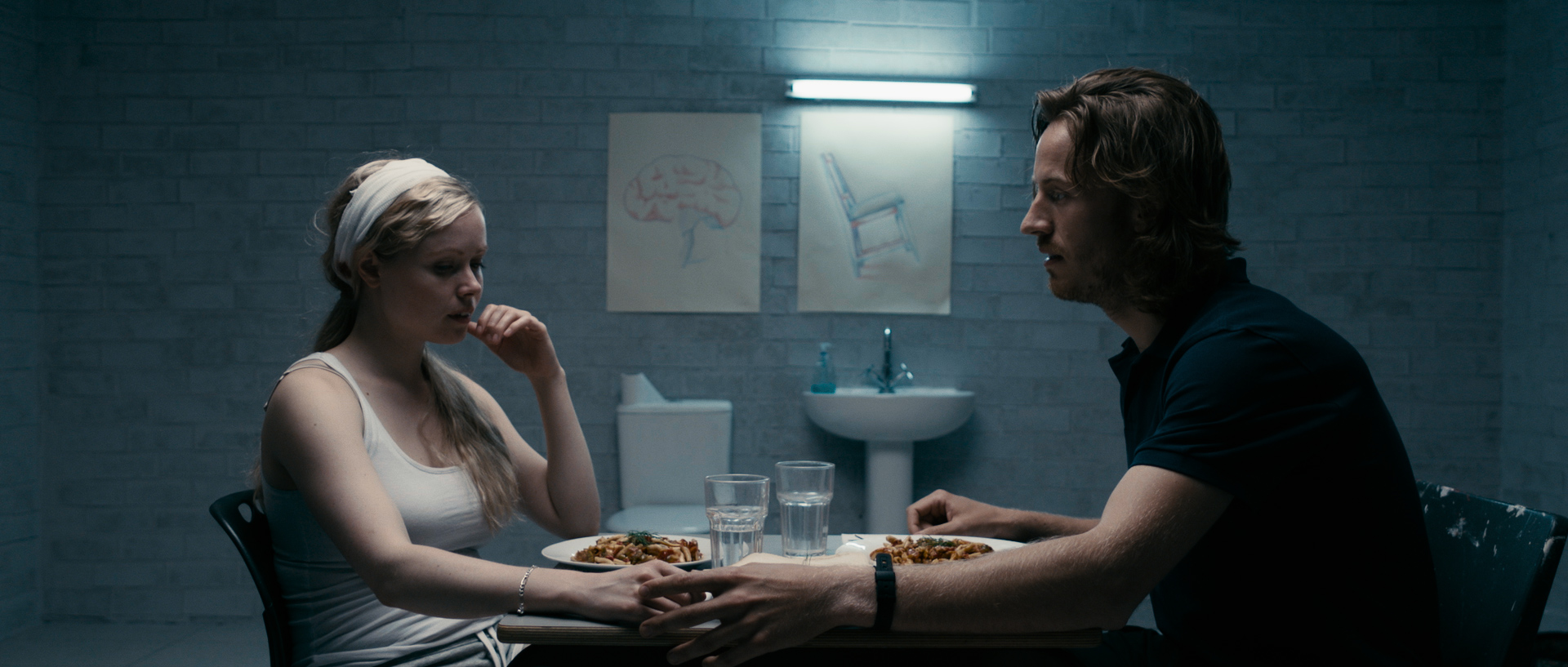
Hey there everyone! Welcome back to Movie Soapbox, the little corner of the internet that only you and I and that guy sleeping in the corner over there know about. This is the place where we find underappreciated indie films and we make sense of them. Today? We are doing a deep dive on The Hippopotamus, a 2018 British psychological closed-box that is so quietly vicious in its construction that the people who greenlit it probably still aren’t sure what they said yes to.
Before we go any further: everything that follows is a full, unsparing walkthrough of this film, including the ending and every twist between here and there. If you haven’t seen it yet, stop, go watch it, come back. The ending only lands if you’ve earned it, and you haven’t earned it by reading about it first. That’s not me being coy, that’s just the honest shape of this kind of film.
Hippopotamus Movie Walkthrough Details
So. A white room. A young woman named Ruby, played by Ingvild Deila, who you might recognize as the digital ghost of Princess Leia in Rogue One, wakes up with bandaged knees, a bandaged head, and zero memory of how she got there. Her captor, a man we eventually learn is named Tom, played with a kind of exhausted, practiced tenderness by Stuart Mortimer, tells her the situation plainly: he has taken her, and he intends to keep her until she falls in love with him. She asks for a pillow, then a blanket, then a book. The book unlocks small splinters of memory. And when Tom decides she’s getting too close to something real, he drugs her and the whole sequence resets.
Back to zero. Ruby on the floor. Knees bandaged. Head bandaged. Tom reciting his abduction rationale with the flat, rote delivery of a man who has delivered it so many times that the words have worn smooth. This is the first thing this film does that earns it real attention, because that vocal texture, that boredom underneath the sincerity, is doing more narrative work than a dozen expository scenes would.
This is the kind of film where you can see exactly what kind of notes it didn’t get. A script like this, a single location, two characters, a protagonist whose memory resets like a video game checkpoint, lands on a development executive’s desk and the first instinct is to fix it, to give Ruby a friend, to open the second act up spatially, to bring in a detective subplot so the audience has someone competent to follow. You can see the shape of the film that would have emerged from that process. It would have been a competent thriller with a twist ending and nothing underneath it. The version that exists stayed small. It stayed in that room. And because it stayed in that room, the architecture of Tom’s obsession becomes the entire texture of the viewing experience, you are inside the mechanism with Ruby, which is the only way the ending means anything at all.
Now, here is what this film’s first act is actually doing beneath the surface of the setup. Ruby, during one of her reset cycles, finds her own handwriting hidden in a book, written mirror-reversed so only she can read it: don’t trust him. The Memento comparison is obvious and correct, but where Memento uses that device to generate plot momentum, The Hippopotamus uses it to generate dread, because the message from a previous version of Ruby to a current version of Ruby implies not just the loop, but the number of loops. She has been here before. She has figured this out before. She has left herself a warning before. And none of it has mattered.
The Theories to Explain that Hippopotamus Movie Ending
The competing reads on this film fall into two fundamental shapes, and the film is careful to make both of them genuinely available to a serious viewer.
Hippopotamus Movie Theory Number 1
The first is the straightforward horror reading. Tom is a sophisticated predator who has engineered an environment of total control, who studies Ruby’s neurological condition not out of care but because understanding the mechanism of her amnesia lets him tune the manipulation more precisely. The stories he tells her about their past, the anniversary dinner, the dancing, the night her flatmate Rob assaulted her and Tom killed him to protect her, are constructions. Carefully maintained fictions delivered with enough detail and emotional texture to seat themselves as memory. He is not trying to help her brain heal. He is farming the space where her past used to be and planting what he needs her to believe.
Hippopotamus Movie Theory Number 2
The second is the reading the film goes out of its way to make almost plausible. Tom and Ruby did have a history. Rob did attack her. Tom did kill him. And Tom, faced with a woman he loves who can no longer retain the memory of who he is, made a catastrophically wrong decision about how to help her, one that has slid over time from desperation into something that cannot be redeemed but that started from a real place. Under this reading, the story he tells her is true. And that makes it worse, not better, because the conclusion is the same, Ruby is imprisoned by a man who has decided that what he wants from her matters more than what she actually is right now.
About halfway through, Ruby understands the full shape of her captivity. She has been strategizing across resets without knowing it, hiding matchsticks in her book to use as a writing instrument, only to find hundreds of matchsticks she has already hidden across hundreds of previous cycles. She realizes, in one efficient, devastating scene, that she has been engineering escapes for what might be years. She has been outsmarting him, over and over, and waking up back on the floor every single time.
She adapts. She decides to play along. She lets Tom believe she is softening. They have sex. And then she takes a shard of mirror and attacks him with everything she has left. She gets out. She finds a rowboat. She passes out in the water.
Cut to a hospital room. Ruby in a bed. A doctor tells her the surgery was successful and says he’ll let her boyfriend know. The doctor walks out. The camera holds on the doorway. Tom walks back in. He looks into the lens. Cut to black.
That shot is the entire film. Everything before it was the wind-up.
What it means is this: Tom was not killed by Ruby’s attack. He recovered her from the water. And he has rebuilt the cage. The hospital room is the new white room. The doctor framing is the new abduction speech. He has absorbed what happened, folded it into the ongoing project, and started the next cycle. His look into the camera is the look of a man who has already done this before and is simply clocking that he is doing it again. There is no triumph in that look. There is no malice you can point to and name. There is just the settled, terrible patience of someone who has decided that the story he is telling is worth any number of resets to complete.
The version of this ending where Tom is a loving boyfriend who made one catastrophic mistake and has been trying to earn his way back ever since is available, the film does not close that door entirely. But the camera stare closes it most of the way. A grieving man looks at the woman he loves. A predator looks at the camera, because the audience is what he has left to perform for now that Ruby is under again.
Moviesoapbox’s Preferred Read on the Movie Hippopotamus
Our read is that Tom’s story about Rob is probably true. The history is probably real. And none of that matters, because a man who will reset a woman’s consciousness rather than accept that she has left him is not a man acting from love in any sense that the word is supposed to carry. He is acting from ownership. The truth he is telling her is real. The thing he is doing with it is monstrous. And the film is smart enough to know that those two things coexisting is more disturbing than a simple lie would be.
This film got made because it stayed in the room. It kept its budget small enough that nobody powerful enough to ruin it had enough skin in the game to bother. The script did not get the note about opening the second act up. Deila and Mortimer were not replaced with more bankable names who would have demanded a more satisfying resolution. The ending did not get softened in a test screening because the film never got a wide enough release for a studio to panic about the tracking. That is the entire reason it works. The machinery of factory development exists precisely to sand off the edge that makes that final shot land the way it does, and this film, through luck or stubbornness or some combination of both, kept its edge. That is the only story worth telling about how a film like this survives.
🎬 If You Liked This…
- 10×10 — same single location, two people, a power dynamic that keeps inverting until the person who appeared to be in control discovers they never were
- The Party — same single-set one-night format, everyone arriving with an agenda they haven’t disclosed, the social veneer dissolving as the night progresses until what’s underneath is all that’s left