
Hey there everyone! Welcome back to Movie Soapbox, the little corner of the internet that only you and I and that guy sleeping in the corner over there know about. This is the place where we find underappreciated indie films and we make sense of them. Today? We are doing a deep dive on The Girl With All the Gifts, a movie so quietly, ruthlessly committed to its own logic that by the time you realize what it’s actually arguing, it has already burned the world down and moved on without you.
Fair warning: everything from this point forward is a spoiler. The ending, the fungus, the fire, what Melanie actually does and why, all of it. If you haven’t seen it yet, close the tab, find the movie, come back. This post will still be here. The world Colm McCarthy built will still be waiting to gut you. Go.
For everyone else, let’s get into it.
Before we walk the film beat by beat, understand something about what this movie is. Colm McCarthy directing a script by Mike Carey, adapting his own novel, on a budget that would not have covered the catering bill on a mid-tier Marvel second unit, with a cast that punches about four weight classes above the production’s pay grade. Glenn Close. Gemma Arterton. Paddy Considine. When a film at this budget tier lands a cast like that, one of two things is usually true: either the script is genuinely extraordinary and those actors read it on a plane and called their agents from thirty thousand feet, or a producer with good taste got to them early before the money calculus caught up. With The Girl With All the Gifts, you can feel both things being true at once. And you can also feel, in a couple of transitional moments, the invisible handprint of a distribution apparatus that wasn’t entirely sure what it had. The third act is lean in a way that reads less like confident minimalism and more like a filmmaker protecting his ending from people who wanted it to mean something more comfortable. That ending held. It shouldn’t have, by the math of how these things usually go. It held anyway.
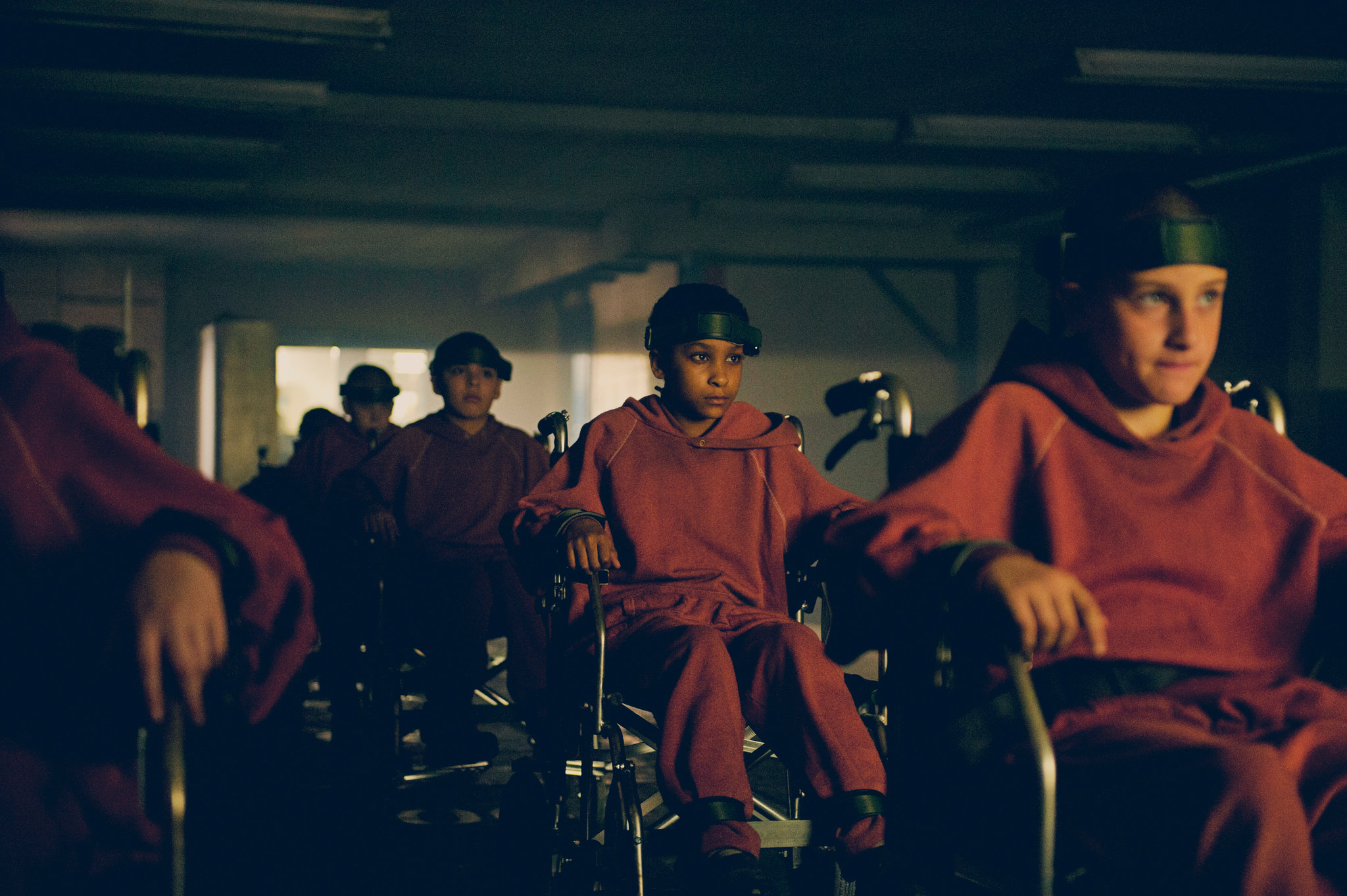
The film opens not in the ruin of London but underground, in a corridor, where children are being wheeled to class in restraint chairs, strapped at wrists and ankles and neck, treated with the kind of procedural caution you’d apply to ordinance disposal. And yet the kids talk to each other. They have favorites among the teachers. One of them, Melanie, played by Sennia Nanua in a performance that should have made her a household name by now, counts down the seconds until she gets to see Miss Justineau. You understand nothing. The film is completely comfortable with that. It drops you into the routine of this place and lets the wrongness build without explaining itself, which is a thing that costs a writer something to commit to when you know an executive is going to read that first act and write in the margin: can we get to the zombie stuff faster.
The setup, without rushing it: a fungal infection, Cordyceps, has swept the world, converting the infected into what the film calls Hungries, people locked in a standing coma until proximity to uninfected human scent trips them into frenzied, animalistic pursuit. Most of the surface world is gone. A military research outpost outside what used to be London is running two parallel operations: Dr. Caroline Caldwell, Glenn Close in full cold-science mode, is vivisecting the brains of captured Hungries trying to reverse-engineer a cure from the fungal tissue. And a small team of teachers, Helen Justineau among them, is running what amounts to a school for a cohort of second-generation infected children, kids who have the fungus integrated into their nervous systems but retained full cognition, full emotional range, full personality. They hunger, but they can choose. They can, in Melanie’s case, choose with extraordinary sophistication.
The facility gets overrun. This is not a spoiler so much as it is a genre inevitability, and the film dispatches it efficiently. What matters is who makes it out. Caldwell, Justineau, Sgt. Eddie Parks, a couple of soldiers, and Melanie, who in the chaos of the breach proves that the restraints were not paranoid overcaution. She tears through Hungries protecting the humans she’s chosen to protect, which is a thing that should reframe everything you thought you understood about the first act. It does reframe it. That’s the film working correctly.
The journey through overrun London is where the movie earns its budget limitations by committing to atmosphere over spectacle. Overgrown streets, Hungries frozen in place mid-stride, a city returned to a kind of terrible stillness. The detail that lands hardest, both in the film and in Carey’s source novel, is a child, crouched in a shop, holding a rat, watching the group pass. Second-generation. Still a child in every way that matters. Already not needing the humans at all.
The fungus itself deserves its own accounting because the film’s ending is completely opaque if you don’t track the evolutionary logic. Cordyceps is real, incidentally, a parasitic fungus that does exactly what the film describes to insects, hijacking the nervous system and directing behavior toward the fungus’s reproductive interests. Carey extrapolated forward: what if it jumped to humans and kept evolving. The first generation are the Hungries, direct infection via bite or blood, nervous system colonized, humanity effectively gone, the organism running on fungal autopilot. The second generation, Melanie’s cohort, come from fetuses infected in utero through a mother who was turned while pregnant. The fungus integrated differently, symbiotic rather than parasitic, the child developing with it rather than being overwritten by it. They hunger. They also think. They also feel. Both things are true simultaneously and the film never lets you forget either half of that.
Then there is generation three, the stalks, and this is where the film’s final movement becomes inevitable once you see it clearly. The Hungries, as the fungus completes its lifecycle in them, become hosts for massive fungal fruiting bodies, the stalks erupting from their bodies and eventually releasing spores into the air. Airborne transmission. Anyone who breathes the released spores converts to a first-generation Hungry. The end of the remaining uninfected human population is not a military event, it’s a weather event, it’s a matter of wind direction and time.
Melanie understands this. Melanie has understood it for longer than she’s let on.
The final conflict resolves the Caldwell question, which was always the film’s moral weight-bearing wall. Caldwell is not a villain in the way that factory genre storytelling needs its antagonists to be. She is a scientist who has correctly diagnosed the existential situation, correctly identified that Melanie’s brain tissue likely contains the key to a viable cure, and who is completely, genuinely prepared to kill a child she has watched think and feel and love in order to save what remains of the species she belongs to. That’s not cartoonish. That’s an actual moral position held by actual people in actual extremity. The film respects it enough to let Caldwell state it clearly and compellingly right up until the end. Which makes Melanie’s choice, when it comes, land with the weight it’s supposed to.
Theories to Explain the Girls With all the Gifts
Now, the theories, because the ending generated genuine disagreement and most of it is worth taking seriously.
Theory one: Melanie acts out of vengeance. She’s had enough of humanity, she’s been restrained and studied and nearly dissected, the only human she’s ever loved is Justineau, and this is the moment where she stops deferring to a species that was always going to choose its own survival over hers. There’s evidence for this reading. It’s emotionally coherent. The film earns the feeling even if this is the least interesting version of what Melanie does.
Theory two: the fire is local and defensive. Melanie lights the stalk to protect herself and the second-generation children from the humans who would otherwise hunt them toward extinction. A controlled burn, not a global statement. The film’s visual language argues against this and the novel argues very strongly against it, but as a reading of the movie’s slightly compressed final images, it’s not impossible.
Theory three: Melanie is attacking the stalks as an act of self-preservation. By burning the fruiting bodies before they complete their cycle, she’s pushing back against the third stage of the fungal evolution that would eventually claim her generation too. This misreads the biology the film establishes, but it’s a reading people reach for because it makes Melanie’s action feel more defensive, less catastrophic.
Theory four: Melanie is engineering succession. This is the correct reading. Carey confirmed it in conversations around the film’s release, and the internal logic of everything the movie builds toward points here. By igniting the stalk, Melanie accelerates the global spread of airborne spores. The remaining uninfected humans, including Sgt. Parks, become first-generation Hungries. First-generation Hungries reproduce and some of their offspring will be second-generation, children like Melanie, born with the fungus integrated rather than imposed. Those children grow up. Those children eventually have children of their own. Generation four: humans who carry the symbiosis forward, who have the intelligence and emotional range Melanie’s cohort has, and who may eventually be born into a relationship with Cordyceps that costs them nothing at all. Melanie is not destroying humanity. She is replacing it with something that will survive. She understands that Caldwell’s version of humanity, the one that would sacrifice Melanie to cure itself and then almost certainly fail anyway as the stalks spread regardless, is a dead end. She is choosing the version that lives.
Moviesoapbox’s All In Theory to Explain The Girl With All the Gifts
That’s the one. Melanie’s final image, sitting across from Justineau through the glass of the lab window, teaching the second-generation children who have followed her there, is not a tragedy. It’s a handoff. Justineau will die inside that lab, safe from spores, watching the species she actually belongs to grow up without her. It’s brutal and it’s earned and it’s the only ending that respects what this film actually built.
Justineau stays in the lab. The children inherit the world. Melanie got something true onto the screen, and so did the people who made this movie, and the fact that you probably had to hunt to find it is the whole story of how this industry treats the work that actually matters.
We’ll see you next time. Don’t let anyone flatten the ending.
🎬 If You Liked This…
- The Cured — the same question of what infected beings deserve when they retain consciousness, a society forced to decide whether the people who did monstrous things while infected deserve to be treated as people again
- Afflicted — the same body horror of a person becoming something new while still recognizably themselves, the transformation as identity crisis rather than simple monster origin story
- Pandorum — the same question of what comes after humanity when the old rules no longer apply, the horror of discovering what survival has made of the people and creatures left behind