
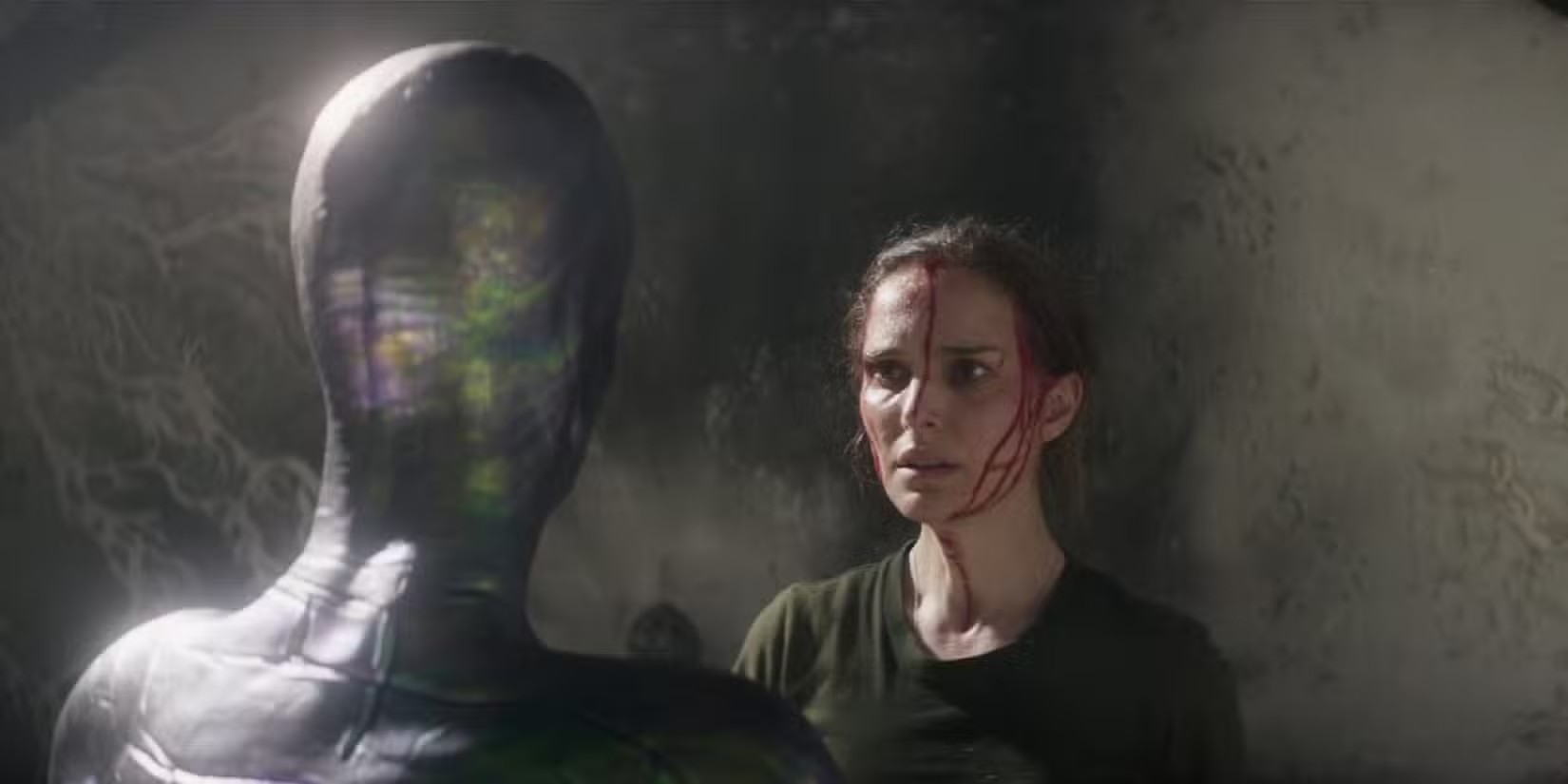
Hey there everyone! Welcome back to Movie Soapbox, the little corner of the internet that only you and I and that guy sleeping in the corner over there know about. This is the place where we find underappreciated films and make sense of them, the ones that got buried, soft-released, sold off, or just plain scared the people holding the money. Today? We are doing a deep dive on Annihilation, a movie so unrelentingly strange and so genuinely hostile to easy answers that the studio that made it decided, quietly, that they’d rather take the check and let Netflix deal with the audience fallout.
And before we get into the movie – I have to give a shoutout to Jeff Vandermeer, and his Southern Reach Trilogy which I absolutely adored. This movie is a pale glimmer of the original books. And I would highly recommend you check them out. “Where lies the strangling fruit that came from the hand of the sinner I shall bring forth the seeds of the dead to share with the worms that gather in the darkness…”
Okay, before we get into it, the trailer. Watch it. If you haven’t seen the film, this is as close as any 2-minute cut is going to get to preparing you for what’s inside.
Alright. Full stop here. Everything past this point is a wrecking ball through the entire film, the books, the ending, the theories, every last frame of it. If you haven’t seen Annihilation and you want to go in clean, close the tab, watch the movie, then come back. I mean it. The ending of this thing only lands once, and I’m not going to be responsible for you losing that. For everyone else, let’s go.
The Making of Annihilation
There’s something worth naming before we walk through a single frame of this film, something the original reviews mostly skipped over because it required reading a little too far between the lines of the press release. Alex Garland made something at the budget tier where studios still expect final cut to feel collaborative, which is a polite way of saying they expect to reshape anything too jagged, too open-ended, too comfortable with ambiguity. This definitely affected the final Annihilation product, 100%. This movie definitely got scalpelled via committee. This much is clear. Sure, they kept from adding an explanatory coda tacked on to the end. The alien was never really explained or humanized into something the audience could rate on a sympathetic scale. An E.T. of sorts. But even so, this movie is a pale reflection of the books, for sure. But you can tell when a distributor panicked in post, decided the thing was too smart to market, and sold it off like a problem property. Seventeen days domestic, then straight to Netflix internationally. Paramount didn’t release this film. They offloaded it. And the movie that survived that process is the one we’re talking about today.
Annihilation Movie Walkthrough
So. The plot, chronologically, because the film cuts it to pieces and some of you came out the other side confused, and I don’t blame you.
A comet, or something that presents like a comet, strikes earth at the base of a lighthouse on the southern coast. What expands outward from that impact point is called the Shimmer, and within it the rules of biology start misbehaving in ways that take the entire film to even begin to describe. The government quarantines the zone, builds a study facility on the perimeter called the Southern Reach, and starts sending expeditions in. Eleven numbered expeditions, plus variants. Animals. Hundreds of rabbits. Scientists with equipment that mostly stops working the moment it crosses the boundary. None of the humans come back the way they went in, and most don’t come back at all.
Expedition Eleven sends in a soldier named Kane. He disappears. A year passes. Then Kane walks back through Lena’s front door, standing in the kitchen, and something is wrong with him in a way that’s hard to articulate, the kind of wrong that doesn’t announce itself with one obvious tell but accumulates, quietly, until he’s coughing up blood on the floor and going into organ failure. The Southern Reach picks him up. And then Dr. Ventress, the psychologist running what’s left of the operation, recruits Lena for the Twelfth Expedition. Five women. All of them, as we will come to understand, carrying some version of the self-destructive impulse that Ventress seems to be selecting for deliberately.
The five go in. The Shimmer does what the Shimmer does. It refracts everything, DNA included, mixing and crossing and duplicating at a cellular level, which Lena starts noticing in her samples before she notices it in her teammates. Strange plants growing in human shapes. Animals that carry something that used to be human in their behavior. A bear that screams in a dead woman’s voice. The group deteriorates. Cass dies to that bear. Anya ties the remaining three up in a locked room, convinced Lena is already something else, and gets killed before she can act on it. Josie walks out into the garden, ivy visibly working its way up her arms, and simply stops being a person who’s leaving. Which leaves Lena and Ventress, and Ventress is already most of the way somewhere else by the time they reach the lighthouse.
At the lighthouse, Lena finds a body in scorch marks and a camera. The footage shows Kane, the real Kane, the one who went in with Expedition Eleven, speaking to a perfect copy of himself and then pulling the pin on a white phosphorous grenade. Before he does it, he tells the copy to find Lena. The copy is the man who walked back through her door. The man who has been in her house, in her bed, for the weeks between his return and his collapse. Below the lighthouse there’s a shaft, and at the bottom of the shaft is Ventress, who has dissolved into something that isn’t Ventress anymore, a shifting, restructuring column of biological material that absorbs a drop of Lena’s blood and builds a copy of her from it. The copy dances. It mirrors her exactly. She has to trick it into taking the grenade. The fire spreads. Area X burns. The Shimmer collapses.
Back at the Southern Reach, Lena answers questions. She’s the only one who came back. She tells them what happened. They tell her that after the Shimmer fell, Kane, her Kane, the copy, began to stabilize. She goes to him. They hold each other. She asks if he’s really Kane. He says, quietly, that he doesn’t think so. And both their eyes catch the light wrong, shimmer for just a moment, and the film ends.
Now. The things people get confused about, the mechanics, because the movie is not interested in explaining itself and some of this requires a beat of deliberate untangling.
The Shimmer is not a force field. It’s not protecting something. It’s a biological event horizon, a zone where the rules of cellular reproduction have been rewritten by whatever arrived at that lighthouse. DNA doesn’t stay sorted inside it. Plants absorb animal genetic material. Animals absorb human. The refraction Lena keeps describing is literal, light refracts inside the Shimmer, and so does every biological signal. This is why the samples look wrong under her scope. This is why the human-shaped plants exist. This is why a bear carries the last sounds of the woman it killed embedded in its vocal apparatus. The Shimmer is making hybrids. Everything inside it is in the process of becoming something that didn’t exist before.
The doppelgangers are a specific output of this process. The alien thing at the bottom of the lighthouse doesn’t have goals we can read. It isn’t conquering. It’s doing what it does, which is copy, mutate, and release. Kane’s copy was sent back out with an instruction that wasn’t really an instruction, more like a tropism, find Lena, the way a plant finds light. The copy didn’t know it was a copy. It just did the thing it was built to do.
Lena’s copy, the one she kills at the end, is built from a drop of blood in the span of what appears to be minutes or hours. Which raises the question, and you should sit with this question rather than try to close it too quickly, of whether the woman who walked back out of that lighthouse is Lena or the copy that survived.
Annihilation Movie Explanatory Theories:
Three readings on the table, stated fairly.
The first is the literal read: alien biology infects earth, twelve expeditions of people get eaten by it or absorbed into it, one woman gets lucky enough to destroy the source before it expands beyond the quarantine zone. The shimmer in the eyes at the end is contamination, lingering cellular alteration, but the threat is contained. Lena is Lena. Kane is a copy but a stable one. The world is saved, more or less.
The second is the Stage Two read: the fire at the lighthouse didn’t destroy Area X, it freed it. By collapsing the boundary, Lena didn’t eliminate the alien biological event, she released it into an environment with no walls around it. The Shimmer was a chrysalis. What hatched is now loose in the world. Every eye that shimmers going forward is just the visible edge of a planet-wide process that’s already underway. The happy ending is the worst possible ending, and Garland shot it to look like relief on purpose.
The third is the mythic read, and this one requires you to know the story of Orpheus and Eurydice. Orpheus loses his wife to death, descends into the underworld to retrieve her, and wins her back on one condition: don’t look back. He looks back. She’s gone. The myth is about the impossibility of retrieval, the way grief makes you reach for something that can only be destroyed by the reaching. Lena descends into the most literal underworld a film has built in recent memory, chasing a husband she’s already lost, who was already a copy of the man she loved before she ever walked in. And she gets him back, sort of, in a form that tells her plainly it isn’t him. The myth says the dead don’t come back the way you knew them. The movie says the same thing in the language of cellular biology instead of the language of gods.
My read is the third with the second folded into it, and here’s why I won’t let go of that ending.
Garland is too precise a filmmaker to let those eyes shimmer by accident. He’s too controlled to give you a warm reunion hug in the final seconds of a film this committed to refusing comfort, and then let it just be a warm reunion hug. The Orpheus myth ends with loss, not recovery. And the shimmer in those eyes is the film telling you, in the last three seconds, that the myth ended the way it always ends. She descended. She brought something back. It told her plainly it wasn’t Kane. And both of them are already something the world hasn’t seen before. Whether that’s the contamination spreading or the alien completing its actual project, which was never about the lighthouse and was always about the people standing on the perimeter sending expedition after expedition over the edge, I think Garland leaves genuinely open. The Stage Two reading doesn’t contradict the mythic one. The fire freed the thing. The thing is in Lena now. The Orpheus story ends with Eurydice lost and the underworld intact.
What makes this film worth defending, and it needs defending because the way it was released was a small, quiet act of institutional cowardice, is that it refuses the move every studio note written between 2010 and now would have demanded. There’s no moment where the alien is given a motivation you can argue with. There’s no scene where a scientist explains the Shimmer in terms that make it feel manageable. There’s no version of Kane at the end who gives Lena something she can grieve cleanly. The film is about the experience of confronting something genuinely outside human comprehension, and it earns that experience by never letting the comprehension arrive. Seventeen days in theaters. Then gone. Paramount blinked. The film didn’t.
Thanks for spending some time at Movie Soapbox today. We’ll be back with another one soon, and as always, it’ll be just us and this little corner of the internet, figuring out the films that didn’t get the audience they deserved. See you next time.
🎬 If You Liked This…
- Ex Machina — Alex Garland’s other cold-blooded masterpiece, the same clinical fascination with something that looks human but isn’t, the same creeping realization that understanding the alien thing was never actually an option
- The Endless — the same walk into a zone governed by an intelligence that never explains itself, the same cosmic entity warping physics and time at its perimeter, and the same question of whether the people inside even want to leave
- Arrival — the same female scientist walking toward the incomprehensible thing everyone else is pointing guns at, the same contact-as-transformation premise where encountering the alien means becoming something new