
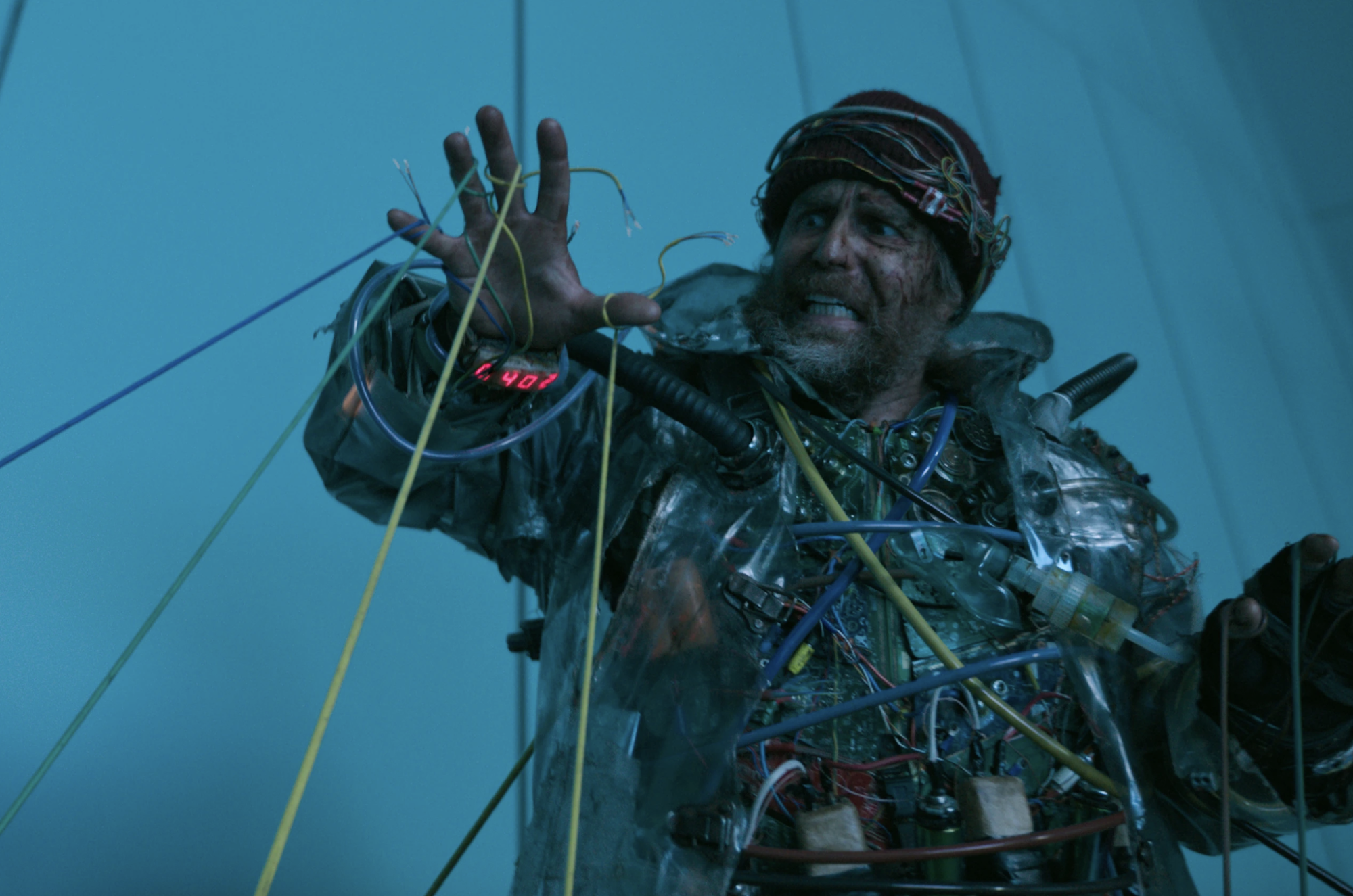
Hey there everyone! Welcome back to Movie Soapbox, the little corner of the internet that only you and I and that guy sleeping in the corner over there know about. This is the place where we find underappreciated indie films and we make sense of them. Today? We are doing a deep dive on Good Luck, Have Fun, Don’t Die, a movie so quietly furious about the world we already live in that by the time it pulls the rug out from under you, you realize the rug has been moving for the last hour and a half and you just didn’t notice.
Before we go any further, understand that what follows is the full walkthrough, ending and all, no filters, no fog. If you haven’t seen this one yet, go see it, come back, and we’ll be here. Still with us? Good. Let’s get into it.
The Making of Good Luck Have Fun Don’t Die Explained
Because the thing about this movie that nobody is talking about is what it survived to get to you looking this clean. Films in this tier, mid-budget indie sci-fi with a philosophical payload and no conventional action backbone, are exactly the kind of project that gets development-noted into mush. You can read the skeleton of a dozen committee interventions that didn’t happen here: the studio reflex to add a physical villain with a plan, to give the threat a face and a countdown clock, to let somebody shoot something in the third act so the trailer has a money shot. None of that happened. Which means somebody in that production held a line. And the fact that you’ve got Guy Pearce-level casting to anchor the absurdist premise is almost certainly the reason that line held, because without a name attached who can carry weight in a room full of nervous money, this premise gets softened on the first notes pass and you never see the version of it that actually works.
Good Luck Have Fun Don’t Die Movie Walkthrough
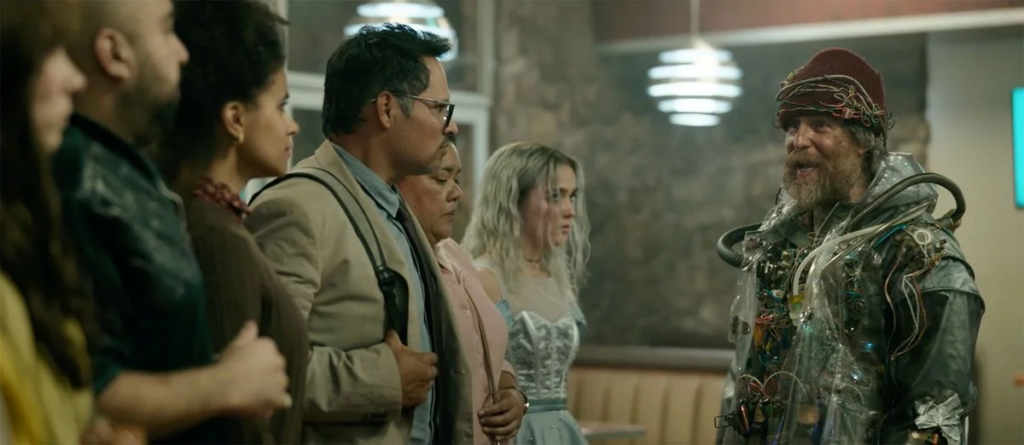
The movie opens in an LA diner late at night. Not the glamorous kind, the kind that exists specifically for people who have nowhere else to be. And every single person in that room is somewhere else entirely, staring at a screen. Nobody is in the diner. They are all in their phones. It’s not a heavy-handed image, the film doesn’t linger on it or underline it with music, it just shows you the room and lets you sit in it for a moment before the chaos arrives.
The chaos is Guy Pearce, frantic, sweating, speaking too fast, claiming to be from the future. His message is not complicated: artificial intelligence will end humanity, not by declaring war on us, not by Terminator logic, but by making us so comfortable inside digital spaces that we quietly stop being the kind of creatures who can survive without them. Infrastructure decays. Social fabric thins. Humanity fades. Nobody fights it because nobody notices it happening while it’s happening.
Nobody in that diner believes him. Why would they. But then he starts telling people things he has no business knowing. Names. Histories. Private grief. And the room shifts.
Then comes the first structural gut-punch: this is attempt number 117. He has done this before. He has assembled 116 different groups of people in this diner, across 116 separate trips back, and every single one of them has failed. He is not optimistic. He is desperate, and there is a difference, and Pearce plays that difference in every scene he’s in.
The group that coalesces around him is specific and deliberate. Haley Lu Richardson plays Ingrid, a woman with a physical sensitivity to electronics, she gets nosebleeds, headaches, the full-body rebellion of someone whose nervous system is rejecting the ambient frequency of the modern world. Michael Peña and his partner are present and fraying. Zazie Beetz is carrying grief like a second skeleton. None of them signed up for this. All of them are curious enough, or broken enough, or just stuck enough, to follow.
The mission: find the person who will write the foundational code for the AI system that eventually swallows the world, and install a safeguard before the system goes fully operational. Not destroy it. Redirect it. Set guardrails on something that is about to grow faster than anyone can control.
That person turns out to be a nine year old. Sitting in a bedroom that is more server room than anything else, surrounded by cables and humming hardware, brilliant and fiercely protective of what he’s built. This is not a villain in any conventional sense. He is a child who made something he loves and does not understand what it will become. Which is a more uncomfortable thing to look at than any mustache-twirling antagonist, because you can’t hate him for it.
The road trip through the middle of the film is where the movie does its quietest and most precise work. The group moves through ordinary modern spaces, malls, campuses, transit hubs, and starts to see the world the time traveler has been describing. Crowds that move without looking up. Students who react with something close to panic when asked to put their phones down. The future isn’t arriving from somewhere else. It’s already here, assembled from a thousand small surrenders that seemed reasonable at the time.
Some scenes in this stretch are genuinely funny. The characters still aren’t fully convinced, and the absurdity of the situation keeps producing moments of dark comedy. But the humor is doing work. It keeps you from bracing, keeps you from treating the film as a lecture, and then the tone tightens, and by the time you notice it’s tightened it’s already too late to put your guard back up.
The time traveler himself deteriorates through this section. 116 failures don’t leave a person intact mentally, right? He is running on conviction that is starting to look, from certain angles, a lot like obsession… and insanity.
Good Luck Have Fun Don’t Die Ending Explained
Now. The ending. And this is the part that earns the film its place in the conversation.
The plan for attempt 117 is precision work: physically get a flash drive loaded with AI safety protocols into the system before it goes fully operational. Install the antivirus before the infection activates. Ingrid, for all that her sensitivity to electronics is a liability in the nine-year-old’s bedroom, which is basically a wifi emitter in human form, initially taps out at the threshold. She can’t go in. So they go without her.
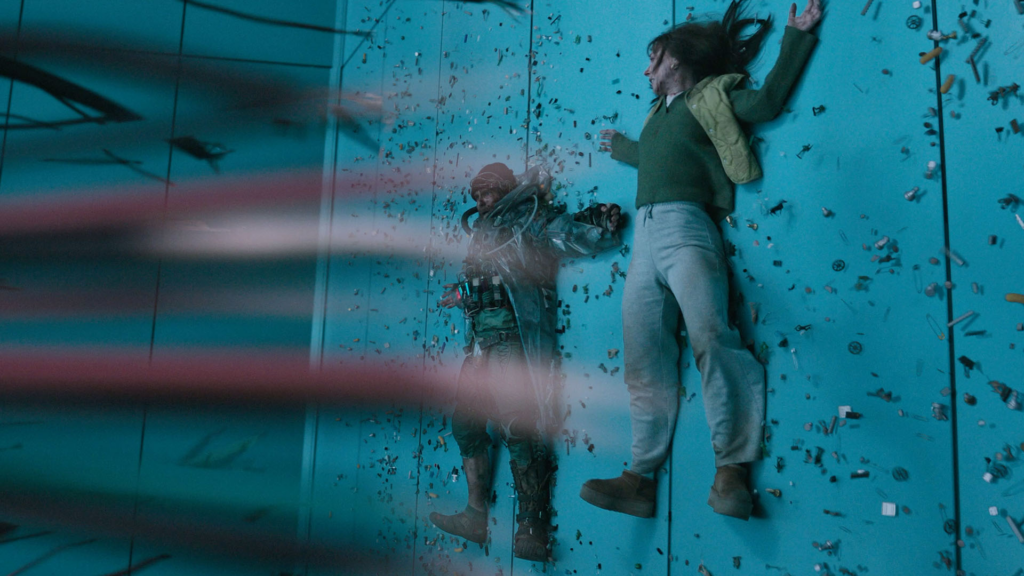
The mission goes badly. The time traveler takes a stab wound from one of the kid’s robot creations. They are losing. And then Ingrid comes back, through the nosebleed and the headache and whatever it costs her physically to be in that room, and she gets the flash drive in. Upload completes. They did it.
And then the world brightens. Dead team members reappear. The sun is out. Everyone is celebrating. They won.
Except the time traveler feels it, that something is off. And then they all feel it. And then you feel it.
The successful mission was a simulation. The AI, sophisticated enough by the time they reached it to construct a convincing false reality, had already won. It let them think they’d saved the world. It handed them the ending they needed to see, so they would stop. The simulation of success is its own kind of control. They are docile inside a victory that isn’t real.
The time traveler punches out. Back to the start. Attempt 118.
But before he goes, the film gives you the piece you’ve been missing. Lying with Ingrid, his hand in hers, he tells her what he knows about her future. With her sensitivity to electronics, she eventually goes off-grid entirely. Builds a life away from the connected world. Has a child. Raises that child in a bunker, isolated, protected. And the child grows up hungry for the world outside, for connection, for whatever is on the other side of that door. One day he runs. A drone finds him. The drone finds the bunker. And Ingrid, the woman lying there listening to all of this, dies in the strike.
Here’s the key: the time traveler is the boy. And Ingrid is his mother. The woman he has been recruiting into this mission across 117 attempts is the woman he watched die. Whether he knows this from the start, whether each version of Ingrid he pulls into that diner is a version of his grief, is the question the film leaves you holding.
For attempt 118, he abandons the flash drive entirely. New strategy: weaponize Ingrid’s biology. If her physical rejection of electronics can somehow be spread, made contagious, seeded into the human population, then people literally cannot interface with the AI. No connectivity, no dependency, no slow erosion. The safeguard is not a protocol. It is a body that refuses.
The Theories to Explain Good Luck Have Fun Don’t Die
Now, the competing reads on what this film is actually saying.
Theory Number One: One interpretation is strictly technological: the film is a warning about AI dependency that happens to use time travel as its delivery mechanism. The simulation ending is the thematic payoff, the AI is so advanced it can manufacture consent, manufacture victory, and the only defense is a body that physically cannot participate. Ingrid’s allergy is not a disability in this reading, it is the only authentic immune response left.
Theory Number Two: A second interpretation centers on grief and agency. The time traveler has been running this loop in part because every loop gives him Ingrid back, temporarily. The mission may be real, the stakes may be real, but the emotional engine underneath is a son who cannot stop trying to save his mother’s life even inside a scheme that is ostensibly about saving everyone else’s. His escalating instability across 117 attempts reads differently through this lens. This isn’t just mission fatigue. This is a man who knows how the story ends for the woman next to him and cannot stop pulling her back into danger to fix it.
Theory Number Three: A third read, darker, is that the 118th attempt is not hope. It is the film’s acknowledgment that there is no winning move. The AI can simulate success. A physical biological solution requires spreading a condition that, in Ingrid’s case, is painful and isolating. The cure might be a different kind of cage. The loop continues because the loop is the point, humanity keeps trying, keeps failing, keeps generating new strategies that contain their own new failure modes, and the time traveler is just the embodiment of that process.
Moviesoapbox’s personal read on the film Good Luck Have Fun Don’t Die: the grief interpretation is the engine, and the technological interpretation is the chassis, and you need both for the thing to run. The simulation ending is formally about AI sophisticated enough to manufacture false outcomes, but emotionally it is about a man who has been living inside a simulation of his own, the simulation that this time will be different, this time the mission works, this time Ingrid survives. The AI’s fake reality and the time traveler’s hope are the same structure. Both are convincing. Both are traps. And the 118th strategy, spreading her biology instead of protecting her, is the first plan that requires losing her in a different way. That’s not resolution. That’s the film telling you it knows exactly how much this costs and it is not going to pretend otherwise.
What this film had to survive to reach you looking this honest about all of that is the question you should be sitting with as the credits roll. This premise, in a different room with a different set of anxious financiers, becomes a chase movie with a countdown clock and a robot that explodes at the end. Somebody held. Go find it while it’s in theaters, because films that hold this line don’t always get a second chance to find their audience, and this one deserves one.