
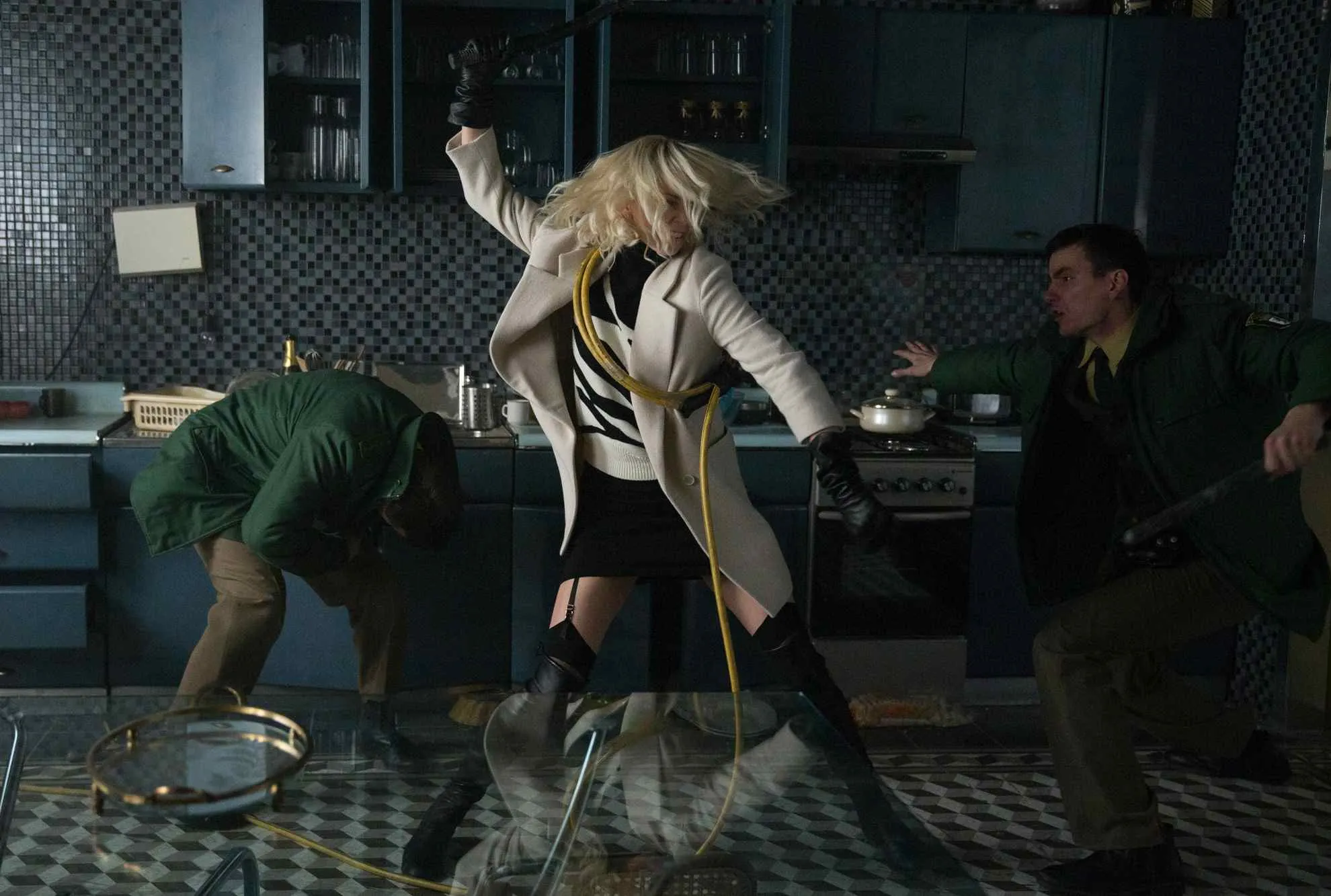
Hey there everyone! Welcome back to Movie Soapbox, the little corner of the internet that only you and I and that guy sleeping in the corner over there know about. This is the place where we find underappreciated films, we pull them apart seam by seam, and we make sense of them together. Today? We are doing a deep dive on Atomic Blonde, a movie so aggressively stylish, so committed to making you think it’s dumber than it is, that even now people walk away from the third act with their wallets missing and no idea who took them.
Alright. Before we go any further, understand that everything from this point on assumes you have seen the film or genuinely do not care what gets spoiled, because we are going to gut this thing on the table and name every organ. You have been warned, and Movie Mike is not in the business of apologizing for that.
So. Atomic Blonde. A film that arrives dressed as a John Wick cousin, all neon and New Order needle drops and Charlize Theron removing her coat in a way that makes the entire genre feel grateful, and then somewhere around the forty-minute mark, quietly, almost rudely, reveals that it has been doing something a great deal more complicated the whole time. What you thought was a spy movie with a twist is actually a nested shell game with a triple agent at its center and a framing structure borrowed directly from The Usual Suspects, the entire story told in a debriefing room, a full week after the events, which means everything you are watching is already being curated by the person telling it. A detail the film does not stop to underline for you. It just trusts that you noticed, or doesn’t care if you didn’t.
And that trust, that refusal to hold the audience’s hand, is the single most interesting creative choice in this movie. Because films at this budget tier, with this kind of action-forward marketing, do not usually make that choice. They get talked out of it. There is a reason you can usually spot a studio note in a thriller’s third act the way you can spot a patch on a tire, the texture changes, the rhythm smooths out, somebody in a conference room decided the audience needed one more scene of a character explaining what just happened to them. Atomic Blonde does not have that scene. Either the director held the line on it, or the cut that exists is the version that survived with its teeth still in, which in 2017 for a mid-budget R-rated spy film was not a foregone conclusion by any stretch. The studio math on a movie like this says: cast, action, soundtrack, done. The spy-game architecture underneath it was a fight somebody had and apparently won.
Atomic Blonde Movie Deep Dive Walkthrough
Start at the structure, because the structure is where most people get turned around. The entire film is a flashback. Lorraine Broughton, MI6 operative, is sitting in a debriefing room approximately one week after the events in Berlin have concluded, being questioned by her handler Gray and a CIA representative named Emmet, and she is walking them through what happened. This is not incidental. This framing device is load-bearing, because it means the story you are watching is the story she is choosing to tell, in the order she is choosing to tell it, with the emphasis she is choosing to place on it. Every cut, every revelation, every moment of apparent confusion in the narrative is, at least potentially, a choice Lorraine made in that room. The film is not being coy with you. It is showing you a professional intelligence officer constructing a debrief in real time, and asking you whether you notice the difference between the story she is telling and the story that actually happened.
The mission as stated is double-barreled. MI6 has lost a list, a roll of every active Western operative in the field, the most maximally generic spy-movie MacGuffin imaginable, the film knows this and leans into it. Lorraine is sent to Berlin to recover the list from a man called Spyglass, who has memorized it and needs to be extracted. Simultaneously she has a second objective: identify and expose the MI6 mole known only as Satchel, who has been feeding intelligence to the Soviets for years. Two missions. One operative. Straightforward enough, until it isn’t.
Lorraine lands in Berlin and immediately connects with David Percival, the local MI6 station chief, who is exactly the kind of man you would cast if you wanted someone to seem untrustworthy without being quite obvious enough about it to constitute a spoiler. She is told to trust no one and she doesn’t, including him. She also connects with Delphine Lasalle, a French intelligence officer who is either surveilling her or falling for her or both, the film is generous enough to let this be real even while it is also operational, and with Merkel, her contact in East Berlin, who functions as her logistical lifeline through the second act.
What Lorraine does with these relationships is where the film’s actual cleverness lives. She feeds the Soviets a bad list, a fabricated version of the MacGuffin, while simultaneously routing the genuine intelligence back through her own channels. Percival, meanwhile, is doing his own business on the side, because Percival is a double agent working for the Russians, and when he gets his hands on the real list, he reads something in it that changes his calculations entirely: Satchel and Lorraine are the same person.
Think about that for a second. Because I’m guessing many of you missed it. Lorraine Broughton is not an MI6 agent. She is CIA. She has been running as an MI6 asset, operating under British cover, working a Russian channel, for the entire film. The debriefing at the start of the movie that felt like a formality is actually an interrogation, because the people in that room do not entirely know who she is working for or what she brought back. The tell the film plants early is Emmet’s offhand comment about getting back to Langley. Langley. Not Thames House. Not Vauxhall Cross. Langley, Virginia. That is a single line of dialogue, easy to miss, that recontextualizes the entire framing structure if you catch it the first time. Merkel, her East Berlin contact, is a second tell: he is CIA infrastructure, not MI6, which means the network she is running has been American the whole time.
So Percival knows. He knows she is Satchel, he knows she is CIA, and he decides that the play is to sell the list to the Soviets and burn Lorraine as the mole while he’s at it. Delphine finds out, warns Lorraine, and this is why Lorraine kills Percival. He is a loose end with too much information and a plan that gets her burned on two continents simultaneously. Once he is dead, Lorraine and Delphine use audio from the wire Percival was carrying to construct a clip that frames him as Satchel. Which he was not. But which solves both of Lorraine’s problems in one move: it gives MI6 a Satchel to close the file on, and it keeps Lorraine’s American identity and her actual operational chain intact, protected, unprovable.
She walks out of the debriefing with commendations. The CIA gets its list and its cover story. The Russians got bad data. MI6 got a dead double agent to point at. Everybody got something except Percival and Delphine, which is the part the film is honest about and does not try to make you feel better about.
Atomic Blonde Movie Explanation Number 1
The competing reads on this film tend to cluster around two questions. The first is whether Lorraine’s emotional connection to Delphine was real or manufactured, a question the film deliberately leaves open and which a significant portion of the audience has strong feelings about in both directions. The second is whether the version of events Lorraine presents in the debriefing is the accurate version, or a construction, and what the difference between those two things would even mean for a CIA officer running this level of operation.
Atomic Blonde Movie Explanation Number 2
The simpler read: Delphine was real, the debriefing account is substantially accurate, and the tragedy of the film is that Lorraine is good enough at her job that the collateral damage is invisible in the final report. The more paranoid read: the entire framing structure exists because Lorraine is the most unreliable narrator since Verbal Kint, and the film has shown you exactly one version of events, the one she chose to present, in a room where the truth was never the objective. Under this read the emotional beats with Delphine may be the only genuine thing in the film, which is either comforting or devastating depending on your tolerance for ambiguity.
Moviesoapbox’s Read on Atomic Blonde
Movie Mike comes down firmly in the middle of those two reads, which is not a hedge, it is a reading of what the film is actually doing. The events are substantially as presented. Lorraine recovered the list, burned Percival, protected her cover. All of that happened. What the film is asking you to sit with is not whether the plot is accurate but whether accuracy is the point when the person recounting it has already decided what the story means and what gets left out of it. The debriefing is not a confession. It is a performance by a professional. The film respects her enough, and respects you enough, to let that be the final note without underlining it.
That is a hard movie to greenlight. It is an even harder movie to let out the door intact. Somebody fought for the version of Atomic Blonde that trusts its audience to catch a single line of Langley dialogue and rebuild the whole architecture from it. That film exists. Go watch it again knowing what you know now, and watch how much it was already telling you.
We will see you in the next one. Thanks for spending time here at Movie Soapbox.
If You Liked Atomic Blonde…
Sicario (2015) – A woman operative thrown into a world where every ally has a second agenda. The tension never breaks and the moral ground never stops shifting.
In Darkness (2018) – A blind woman at the center of a spy thriller with a twist so good it reframes the entire film. Same stylish espionage energy, completely different angle of attack.
The Little Things (2021) – A detective thriller where obsession eats the protagonist alive and the case might never actually get solved. The ambiguity is the whole point.