
Hey there everyone! Welcome back to Movie Soapbox, the little corner of the internet that only you and I and that guy sleeping in the corner over there know about. This is the place where we find underappreciated indie films and we make sense of them. Today? We are doing a deep dive on Aporia, a movie so quietly devastating, so morally precise in what it is asking you to sit with, that the fact it exists at this level of craft at all should make you at least a little suspicious about how close it came to being something else entirely.
Alright. Before we go any further, you need to know: everything from this point forward assumes you have watched Aporia in full. Every scene. Every ripple. Every consequence. If you have not done that yet, close this tab, go find the film, and come back. I am not going to protect you from what happens in this movie because the whole point of talking about it is to get into the machinery. You have been warned, and I mean it more than the usual boilerplate warning, because this is one of those films where the ending only lands if the middle has been allowed to accumulate weight on you in real time. Go watch it. Come back.
Still here? Good. Then let us get into it.
What This Film Had to Survive to Get Here
Films operating at this budget tier, this cast tier, with a screenplay this conceptually demanding and this morally unresolved, do not typically arrive onscreen looking like the director’s cut. They arrive looking like what happened after the third round of notes asked for a cleaner ending, a more sympathetic protagonist, and maybe just a little more hope at the close because the test-screening card said “emotionally unsatisfying” and nobody in the room wanted to explain to the financiers what “philosophically purposeful ambiguity” means when it shows up on a greenlight deck. The fact that Aporia ends the way it ends, unresolved, morally tangled, refusing to let Sophie off the hook or condemn her cleanly, tells you something. A certain kind of pressure did not get applied here, or it got applied and someone held the line. You can feel the difference between a third act that survived and a third act that got committee-written into comfort. This one survived.
The Setup, and Why It Matters That the Machine Is Not a Time Machine
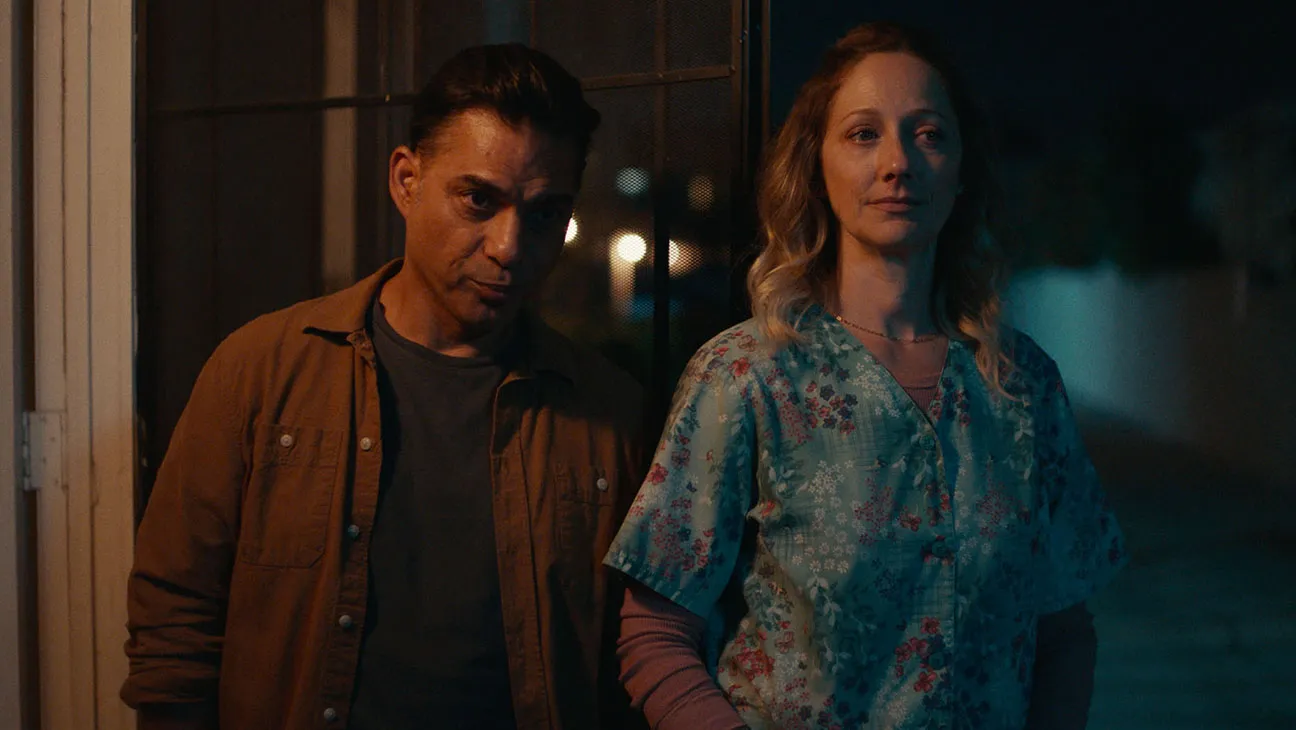
Sophie, played by Judy Greer, is eight months into grief when the film opens. Her husband Mal, played by Edi Gathegi, was killed by a drunk driver. Her daughter has pulled away. Her life has the specific quality of a person who has stopped arguing with the wreckage and started just living inside it. Then Jabir, Mal’s best friend played by Payman Maadi, shows her what he has been building. It was supposed to be a time machine. It is not. What it is, specifically, is a time sniper rifle, a device that can send a bullet backwards through time to a precise moment and kill a specific person before a specific action occurs. Not a machine that lets you walk back into your own past. A gun that reaches back and removes a person from the equation. The distinction matters more than it initially sounds like it does, and the film knows it.
So. Jabir and Sophie use it to kill Darby, the drunk driver, before he gets behind the wheel the night Mal dies. And Mal walks back around the corner, having lived the version of events where none of it happened to him, while Sophie has lived through all of it. That asymmetry, one person carrying the weight of both timelines, is where the film plants its real subject matter, and it is not time travel. It never was.
How the Time Mechanics Actually Work
The film is operating on a branching-but-merged timeline logic, and it is worth slowing down and mapping this clearly because the emotional weight of the back half depends entirely on you understanding what Sophie is actually doing every time she pulls the trigger.
Before Jabir shows Sophie the device, you have a simple sequence: Mal is alive, Darby drives drunk, Mal dies, Sophie and her daughter’s lives collapse. Clean, brutal, linear.
What the device creates is not a replacement for that timeline. It creates a third one, a new branch, and Sophie is the only person who exists in the overlap between them. She remembers Mal dying. She remembers the eight months of ruin. And she also now gets to watch Mal walk back into her kitchen, carrying no memory of any of it, because in his thread of causality it never happened. He experienced Timeline Two: Mal alive, Darby dead before the accident, Mal continues living. Sophie experienced Timeline Three: everything that happened, plus the act of changing it, plus the rejoining. She is the only person holding both versions simultaneously. That is the loneliness the film is actually about, not grief. The thing after grief, when you fix the thing that caused the grief and discover that you are still carrying it alone.
Once you understand that structure, everything that follows makes a different kind of sense. Because Sophie does not stop at Darby.
The Ripples, and Why They Cannot Be Contained
This is where the film asks its real question, and it is worth stating plainly before getting into the mechanics of how the answer plays out. If you had a tool that could retroactively remove people who caused harm, who gets to decide where the list ends. Sophie starts with Darby, which is understandable, which is what the film needs you to feel so that you go along with her when she starts going further. Then she investigates the ripple effects. Darby’s widow. Darby’s daughter. The bakery that has to close because the household income is gone. The medical bills that are now unpayable because the insurance structure changed. She intended to correct one stitch and found that the garment around it had already started pulling. So the machine gets used again. And again. Each correction justified by the logic of the previous one, each one producing new damage in a different place.
The snake eyes the film rolls, the moment where a daughter becomes a son, a character flipped not metaphorically but literally by the accumulated changes cascading back through the timeline, is where the film makes its hardest argument. The chaos is not punishing Sophie for being selfish. It is showing her that the categories of selfishness and altruism do not survive contact with actual causality. She is doing harm while doing good and the machine cannot tell the difference and neither, it turns out, can she. By the time someone else is pulling the trigger, the question of who is responsible for what outcome has become genuinely unanswerable. That is not a flaw in the screenplay. That is the point of the screenplay.
What “Aporia” Actually Means and What the Title Means
The Greek word aporiaconnotes a state of genuine philosophical puzzlement, not the kind where you just need more information, but the kind where more information does not resolve the problem because the problem is structural. A paradox you cannot think your way out of because every valid path through it leads somewhere you cannot accept. Sophie is not confused about what she wants. She wants Mal back, and she wants the people she hurt in getting him back to be okay, and she wants the people who were always going to cause harm to not cause it, and she wants her daughter to be her daughter. Those are not unreasonable things to want. The film’s argument is that the universe is not structured in a way that allows all of those things to coexist, and the tool she has been handed does not change that structure. It just makes the collision happen faster and with more visible wreckage.
Aporia Movie Theories Explained
The ending is deliberately unresolved and the film earns that, though it creates a split in how viewers receive it. The major interpretive camps break down roughly like this.
Aporia Movie Explanation Theory Number 1
The first read: Sophie has realized the machine is catastrophic and the ending implies, without confirming, that she or Jabir will find a way to stop using it, to accept the new version of events as the version they have to live with, whatever that looks like now that so much has been changed. The moral weight of the ending, on this read, is about acceptance. The Greek philosophical sense of aporia as a stopping point, a place where you have to put the problem down because you cannot solve it.
Aporia Movie Explanation Theory Number 2
The second read: the ending is not about stopping. The ending is about the impossibility of stopping. Sophie has now crossed enough thresholds that the version of events she is living in is so far from the original that she cannot locate a stable ground to stop on. Every potential stopping point requires accepting some consequence she caused, and the machine is still there, which means the temptation to correct that consequence is still there. On this read, the ambiguity is not hopeful. It is a trap she has built for herself and the ending is the film refusing to spring it for you because that would let you off too easy.
Aporia Movie Explanation Theory Number 3
The third read, and the one that rewards the most careful attention to how Sophie and Jabir’s relationship shifts across the film: this is a movie about what it costs to share a secret that changes what you know about reality, and the ending is less about the machine than about what two people look like when they have gone through something together that they cannot explain to anyone else. The isolation of Timeline Three is not just Sophie’s burden. Jabir built the thing. He knows. The ending, on this read, is about those two people trying to figure out what they are to each other now, after all of it, and the film leaving that question open is the only honest thing it could do.
Movie Soapbox’s Read on the Movie Aporia
The second interpretation is the right one, and I will tell you exactly why. The film is not interested in redemption. It is interested in the architecture of how people justify each incremental step toward a version of themselves they would not have recognized at the start. Sophie’s first decision is completely defensible. Bring her husband back. Every decision after that is slightly less defensible but follows logically from the one before it, and the machine makes each one feel like a correction rather than a choice. That is the trap. By the time the consequences are catastrophic, she is too far into the logic of the machine to locate the exit. The ending does not show you someone who has found the exit. It shows you someone who now understands there is no exit, which is a different thing, and a harder thing, and the film is honest enough not to dress it up as the same thing. That is what aporia actually means. Not “I am confused.” Not “I need to think harder.” The door is not there. There is no door.
That a film operating at this budget, with this cast, asking this question, made it to your screen with that ending intact? Damn. Someone held the line. Not every film like this gets to keep its ending. Most of them lose it in a room full of people who have never read a philosophy textbook and are very concerned about what the audience will feel walking out. Remember that the next time someone tells you the indie space is struggling. The indie space is the only space still capable of making this film. Everything we just talked about was the proof.
Thanks for spending some time here with us on Movie Soapbox. We will see you at the next one.
If You Liked Aporia…
Enter Nowhere (2011) – Three strangers in a cabin discover they’re connected across time, and the choice to fix the past costs more than they bargained for. Same moral weight as Aporia’s trigger pull.
The Jacket (2005) – A man gets thrown forward in time and uses what he learns to try to save someone. The desperation to rewrite fate is identical to what drives Aporia.
Next Exit (2022) – Two strangers drive toward a facility that proves life after death. The question isn’t whether it works — it’s whether you’d actually use it. Same moral territory.