
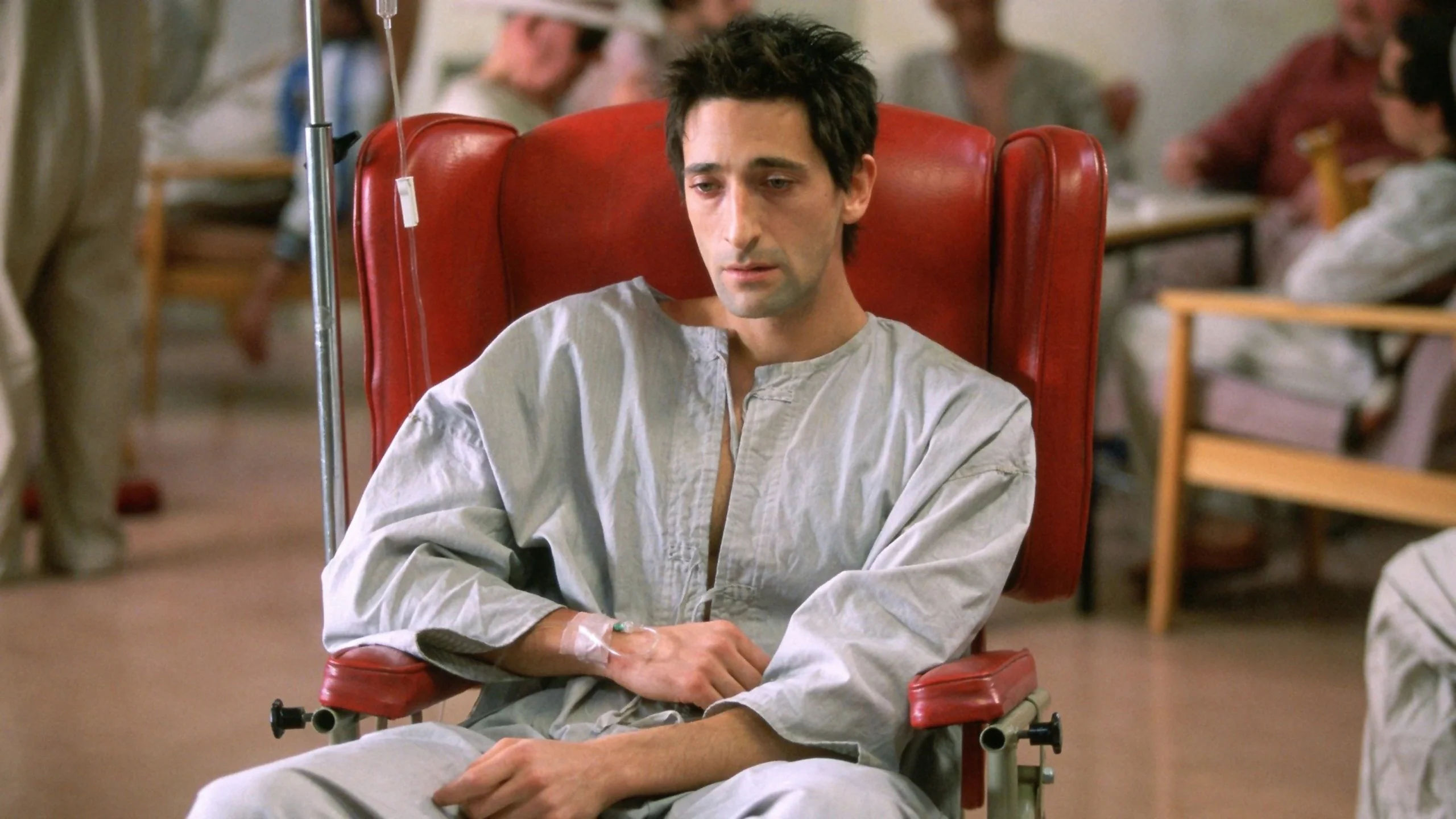
Hey there everyone! Welcome back to Movie Soapbox, the little corner of the internet that only you and I and that guy sleeping in the corner over there know about. This is the place where we find underappreciated indie films and we make sense of them. Today? We are doing a deep dive on The Jacket, a movie so quietly brutal in its construction that even now, twenty years later, people finish it and immediately start arguing about what they just watched, which is honestly the highest compliment a film like this can receive.
Before we go any further: if you have not seen The Jacket, close this tab. Come back when you have. I mean that. Everything past this sentence is a spoiler, the good kind, the kind that only lands after you have sat with the film and felt its particular flavor of disorientation settle into you. You were warned.
Let’s get into it.
The Jacket: A Walk Through the Machine
Jack Starks, played by Adrien Brody with the specific hollowness of a man who has already been emptied out once, gets shot in the head in Iraq. Fatal wound. Bag him and tag him. Except his eyes open on the table and the docs pull him back, which is the kind of moment that in a factory studio film would be scored with swelling strings and framed as a miracle. Here it feels more like a clerical error.
Back stateside, he catches a ride with a stranger who has warrants, and when the cop pulls them over, the stranger kills the officer and walks. Jack, standing next to the body, gets charged. Found not guilty by reason of insanity, he ends up at Alpine Grove under Dr. Becker, played by Kris Kristofferson with the absolute conviction of a man who has written the justification for what he does in language he cannot stop believing. Becker’s treatment is exactly what it sounds like: drugs, a straitjacket, a morgue drawer. A womb, he calls it. We find out another patient, Ted Casey, went through the same treatment and died in it. That detail is not buried. The film puts it right in front of you and lets you sit with it.
In flashbacks, Jack starts remembering hitching a ride with a mother and her young daughter, Jackie. He gave the girl his dog tags. He remembers it the way you remember something that already felt significant when it happened.
In the tank for the second time, the chaos breaks through into something structured: he is in the future, 2007, and he meets Jackie again, played by Keira Knightley, older, rougher around the edges, carrying the particular kind of damage that comes from a mother who was not around. She offers him a ride. He ends up at her place. He finds his own dog tags in a jar on her shelf and the floor drops out.
Now he knows three things. He traveled. He traveled forward. And according to Jackie, he died on January 1st, 1993, in the box at Alpine Grove. So the rest of the film becomes a problem to be worked: two people in 2007 trying to reverse-engineer a death that has already happened from their perspective and has not happened yet from his.
Here is where the film does something that most studio pictures at this budget level would never be allowed to do: it trusts the mechanism. Jack goes back to Alpine Grove in 1992, tells Dr. Beth Lorenson what is happening, proves it to her by telling her how to break through to a catatonic patient named Babak, and she believes him. Not because the script needs her to believe him, but because the evidence is right there and she is a scientist. When Jack travels to 2007 again, he and Jackie go back to Alpine Grove and find Becker, still alive, haunted in exactly the way you would expect a man haunted. Jack gets the names of three other patients Becker killed. He gets Jackie’s childhood address.
He goes to Waldemere Way with Lorenson and delivers a letter to Jackie’s mother. The letter tells her that if she keeps drinking and smoking in bed, she will die in a fire. She changes. And when Jack arrives in 2007 for the last time, Jackie does not recognize him. They have never met. Her whole life is different.
He slips on the ice, cracks his head, Lorenson gets him into the box one more time, and he arrives at the diner where they first met. She still offers him a ride, different timeline, same instinct. Jack smiles. That is where the film ends and the argument starts.
What This Film Had to Be, and What It Actually Became
You can read this movie in the credits. Adrien Brody coming off his Oscar win for The Pianist, Keira Knightley mid-ascent after Pirates, Kristofferson as a third-act villain, Jennifer Jason Leigh as the sympathetic doctor. That cast does not attach to a film like this without an element of prestige packaging around it, and prestige packaging means development notes, and development notes on a time travel film with a morally compromised ending and no clean resolution almost always mean the same thing: pressure to explain more, to resolve cleaner, to give the audience a handhold.
The fact that The Jacket does not do any of that, the fact that it ends in deliberate ambiguity and trusts the viewer to hold four genuinely incompatible readings in their head at once, tells you something about how this film got made. Either the director, John Maybury, protected the script at every negotiation point, or the financiers simply did not understand what they were financing well enough to note it to death. Both outcomes produce the same artifact: a studio-adjacent film that behaves like an independent one. You can feel the shape of what this movie could have become in the wrong hands. A clean Jacob’s Ladder riff with a resolution that explains everything in the last three minutes. That film does not exist, and we should be grateful for the one that does.
Untangling the Mechanics of The Jacket
The time travel in The Jacket operates on a specific and consistent rule that the film never states out loud, which is both its virtue and the source of most viewer confusion. Jack does not travel consciously. The tank is the trigger, the combination of sensory deprivation and whatever Becker is putting in him creates a condition his particular brain chemistry can exploit. He goes forward, not backward. From 1992 he goes to 2007. He cannot choose his destination and he cannot choose his departure point. The box sends him and the box brings him back.
The implication of Jackie’s changed life in the final sequence is crucial to reading the mechanics: if time travel in this film were purely linear, a fixed track where Jack observes but cannot alter, then Jackie in 2007 would still know him, because the version of events where they met two days ago would be the only version. The fact that she does not know him means the letter worked, her mother lived, and Jack is now arriving in a 2007 that was not there before. The timeline changed. The film commits to that without underlining it twice.
The dog tags are the anchor. They persist across timelines because Jack physically carried them from 1992 to 2007 inside the pocket of every version of himself. They are the proof object. When Jackie finds them in her jar early in the film, that version of Jackie has been holding them for fifteen years in a timeline where her mother died and she grew up hard. When the film ends, that Jackie is gone.
The Four Theories to Explain The Jacket
Theory One: Jack Is Dead. The simplest read. Jack takes a bullet in Iraq, and everything after is the hypoxic hallucination of a dying brain. The Jack/Jackie symmetry is wish fulfillment. The resolution is comforting chaos. He dies, the visions end. This theory requires the least faith in the film’s internal logic and rewards the least engagement with it. It is not wrong, exactly. It just treats the film as less than it is.
Theory Two: Linear Time Travel. Jack survives, travels, but cannot change anything. The future is fixed and he is just a witness moving through it. The problem is the film explicitly shows this to be false. Jackie’s changed life at the end is not ambiguous. Her not recognizing him is not ambiguous. Something changed. Theory Two cannot absorb that fact without collapsing.
Theory Three: The Multiverse. Jack survives. He travels. Every intervention he makes in the timeline causes it to shard, and when he returns, he arrives in the new version. The Babak treatment, the patient names, the letter to Jackie’s mother, each one is a change that creates a new branch. The Jackie who does not recognize him at the end exists in a branch that Jack himself created. This is the theory the film’s structure most consistently supports. It also explains why Jack smiles at the end, not because he has won, but because he understands now what kind of machine he is inside.
Theory Four: The Becker-verse. Becker says, in the 2007 sequence, “We’re all dead, Jack.” And Jack responds that the dead patients stay with Becker, haunt him. What if that is literally true? What if Jack, Casey, McGregor, Piechowski, all the patients Becker killed in that box, are ghosts running a haunting? What if the entire film after minute five is Becker’s guilt given architecture? It is the most structurally disruptive of the four readings because it reframes Jackie as either a ghost herself or a projection, and the film does not give you clean evidence either way. It is also the theory that costs Becker the most, which feels right for a film this interested in accountability.
Moviesoapbox’s Take on The Jacket
The multiverse. I have sat with all four of these and the multiverse is the one that survives contact with the film’s actual details. The letter to Jackie’s mother is the proof. The film does not show you that scene as a maybe. It shows you Jackie in a VW Bug with a different life and a face that has never seen Jack Starks before, and it does that because it wants you to understand that the intervention worked and the branch split. That is not ambiguity, that is mechanism. The film built a machine and it runs.
The Becker-verse is the more poetic theory and I understand why it sticks with people. “We’re all dead, Jack” is the kind of line that lands in your chest and sits there. But the ghost theory requires Jackie to be either dead or a construct, and Keira Knightley is playing a real person in pain in a real apartment with real dog tags in a real jar, and that specificity is earned. You do not earn that kind of specificity for a projection.
Jack Starks survived a bullet, got fed into a machine designed by a man who believed he was helping, and used that machine to fix things that the machine was supposed to make worse. That is the version of this story worth believing. Becker built the box to break people and a broken man used it to save someone’s mother. That is the kind of outcome factory Hollywood could never have written on purpose, and the reason this film is worth your two hours twenty years after anyone thought it was.
We’ll see you next time. Stay in the corner with us.