
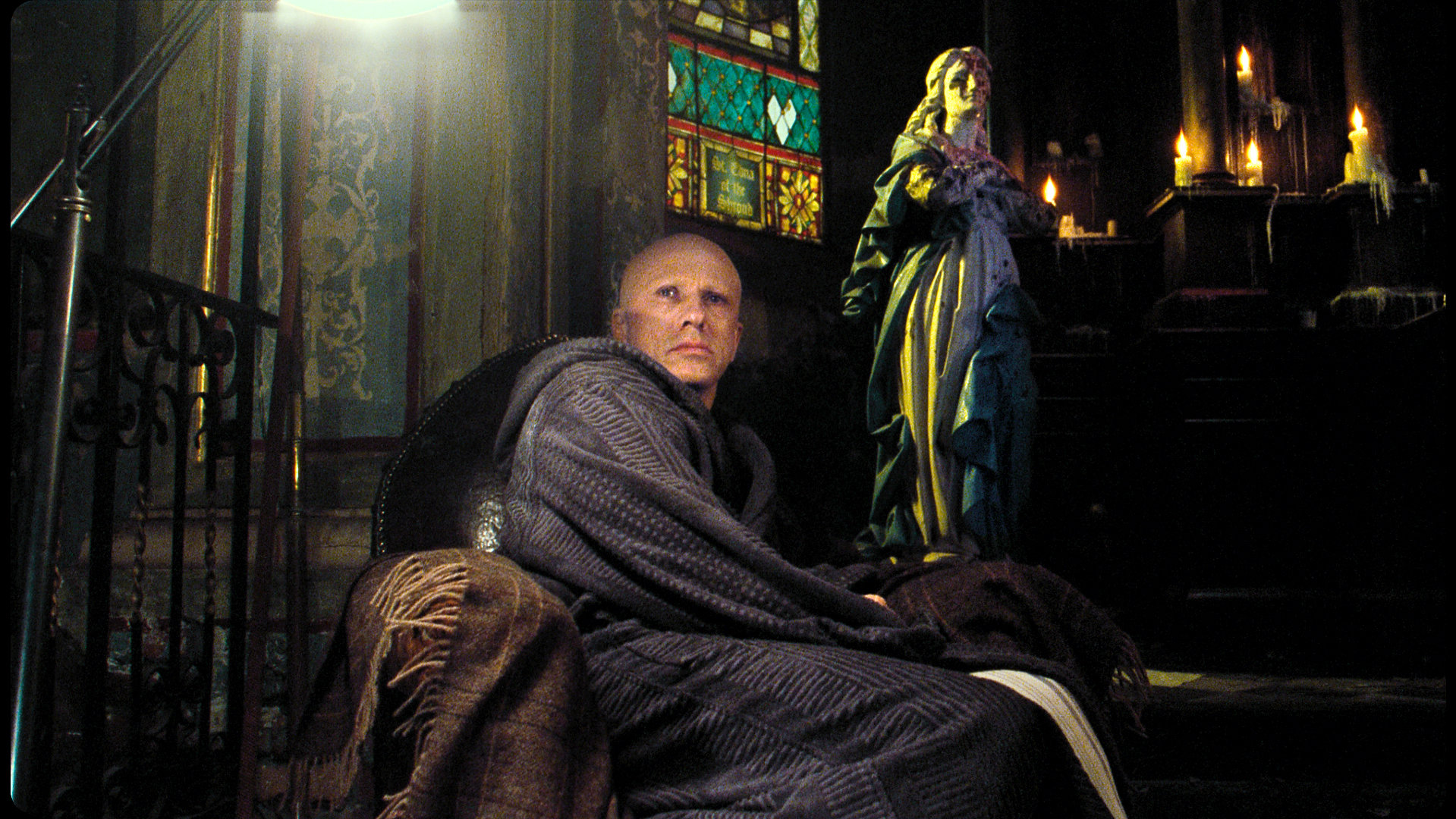
Hey there everyone! Welcome back to Movie Soapbox, the little corner of the internet that only you and I and that guy sleeping in the corner over there know about. This is the place where we find underappreciated indie films and we make sense of them. Today? We are doing a deep dive on The Zero Theorem, a movie so eccentrically, stubbornly, defiantly weird that the marketing department responsible for selling it probably filed for emotional disability leave afterward.
Alright. If you haven’t seen The Zero Theorem yet, close this tab, go watch it, and come back. I’m not going to hold your hand through the plot points while simultaneously keeping the good stuff hidden, that’s not how this works here. Everything from this point forward is spoiler territory, all of it, including the ending, including the beach, including the phone call he doesn’t answer. You’ve been told.
Zero Theorem – The Making Of
Now. Before we get into what this movie is actually doing, you need to understand what kind of film this was trying to be, and what the machinery of the industry was almost certainly whispering in everyone’s ear while it was being made. A Christoph Waltz vehicle. A Terry Gilliam film. A dystopian sci-fi with a budget that sat in that uncomfortable middle tier, not cheap enough to be fully author-controlled, not expensive enough to have real franchise armor protecting it from interference. That budget range is where directors get the most notes and the least cover. You can tell when a film at this level has survived a certain kind of pressure because the third act gets a little loose, the emotional resolution comes in slightly sideways rather than landing clean, and the ending defaults to image over statement because at some point someone in a room said “we can’t end on that” and the filmmaker swallowed it and went back to the edit. The Zero Theorem’s ending, Qohen alone on a virtual beach, Bainsley’s voice drifting in from somewhere off-screen, reads like a man who fought to keep ambiguity alive against people who kept asking for resolution. Gilliam kept the ambiguity. It cost him the clean landing. That’s the trade, and he made it, and it was the right call.
The Zero Theorem Movie Walkthrough
Qohen Leth is a man who refers to himself in the plural, works a soul-grinding computational job for a corporation called Mancon, and is waiting, has been waiting, will apparently continue waiting, for a phone call he believes will deliver him the meaning of his existence. He’s not presented as crazy. He’s presented as the only person in the film who is still asking the question everyone else stopped asking the minute the paycheck cleared. He wants to work from home, stays close to the phone, goes through rounds of psychological evaluation administered by an AI called Dr. Shrink-ROM, and eventually lands at a party where he meets Management, played by Matt Damon doing his flat, affectless, quietly menacing thing, who labels him insane and then immediately hands him exactly what he asked for. Work from home. Solve the Zero Theorem.
The Zero Theorem, as a mathematical concept inside the film’s logic, is the equation that proves zero equals one hundred percent. Nothing equals everything. The void is the whole. Mancon wants this solved not because of any philosophical hunger but because the answer is a product. The meaninglessness of existence, once mathematically proven, is a thing you can sell to people who are already halfway to believing it. Qohen doesn’t know this. He thinks he’s been handed his life’s purpose. He thinks solving the Theorem might be the phone call, or at least the path to it.
Into this setup walks Bainsley, played by Mélanie Thierry, who meets Qohen, forms something that starts as warmth and gets complicated fast. There are VR sequences. There is the suggestion of intimacy. There is Qohen, terrified and reaching, asking her to run away with him, elope, leave all of it. She says no. Later we learn she’s been reporting to Management the whole time. A spy, a plant, a pair of eyes in his house. When she’s not with Qohen she’s a webcam performer. The film presents this without judgment, which is one of the things Gilliam does that the factory version of this movie absolutely would not have done.
Then Bob shows up. Bob is Management’s son, played by a very young Lucas Hedges before anyone outside of casting directors knew who Lucas Hedges was, and Bob tells Qohen the thing Qohen most cannot afford to hear: the phone call is a myth. It doesn’t exist. There is no call coming. There never was.
And then Bainsley comes back. She apologizes. She says she fell in love with him, the real thing, not the assignment. She asks him to elope. She is standing in front of him offering him the only genuinely human connection the movie has shown to be possible in this world. He turns her down.
What the Zero Theorem Movie Is Actually About
Gilliam said it himself in an interview, and it’s worth letting him say it plainly: the most dooming thing in the film is the moment Bainsley says “come away with me” and Qohen can’t do it. Gilliam called it impotence. Not failure, not tragedy, impotence. The specific paralysis of a person who can see the meaning of life standing right in front of him and cannot move his feet to walk toward it because he is still waiting for a phone call that was never going to come.
You need to hold that for a second. Because the movie has spent its entire runtime building Qohen as the sympathetic figure, the one sane man in an insane system, the lone soul still asking the real questions while everyone around him feeds the machine. And then, at the exact moment the film offers him an answer, he fails the question. He turns it down. He goes back to the equation. He goes back to waiting.
The Zero Theorem is not a puzzle about what the Zero Theorem means mathematically. The film doesn’t actually care about that. It’s a film about the phone call you don’t answer because you’re too busy waiting for the phone to ring. Bainsley was the call. She arrived. He saw it. He let it go.
Zero Theorem Movie Theories
There are a few ways people read the ending, and they’re worth laying out honestly.
Zero Theorem Theory #1 –
The first reading is the hopeful one: Qohen jumps into the black hole he’s uncovered in the Neural Net, ends up on the virtual beach, hears Bainsley’s voice, and the implied suggestion is reunion. The digital space is where they can exist together in a way the real world wouldn’t allow. The beach is a second chance. He runs toward her voice. They find each other in the only place left that’s safe. Gilliam gives you enough visual warmth at the end to allow this read if you want it.
Zero Theorem Theory #2 –
The second reading is the cold one: Qohen has retreated into pure simulation. He missed the real Bainsley. He chose the equation over the relationship, chose the waiting over the arrival, and now he’s alone in a virtual space hearing an echo of something he turned away. The voice on the beach is the sound of what he gave up, not a door opening. Gilliam’s track record on happy endings strongly suggests this is the intended read, whatever the imagery allows.
Zero Theorem Theory #3 –
The third reading, which is the one that sits between the other two, is that the question is the point. Gilliam deliberately doesn’t close the door all the way. The ambiguity is the argument. The film is asking you whether you think reconnection is still possible after that level of refusal, and the answer you give says more about where you are in your own life than it does about anything Qohen did on screen.
Moviesoapbox’s Take on Zero Theorem
The cold reading is the right one, and here’s why: the movie has been meticulous about showing you every other way Qohen could have turned toward life and didn’t. The evaluation processes he endured just to stay near a phone. The relationship he destroyed before it could threaten his waiting. The moment Bob told him the call didn’t exist and Qohen couldn’t absorb it because absorbing it would mean he had wasted everything. By the time Bainsley comes back, you already know Qohen is not capable of saying yes to her. The film has shown you his incapacity three times before she arrives. Her return is not an opportunity he might take. It’s the final proof of what he’s been all along.
The beach is a consolation prize he built for himself. The voice is a recording. He is alone in a simulation of the one good thing he could have had, and the film ends there because Gilliam is a filmmaker who respects you enough to not lie to you about what that is.
What makes The Zero Theorem worth your time is that it got this dark, this specific, this uncomfortably pointed about the way people turn away from meaning when meaning actually shows up, and it got there intact. Gilliam made this film in his seventies. He’d been fighting the machine since Brazil. He knew exactly what he was doing and exactly what he was saying, and the film exists in the form he intended it to exist in, which is more than you can say for most movies that ask this kind of question. The ones that don’t have a Christoph Waltz attached, and don’t have a Terry Gilliam’s name on the poster to drag them past the suits, get reshaped into something that ends with reunion on the beach and a score that tells you how to feel. This one doesn’t. That’s the whole thing right there.