
Hey there everyone! Welcome back to Movie Soapbox, the little corner of the internet that only you and I and that guy sleeping in the corner over there know about. This is the place where we find underappreciated films and we make sense of them, the ones that got made in spite of everything working against them, the ones that deserved a bigger room and got a smaller one instead. Today? We are doing a deep dive on Enemy, Denis Villeneuve’s 2013 psychological nightmare, a movie so deliberately, structurally, philosophically disorienting that the suits who approved it probably thought they were getting a thriller about a guy who finds his doppelganger and then things get tense. They were not getting that. They were getting something much worse, and much better, and they didn’t know it until it was already in the can.
Before we go any further, you should know: everything from this point forward is a spoiler. Not just the ending, everything. The structure of this film only makes sense if you’re allowed to talk about all of it at once, and I am going to do exactly that. If you haven’t seen Enemy yet, go watch it. Come back. We’ll be here. What I’m about to say will not make sense to you without the images already burned in, and frankly, this film deserves the full experience before anyone starts explaining the mechanism to you.
Still here? Good. Let’s talk about what this film actually is.
Enemy Movie Walkthrough
Jake Gyllenhaal plays two men. Adam Bell, a history professor so deep in the groove of his own routine that he’s basically become furniture in his own life, quiet, hollowed out, reciting lectures he’s memorized so thoroughly they’ve stopped meaning anything to him. And Anthony Claire, an actor operating under the stage name Daniel Saint Claire, who lives the version of life Adam can’t quite reach, leather jacket, pregnant wife, a different kind of restlessness. Gyllenhaal plays both. You need to hold that in your head right now because the entire architecture of this film depends on it.
Now, before we walk through what actually happens on screen, let me tell you what kind of film this is, underneath the skin of it, because it matters for everything that follows.
Enemy arrived at a moment when Villeneuve was not yet the industry’s favorite prestige hire, he was a guy who’d made Incendies and was now making a small, strange, psychologically dense Canadian co-production on a budget that wouldn’t cover a single act of reshoots on a Marvel picture. That budget tier, that level of financing, usually means one of two things: either the director had final cut as a condition of getting out of bed in the morning, or he had none of it and you can tell by looking at the third act. Watch the third act of Enemy. There is no test-screening flinch in it, no softening, no moment where the camera cuts away to let you off the hook. That ending doesn’t exist in a film where twelve VPs with weekend-read coverage had a pass at the script. What you’re watching is a film that survived the financing process precisely because it was too weird and too small to attract the kind of attention that ruins things. The obscurity was the armor.
So. The film opens in an underground sex club, candlelit, velvet, the kind of place that costs a lot to look that shabby. A man, we’ll get to which one, is watching a performance that ends with a woman about to crush a live tarantula under a stiletto heel. File that image. You’re going to need it.
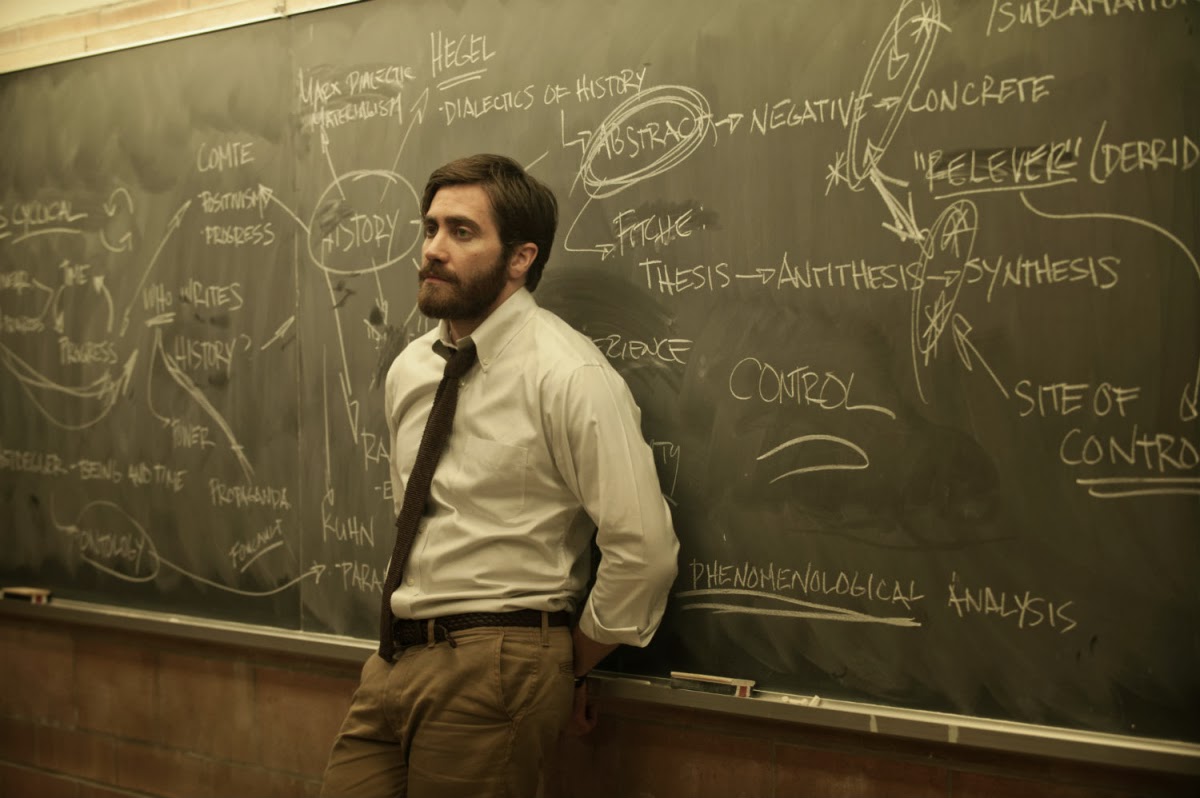
Then we meet Adam, walking to the university where he teaches, delivering a lecture that, and this is the film telling you exactly what it’s doing right at the start if you’re paying attention, circles around the Marxist idea that history repeats itself, first as tragedy, then as farce. He’s also got Hegel on that chalkboard, the philosophy of mediated perception, the idea that we never experience reality directly, only our representation of it. And at the bottom right of the board, phenomenological analysis, the study of consciousness through direct experience. Villeneuve is not being subtle here. He is writing the operating manual for the film on a prop chalkboard in the second scene.
A colleague recommends a movie. Adam watches it. He sees a bellhop on screen who looks exactly like him. And from that moment, the spiral begins to turn.
Adam tracks down the actor, Daniel Saint Claire, whose real name is Anthony Claire. He starts pulling at the thread, grabbing Anthony’s mail, calling Anthony’s pregnant wife Helen on the phone. There’s a moment, a crucial one, where Adam sits across from Helen on a park bench and she clearly recognizes him but he doesn’t recognize her at all, and then his phone rings and it’s Helen calling Anthony, and Adam steps out of frame just as Anthony answers. They are never in frame together with a third person. Not once. Think about that while I keep going.
Anthony, once he knows Adam exists, starts running the same move in reverse. He follows Adam. He finds Mary, Adam’s girlfriend, and wants what Adam has the same way Adam wanted what Anthony has. The men agree, somehow, to swap. Adam goes to Anthony’s apartment, the concierge waves him through without a key, Helen asks him to come to bed and then asks how school was, because she already knows. They make love. Meanwhile Anthony takes Mary to a hotel, and the night ends when Mary sees Anthony’s wedding ring and understands, finally, who she’s actually been with. They fight. They drive. The car crashes. We can assume they’re both dead.
And then the ending.
Adam, the morning after, dresses in Anthony’s clothes, opens the envelope that’s been sitting there since he stole it from the mailbox. Inside is the key to the sex club from the opening scene. Helen comes out of the shower, tells him to call his mother, goes back into the bathroom. Adam asks if she has plans tonight, because he might go out. Helen doesn’t answer. Adam rounds the corner into the bedroom. And where Helen should be, against the back wall, there is a tarantula the size of the room, tensed, waiting. Adam looks at it. His face is not shocked. His face is tired. The film ends.
Enemy Movie Ending Explained
Now let me tell you what’s actually happening, because once you see it, you cannot unsee it, and the film becomes a completely different and much more devastating object.
Adam and Anthony are the same person. They have always been the same person. The film is not about two men who look alike. It is about one man playing out the two competing lives inside his own skull, the professor and the actor, the husband and the cheater, the controlled and the reckless, and it is structured as a spiral because Villeneuve told an interviewer exactly that, the film is a spiral, an enigma, and he hoped the audience would have fun trying to solve it. The fun is not in the puzzle. The fun, the real structural satisfaction, is in watching the mechanism of one man’s self-destruction repeat with perfect, terrible fidelity.
The timeline, reassembled, goes something like this. A man, call him A, is married to Helen. Something is wrong in the marriage, the kind of wrong that lives in silences and unanswered questions. A takes Helen out to dinner, to a hotel, trying to restart something, and it doesn’t work. A starts an affair with a woman named Mary, moves into a separate apartment, builds a second life. A starts going to the sex club his marriage somehow led him to know about. A watches a movie one day and sees himself in it, the actor version of himself, the life he might have led, and he begins to dissociate, to split the two selves into separate people he can examine from the outside. The affair ends when Mary realizes he’s married. The car crash happens. And the next morning A is right back where he started, standing in Anthony’s apartment, which is his apartment, and Helen is in the shower, and he has the key to the club in his hand again, and his wife doesn’t answer when he asks if she has plans.
The tarantula is Helen. The tarantula is Mary. The tarantula is the entire category of women in this man’s life, the web he keeps walking into voluntarily, the thing that holds him and frightens him and which he cannot stop moving toward. The stiletto in the opening scene is about to crush the tarantula. Nobody crushes it. The shoe never comes down. And at the end of the film, the spider is still there, still filling the room, and A just sighs, because he has been here before, and he will be here again, and he knows it.
Enemy Movie Theory Explanation #1
There are competing theories that attempt to explain the movie that are worth knowing about. One school takes the film as a political allegory, the surveillance state as spider, the underground club as the reward structure of authoritarianism, Adam’s lecture on the recurrence of totalitarian control as the thesis statement of the whole picture. Slate made this case. It’s coherent. The yellow-tinged cinematography, that jaundiced, suffocating palette, does read like a city under observation. And the club with its rituals and its key-based access and its controlled performances has the texture of something a government would run if governments ran sex clubs, which, history suggests they sometimes have.
Enemy Movie Theory Explanation #2
Another read takes the film at face value, two real men, a genuine doppelganger story, the uncanny made literal. Under this reading the film is a straightforward psychological thriller with an inexplicable ending bolted on. This is the read of someone who checked their phone during the chalkboard scene.
Enemy Movie Theory Explanation #3
A third read emphasizes the Mother, played by Isabella Rossellini, who tells Adam in no uncertain terms that he should give up his little acting hobby and be the professor she raised. Under this read the split is between the self the mother made and the self trying to escape it, and every woman in the film is either the mother or the rebellion against her, and the tarantula is exactly what you think it is.
Movie Soapbox’s Read on the Enemy Movie Ending
My read is the one I already gave you. One man. One spiral. Adam and Anthony are the same person running the same loop, marriage, affair, sex club, crash, reset, and the film’s structure is honest about this in a way its protagonist is not. The blueberries are the tell nobody talks about enough. Adam hates blueberries. Anthony eats them constantly. These are not two men with different taste preferences. These are the same man’s contradictions, embodied, given separate names and separate apartments so the film can show you both sides of a thing that cannot bear to look at itself directly.
Villeneuve said it himself. The film is about repetition. About the question of how to live without repeating your own mistakes. A never answers the question. He just keeps turning the key.
That tarantula at the end of the film? It didn’t get there by accident. It got there because every piece of pressure that should have softened this movie, the budget constraints that could have forced a cheaper ending, the distributor anxiety that usually demands a legible final image, the test-screening process that flattens anything a room full of strangers can’t immediately parse, none of it touched this film. It was too small to save and too strange to fix, and so it survived intact, which means you got to see a man confront the exact size of the trap he built for himself, in the shape of a spider, in a room he can’t leave, and sigh.
That’s what it costs to make something true. That’s what it costs to let it stay true. Most films like this don’t make it. This one did. Go watch it again.
If You Liked Enemy…
Remainder (2015) – A man obsessively recreates fragments of a life he can’t remember. Same doppelgänger dread, same question of whether identity is something you own or something that owns you.
Ultrasound (2022) – Nothing is real, everyone is being manipulated, and the layers of deception go deeper than the characters can perceive. Villeneuve would approve.
The Frame (2014) – Two people discover they exist inside each other’s narratives. If Enemy’s spider made you question what’s real, The Frame will finish the demolition.