
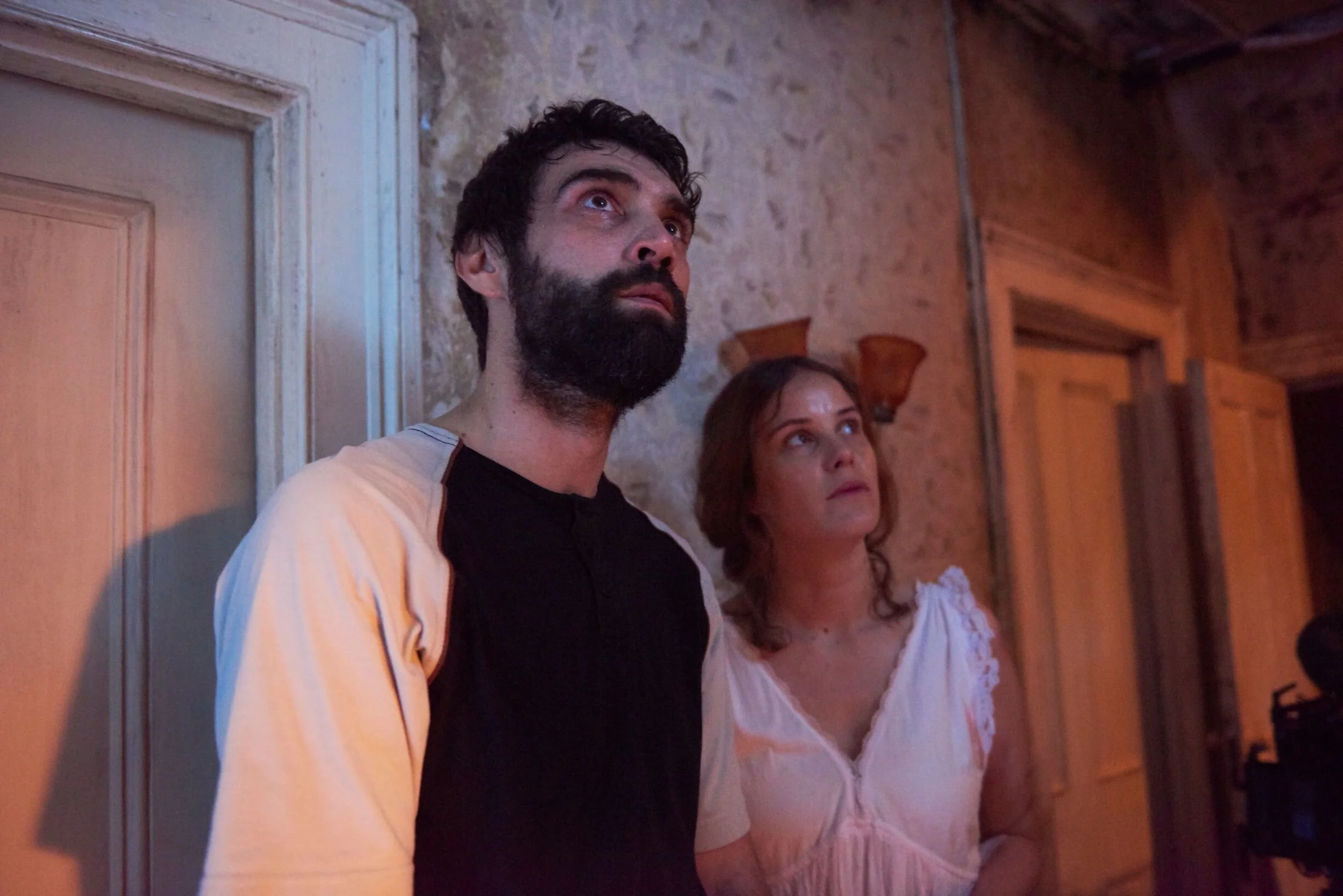
Hey there everyone! Welcome back to Movie Soapbox, the little corner of the internet that only you and I and that one guy in the back who keeps rewinding the last ten minutes know about. This is the place where we find the films that slipped through the cracks, got buried under the algorithm, or just straight-up confused everybody who watched them, and we make sense of them. Today? We are doing a full deep dive on Amulet, a 2020 horror film so theologically loaded and morally uncompromising that it came and went in about thirty seconds of cultural conversation, which tells you everything you need to know about whose movies get talked about and whose get quietly shuffled off the platform after two weeks.
Fair warning: everything that follows is going to spoil this movie completely, irreversibly, and without apology. If you haven’t watched it yet, go find it, watch it, and come back. You’ll need what you saw in your head when we get to the shell at the end. Trust me on that one.
Now. Before we get into what’s actually happening in this film, take a second and think about what kind of movie Amulet is, structurally, and what that means for who made it and how. This is a female writer-director’s debut feature, Romola Garai, and it is a film built entirely around the premise that a male sexual predator will construct an elaborate internal mythology of guilt and redemption to avoid the one thing he actually owes: accountability. That is not a premise that sails through a standard development process. You can feel, in the way this film is paced and in the way it trusts the audience to sit with discomfort, that nobody at a major studio touched it, because if they had, there would have been a scene somewhere around the forty-minute mark where Tomaz cries convincingly enough that we’re supposed to consider forgiving him. The fact that scene doesn’t exist is the whole movie. Films at this budget tier and with this kind of cast, good actors doing serious work for scale, usually survive because one person protected the thing all the way to the cut. You can see the protection in every frame. Nobody flattened this.
Detailed Amulet Movie Walkthrough
So. What actually happens in Amulet, from the beginning, in the order it matters rather than the order the film presents it.
The film runs two timelines that it feeds you out of sequence, so let’s straighten the spine of it. Timeline one: Tomaz, played by Alec Secareanu, is a soldier manning a remote checkpoint in some unnamed Eastern European conflict. His post is quiet. He reads, he minds his business, and then a woman named Miriam comes sprinting out of the woods toward his position. She’s running from the war on both sides of the border, which means she’s dead either direction. Tomaz takes her in. He hides her when patrols come by. He shares his food. You’re watching this and thinking, okay, here is a decent man doing a decent thing, and the film absolutely wants you to think exactly that, because the pivot is going to land harder if you do. Miriam, grateful, in the way a person is grateful when someone has power over their survival and is currently not exercising it badly, mentions at some point that she needs to move on. She has a daughter. She has a life. She is going to try to cross the border. And Tomaz, who has been quietly cataloguing his feelings about her this entire time in a way she has no idea about, tells her not to run.
She runs. He catches her. And he rapes her in the woods.
The film doesn’t linger on this. It doesn’t editorialize in the moment. It just shows you what he is, and then it moves to timeline two, and that restraint is doing enormous work, because everything that follows in London has to be read against this thing you now know about Tomaz.
Timeline two: Tomaz is homeless in London. He does dangerous odd jobs. He helps people. He is, superficially, a man performing goodness in the way a man performs goodness when he is trying to build a case for himself. A nun, Sister Claire, played by Imelda Staunton with a particular kind of serene knowingness that should put you on notice immediately, takes him to a crumbling house where a young woman named Magda, played by Carla Juri, is caring for her deteriorating mother. The mother lives in the attic. The mother, it becomes clear, is not exactly a mother, and not exactly human anymore. She writhes. She tries to grab exposed wiring. She gives birth to small bat-things with teeth that Magda has to stomp on. The house itself is decaying from the inside out, mold and rot and failing structure, and the set design here is doing real thematic labor, this isn’t just texture, the house is the condition of what has been done and left untended in it.
Tomaz and Magda connect. He takes her dancing. He starts to feel things he decides constitute redemption. He tells Sister Claire he wants to help Magda, which in his mind means killing whatever is in the attic so that she can be free. What he tells Magda reveals the truth of his motivation: “I thought if I could free you I’d have a right to be happy again.” Not: I want to free you because you deserve freedom. I want to free you because I need the transaction. I need what it will do for me. That sentence is the entire moral X-ray of Tomaz, and the film delivers it without underlining it, which is the right call.
He goes to the attic. The thing he finds there isn’t a mother. It’s a man, Christopher General, the original owner of the house, a man who murdered his wife and five of his children to marry his own daughter. A predator who has been rotting in the shape of his own evil. Tomaz kills him. And then, given the complete freedom to do the right thing, given every possible narrative off-ramp toward genuine reparation, Tomaz tells Sister Claire that he wants Magda to stay and care for him, even knowing she has already served her time. He re-chains her. He does it consciously. He does it while believing himself to be a changed man, which is the specific horror the film is after.
Now, the mechanics that are genuinely confusing, because there are a few things this film leaves implicit and the forums mostly get wrong.
The amulet itself: Tomaz finds it in the woods at the start of the film, buried, seemingly by accident. It pulls him toward it. The film is telling you, quietly, that this object and this man have an affinity, that evil recognizes evil, that the amulet is not a protective charm but a marker, and that Miriam, who believed it would keep her safe, was wrong about what it was. By the end, when Tomaz crawls into the enormous shell and finds Miriam there, she has become the amulet. She is the artifact of what he did, housed inside him now, the thing that will bake him from the inside out for as long as he exists. The punishment isn’t external. It is the crime itself, made permanent.
Sister Claire: She is not a nun in any conventional sense. She has powers, she has knowledge of what these men are, and she appears to be doing this systematically, walking the streets, collecting men whose souls are configured for predation, and housing them in demonic halfway houses where they will rot in the shape of their own evil the way Christopher General rotted before Tomaz arrived. She is not good in any warm sense. She is something older and more exacting than good.
Magda: The name is not accidental. Mary Magdalene, mentioned more times in the Gospels than most of the disciples, a woman described as having been freed from seven demons. Magda has been chained to two, Christopher General and Tomaz, sequentially. She is a figure of bondage and eventual liberation, and the film treats her freedom, when it finally comes, as the only genuinely earned moment of grace in the entire runtime. She returns the amulet to Miriam. She reunites with her daughter. She was already building a better life than Tomaz would ever have. The film saves its warmth entirely for her. Now here is where readers and reviewers split, and the split is revealing.
Amulet Movie Explanation Number one
Theory one, the one the internet mostly landed on: Magda and Miriam are the real evil of this film. The demon house is a trap for men, Tomaz is a victim of supernatural predation, and Sister Claire is malevolent in a way that implicates the women who surrounded him. This reading requires you to decide that Tomaz’s guilt is the emotional center of the film, that his suffering matters most, that the horror is what happens to him rather than what he did. A lot of viewers land here because the film is nominally structured around Tomaz’s perspective, and when you’re inside a perspective long enough you start advocating for it without meaning to.
Amulet Movie Explanation Number two
Theory two: The film is a moral reckoning for male predators who construct narratives of guilt and self-forgiveness to avoid actual accountability. Tomaz is not a tragic figure. He is a case study in a specific and common kind of evil, the kind that performs remorse as a means of self-rehabilitation while remaining, at its core, unchanged. Sister Claire is an agent of something ancient and corrective. The women are not evil. They are the mechanism of a justice that ordinary society consistently fails to deliver.
Movie Soapbox’s Read on the Movie Amulet
Movie Mike’s flag is planted firmly in theory two, and here is why there isn’t much room for argument. The film gives Tomaz every possible off-ramp. He could tell Magda to run. He could absorb the cost himself. He could choose her freedom over his comfort in any single moment. He never does. Not once. His final act, explicitly re-enslaving someone who had already suffered, is performed by a man who has convinced himself he is sorry. The film’s thesis is not that guilt haunts bad men. The thesis is that guilt, weaponized as a self-improvement project, is just another form of the same selfishness that produced the original crime. Tomaz doesn’t want forgiveness. He wants relief. And the film, to its lasting credit, refuses to give it to him.
That refusal is what makes Amulet worth your time. A film that got through the machine without having that refusal sanded down into something a twelve-person development team could greenlight with clear consciences. It didn’t get wide distribution. It didn’t get the conversation it deserved. Most films that ask this particular question this directly don’t survive to have an ending. This one did, and the ending delivers. Find it. Watch it. Sit in the discomfort. That’s what it’s there for.
If You Liked Amulet…
Spoonful of Sugar (2023) – A babysitter who isn’t what she seems enters a household that isn’t what it seems. Same slow domestic horror that curdles into something genuinely unholy.
Under the Shadow (2016) – A djinn attaches itself to a mother and child during the Iran-Iraq war. Religious dread and supernatural horror fused together — same territory Amulet is mining.
We Have Always Lived in the Castle (2018) – Two women hiding in a rotting house with secrets buried underneath everything. A stranger arrives and the fragile world cracks open.