
You Were Never Really Here the Cost of Joe’s Violence. Hey there everyone! Welcome back to Movie Soapbox, the little corner of the internet that only you and I and that guy nursing a lukewarm coffee in the corner over there know about. This is the place where we find under-appreciated films and we make actual sense of them, not the sanitized version, the real version. Today we are doing a full deep dive on You Were Never Really Here, a movie so brutally, quietly correct about how violence actually works on a person that most of the studios it got anywhere near probably didn’t fully understand what they were distributing.
Before we go any further, you need to know that everything from this point forward is a spoiler. The ending, the governor, Nina, all of it. If you haven’t seen this film yet, close this tab, find it, watch it in a dark room by yourself, and come back. I’m serious about the dark room. This movie requires that kind of quiet. You’ll understand why when you get there.
Now. Let’s talk about what Lynne Ramsay actually built here, and more importantly, what the machinery of commercial film almost certainly would have turned it into if the circumstances had been even slightly different.
Because here is the thing you feel in every frame of this movie even if you can’t name it: this is a film that had every structural reason to become something else. A Joaquin Phoenix vehicle at this budget tier, with a premise that reads on a logline as “damaged operative rescues trafficking victim and hunts the powerful men behind it,” that is a film that gets notes. That gets a third act where Joe assembles a plan, executes the plan, and stands in the rubble victorious. The test-screening version of this movie has a conventional catharsis. You can almost feel the ghost of that other movie underneath Ramsay’s cut, the one where the score swells, where the violence is legible and satisfying, where Joe’s trauma is resolved by the completion of the mission. Ramsay didn’t make that film. What you’re watching instead is what happens when a director with enough cast weight attached to get left alone actually gets left alone. The fact that this thing exists in the shape it exists in is, depending on how you look at it, either a minor miracle or an illustration of exactly how rarely the conditions for that miracle occur.
The film opens in the residue of a job already finished. Joe, our man, is disposing of a bag. There is a necklace. A payphone. Blood that is being cleaned rather than examined. Ramsay drops you into the aftermath and just leaves you there, and the disorientation is entirely intentional, because Joe lives in aftermath. His whole nervous system is aftermath. We piece together quickly that he is some kind of fixer, specifically one who recovers girls from trafficking operations, and that he lives with his elderly mother in a house that functions as the only stable thing in a life organized entirely around controlled chaos.
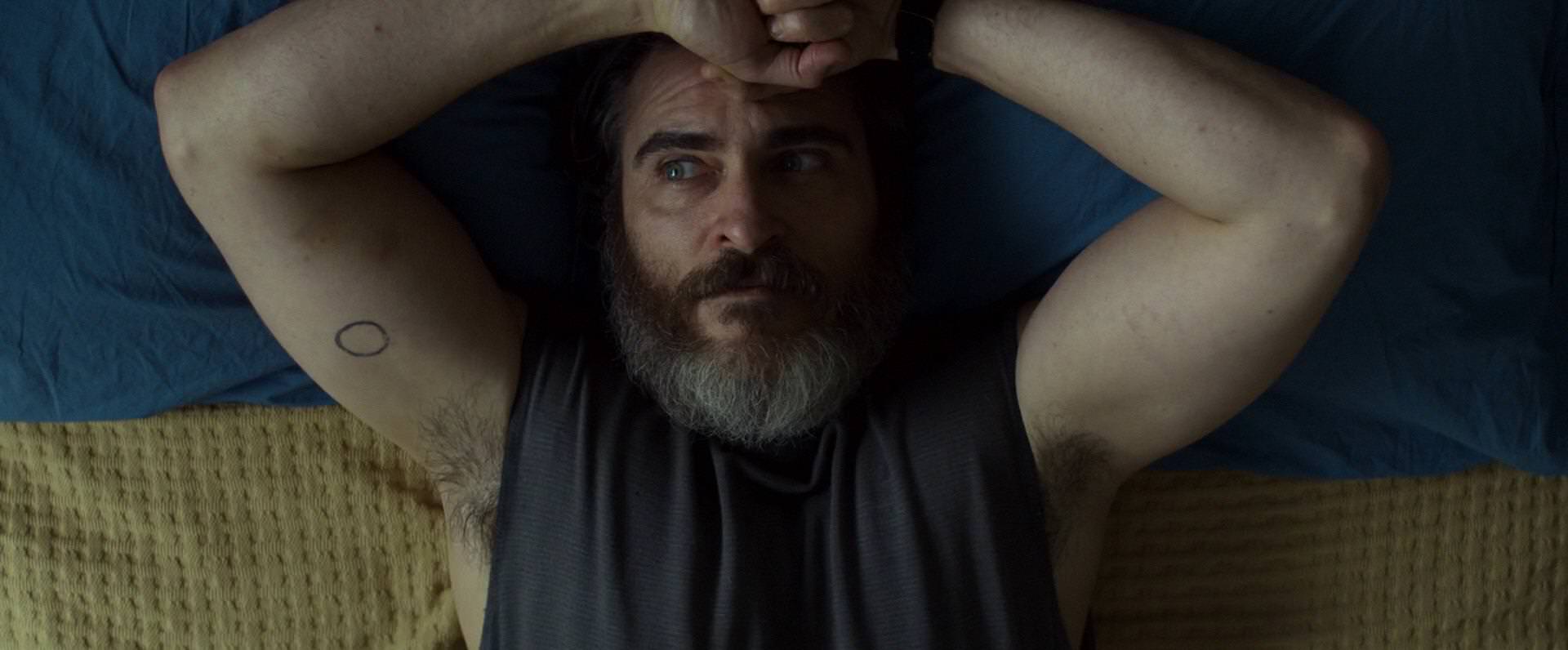
Joe, played by Joaquin Phoenix with a physical specificity that deserves more than the word “committed,” is a large man who moves like someone trying not to be noticed in his own body. He fixates on methods of dying. Suffocation. Knives turned inward. These aren’t dramatic flourishes, they are a PTSD symptom map, and Ramsay renders them as intrusive images, fast and flat, the way the actual experience of intrusive ideation works, not as scored dramatic moments but as interruptions. The film’s grammar is built around interruption. Around the gap between what we expect to see and what we get instead.
His weapon of choice is a ball-peen hammer. Not a gun, not a blade, a hammer. The choice matters. A hammer is labor. It is close. It means Joe absorbs something every time he uses it, there is no clean distance. And it tells you something about how the film understands his psychology: this is not a man who wants to be insulated from what he does.
The job that drives the plot comes through his handler. A senator’s daughter, Nina McCleary, has gone missing and an anonymous tip has surfaced placing her in a specific location being used for trafficking. The fee is fifty thousand dollars. Joe takes the job, cases the location, goes in with the hammer, and gets Nina out. The violence is shot in fragments and security-camera overhead footage, deliberately ugly, deliberately unglamorous. Ramsay will not let the action beat be exciting. That is a choice that every action-adjacent film gets notes against, and she made it anyway.
The handoff goes wrong. Senator McCleary doesn’t show. Then Nina sees on a television that her father has jumped from a hotel building. Then the man who was supposed to be waiting at the door is shot from behind, and his blood is on Joe’s face before Joe has processed what’s happening. Two security operatives move in. One takes Nina. The other nearly kills Joe and doesn’t, because Joe is Joe.
Joe, wounded, starts walking back the chain of contact to find out how they were tracked. His handler: dead. His cutout: dead. McCleary: dead. And then he gets home and finds his mother has been killed while he was gone.
What follows is a sequence that is as precise an illustration of grief-and-rage as you will find in recent cinema. Joe moves through his own house with two men already inside it. He kills one immediately. The second he guts, and then, in the film’s strangest and most genuinely affecting moment, he lies down on the floor next to the dying man and they sing together to the radio. Charlene’s “I’ve Never Been to Me” playing while these two men, one of whom has minutes left and knows it, hold hands and wait. It should be absurd. It is devastating. Because Ramsay understands that violence and tenderness are not opposites, they are just different responses to the same unbearable fact of other people.
The dying man tells Joe what he needed to know. Governor Williams. Nina was his favorite. Williams trades them.
And now Joe has a name.
But before he can do anything with it, he has to bury his mother. He takes her to a lake. He adds rocks to her body and walks in with her, and in the underwater shot, we understand, or think we understand, that he is going down with her. That the loss of the last person he was tethered to has finished what his memories started. The suicidal ideation that has run beneath the entire film has finally surfaced.
And then he hears Nina counting. Backwards from forty, slowly, the coping mechanism she used when Joe first found her. The sound of another damaged person doing the work of staying present. Joe pulls the rocks from his pockets and swims up.
Whatever is waiting for Governor Williams at this point, it is going to be specific and unhurried.
The Ending, Untangled
Joe arrives at Williams’ estate soaking wet and finds the bodies already arranged. Security personnel down across every room, and at the center of it, Williams, throat opened, bled out across the floor. Joe had come to deliver the violence and the violence had already been delivered. By someone else. By Nina.
He finds her at the dining room table, eating. The straight razor on the table in front of her still has blood on it. Nina, who spent the entire film as the rescued, as the object of other people’s agendas, her father’s grief, her traffickers’ commerce, Joe’s protective mission, Nina took the room herself. She killed the governor and however many of his security detail stood between her and him. The film doesn’t dramatize it. It just shows you the aftermath, which is how the film shows you everything, and lets the implication do the work.
This matters enormously for what the film is actually saying. Joe’s violence throughout has been purposeful but also self-directed, aimed outward but metabolized inward, a punishment ritual as much as a rescue mission. Nina’s violence is something different. It is a straight-line act of reclamation. She is not punishing herself with it. She is ending something.
The two of them go to a diner. They are quiet with each other, the careful quiet of two people who have no established language for what they just shared. Nina goes to the bathroom. And while she is gone, Joe takes a revolver from his jacket and shoots himself in the head.
Except no one in the diner reacts. The shot didn’t happen. It is one more intrusive ideation in a film full of them, except this time we have been dropped into it so seamlessly that the film allows us to experience it the way Joe experiences it, as something that felt entirely real for a moment and then didn’t happen.
Nina comes back. “Joe, come on, let’s go. It’s a beautiful day outside.”
Joe lifts his head. Looks out the window. Repeats it back. “It is a beautiful day.”
That is where Ramsay leaves it.
What the Ending Is and Isn’t Saying
There are a few ways to read the closing beat, and the film is honest enough not to force one on you.
The first read is the most literal: Joe and Nina are two survivors at the beginning of something undefined. Joe lost his mother and, in a form the film is careful not to sentimentalize too quickly, seems to have found an unexpected reason to stay. Nina lost her father and found someone who will not abandon her. The future is genuinely open. Maybe they build something quiet. Maybe they become exactly what you’d expect two traumatized people with Joe’s skill set and Nina’s demonstrated capacity for violence to become. The film doesn’t tell you, because Joe doesn’t know yet.
The second read focuses on the imagined suicide as an almost-crossing, a moment where Joe’s mind went all the way to the edge and Nina’s voice pulled him back, the same voice that pulled him up from the bottom of the lake. This reading makes Nina something more than a rescued victim and something less than a symbol. She is simply the person whose presence, in two specific moments, was enough to make Joe choose differently. That is not a grand thesis. It is just a true thing about how people sometimes survive.
The third read, and the one that sits with me, is about what the title has been saying the whole time. “You Were Never Really Here” is addressed to the disappeared. To every girl that moved through the system Joe spent his life adjacent to and never made it out. To the children in that storage unit he keeps returning to in memory. Joe’s whole existence is a kind of penance paid to people who are gone, who were made to be gone, who the systems of power that should have protected them instead consumed. The film’s final gesture, two broken people sitting in a diner on a beautiful day, is not triumphant. It is just resistant. Just the refusal to not be here.
Movie Mike’s read: that third one. The film is an elegy for the disappeared and Joe is its most involuntary mourner, a man who cannot stop grieving people he failed to reach. Nina surviving, and Nina being the one who ends Williams, and then Nina being the one who keeps Joe present in that diner, is Ramsay’s careful argument that the only meaningful response to systems that make people disappear is the stubborn, undramatic insistence on being here anyway. Joe repeating “it is a beautiful day” is not a recovery. It is a man choosing, one more time, to be in the world rather than out of it. After everything this film puts him through, that is enough. It is barely enough, but it is enough.
Lynne Ramsay made a film about institutional violence, about the governors and senators and traffickers who consume the powerless, and she made it by refusing to give you the catharsis those institutions would prefer you to have instead. No clean third act. No legible victory. Just the hammer, the lake, the diner, and a beautiful day. Most films at this budget and with this cast don’t get to make that choice. This one did. That matters.
Find it again Watch it again. Remember it.
If You Liked You Were Never Really Here…
Mandy (2018) – A shattered man wages a one-person war through a nightmare. Same Cage-level intensity, same refusal to make violence feel clean or heroic.
Blue Ruin (2013) – A broken, unprepared man tries to execute a revenge plan and everything goes wrong. If Lynne Ramsay’s film is surgical, this one is a wound that won’t close.
Pig (2021) – Nicolas Cage channeling grief into something so quiet it feels volcanic. The world expects violence from him and he refuses to give it. Devastating.