
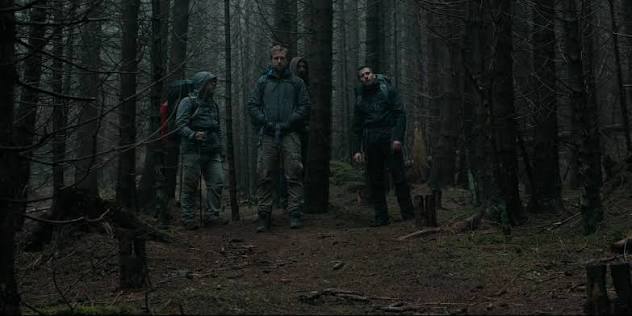
Hey there everyone! Welcome back to Movie Soapbox, the little corner of the internet that only you and I and that guy sleeping in the corner over there know about. This is the place where we find underappreciated indie films and we make sense of them. Today? We are doing a deep dive on The Ritual, a movie so quietly, deliberately brutal that even the people who greenlit it probably thought they were buying a standard-issue camping-trip slasher and got something that has been living in the back of viewers’ skulls rent-free ever since.
Before we go any further, understand that everything from this point on is a spoiler. Every theory, every beat, every gut-punch ending, all of it. If you haven’t seen this film and you read past this paragraph, that’s a choice you’re making, and I will not feel bad about it. Go watch it, come back, and then we’ll talk.
Still here? Good. Because there’s a lot to get into.
What you need to understand before we walk through a single frame of this movie is what it almost certainly looked like on paper when it was making the rounds. Mid-budget British horror. Four guys in a forest. A monster that doesn’t show up until the third act. On the surface, that is a film that gets its monster redesigned by committee, its ending reshot to include a false hope beat that tests better with a Friday-night multiplex crowd, and its thematic spine quietly snapped in half somewhere around the fourth round of notes. You can feel, in the finished film, exactly where those notes would have landed if this had gone the normal route. The fact that the creature looks the way it looks, that the ending lands the way it lands, that nobody survives in a clean redemptive-arc way, all of that tells you David Bruckner had enough creative cover, whether from the cast, the source material, or sheer stubbornness, to keep the knives away from the parts that mattered. This is a film that knew what it was and refused to become something easier. That’s worth paying attention to before you even meet Luke.
So. Luke. Rafe Spall, who you watched hold his own against a Christian Bale performance in The Big Short and somehow not disappear entirely, which should tell you something about what he can do in a room. Luke and four friends, Hutch, Phil, Dom, Robert, lifetime friends with the full weight of a shared history you can feel without being told about it, are planning a hiking trip to northern Sweden. Before they even pack a bag, Luke and Robert step into a liquor store mid-robbery, and Robert ends up dead while Luke hides behind a shelf and does absolutely nothing. That is the wound the entire film is pressing on for the next ninety minutes. Luke didn’t freeze in the way action-hero movies frame freezing, as a temporary failure before the redemption charge. He made a choice, and he knows it, and his friends, eventually, know it too.
They go on the trip anyway, because grief does strange things to planning. They’re building a memorial hike, a cairn in the mountains, drinks to Robert’s memory. Then Dom twists his ankle and they break the first and most unforgivable rule of every horror film ever made, they take a shortcut through the woods. Gutted elk spread between two trees. Glyphs on bark. Rain coming down like the sky is trying to drown a secret. They find a cabin, they take shelter, and the movie drops the floor out from under you.
Inside the cabin there’s a headless totem, antlers where hands should be. They sleep. Luke wakes up back in the liquor store, reliving Robert’s death, and comes out of it with five puncture wounds in his chest. Hutch has urinated himself. Dom won’t stop screaming a woman’s name in his sleep. Phil is upstairs, naked, kneeling in front of the totem like he’s been doing it his whole life. They run. Of course they run. It doesn’t help. It never helps.
Hutch ends up gutted and pinned in the trees the same way the elk was, which is the film making a visual argument you cannot talk your way out of. Phil follows. Luke and Dom are captured, chained, dragged into a village of people who are ancient in the way that has nothing to do with years and everything to do with what they’ve given up to stay breathing. The village exists to worship the thing in the woods, a jötunn, a bastard offspring of Loki in the Norse mythological tradition, and it has been doing this for longer than anyone in that village can remember. Dom gets sacrificed. The creature shows Dom his wife Gayle walking out of the treeline before it kills him, which is the film being precise about something, that this thing knows exactly what shape your submission takes. It shows you what you love most and then it takes you apart.
Luke gets a different offer. One of the villagers tells him the god has chosen him, that his pain is great, and that he can worship or he can hang. When Luke asks why him, the answer is the gut-punch the entire film has been building toward: your pain is great. Which sounds like a compliment until you understand what the creature actually saw in him, not grief, not depth, but a man already halfway to his knees. Luke breaks free, punches the head woman in the face, finds a chapel full of old bones still arranged in pews, and burns the whole thing down.
The ending is where people get confused, so let’s be direct about the mechanics. The jötunn chases Luke through the forest and catches him twice. Both times it pins him down, and both times the gesture is a command: kneel, or die. Both times, Luke gets back up. The third time he lands a hit to the creature’s face, gets enough separation to run, and breaks through the treeline into open country. The jötunn stops at that boundary. It cannot or will not cross it. Luke screams. The creature screams back. Film ends.
What just happened? Here are the five reads that survive serious scrutiny.
The Ritual Movie Theory #1 – The Literal Read
A group of men went hiking in the wrong forest, stumbled into a territory owned by a genuine piece of Norse mythology that has been there since before anyone was writing things down, and most of them died. The creature is real. The village is real. The boundary at the treeline is real, a territorial limit, a border of the creature’s domain that it respects or is bound by for reasons the film doesn’t explain and doesn’t need to. Luke survives because he refused to kneel, which is the one thing the creature wanted from him and the one thing it couldn’t manufacture by force. Full stop. This reading has the advantage of coherence and the disadvantage of being the least interesting thing the film is doing.
The Ritual Movie Theory #2 – The Remembered Nightmare
Luke is not in Sweden. Luke is in a hospital, or a therapist’s office, or an insane asylum, or just in his own apartment at three in the morning, and everything you watched is a psychological architecture built from survivor guilt. The demigod is his guilt. The village is every relationship in his life that now defines him by what he didn’t do. The creature’s taunt, your pain is great, becomes his own internal voice confirming what he already believes about himself. His friends die because in some part of his mind they are already dead to him, the friendship ended in that liquor store. And his refusal to kneel at the end is the moment the nightmare breaks, not because he escaped a forest, but because he stopped agreeing with the worst thing he believes about himself.
The Ritual Movie Theory #3 – The Walking Nightmare
Similar architecture, different mechanism. Luke isn’t fully dissociated. He’s on the hike, the hike is real, but the trauma is bleeding into his perception of it in real time, the way severe PTSD can colonize the present with the past until you cannot tell which forest you’re standing in. Under this reading, the other men may or may not have actually died. What we’re watching is Luke’s experience of the trip, filtered through a mind that has been doing nothing but replaying a murder for months. The director flagged this door himself, saying his goal was to obscure the lines between real and surreal until the viewer can’t reliably separate them. That’s a filmmaker telling you the ambiguity is structural, not accidental.
The Ritual Movie Theory #4 – The Mythological Frame
This one requires you to set aside the Marvel version of Norse mythology, the one where Loki is a charming villain in a cape, and engage with the older material. In actual Norse mythological tradition, the jötunn are not gods in the Asgardian sense, they are older, stranger, less interested in human worship in the organized-religion way and more interested in it the way a parasite is interested in a host. Loki’s offspring in the original texts include Hel, Fenrir, and Jörmungandr, entities that exist to unmake things. A bastard offspring running a small territorial cult in a Swedish forest is, mythologically speaking, doing exactly what those lineages do. This reading doesn’t contradict the literal read, it deepens it, suggesting the film is drawing on a specific tradition deliberately and rewarding viewers who know what those traditions actually say.
The Ritual Movie Theory #5 – The Masculinity Crisis
This is the one the film is actually about, regardless of which of the above four you believe literally occurred. Bruckner has said the creature manifests in the shape that best serves its control over a given person. For Dom, it shows him his wife. For Luke, it shows itself in full, all sixteen feet of it, because the creature correctly assessed that Luke was already flinching. The five friends at the start of the film are men in the specific middle-age drift where the group that once defined them is atomizing, marriages, different life trajectories, the slow divergence that happens when the shared identity of youth stops being sufficient scaffolding. They’re together and already strangers in the ways that matter. Luke failed Robert in the liquor store, but the film is careful to show you that Luke’s failure was already being set up by who he was becoming before that night. The creature didn’t choose Luke because his pain was great. It chose him because his pain had already bent him. The ending isn’t Luke defeating a monster. It’s Luke refusing, for the first time in the film, to confirm what the creature, and Dom, and his own guilt, have been telling him about himself. He gets back up. That’s the whole movie.
Movie Mike’s Movie Soapbox Read –
Theory Five is the load-bearing framework and Theory One is the floor it sits on. The forest is real. The creature is real. The village is real. And none of that matters at all compared to the fact that the creature chose Luke for the same reason a predator chooses the animal that’s already limping. The mythological frame is doing exactly what good horror mythology does, it externalizes an internal condition so you can look directly at it. Luke’s guilt made him visible to something that feeds on submission. His survival isn’t a triumph in the action-movie sense. It’s a man deciding, in the worst possible circumstance, to stop agreeing with his own worst assessment of himself. That’s a small victory. It’s also the only kind that’s real.
David Bruckner made this film between The Signal and what would eventually become The Black Phone and Hellraiser, and if you watch those three things in sequence you can see a filmmaker developing a specific and unusual skill, the ability to make a genre machine that is also a genuine psychological portrait, without letting either half apologize for the other. The Ritual is the purest version of that. It is a horror film that takes its monster seriously and its protagonist’s damage equally seriously, and it does not flatten either one to make the other easier. That is rarer than it should be, and it almost certainly required fighting for every frame of it. The fact that you can watch this film and feel the shape of what it almost became, safer, tidier, with a cleaner ending and a creature that shows up less, makes the version we actually got feel like something that got out of the building before the door closed.
That’s the movie. Go back and watch the ending again knowing what the creature was actually asking him. It definitely lands completely differently the second time around.